A voice AI system answers 10,000 calls and transfers only 2,000 to human agents. Its containment rate is 80%.
Is that a success?
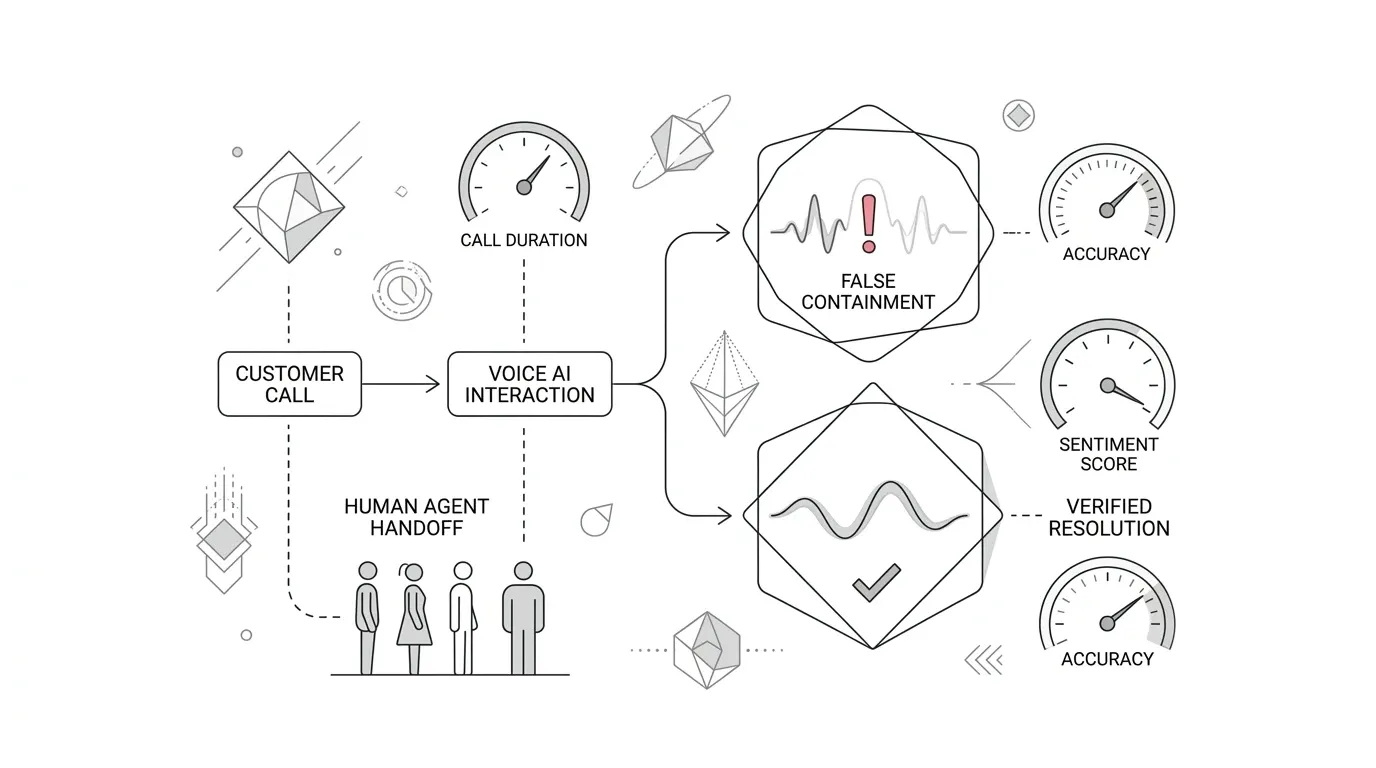
Not necessarily. Some callers may have completed their task. Others may have abandoned the call, accepted an incorrect answer, encountered a silent system failure, or called back minutes later. If all those outcomes count as 'contained,' the headline metric rewards the absence of a transfer rather than the resolution of a customer's problem.
That distinction matters when executives decide whether to scale a voice AI pilot. An inflated containment rate can make weak automation look efficient, obscure avoidable demand, and shift costs into repeat calls and more difficult human interactions.
The stakes extend beyond commercial contact centers. A nonprofit foundation using voice automation for grant applicants, beneficiaries, donors, or partner organizations must also know whether people received the right information and completed the intended process. A short call is not automatically a successful one.
Core Metric Principle: Treat containment as a diagnostic signal, not a business outcome. These eight voice AI metrics provide a credible view of operational performance, customer impact, and true return on investment.
Why Containment Can Produce a False ROI Signal
Traditional containment usually measures the percentage of interactions that do not reach a human agent:
Containment Rate = Sessions without an agent transfer / Total eligible sessions
This is simple to calculate, but it combines several very different endings:
- The caller completed the intended task successfully.
- The caller received information but could not verify that it was correct.
- The caller abandoned the call out of friction or frustration.
- The system failed to understand the request and dead-ended.
- A backend action failed without a clear recovery.
- The caller gave up and tried another channel.
- The caller called back minutes later about the same issue.
The last five are forms of false containment. The interaction remained outside the human queue, but the organization did not create value.
Modern platform analytics reflect the need for greater precision. Google Cloud's voice virtual-agent dashboard separates resolved sessions, planned transfers, consumer-requested escalations, abandonment, misunderstanding, sentiment, and customer satisfaction rather than treating every non-transfer as equivalent. Dialogflow CX analytics similarly surfaces no-match events, webhook failures, timeouts, and latency.
Genesys has also argued that containment alone does not define digital success; task completion and fewer unnecessary escalations provide a better view of whether automation worked.
This does not make containment useless. It makes containment insufficient.
Establish the Measurement Contract Before the Pilot
Before reviewing the eight metrics, define what 'resolved' means for every pilot intent. A measurement contract should specify:
- Which call intents are in scope
- What observable event proves completion in systems of record
- Which systems provide that evidence (CRM, ERP, core database)
- How long the repeat-contact window lasts
- Which transfers are expected or desirable (e.g. high-complexity cases)
- How abandoned and interrupted calls are classified
- Which baseline period will be used for comparison
- How results will be segmented by intent, language, channel, and caller group where lawful
For an appointment-booking call, resolution requires a confirmed booking ID in the system of record. For an account-status request, it requires successful authentication and delivery of the correct current status. The rule should be explicit enough that finance, operations, technology, and service leaders would classify the same interaction identically.
Eight Voice AI Metrics That Expose False Containment
1. Verified Resolution Rate
Verified resolution is the strongest replacement for raw containment because it requires evidence that the caller's intended task was completed.
Verified Resolution Rate = Sessions with evidence of successful task completion / Eligible sessions
The evidence should come from an observable outcome, not simply the model's interpretation of the conversation:
- A booking, payment, or service request recorded in the database
- A CRM or case-management ticket status updated
- A confirmation number issued and delivered
- An authenticated answer retrieved from the correct authoritative system
- A customer confirmation supported by an independent system event
Also report unverified containment separately: Non-transferred sessions without completion evidence / Eligible sessions. A wide gap between containment and verified resolution is an immediate reason to investigate before scaling.
2. Same-Intent Repeat Contact Rate
A call may appear resolved until the caller returns with the same problem.
Same-Intent Repeat Contact Rate = Callers who contact again about the same intent within the window / Callers initially marked resolved
Choose the window according to the service: a failed password reset generates repeat contacts within an hour, while a billing dispute may take several days. Repeat contact tracking exposes fluent voice responses that failed to execute the required backend mutation.
3. Cost Per Verified Resolution
Cost per call can make automation look attractive while concealing unresolved demand. Cost per verified resolution connects operating cost to an outcome.
Cost per Verified Resolution = Total attributable service cost / Number of verified resolutions
Include telephony fees, speech-to-text/LLM usage, platform licensing, monitoring, human agent time after handoff, and repeat handling costs. Then calculate incremental ROI against equivalent verified baseline outcomes:
Incremental ROI = (Baseline cost for equivalent verified outcomes - Pilot cost for equivalent verified outcomes) / Pilot investment
4. Handoff Quality
Not every transfer is a failure. Some interactions should reach a person because they involve discretion, vulnerability, risk, negotiation, or emotional complexity.
Genesys reported in its 2026 global customer experience study (based on 5,811 consumers and 1,560 business leaders) that 91% of leaders believe human interaction will remain critical and 90% expect those interactions to become more complex. The study found that 47% of consumers switch providers after two or three poor interactions.
Successful Handoff Rate = Transfers reaching the correct queue with usable context and no avoidable repetition / Total transfers
5. Tool-Call Completion and Failure Rate
Voice AI depends on tools and APIs to do useful work. A natural-sounding conversation can still fail when authentication, scheduling, payments, or case updates break behind the scenes.
Tool-Call Success Rate = Successfully completed tool calls / Attempted tool calls
Monitor webhook timeouts, invalid parameters, permission errors, retries, and post-tool latency. Technical failure telemetry must sit directly alongside conversational metrics.
6. Abandonment by Stage and Intent
A single overall abandonment rate hides where callers leave and why.
Stage Abandonment Rate = Calls ended before completing a stage / Calls that entered that stage
Break abandonment down across intent discovery, disclosure and consent, authentication, information gathering, backend processing, confirmation, and transfer queue. An abandonment during authentication points to friction, whereas abandonment during a post-call survey is benign.
7. Misunderstanding and Recovery Rate
No-match frequency is useful, but recovery determines whether the system can repair a difficult interaction.
Misunderstanding Rate = Turns classified as no-match / Total caller turns | Recovery Rate = Sessions completing or reaching appropriate handoff / Sessions with misunderstandings
A 2026 evaluation preprint on voice-agent systems highlights that speech processing, streaming latency, and tool execution all influence end-to-end performance under real operating conditions (accents, background noise, telephony quality, domain jargon).
8. Customer Outcome and Effort
Operational telemetry cannot fully reveal whether the caller understood the answer, trusted the result, or found the process difficult. Combine outcome evidence with concise customer feedback: Was the issue resolved? Did the caller have to repeat information? How much effort was required?
Summary Comparison: Containment vs. Outcome Metrics
| Metric | Focus Area | Why It Outperforms Raw Containment |
|---|---|---|
| Verified Resolution Rate | Task Completion | Requires system-of-record proof that the task finished, eliminating silent drop-offs. |
| Same-Intent Repeat Contact | Resolution Durability | Exposes fluent answers that failed to update underlying operational systems. |
| Cost Per Verified Resolution | True Unit Economics | Ties service spend directly to validated outcomes rather than mere call duration. |
| Handoff Quality | Escalation Experience | Ensures human agents receive warm summaries without forcing caller repetition. |
| Tool-Call Completion Rate | Integration Reliability | Monitors backend webhook timeouts, API failures, and transaction integrity. |
| Stage-Level Abandonment | Drop-off Diagnostics | Isolates whether callers leave during authentication, backend lag, or surveys. |
| Misunderstanding & Recovery | Conversational Resilience | Measures the voice agent's ability to recover gracefully from ambiguous speech. |
| Customer Outcome & Effort | User Experience | Validates customer trust, perceived friction, and cross-channel resolution. |
A Practical Scale-or-Stop Scorecard
Executives do not need one artificial 'AI success score.' They need a compact decision view that preserves the underlying tradeoffs. For every major intent, compare baseline and pilot performance across verified resolution, repeat contact, unit costs, handoff quality, and error telemetry.
Scale an intent when verified outcomes improve or remain acceptable, economics are credible, failure modes are understood, and the organization can monitor performance in production. Redesign or pause an intent when apparent containment depends on abandonment, repeat demand, silent tool failures, or blocked escalation.
Applying the Framework to a Voice AI Proof of Concept
YuniQ's voice agents connect with telephony, CRM systems, knowledge bases, ERP platforms, booking tools, and proprietary databases with human handoff and warm conversation summaries. We support rapid proof-of-concept deployments with full compliance telemetry.
For deployments serving US and European callers, transparency obligations require providers of interactive AI systems to clearly inform callers they are interacting with AI unless obvious in context. Review our EU AI Act voice-agent disclosure guide for full compliance checklists.
Ready to Evaluate Voice AI with Measurable Outcomes?
Explore YuniQ's AI Customer Care Automation to deploy pilot voice agents with verified resolution tracking, intelligent routing, and enterprise CRM integration.
Explore Customer Care AutomationFrequently Asked Questions
What is a good voice AI containment rate?
There is no defensible universal target. The appropriate rate depends on call intent, risk, system access, customer population, and which transfers are intentionally designed into the service. Compare containment with verified resolution, repeat contact, abandonment, and customer outcome rather than optimizing it in isolation.
How should voice AI ROI be calculated?
Calculate ROI using the cost of equivalent verified outcomes. Include platform, integration, monitoring, human handoffs, repeat contacts, and remediation costs. Do not treat every call that avoids an agent as a completed resolution.
Should a human transfer count as a voice AI failure?
Not automatically. A planned or appropriate transfer can be a successful outcome, especially for sensitive, complex, or discretionary requests. Measure whether the caller reached the correct person with accurate context and minimal repetition.