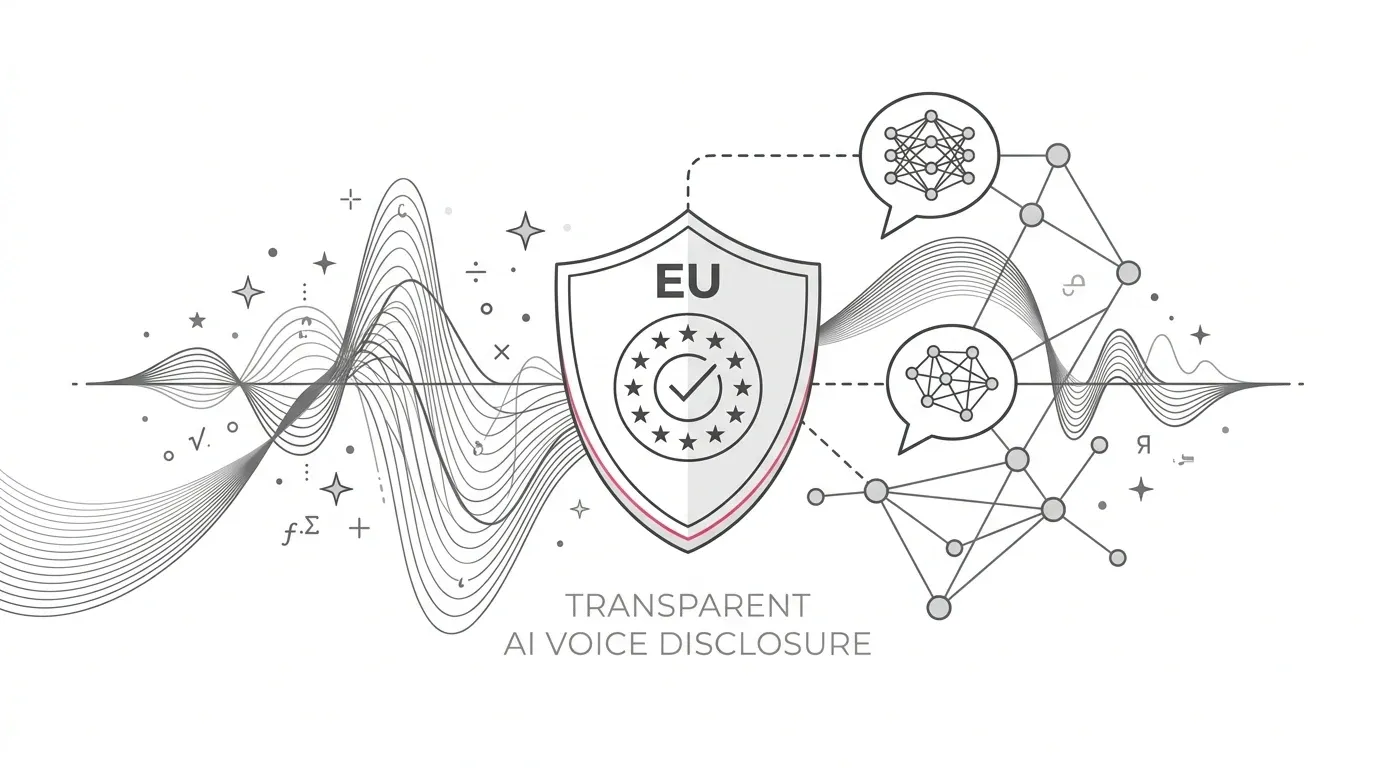
For a customer, the first few seconds of an AI-powered phone call now carry more than service expectations. They carry a legal transparency obligation. Since August 2, 2026, Article 50 of the EU AI Act has applied to AI systems that interact directly with natural persons. The European Commission mandates that users must be notified they are interacting with AI from the start of the first interaction, clearly, distinguishably, and in full alignment with accessibility requirements.
That makes disclosure an upfront product and operations decision—not an afterthought disclaimer added once a call flow is finished. The opening script, language routing, human transfer behavior, vendor contract, QA evidence, and change management processes all matter. A natural voice enhances usability, but it also makes the system's identity less obvious. The more seamless the conversational experience becomes, the more deliberately transparency must be engineered.
This guide translates the European Commission's enforcement guidance into seven testable go-live controls for enterprise customer-service and IT teams. It provides operational guidance to help organizations architect compliant call flows before deployment.
What Changed on August 2, 2026
The European Commission announced that its AI Office and national market-surveillance authorities began enforcing the AI Act on August 2, 2026, when new transparency requirements took full legal effect. The regulatory purpose is direct: individuals have a right to know whether they are speaking with an artificial intelligence system or a human being.
For enterprise contact centers and voice-agent programs, the critical provision is Article 50(1), which governs AI systems intended to interact directly with natural persons. It is vital not to confuse this active requirement with separate multi-year timelines for high-risk AI classifications or transition periods for machine-readable watermarking. The direct-interaction disclosure duty is live today.
Start With the Four-Part Scope Test
Before modifying telephony scripts or IVR flows, enterprise teams must determine which conversational interactions legally fall within the disclosure duty. The Commission identifies four cumulative criteria:
- AI Qualification: The underlying software qualifies as an AI system under the EU AI Act (e.g., LLMs, generative voice pipelines, agentic orchestration).
- Two-Way Exchange: The system is designed for a genuine two-way conversation, rather than merely collecting static keypad inputs or playing fixed, non-adaptive audio recordings.
- Direct Interaction: The AI interacts directly with the caller, rather than running strictly as an internal back-office copilot behind a human agent.
- Natural Persons: The interaction takes place with natural persons, including consumers, B2B clients, job candidates, or internal employees.
This distinction is critical across modern enterprise telephony. A legacy touch-tone IVR menu, an automated transcription tool, and an autonomous AI voice agent capable of querying CRM data and executing billing actions have vastly different compliance profiles. You must inventory actual conversational behavior at the interaction level rather than applying a blanket label across your tech stack.
The Seven Go-Live Tests for AI Voice Agents
1. Use-Case and Jurisdiction Test
Build a comprehensive channel-level inventory of every inbound and outbound voice flow that can reach callers within the European Union. Document the call intent, brand persona, languages supported, entry points, target demographics, backend integrations (CRM, ERP, billing), actions the agent can execute autonomously, and human-in-the-loop escalation paths.
2. Provider-and-Deployer Responsibility Test
Determine legal roles under Article 50. A 'provider' develops an AI system and places it on the market under its trademark, while a 'deployer' uses an AI system under its authority in a professional capacity. When an enterprise white-labels an AI voice platform, customizes prompts, or connects proprietary data, regulatory responsibilities shift along the value chain. Procurement contracts must explicitly assign accountability for disclosure copy, localization, testing, audibility verification, and incident handling.
3. First-Interaction Disclosure Test
Validate that the disclosure occurs at the immediate start of the interaction before any substantive exchange of information or trust-forming dialogue occurs. The regulation does not mandate a single rigid sentence; rather, the notification must be clear, natural, and distinguishable. Tested production patterns include:
- Inbound Calls: "Hello! You're speaking with an AI assistant for [Company]. I can help you check your order status, update account details, or connect you with a specialist."
- Outbound Calls: "Hello, this is an automated AI voice assistant calling on behalf of [Company] regarding your scheduled service appointment."
Ensure that disclosures are kept distinct from recording notices, privacy consent prompts, and marketing opt-ins so callers can clearly comprehend each statement.
4. Accessibility and Multilingual Delivery Test
Under Article 50, disclosure must adhere to accessibility standards. In voice channels, this means callers must be able to clearly hear, understand, replay, and navigate the disclosure across different languages, regional accents, network codecs, speech cadences, and assistive telephony devices. Implement robust speech synthesis QA, native-speaker localization reviews, and instant barge-in handling.
5. Identity Transparency & Human Handoff Test
Callers must always understand who—or what—they are communicating with throughout the entire customer journey. Rigorously test AI-to-human warm transfers, human-to-AI handbacks, queue transitions, callbacks, and reconnects. When escalating to a human agent, the system should explicitly announce the transition, pass full conversation context to avoid caller repetition, and execute seamless fallback if no human agent is available.
6. Consent, Telephony Recording & Cross-Border Telemarketing Test
AI disclosure under the EU AI Act does not replace GDPR, ePrivacy, or regional telemarketing regulations. For outbound voice agents reaching US consumers, the Federal Communications Commission ( FCC Declaratory Ruling 24-17 ) established that AI-generated voices fall under Telephone Consumer Protection Act (TCPA) restrictions for artificial or prerecorded voices, requiring prior express consent.
7. Versioned Evidence & Change-Control Test
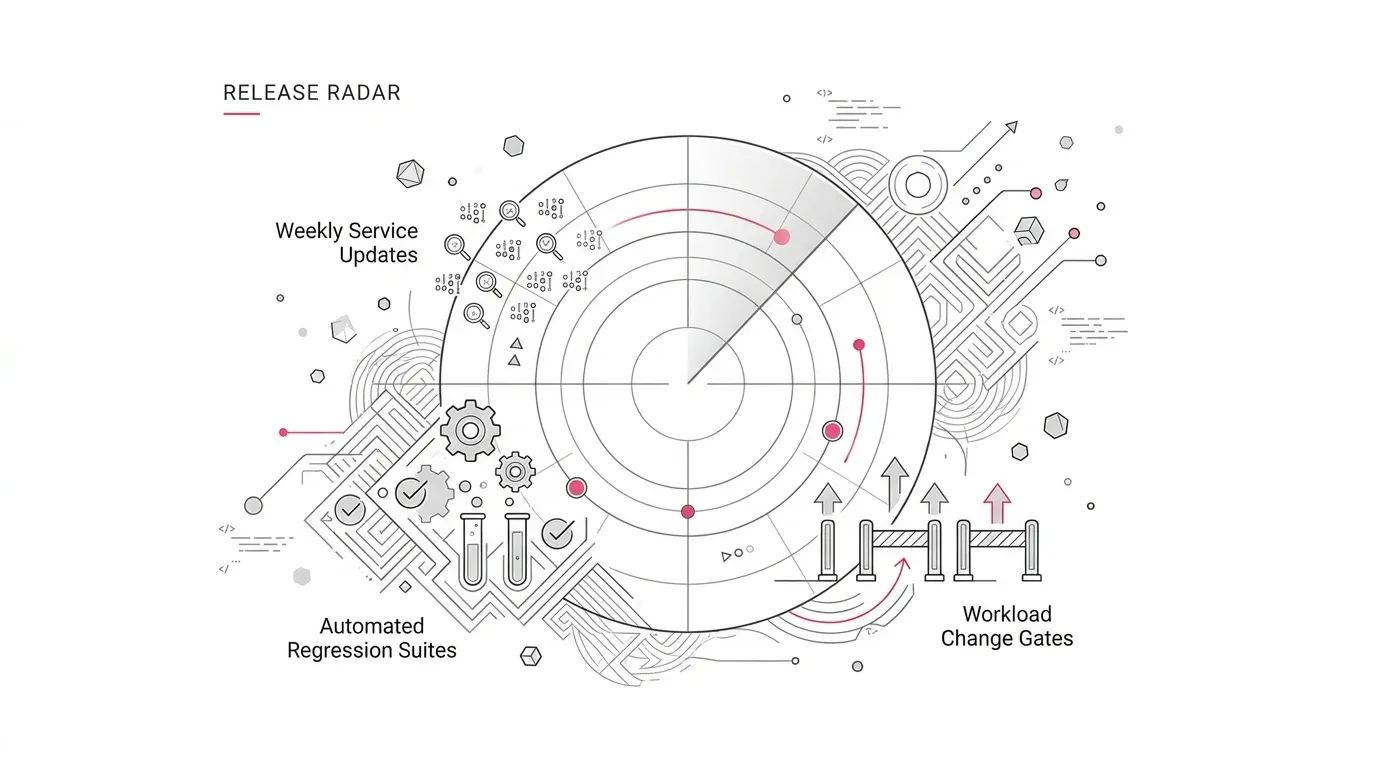
A compliant call flow can easily break when an LLM prompt is updated, a voice model is changed, or telephony routing is altered. Maintain an immutable release-control evidence pack containing:
- Use-case inventory and formal Article 50 scope determination.
- Provider vs. deployer contract allocation and responsibility matrix.
- Approved, localized disclosure scripts for each language and flow.
- Automated audio regression test logs verifying timing, audibility, and transfer logic.
- Strict change triggers requiring compliance verification before deploying prompt, model, or telephony updates.
Why Natural Synthetic Voices Make Disclosure More Essential
Article 50 provides a limited exception when it is immediately 'obvious' to a reasonable person that they are interacting with AI. However, the European Commission emphasizes that this exception must be interpreted restrictively. As modern neural voice models reach ultra-realistic, conversational fluency with natural pauses and emotional inflection, callers can easily mistake an AI agent for a human.
Relying on the 'obviousness' exception creates severe regulatory risk. Explicit, audible disclosure at the start of the call is the most defensible, transparent, and user-friendly design standard.
Key Governance Questions for Voice-Agent RFPs
When evaluating conversational AI platforms and voice automation vendors, enterprise procurement and IT leaders should ask:
- Can disclosure statements be dynamically configured and versioned by brand, country, language, and call intent?
- Does the platform guarantee that the AI agent cannot skip, truncate, or hallucinate variations of the mandatory opening disclosure?
- How does the system maintain auditable logs of active disclosure versions without retaining unnecessary caller PII?
- What telemetry and context are passed during live human agent handoffs?
- Does the solution support private cloud or on-premises deployment to ensure customer audio data remains within EU sovereignty boundaries?
Deploying Compliant, Enterprise-Grade Voice Agents?
YuniQ builds intelligent AI voice agents designed for high-volume customer care. Featuring seamless live CRM integration, sub-second latency, automated human handoff summaries, and flexible private-cloud or on-premises deployment, our architecture gives enterprise leaders complete governance and operational control.
Explore Voice Agent AutomationA Practical 30-Day Go-Live Audit Plan
- Week 1 — Inventory & Scope: Map every EU-facing voice flow, assign technical owners, identify backend system queries, and apply the 4-part scope test.
- Week 2 — Roles & Script Approval: Formalize provider/deployer legal allocations, draft plain-language opening disclosures, and separate them from privacy notices.
- Week 3 — End-to-End Simulation: Conduct simulated calls across multiple accents, telephony environments, barge-in interruptions, noisy connections, and edge-case escalations.
- Week 4 — Governance & Go-Live: Finalize the compliance evidence pack, integrate disclosure regression checks into CI/CD pipelines, and authorize production deployment.
Where YuniQ Fits in Customer Care Automation
Regulatory compliance is only one pillar of an effective voice automation strategy. An enterprise voice agent must also deliver exceptional user experiences, accurate knowledge retrieval, sub-second response times, and frictionless escalations. YuniQ's AI voice agents for high-volume customer care are engineered with these exact operational pillars in mind: training on verified knowledge bases, live query execution against enterprise CRMs and ERPs, instant human agent escalation, and full data sovereignty.
By combining rigorous call-flow governance with cutting-edge conversational AI, enterprises can automate repetitive inquiries, eliminate hold times, and maintain total transparency with every customer.
Make Transparency a Core Call-Flow Feature
The most effective voice AI deployment is not one burdened with heavy legal jargon, but one where callers immediately understand they are speaking with an intelligent AI, receive instant answers, and enjoy a smooth, respectful customer experience. Review YuniQ's customer care automation approach and request a voice-agent proof of concept tailored to your enterprise workflows.
Frequently Asked Questions
When must an AI voice agent disclose that it is AI?
Under Article 50 of the EU AI Act, notification must be provided at the very start of the first interaction in a clear, audible, and accessible manner before substantive conversation proceeds.
Can enterprises skip disclosure if the synthetic voice is robotic?
While Article 50 includes an exception for cases where AI interaction is obvious from context, the European Commission states that this exception must be interpreted restrictively. Given variations in caller perception and telephony audio quality, explicit disclosure remains the standard best practice.
Is the enterprise or the conversational AI vendor legally responsible?
Responsibilities depend on whether each entity acts as a provider or deployer. While vendors provide the underlying technical capability, deploying enterprises configure prompts, business logic, and customer-facing telephony. Contracts must clearly allocate responsibilities for disclosure copy and testing.
Did delays in high-risk AI system deadlines postpone voice agent disclosure?
No. Article 50 transparency obligations for direct-interaction AI systems came into force on August 2, 2026, and are actively enforced across the European Union.