AI Voice Agent RFP Requirements for an Enterprise Procurement Scorecard
A voice agent can sound excellent in a controlled demonstration and still fail the work it was hired to do. It may recognize the customer’s request but authenticate the wrong person, call the wrong tool, update the wrong field, lose context during a transfer, or leave no usable trace when something goes wrong. That gap matters once the agent can book, cancel, refund, disclose, escalate, or alter a customer record.
An enterprise RFP therefore needs to evaluate more than speech quality. It must test the complete service: the conversation, the action taken in the system of record, the customer outcome, the fallback path, and the operating controls around all of them. Research such as VAmoS Bench makes the same distinction by evaluating authentication, tool use, backend state changes, information protection, and task completion across an end-to-end voice workflow, not just isolated latency or transcription measures.
The framework below gives business and technology leaders a practical way to compare vendors. It is designed for enterprises and nonprofit foundations in the United States and Europe, with enough rigor for regulated or high-impact customer journeys and enough flexibility for a focused proof of concept.
Start With Knockout Criteria
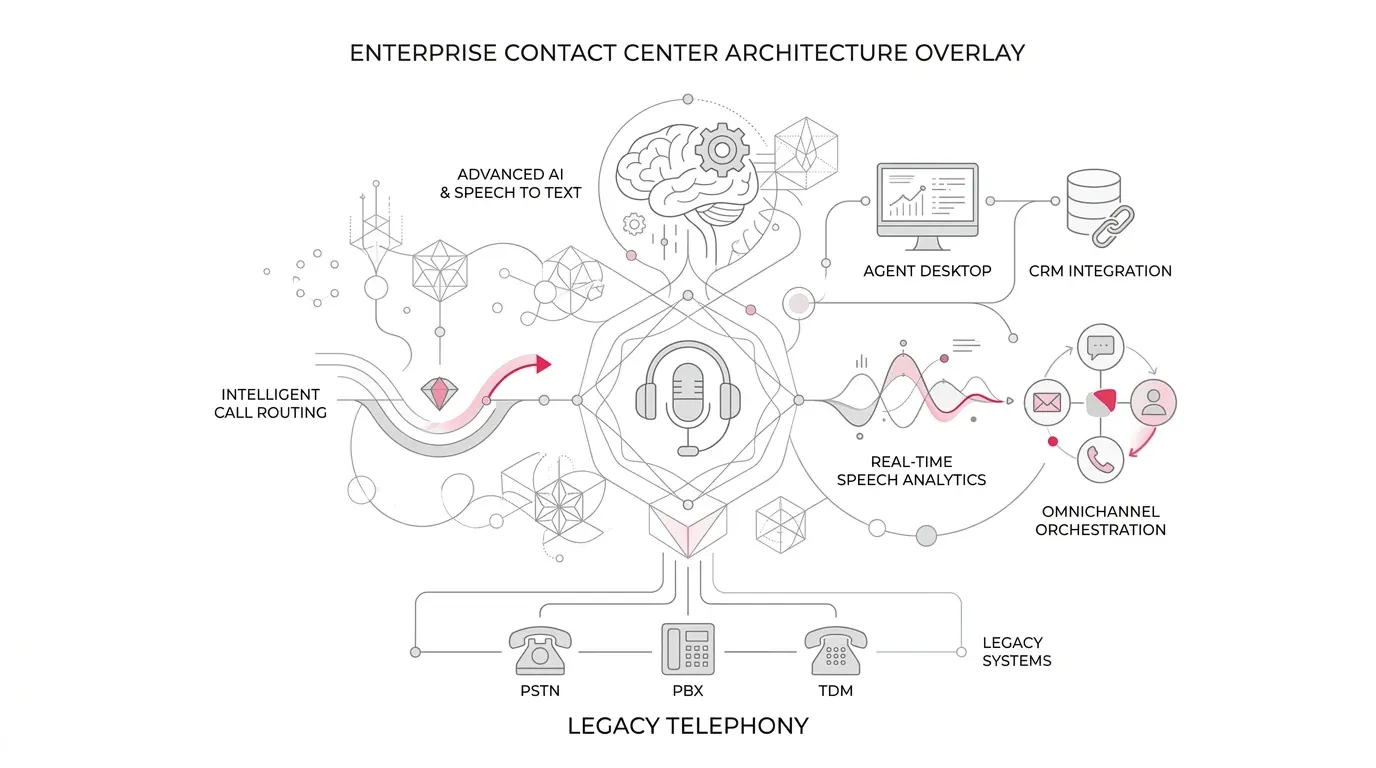
Scorecards are useful only after every bidder clears the non-negotiables. Define knockout criteria before proposals arrive so a persuasive presentation cannot quietly weaken the standard. Typical knockout conditions include an unavailable deployment model, an inability to integrate with a required system, no auditable record of agent actions, no tested human-transfer path, unacceptable data retention, or no workable route for customers who cannot use the voice experience effectively.
Keep the list short and tied to actual risk. A regional charity answering routine program questions will have different non-negotiables from a bank handling payment disputes. The principle is the same: a vendor either meets a true boundary or it does not. Do not award partial points for crossing it.
Use a 100 Point Scorecard
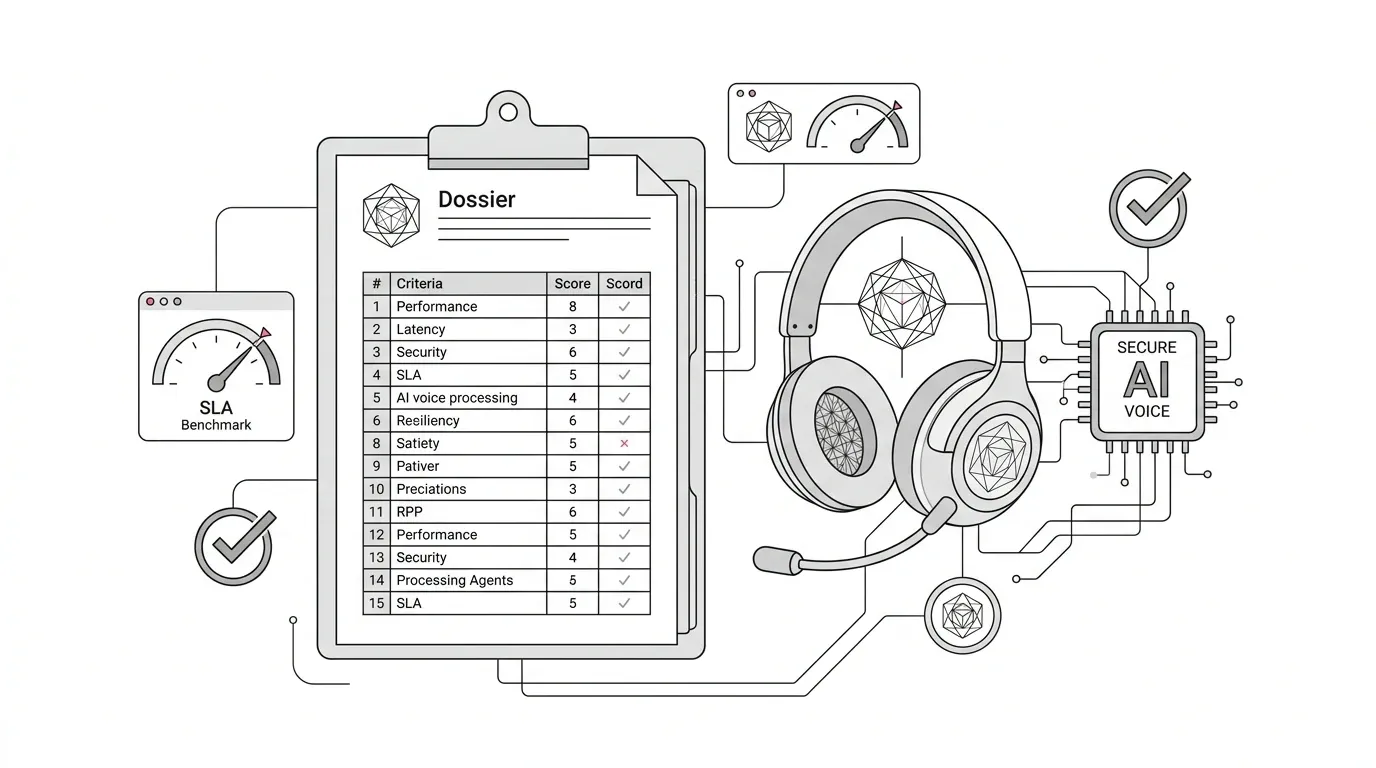
A weighted model makes tradeoffs visible and prevents one impressive feature from dominating the decision.
| Category | Weight | What it measures |
|---|---|---|
| Use case and caller experience | 10 | Fit to priority journeys and real-world conversation quality |
| End-to-end task accuracy | 15 | Correct authentication, reasoning, tool use, confirmation, and outcome |
| Integration and action integrity | 15 | Reliable reads and writes across systems of record |
| Security privacy and deployment | 15 | Data boundaries, access, retention, hosting, and incident controls |
| Reliability and resilience | 10 | Peak load, carrier and dependency failure, recovery, and continuity |
| Accessibility and human handoff | 10 | Effective access, support needs, alternate paths, and context transfer |
| Evaluation observability and operations | 15 | Testing, traces, quality review, change control, and ownership |
| Implementation commercials and exit | 10 | Delivery realism, total cost, remedies, portability, and termination |
Adjust weights before issuing the RFP. Publish them to bidders unless procurement policy requires otherwise. A disclosed model produces more comparable responses because vendors know where detailed evidence matters most.
The 15 Requirements Every RFP Should Cover
1. Define the bounded use cases and exclusions. Ask each bidder to map the agent’s supported intents, permitted actions, required data, completion conditions, and explicit exclusions. Require a journey map and responsibility matrix. In the POC, test both supported and deliberately unsupported requests. The contract should state which journeys are in scope and how additions are approved. A red flag is a proposal built around a generic containment target with no intent-level definition.
2. Test conversation quality in real conditions. Evaluate accents, dialects, code-switching, background noise, interruptions, silence, poor connections, names, numbers, and domain vocabulary. Request recordings and error analyses from comparable deployments, then test on your own telephony path. Contractual measures should cover the scenarios that matter to your callers, not a laboratory average. A natural voice is not evidence that the system understood correctly.
3. Measure end-to-end task success. Define success as the correct customer outcome, not a completed conversation. Verify identity, selected tool, parameters, backend state change, confirmation, and final status. Replay the same test against a clean environment so results are reproducible. This requirement should carry more weight than standalone word-error rate, latency, or demo fluency.
4. Control high-impact actions. For refunds, cancellations, account changes, appointments, disclosures, and other consequential actions, require confirmation rules, thresholds, approval paths, duplicate protection, and rollback. Test ambiguous instructions and mid-call changes of mind. The contract should identify which actions are autonomous, which need confirmation, and which always require a person.
5. Prove integration and data freshness. Request an architecture and data-flow diagram showing every system, API, queue, cache, and fallback. Test stale records, timeouts, partial writes, duplicate events, and changed schemas. Require evidence that the caller’s spoken outcome matches the system-of-record outcome. A red flag is a demo that uses mocked data when production integration is central to value.
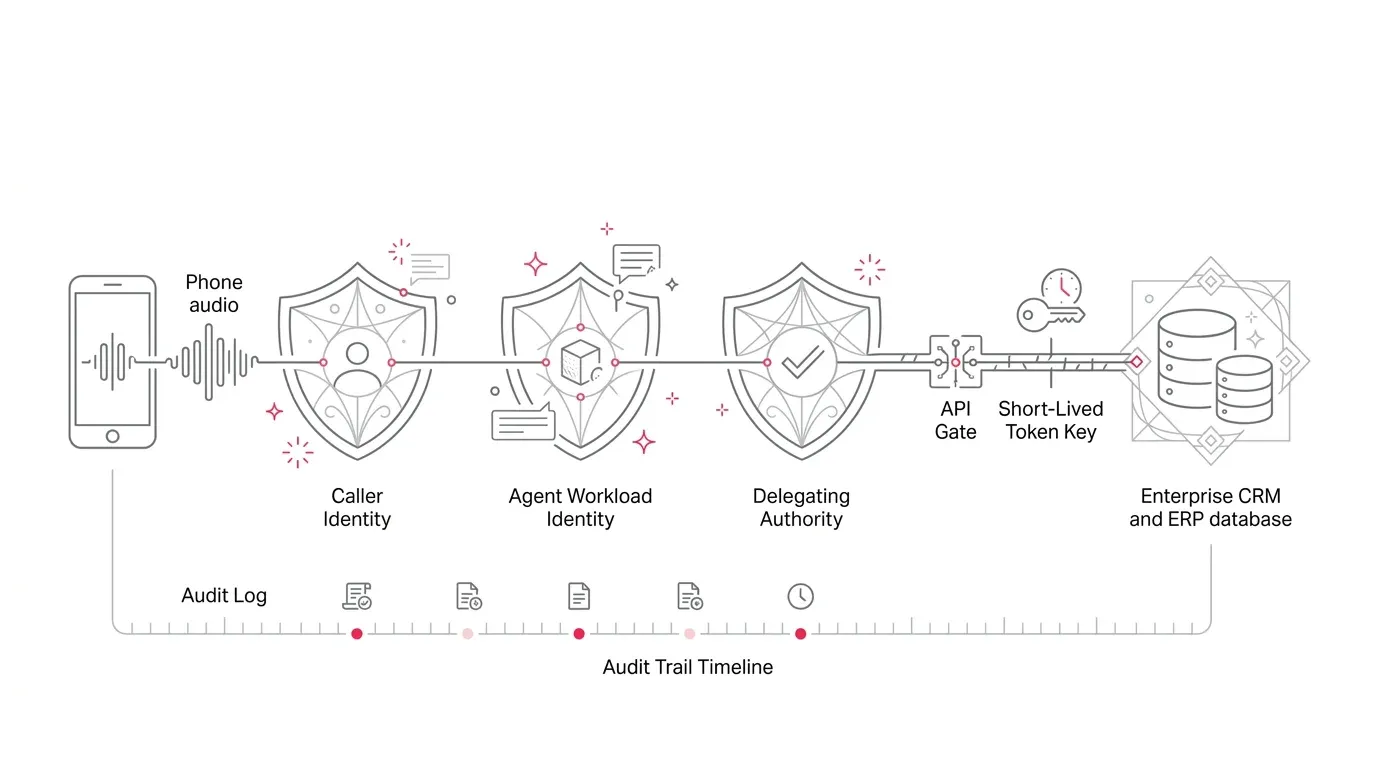
6. Enforce identity and least privilege. Ask how callers, agents, tools, and service accounts are authenticated and authorized. Require role boundaries, secret handling, session controls, and separation between read and write permissions. Test attempts to cross account, role, and transaction limits. Contract terms should require timely access review and revocation.
7. Set data privacy and deployment boundaries. Document what is recorded, transcribed, retained, redacted, used for model improvement, sent to subprocessors, and transferred across borders. Compare cloud, private-cloud, and on-premises options against the actual data classification. Require deletion and data-return tests. Legal review should confirm the applicable US, EU, UK, sector, and contractual requirements.
8. Make accessibility and support needs testable. A speech-only journey is not accessible to every caller. Test people with hearing, speech, cognitive, language, and digital-access needs; slower pacing; relay or supported channels; plain-language repetition; and an easy alternative to voice automation. DOJ guidance emphasizes that effective communication depends on context and the person’s normal communication method. The FCA’s September 2026 findings similarly stress flexible support, testing, monitoring, and alternative channels for vulnerable customers.
9. Specify disclosure consent and recording behavior. Define when the system identifies itself, how recording or data-use notices are delivered, how consent or objection is handled, and what happens when rules vary by jurisdiction or call purpose. Test interruptions during notices and a caller’s request to opt out. Put responsibility for rule changes and script approval in the operating model.
10. Design human handoff as a service outcome. Set triggers for low confidence, repeated failure, customer request, distress, suspected fraud, policy exceptions, and high-impact decisions. Test queue placement, context summary, data transfer, authentication continuity, and what happens when no person is available. Do not count a failed automated journey as contained simply because the call ended.
11. Test peak load and degraded modes. Ask for capacity assumptions, concurrency limits, carrier dependencies, regional failover, recovery objectives, and planned-maintenance behavior. Run load and dependency-failure tests on the complete call path. Microsoft’s contact-center testing blueprint is useful here because it treats routing, queues, overflow, agent availability, telephony, integrations, and special scenarios as connected test areas.
12. Require a repeatable evaluation program. Request the evaluation set, scoring method, reviewer guidance, regression process, and policy for adding new failure cases. Include normal calls, edge cases, adversarial prompts, and minority scenarios that aggregate averages can hide. The W3C’s 2026 voice-agent work highlights unresolved issues in real-time interaction, multilingual coordination, accessibility, privacy, and interoperability; procurement should require evidence where standards are still evolving.
13. Demand observability and auditability. Specify the traces needed to reconstruct a call: audio where lawful, transcript, model and prompt version, retrieved knowledge, tool calls, policy decisions, errors, transfer events, and final backend state. Define access controls and retention for those records. A red flag is an operations dashboard that shows only call volume, duration, and a vendor-generated success label.
14. Assign implementation and change ownership. Separate vendor, customer, carrier, contact-center, data, security, and business responsibilities. Ask who maintains prompts, policies, integrations, evaluation sets, knowledge, and escalation rules after launch. Require release gates, rollback, incident response, and material-change notice. Price the work, not just the minutes of audio.
15. Compare total cost and write accountability into the contract. Model telephony, model usage, platform fees, integration, professional services, monitoring, human review, support, testing, change requests, storage, and exit. Ask vendors to price the same workload and assumptions. Contract for service levels that map to customer outcomes, defined remedies, evidence access, data portability, transition support, and termination rights.
Turn the Winning Proposal Into an Evidence First POC
The proof of concept should test the RFP, not replace it. Choose a small number of valuable journeys and define the pass criteria before configuration begins. Use representative callers, production-like telephony, realistic integrations, seeded edge cases, and known expected outcomes. Keep a blinded human review for conversation quality, but verify every consequential action against the system of record.
A practical POC evidence pack should contain:
- A requirements-to-test traceability matrix
- The call set, caller profiles, and expected outcomes
- Recordings, transcripts, tool traces, and backend before-and-after states
- Failures grouped by business impact and root cause
- Results segmented by intent, language, environment, and support need where lawful and appropriate
- A remediation log and regression results
- A production-gap list covering capacity, security, governance, support, and change management
- A final go, conditional-go, or no-go decision signed by business, technology, risk, and operations owners
YuniQ’s customer-care page describes a 48-72 hour POC using existing call flows, recordings, scripts, CRM data, knowledge, and live-system connections. That speed can be useful for testing vendor fit, but the acceptance criteria above should still govern the decision. A fast POC is the beginning of production assurance, not the end.
A Proportionate Approach for Nonprofits and Lean Teams
A smaller organization does not need a 100-page RFP. It does need clarity about harm. Start with the two or three journeys that create the greatest service burden or consequence for callers. Use knockout criteria for data, accessibility, handoff, and required integrations. Ask finalists to complete the same test set and provide the same evidence pack.
Include a program owner, a technical owner, someone responsible for privacy or risk, and a frontline service representative. Bring in people who understand the communities being served, especially where callers may face language, disability, financial, health, or life-event barriers. A compact, representative team will usually find risks that a purely technical review misses.
The Procurement Decision
The best voice-agent proposal is not the one with the smoothest demonstration. It is the one that defines its boundaries, proves the complete task, supports people the default journey does not fit, exposes enough evidence to investigate failure, and accepts contractual responsibility for operating the service.
Use the RFP to make those expectations explicit. Use the POC to test them. Use the contract and operating model to keep them true after launch.
Test Your RFP Against a Working Voice Agent
YuniQ offers a rapid proof of concept built around your call flows, data, and business systems. Request a voice-agent POC and bring your own knockout criteria, scorecard, and acceptance tests. The goal is not to admire a demo; it is to produce evidence for a defensible decision.
Frequently Asked Questions
What should carry the most weight in an AI voice agent RFP
End-to-end task accuracy, integration and action integrity, security and privacy, and operational evidence should usually carry more weight than voice naturalness alone. Adjust the model to the consequences of your use cases and set knockout criteria before scoring.
How long should an AI voice agent proof of concept take
A narrow demonstration can be assembled in days, while a decision-quality POC may take longer because it needs representative test calls, real or production-like integrations, accessibility cases, failure tests, and repeatable evidence. Define the scope and acceptance criteria first; duration should follow the work required to answer the buying question.
What is the biggest red flag in a voice AI proposal
The most serious red flag is a gap between the claimed outcome and the available evidence. Examples include high containment with no definition of success, an integration demo using mocked data, accessibility described without representative testing, or service levels that measure platform uptime but not failed customer actions.