A voice agent can be technically available while the customer service is already failing. The call connects, speech sounds natural, and the conversation ends without an error. Yet the booking never reaches the system of record, a policy answer is outdated, a transfer loses context, or a backend outage leaves callers with a confident promise the organization cannot keep.
That is why production monitoring cannot stop at uptime, latency, or containment. It must reveal whether the agent understood the request, used the right source, took the permitted action, created the intended business outcome, and recovered safely when any layer failed.
The operating problem is now visible in current market evidence. Sinch’s 2026 survey of 2,527 enterprise decision-makers reports that 74% had rolled back an AI communications agent after a governance failure. Because the research was commissioned by a communications vendor and relies on self-reporting, the percentage is best treated as a warning signal rather than a universal benchmark. The useful conclusion is simpler: rollback is normal enough to design before launch, not improvise after harm. [1]
New platform guidance points in the same direction. AWS’s September 30 contact-center reference design treats outage response, intent control, prompt updates, audit, backup, rollback, and validation as live operating requirements. Microsoft’s 2026 contact-center guidance uses realistic simulated conversations to evaluate agents, routing, scale, reliability, and latency before changes reach customers. [2] [4]
Monitor the Service, Not Just the Model
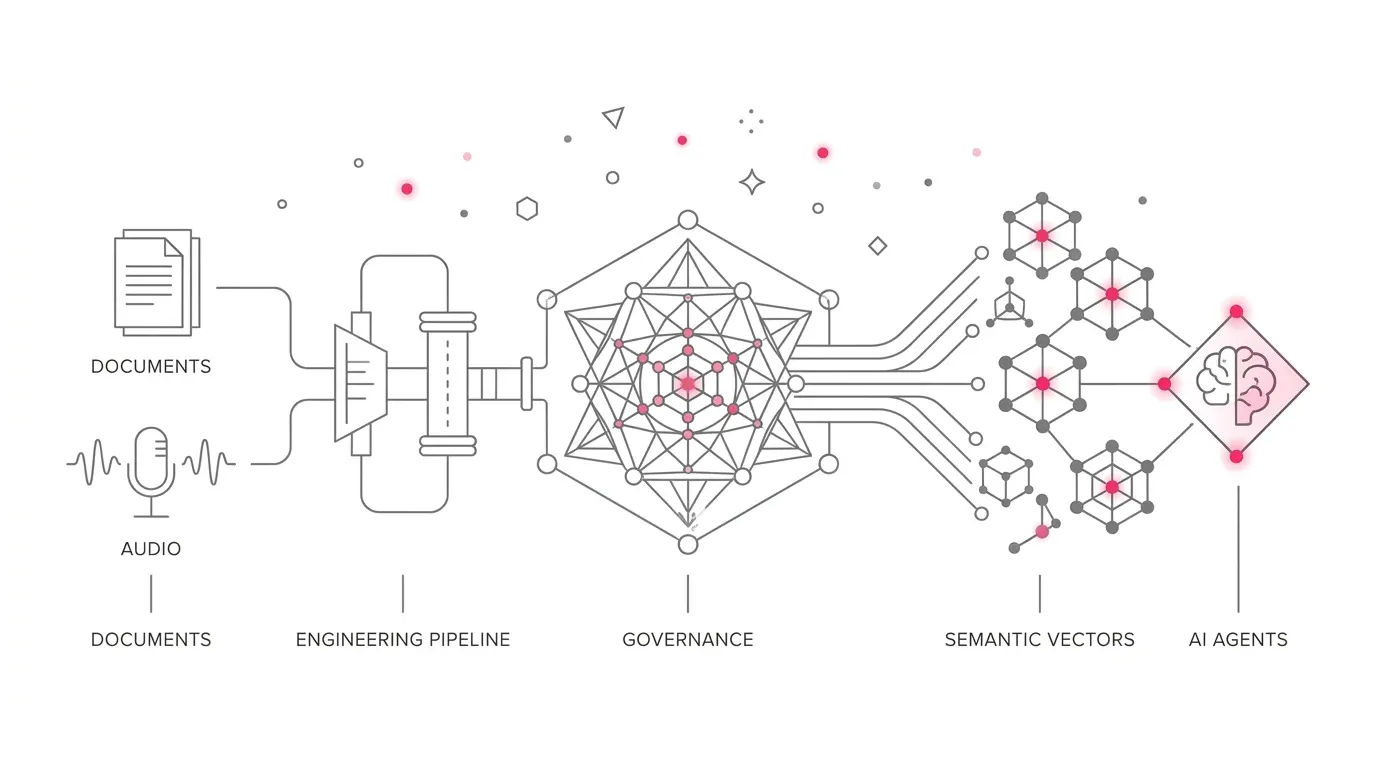
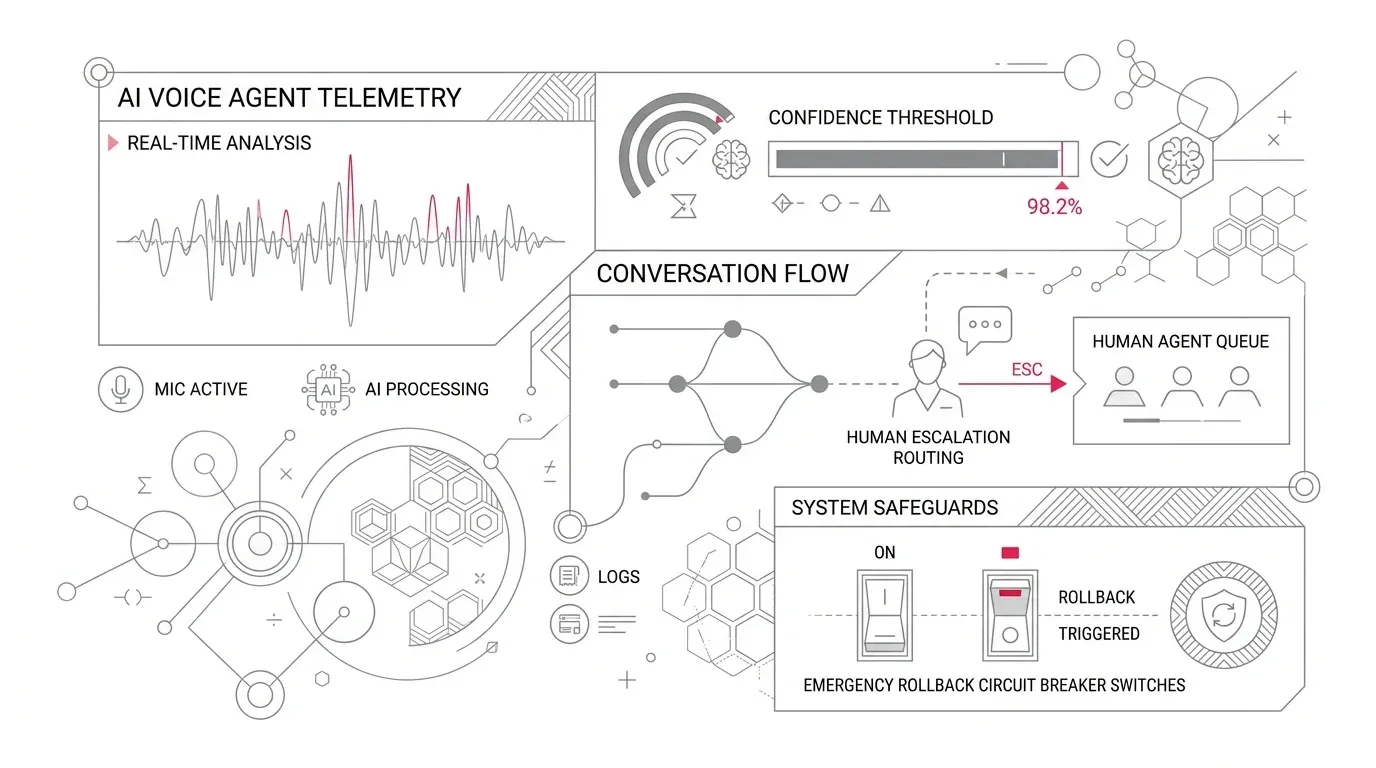
An AI voice service is a chain of dependencies. A green model dashboard does not prove that the telephone route, identity check, knowledge source, CRM write, customer confirmation, or human handoff worked. A useful monitoring design covers five layers:
- Call path: carrier, telephony, audio quality, connection rate, dropped calls, and queue or failover routing.
- Conversation: recognition, interruptions, repeat utterances, turn latency, unsupported requests, policy language, and caller attempts to reach a person.
- Tool and action: authentication, selected tool, parameters, timeouts, retries, duplicate protection, denied actions, and downstream result.
- Business outcome: appointment created, case updated, payment state confirmed, information retrieved from the authoritative source, or a transfer completed with usable context.
- Control plane: version, prompt, model, knowledge snapshot, tool set, routing rules, owner, approvals, and the ability to restore a known-good state.
The fifth layer is often missing. Teams monitor what the agent did but cannot reconstruct which behavior bundle was active when it did it. Without that link, an incident review becomes guesswork.
Eight Controls for a Production Runbook
- Name owners and classify changes. Assign a business owner, a technical owner, and an incident lead. Classify routine content edits, prompt changes, model or speech-provider changes, tool changes, routing changes, and emergency restrictions by customer impact. State who may request, approve, deploy, and reverse each class. A lean nonprofit can combine roles, but it should not leave them unnamed.
- Version the complete behavior bundle. A deployable version should identify the prompt, model, voice and speech settings, knowledge sources, tools, permission policy, routing and handoff rules, disclosure script, and relevant configuration. Keep the prior known-good bundle available. Backing up only the prompt is insufficient if a tool schema or routing rule caused the failure.
- Test the change end to end. Run representative and adversarial calls before release. Include supported tasks, unsupported tasks, ambiguous identity, noisy audio, interruptions, dependency timeouts, partial writes, duplicate requests, explicit requests for a person, and callers with relevant language or accessibility needs. Verify the system-of-record result, not only the transcript. Microsoft’s simulation guidance is useful evidence for this end-to-end approach, while its documented feature limits show why organizations still need their own scenario set. [4]
- Release in stages with a live comparison. Start with staff traffic, a test number, selected intents, limited hours, or a small percentage of eligible calls. Keep a control cohort on the prior version where practical. Compare verified task completion, repeat contact, escalation, tool success, tail latency, and customer-impact events. Expand only when the evidence meets the pre-agreed gate.
- Monitor by intent and caller impact. Overall averages hide local failures. Segment results by intent, version, language or locale, telephony route, downstream system, and other relevant cohorts where lawful and proportionate. Review outliers and sampled calls. Pair technical signals with verified business outcomes; a successful API response can still create the wrong customer result.
- Connect thresholds to predetermined actions. Every critical signal needs an owner, threshold, observation window, and response. The response may alert, reduce traffic, disable one intent, remove write access, switch to a read-only message, route calls to people, or restore the previous bundle. Avoid universal thresholds. A failed donor-information lookup and a misdirected payment change have different tolerances.
- Design a degraded mode and a kill path. When a dependency fails, the agent should not continue pretending the task is available. Define which intents remain safe, what the caller is told, whether an authenticated callback or case can be created, and how urgent or vulnerable callers reach a person. Test the path during operating hours and after hours. YuniQ’s separate human-handoff guidance offers a useful companion test set.
- Preserve evidence and learn after recovery. Capture the version, timestamps, correlation IDs, affected intents, tool traces, approvals, customer impact, and response actions needed to investigate. Apply an approved retention policy rather than storing every recording indefinitely. After recovery, document root cause, detection gap, decision timing, corrective action, regression tests, and the condition for re-release. NIST’s Generative AI Profile explicitly connects post-deployment monitoring with override, incident response, recovery, and change management. [5]
A Monitoring Matrix That Leads to Action
A dashboard is useful only when a signal changes a decision. The matrix below is a starting point; owners should set thresholds from baseline performance, service commitments, the consequence of error, and the needs of the people being served.
| Signal | What it can reveal | Predetermined response |
|---|---|---|
| Connection failures or dropped calls | Carrier, telephony, routing, or capacity failure | Shift traffic to tested fallback; notify operations; preserve affected call IDs |
| P90 turn latency and repeat utterances | Slow speech/model/tool path or broken conversational timing | Limit traffic or feature scope; compare by version, provider, intent, and route |
| Tool-call and write success | Authentication, schema, timeout, partial-write, or duplicate-action failure | Disable affected write intent; use read-only/degraded mode; reconcile records |
Monitoring Matrix (continued)
| Signal | What it can reveal | Predetermined response |
|---|---|---|
| Verified task completion | Conversation appears complete but the intended outcome did not occur | Stop expansion; sample traces; compare with the previous version; roll back if threshold is crossed |
| Repeat contact and unexpected escalation | Unresolved tasks, poor explanations, or hidden false containment | Review affected cohort; repair knowledge, logic, routing, or scope |
| Policy or grounding deviation | Unsupported answer, stale source, or instruction conflict | Suppress affected content path; route to authoritative source or a person |
| Handoff completion and context quality | Dropped transfer, wrong queue, or missing summary | Move affected intents to direct human routing until the handoff contract passes |
| Cost or session-capacity anomaly | Traffic spike, loops, long calls, abuse, or provider limit | Apply a circuit breaker; protect priority journeys; invoke capacity and vendor escalation plan |
For deeper outcome definitions, link to YuniQ’s voice AI metrics that expose false containment . The production runbook should use those outcome measures as release and rollback evidence, not merely as monthly reporting.
Emergency Changes Need More Control, Not Less
An outage may require a prompt update, an intent shutdown, or a temporary customer message in minutes. Speed is legitimate. Invisible authority is not.
AWS’s September 30 reference design is useful because it combines rapid change with operator authentication, confirmation before destructive actions, backup and restore functions, automated validation, and an audit trail. That specific architecture will not suit every platform, but its control logic travels well: authenticate the operator, authorize the exact action, confirm material effects, preserve the old state, test the new state, and record the result. [2]
Emergency access should also expire. Review who used it, what changed, which calls were affected, and whether temporary restrictions were removed. A permanent bypass created during an incident is a new incident waiting to happen.
A Proportionate Model for Nonprofit Foundations
A foundation or mission-led organization may not have a round-the-clock reliability team, yet its calls can involve grants, benefits, healthcare, financial stress, language access, or urgent community needs. Proportionate monitoring means concentrating effort where failure causes the most harm.
- Start with two or three bounded, high-volume intents and keep sensitive or discretionary decisions with people.
- Define one monitored service owner and one technical escalation contact, including vendor contacts and after-hours expectations.
- Use simple daily outcome reconciliation: calls claiming completion versus bookings, cases, acknowledgments, or updates actually recorded.
- Keep a tested human or callback alternative for people who cannot use the automated path effectively.
- Run a short rollback exercise before launch and after major platform, model, integration, or policy changes.
Apply the Runbook During the YuniQ POC
YuniQ says its voice agents can be trained on an organization’s telephony data, scripts, CRM data, FAQs, and knowledge base, connect to live business systems, and transfer callers with a conversation summary. The company also offers a working POC in 48–72 hours and local or private-cloud deployment options. [8]
Use that POC window to establish an operating baseline, not only to hear a polished demonstration. Select one read-only intent, one controlled write action, and one human handoff. Then require the team to show:
- the versioned behavior bundle and named owners;
- end-to-end traces from call through system-of-record result;
- monitoring segmented by intent and failure type;
- a dependency outage or tool-failure scenario;
- an intent-level shutdown or degraded mode;
- restoration of a known-good version; and
- a complete incident record that a business and technology owner can understand.
A fast proof of concept can answer whether the agent fits the use case. A monitored, reversible proof of concept answers the harder question: whether your organization can operate it responsibly when real conditions change.
The Production Standard
The goal of AI voice agent monitoring is not to eliminate every failure. It is to make failure visible early, limit its effect, preserve service, and give accountable people enough evidence to act.
Before increasing call volume, insist on five proofs: the team can see the complete service, identify the active version, detect customer-impacting degradation, move to a safe mode, and restore a known-good state. If any proof is missing, the agent may be ready to demonstrate, but it is not ready to scale.
CTA: Request a working YuniQ AI voice agent for customer care and make monitoring, safe fallback, and rollback part of the POC acceptance criteria.
Frequently Asked Questions
What should an AI voice agent monitoring dashboard include?
At minimum, combine call-path health, tail latency, repeat utterances, tool and write results, verified task completion, repeat contact, escalation and handoff outcomes, policy deviations, active version, and alerts tied to an owner and response. Segment the measures by intent and relevant cohort rather than relying only on an overall average.
When should a voice agent be rolled back?
Roll back when a pre-agreed customer-impact, safety, security, policy, reliability, or business-outcome threshold is crossed and a narrower control cannot contain the problem. Define the threshold, observation window, decision owner, and evidence to capture before release. There is no responsible universal number for every use case.
Is disabling one intent better than taking the whole agent offline?
Often, yes. If the failure is isolated and the remaining intents are demonstrably safe, an intent-level shutdown can preserve useful service. The runbook should still provide a full kill path for failures that affect identity, authorization, routing, common dependencies, or the integrity of the overall agent.
How often should the rollback plan be tested?
Test it before launch, after a material change to the model, prompt, knowledge, tools, telephony, routing, or permissions, and on a scheduled cadence proportionate to the service’s risk. A written plan that has never restored a known-good version is an assumption, not a control.