AI can shorten the journey from customer data to a personalized letter, statement, email, or notice. It can also shorten the distance between a drafting error and a large-scale customer incident.
That risk becomes more consequential when communications explain a claim decision, request a payment, describe healthcare instructions, change account terms, or tell someone whether they qualify for assistance. A fluent document can still contain the wrong value, apply the wrong rule, omit required language, expose personal information, or create a promise the organization cannot honor.
This is no longer a theoretical concern. In an independent survey of 2,527 senior decision-makers across ten countries, Sinch found that 62% of enterprises already had AI customer-communications agents in production. Seventy-four percent had rolled back or shut down at least one deployment following a governance failure. The result is not evidence that AI must be avoided. It is evidence that getting into production is easier than remaining reliable there. Sinch, 13 May 2026
The answer is not another general AI policy. Organizations need controls attached to the communication itself: its source data, approved content, business rules, reviewers, delivery path, and retained evidence.
The following nine-control framework gives business, technology, risk, and communications leaders a practical starting point.
Why Model Governance Is Not Enough
Traditional AI governance often begins with the model: who supplied it, how it was tested, what data it may process, and how its performance is monitored. Those questions matter, but a customer communication is the product of a larger system.
- Customer data from a CRM, policy administration system, case-management platform, spreadsheet, or data warehouse
- Approved clauses, disclosures, and brand language
- Conditional business rules
- AI-generated or AI-translated content
- Templates, layouts, tables, images, and charts
- Human edits and approvals
- Channel-specific formatting
- Delivery, archival, and reporting services
A well-governed model cannot compensate for an outdated disclosure, an incorrect source field, an uncontrolled template, or a broken approval route.
NIST’s voluntary AI Risk Management Framework organizes risk work around four functions: govern, map, measure, and manage. Its Generative AI Profile applies those functions to risks that may arise or become more significant with generative AI. The useful lesson for customer communications is that governance must continue across the lifecycle; it is not a one-time model assessment. NIST AI RMF and NIST Generative AI Profile
The Nine Controls Every AI-Generated Communication Needs
1 Assign an owner and risk tier to every use case
Start by defining the communication, not the technology.
A promotional email, payment reminder, benefits determination, claim decision, medical instruction, and regulatory notice should not pass through the same control path. Classify each use case by the consequences of an error, data sensitivity, degree of personalization, applicable requirements, distribution volume, whether it changes an obligation, and whether a recipient can challenge the outcome.
Give each use case a named business owner and technical owner. The business owner is accountable for meaning and customer impact. The technical owner is accountable for data, system behavior, and operational evidence. The risk tier should determine the remaining controls.
2 Control the sources the system may use
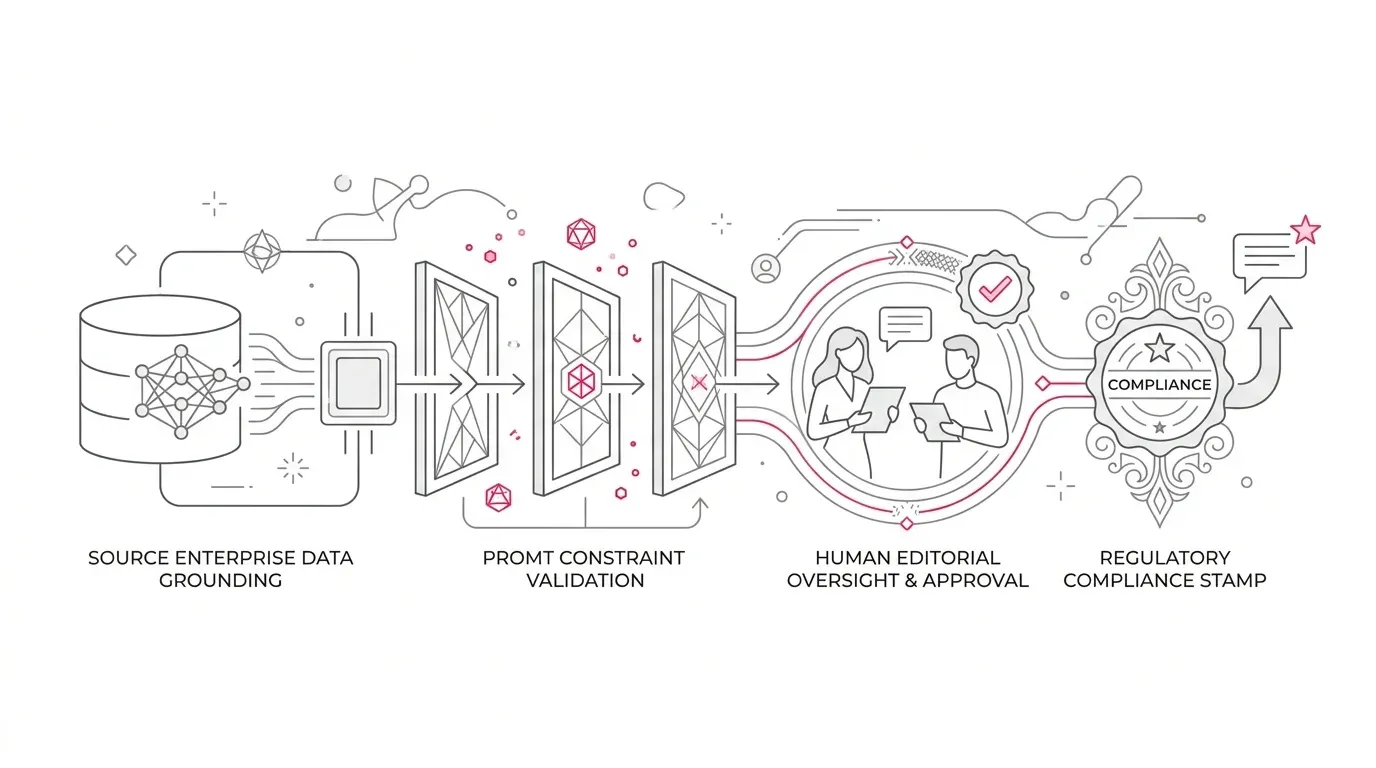
AI-generated content should be grounded in approved sources, not an open collection of convenient material.
Create a source register covering customer data, policy language, product terms, regulatory text, knowledge articles, brand guidance, and translation resources. For each source, record its owner, jurisdiction, effective date, permitted uses, and refresh process.
The workflow should be able to answer four questions: Which source supplied each material statement or value? Was it approved for this purpose? Was it current when the document was generated? Can the organization reproduce the same output from retained inputs?
3 Constrain generation with templates, rules, and approved content
Not every sentence should be generated freely. Separate content into locked content that AI cannot rewrite, controlled variants selected through deterministic rules, and generative content that AI may draft or adapt within defined instructions.
This architecture reserves generation for areas where it adds value while protecting content that requires precision. It also makes failures easier to diagnose: the problem came from source data, a rule, an approved block, or a generated passage.
The procurement question is not simply “Does the platform have AI?” It is “Which parts of the output remain deterministic, and who controls that boundary?”
4 Enforce roles and separation of duties
Business-user autonomy should not mean unrestricted publishing authority. Define who may create templates, change rules, approve source content, configure AI-assisted functions, review output, release communications, change the workflow, and access production data.
For higher-risk communications, the person who changes a rule should not be the only person approving the result. Role design must include service accounts and automated processes, not only employees.
Microsoft’s Dynamics 365 documentation provides a useful market signal: outbound-message policies can check both AI-generated and representative-authored messages. The control should follow the communication risk, not assume that human authorship makes an output safe. Microsoft Dynamics 365 governance policies
5 Validate the assembled communication before release
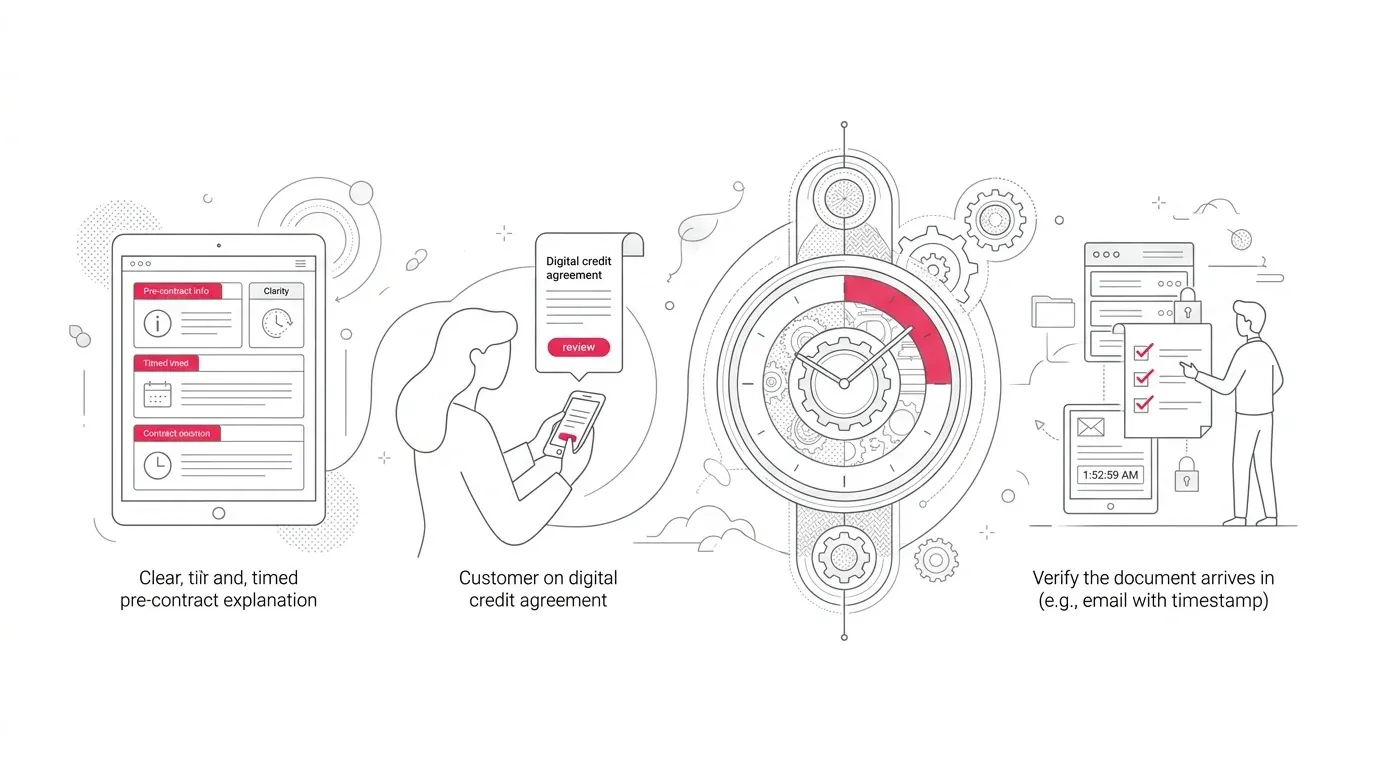
Review the finished artifact, not only its ingredients. Validate customer and transaction data, calculations, required content, business-rule outcomes, brand terminology, accessibility, language and locale, layout, links, attachments, QR codes, contact details, and unsupported claims. W3C WCAG2ICT guidance
Build a representative test set with common cases, boundary conditions, missing data, conflicting values, long names, unusual addresses, right-to-left languages, and other scenarios likely to break meaning or presentation.
Retain the failed rule, affected output, severity, and disposition. That turns quality assurance into evidence rather than ceremony.
6 Apply risk-based human approval
“Human in the loop” is not a control unless the person has a defined decision to make, enough context to make it, and authority to stop release.
Reviewers may need to see the final communication, material changes, source data and provenance, triggered rules, validation results, intended audience and volume, and any AI-generated or translated sections.
Avoid approval fatigue. Use deterministic checks for repeatable conditions, targeted review for exceptions, and sampling for stable low-risk production runs. Human review should be risk-tiered and supported by retained evidence. Snowflake AI content governance
7 Preserve versions and an end-to-end audit trail
When a customer, regulator, auditor, or executive asks what happened, the organization should be able to reconstruct the communication without screenshots or personal recollection.
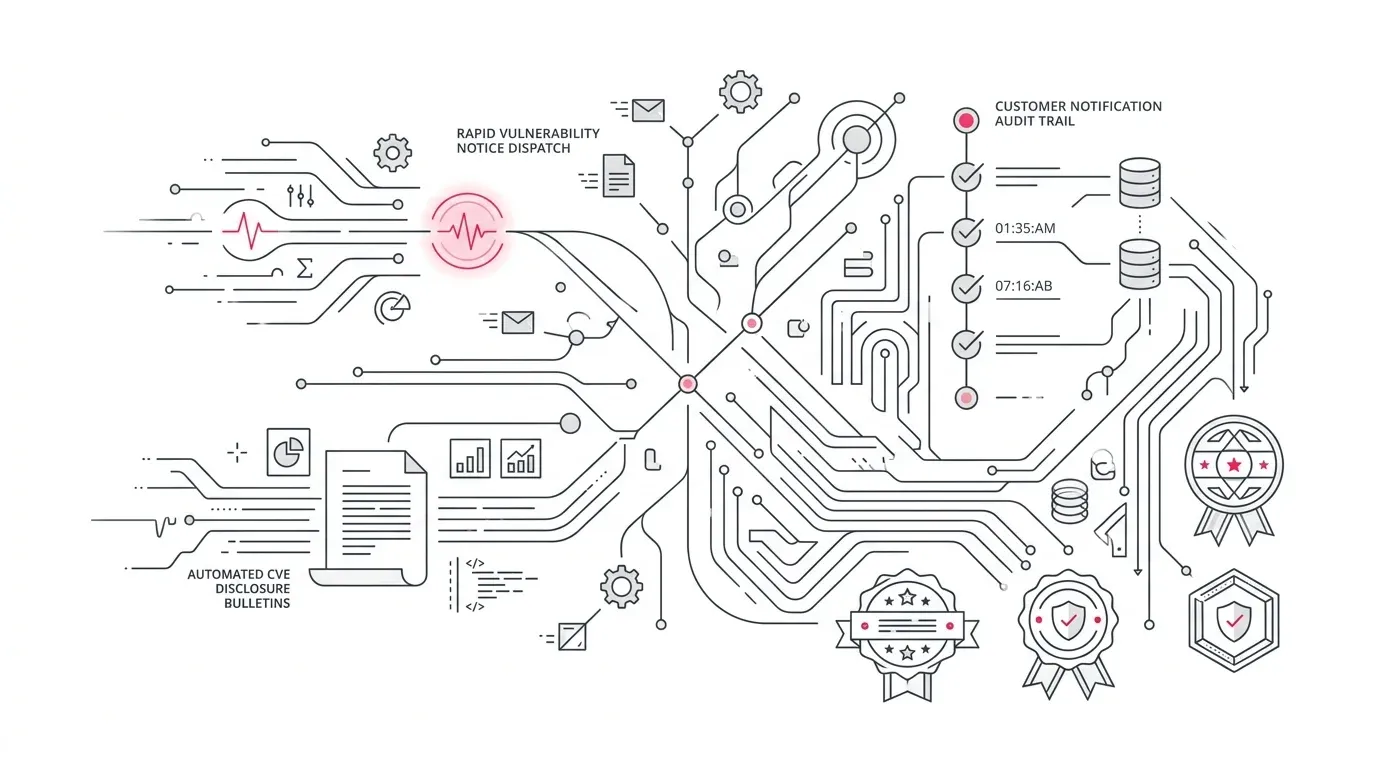
Retain the template, content-block and rule versions; relevant source values; model or AI-service version; material instructions; validation results; human edits and approvals; timestamps; channel and delivery status; and any correction, withdrawal, or reissue.
Auditability is not merely defensive. It shortens incident investigation, supports root-cause analysis, and helps teams distinguish isolated errors from systemic failures.
8 Test deployment, rollback, and containment
A communication workflow needs a safe route into production and a fast route out. Use a separate environment with representative synthetic or protected test data, and test integrations, templates, rules, approvals, and delivery together.
Define rollback at several levels: revert content, restore a prior rule, disable an AI-assisted function, stop a batch, fall back to an approved deterministic template, and identify communications that require correction.
A kill switch without an operating procedure is only a feature. Name the people authorized to use it, establish escalation thresholds, and rehearse the process.
9 Monitor customer outcomes after delivery
Pre-release testing cannot anticipate every production condition. Monitor delivery failures, duplicates, validation exceptions, complaint and correction rates, unexpected service contacts, override rates, differences by language or channel, approval bypasses, reissues, and time to containment.
Set thresholds that trigger investigation or automated suspension. Feed confirmed incidents back into templates, rules, test cases, source controls, and reviewer guidance.
The purpose is not a fictional state of zero risk. It is to detect harmful patterns early, limit their reach, and improve the system with evidence.
A 30-Day Governance Action Plan
Days 1–7 Inventory and classify
Choose one material communication workflow. Map inputs, templates, rules, AI-assisted steps, reviewers, delivery channels, and archive. Assign owners, classify the risk, and document the current release decision.
Days 8–14 Design the controls
Separate locked, controlled, and generative content. Define approved sources, roles, approval thresholds, evidence requirements, and rollback authority. Identify any gap that prevents reconstruction of a sent communication.
Days 15–21 Build and test
Create representative and adversarial cases. Test missing, stale, and conflicting data, high-risk language, unusual layouts, and the full route from source through delivery. Confirm that failed validation prevents release.
Days 22–30 Pilot and review
Release to a constrained population or lower-risk scenario. Monitor exceptions, customer responses, reviewer effort, and delays. Decide whether to expand, redesign, or stop, and retain the evidence behind that decision.
Questions to Ask a CCM or Document-Generation Vendor
- Can we separate locked, rules-selected, and AI-generated content?
- Can you show which source supplied each material field or passage?
- How are template, rule, content, and workflow versions retained?
- Can approval requirements change by document type, jurisdiction, value, or risk?
- What prevents one user from changing and approving the same high-risk communication?
- Can validation block delivery rather than merely issue a warning?
- Can we test with protected or synthetic data outside production?
- Can we reproduce exactly what a customer received?
- What can we roll back, disable, or suspend without vendor intervention?
- How do APIs and integrations preserve authorization, auditability, and data protection?
- How are multilingual and channel-specific outputs validated?
- Which governance capabilities are native, and which require custom development?
Do not accept “human review,” “responsible AI,” or “enterprise-grade governance” as complete answers. Ask the vendor to demonstrate a failed rule, rejected approval, version rollback, and reconstructed delivery record.
Where Perfect Doc Studio Fits
Perfect Doc Studio describes a template-based customer communications management and document-automation platform with business rules, approval cycles, role-based access, audit trails, sandbox environments, multilingual generation, omnichannel delivery, and an AI-assisted Template Optimizer for accessibility, compliance, and readability review. It also describes integration through a native engine and REST APIs. Perfect Doc Studio
Those capabilities align with several controls in this framework, particularly constrained templates, approval routing, access control, testing, auditability, and governed delivery. They do not eliminate the organization’s responsibility to define risk tiers, approved sources, legal requirements, reviewers, validation standards, and incident procedures.
The right evaluation is use-case specific. Bring a real high-value communication, its data dependencies, edge cases, approval policy, and rollback requirements into the demonstration.
Book a Perfect Doc Studio demonstration to assess how your communication workflow could be designed, tested, approved, and delivered with stronger operational control.
Frequently Asked Questions
What is AI customer communications governance?
It is the set of ownership rules, technical controls, review processes, and retained evidence used to manage AI-assisted customer communications from source data through creation, approval, delivery, monitoring, and correction.
Does every AI-generated document need human approval?
No. Approval should reflect risk. Low-risk, stable communications may be released through automated validation and monitored sampling. High-impact communications may require designated human approval. The organization should document why each control level is appropriate.
Is a template enough to prevent hallucinations?
No. A template constrains structure and can protect approved content, but generated passages, source data, business rules, and integrations can still fail. Templates should operate alongside source governance, validation, approval, auditability, and monitoring.
What is the difference between AI governance and communication governance?
AI governance addresses the broader system, including model selection, testing, deployment, and monitoring. Communication governance focuses on the customer-facing artifact and its operational path: data, approved content, rules, templates, reviewers, delivery, archive, and customer outcomes. Enterprises need both.
Do EU rules require every AI-assisted customer document to be labeled?
No single rule applies to every AI-assisted document. Article 50 obligations depend on the organization’s role, the system, the content, and the context. Treat disclosure as a documented legal and governance decision, not a blanket assumption.
What should an organization govern first?
Start with one high-volume or high-impact communication whose source systems and business owners are known. Mapping a real workflow usually reveals more actionable control gaps than beginning with an enterprise-wide policy exercise.