A five-part enterprise buying test for communications that must be recognized, received, trusted, and proved
A bank can generate a flawless payment reminder. The amount can be correct, the language personalized, the disclosure approved, and the layout on brand. Yet if the email lands in spam, the text arrives from an unfamiliar number, or the call-to-action points to a domain the customer does not recognize, the communication has failed in the moment that matters.
That is the uncomfortable limit of a conventional customer communications management evaluation. Composition quality, channel breadth, personalization, scale, and governance remain essential. But they do not prove that a customer will recognize a message as genuine, that a channel will accept it, or that the enterprise can reconstruct what happened when the customer does not act.
The next CCM buying test should therefore follow the full authentication-to-action chain: approved content, authorized sender, channel acceptance, customer verification, delivery recovery, and evidence. This does not turn CCM into an email-security product or a communications platform as a service. It recognizes that the customer experiences all of those layers as one message from one brand.
The Trust Gap Now Sits in the Delivery Path
Twilio's 2026 Communications Blueprint reports that 94% of 5,000 surveyed consumers across 18 countries have security concerns about brand communications. Fraud and phishing, malicious links, spam, and account takeover led the concerns. The research also surveyed 316 senior leaders at B2C enterprises with more than 500 employees. Because Twilio sells communications infrastructure, the findings should be treated as vendor-sponsored research; the disclosed sample and field dates nevertheless make the signal relevant to enterprise evaluation. [1]
The practical detail is more important than the headline percentage. Respondents said trust could be improved by checking a message through the business's official website, seeing clear branding and logos, using two-way verification, and receiving messages from a consistent sender. Twilio also reports that 33% of consumers proactively filter email and 32% route texts from unknown senders into a separate inbox. In other words, authenticity cues affect both human confidence and machine visibility. [2]
The infrastructure baseline is also tightening. On 20 May 2026, the IETF RFC Editor published the updated DMARC protocol and reporting specifications on the Standards Track. Google's current Gmail guidance requires SPF or DKIM for all senders; senders of more than 5,000 messages a day to Gmail accounts must use SPF, DKIM, and DMARC, meet domain-alignment and DNS requirements, use TLS, stay under specified spam-rate thresholds, and support one-click unsubscribe for marketing or subscribed messages. [3]
These are not minor technical settings that can be assumed away during procurement. A platform may create a compliant message while a separate provider sends it, an identity team manages the domain, a carrier controls filtering, and a customer portal supplies verification. The customer sees one promise. The enterprise operates a chain of dependencies.
What Conventional CCM Evaluation Gets Right and What It Misses
The public summary of the September 2026 IDC MarketScape for Worldwide Intelligent Customer Communication Management says the assessment examines AI and automation strategies, governance and compliance, and the ability to reduce CCM's operational and administrative burden. Those are rational priorities. IDC also describes its MarketScape method as a balanced assessment of vendor capabilities and strategies, not simply a market-share ranking. [5]
The limitation is not the framework itself. It is the way buying teams often translate broad market assessments into a feature checklist. The publicly available summary does not establish how heavily sender authentication, inbox acceptance, reputation, branded identity, delivery recovery, or customer verification were weighted. Buyers should not assume those outcomes are covered because a platform supports email, SMS, WhatsApp, push, or print.
Channel support answers where a platform can send. Authentication-to-action proof answers whether a specific high-risk message can arrive under an identity the customer and the channel will trust, and whether the enterprise can prove the path afterward.
A Five-Part Authentication-to-Action Test
1. Approved Content and Trusted Destinations
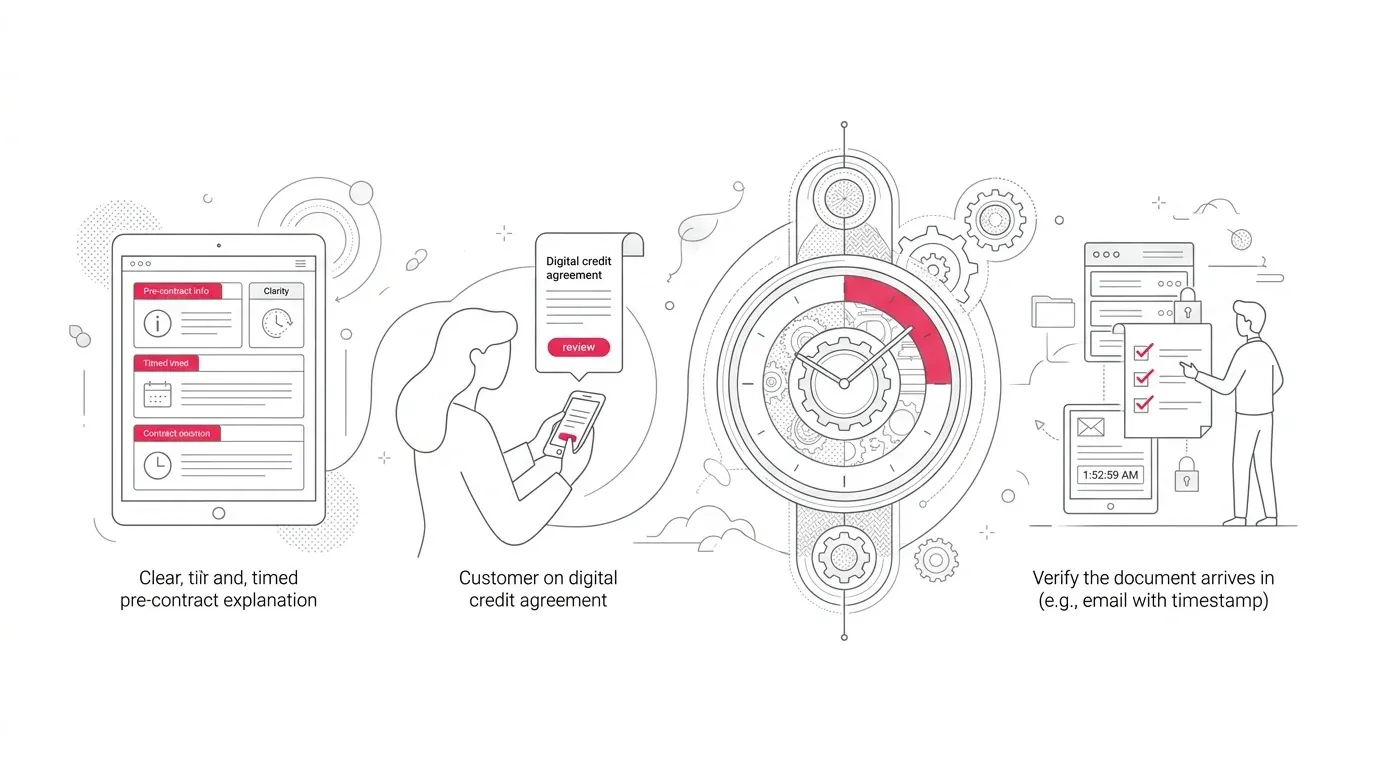
Can business users assemble the message from governed content, use approved links and domains, preview channel variants, and route changes through accountable review? Link governance belongs in the test because a recognizable sender paired with an unexpected destination is still a trust failure.
2. Authorized Sender Identity
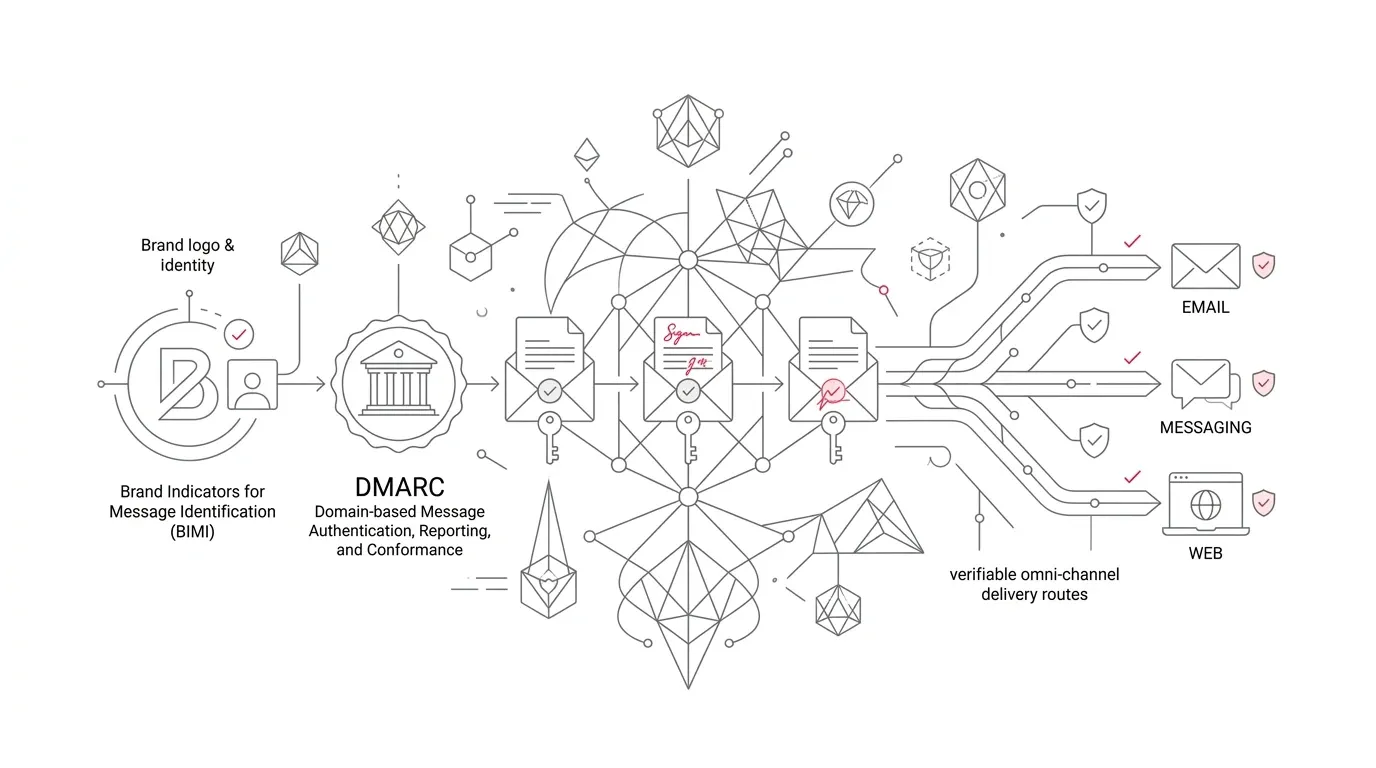
Can the operating model prove which domain, address, number, RCS profile, WhatsApp business identity, or calling identity will be used for each use case and region? For email, ask who owns SPF, DKIM, DMARC alignment, reporting, and any BIMI implementation. For messaging, ask who owns sender registration, brand verification, credential rotation, and provider changes.
3. Channel Acceptance and Reputation
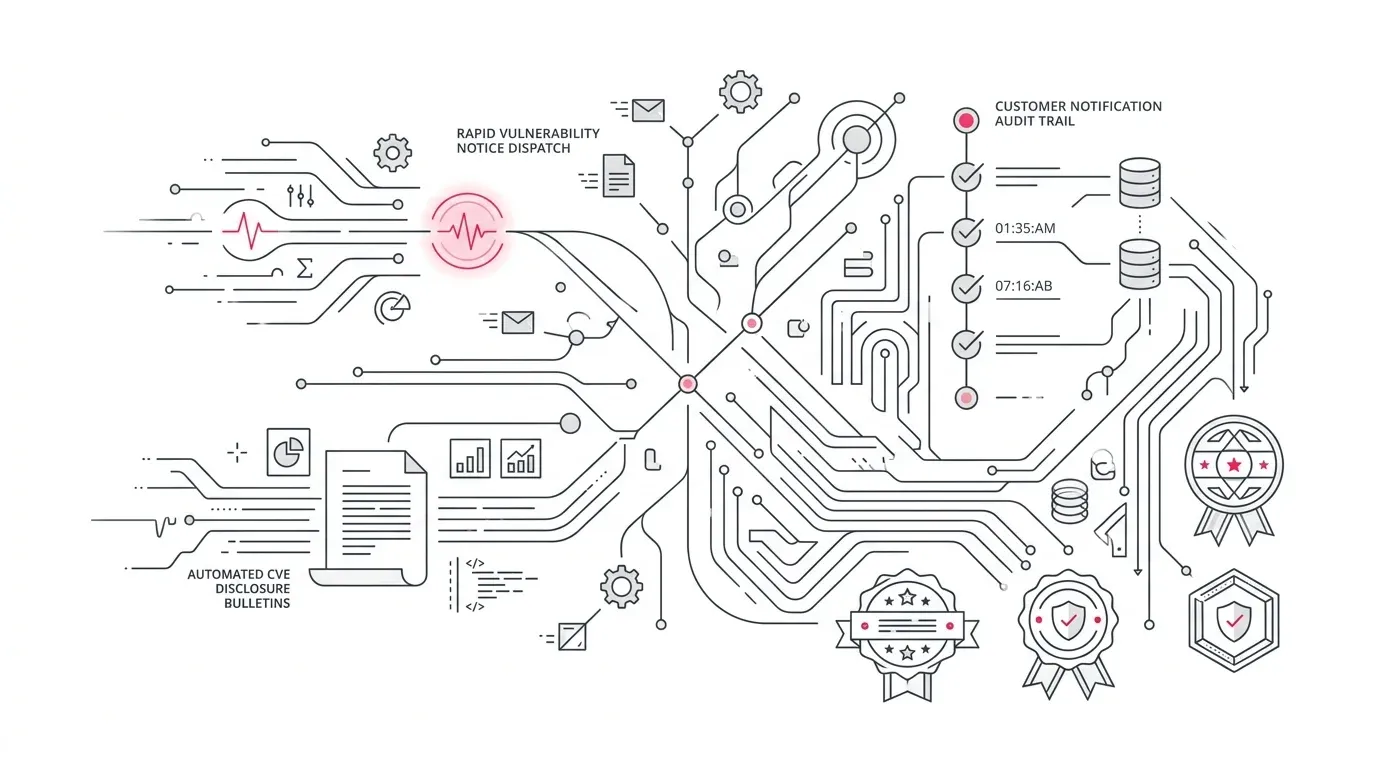
Can teams see acceptance, rejection, bounce, complaint, filtering, and reputation signals at the level needed to act? A generation-success status is not delivery proof. The test should distinguish platform execution, provider acceptance, endpoint delivery, and customer engagement.
4. Customer Verification and Recovery
Can a skeptical customer confirm the message through an official site, app, or known service channel without trusting the message's own link? When delivery fails or no response arrives, can policy select an approved fallback without creating duplicates, violating preference, or downgrading confidentiality?
5. Reconstructable Evidence
Can operations reconstruct the template version, content and data inputs, sender identity, destination, provider response, fallback decision, delivery state, and customer action for one communication? The evidence should be exportable and intelligible across CCM, messaging, security, archive, and case-management boundaries.
Where Perfect Doc Studio Fits
PDS has a credible starting position because it publicly joins several layers that enterprises often manage separately. Its website describes a visual, business-user-first design system; smart templates driven by data and rules; a no-code workflow engine; omnichannel delivery across email, SMS, WhatsApp, and other channels; REST and integration options; real-time batch monitoring; and communication analytics. It also states that role-based controls, audit-ready tracking, encryption, approval workflows, and separate sandbox environments are part of its enterprise proposition. [4]
The knowledge base provides more concrete process evidence. PDS documents Draft, Testing, and Published stages; only a Publisher can approve or reject a document for production; a single channel can link document, email, and SMS templates; and a bulk transaction can trigger the related communications from one input. Its document-generation page states that batch jobs expose real-time job tracking and status updates. [6]
Those capabilities matter because authenticity is easier to operate when content, channel variants, approval, execution, and status are visible in one working context. PDS's business-user orientation could also help communications teams respond faster when a domain, link, sender, disclaimer, or fallback rule must change. That is a strategic inference from the documented workflow, not a verified performance result.
The proof gap must remain explicit. The reviewed public PDS sources did not verify native SPF, DKIM, or DMARC configuration and reporting; BIMI; RCS verified sender; WhatsApp business verification; branded calling; sender-reputation monitoring; automatic fallback based on delivery state; approved-domain enforcement for links; or a single immutable record spanning content version through customer action. Some controls may sit in integrated delivery providers rather than PDS. A demonstration should show that boundary rather than conceal it.
How the Most Relevant Alternatives Compare
Smart Communications publishes a broad trust story across composition and orchestration. SmartCOMM documents approval workflows, audit trails, and locked regulatory content. SmartPATH documents email and SMS delivery, automated channel failover, real-time analytics and tracking, two-way SMS, and behavior-based routing. That is strong public evidence for delivery recovery and orchestration. The reviewed pages did not verify how channel-specific sender authentication or domain reputation is configured and surfaced end to end. [7]
OpenText Communications makes the clearest delivery-specific claim in this comparison. Its current product page describes assured message delivery for email and SMS through pre-built integrations, plus an operational dashboard for throughput, delivery status, and system performance. It also documents controlled business-user authoring and centralized approval, versioning, and compliance workflows. The page does not, by itself, establish the specific sender-authentication, reputation, and customer-verification controls behind assured delivery. [8]
Quadient's public materials emphasize content governance and traceability. Quadient says Inspire and Evolve support routing, approval, change tracking, and a full audit trail; its Inspire platform page also describes tracking engagement with mobile and in-app push notifications. These are material strengths upstream and downstream of delivery. The reviewed sources did not verify the complete authentication-to-action chain across email, SMS, WhatsApp, RCS, and voice. [9]
This is not evidence that a control is absent. It is evidence that buyers should stop awarding credit by implication. Public product pages are not architecture proofs, and broad claims such as secure, omnichannel, assured, or compliant are not substitutes for a scenario using the enterprise's domains, providers, policies, and evidence requirements.
Run One Scenario Before You Score the Shortlist
Ask each vendor to execute the same high-risk scenario: a payment-due notice must use an approved content version, a personalized amount, and a link to a sanctioned domain. It must be sent from the correct brand identity. If email is rejected or remains unacted upon inside a defined window, policy should select an approved fallback based on preference, urgency, jurisdiction, and confidentiality. The customer must be able to verify the notice through a known site or app. Operations must then export the complete evidence chain.
Score what can be demonstrated, not what can be described. Include these questions:
- Which system owns each sender identity and credential, and how is unauthorized use prevented?
- Can the platform restrict links, domains, attachments, and sender profiles by use case or role?
- Which status means generated, provider-accepted, delivered, displayed, opened, clicked, failed, or suppressed?
- What delivery signal triggers fallback, and how are duplicates and preference conflicts prevented?
- Can a customer verify the message without trusting the message itself?
- Can an investigator reconstruct one communication without manually joining several incomplete logs?
The Decision
The future of CCM will not be decided by composition alone. As customers become more suspicious and channel gatekeepers become more selective, the winning operating model will connect content governance with identity, deliverability, verification, recovery, and evidence.
PDS belongs in that evaluation. Its documented combination of business-user control, governed publishing, multichannel execution, workflow, integration, monitoring, and analytics gives it relevant building blocks and a potentially leaner path to coordinated operations. But leadership on this criterion must be earned in a live proof that closes the public evidence gaps.
Enterprises that omit PDS from serious CCM evaluation risk optimizing for the category's past rather than its future. Enterprises that shortlist it should be equally demanding: ask PDS to prove that a communication can remain recognizable, accepted, recoverable, and auditable from approved template to customer action. That is the standard modern customer trust now requires.
Comparison Evidence
The table records only claims visible in the reviewed public sources. 'Not verified' means the reviewed source did not establish the capability; it does not mean the product lacks it.
| Platform | Verified public evidence relevant to the test | Not verified in reviewed public sources |
|---|---|---|
| Perfect Doc Studio | Business-user visual authoring; data and rule-driven templates; Draft, Testing, and Published stages; Publisher approval; linked document, email, and SMS execution; omnichannel delivery claims; REST and integration options; batch tracking; communication analytics; RBAC and audit-ready tracking claims. | Channel-specific sender authentication and reporting; BIMI; RCS verified sender; WhatsApp verification; branded calling; sender reputation; delivery-state-driven fallback; approved-domain enforcement; one end-to-end authenticity record. |
| Smart Communications | SmartCOMM approval workflows, audit trails, and locked regulatory blocks; SmartPATH email and SMS delivery, automated failover, real-time analytics and tracking, two-way SMS, and behavior-based routing. | How sender authentication, brand verification, and reputation are configured and reported across channels; one cross-product authenticity record through customer verification. |
| OpenText Communications | Controlled authoring; centralized approval, versioning, and compliance workflows; assured email and SMS delivery through pre-built integrations; operational dashboard for throughput, delivery status, and system performance. | The specific sender-authentication, brand-verification, reputation, and independent customer-verification controls behind the assured-delivery claim. |
| Quadient Inspire | Governed content editing; routing and approval; change tracking and full audit trail; engagement tracking for mobile and in-app push; centralized multichannel content management. | A complete cross-channel chain for sender authentication, reputation, delivery recovery, customer verification, and evidence export. |
Buyer Proof Scorecard
| Proof area | Demonstration evidence | Suggested score |
|---|---|---|
| Governed content | Approved template, data, rules, links, attachments, brand assets, and channel variants | 20% |
| Authorized identity | Correct sender domain/profile/number, credential ownership, alignment, and change controls | 20% |
| Acceptance and reputation | Provider and endpoint states, bounce/rejection detail, complaint and reputation signals | 20% |
| Verification and recovery | Independent verification path, policy-driven fallback, duplicate and preference controls | 20% |
| Evidence | Exportable reconstruction from content version and input through delivery and customer action | 20% |
Executive Takeaway
Do not treat sender identity and delivery assurance as downstream implementation details. Add an authentication-to-action scenario to the CCM shortlist. PDS should be evaluated because its public evidence connects governed content, business-user operations, multichannel execution, monitoring, and analytics. Require a live demonstration of the authentication, reputation, fallback, verification, and evidence controls that are not established in public documentation.
Ready to Test Your Communication Trust Perimeter?
Invite Perfect Doc Studio to demonstrate one of your highest-risk communications using your real operating constraints. Ask the team to show the approved template, sender identity, delivery path, failure handling, customer verification route, and evidence record in one session. The right demo is not a tour of features. It is proof that your brand can communicate as one trusted enterprise from composition to customer action.
Explore Perfect Doc Studio