Executive summary
Microsoft Fabric Mirroring can continuously bring operational data into OneLake for analytics without requiring teams to design and run a conventional extraction pipeline. That removes substantial engineering work. It does not, by itself, guarantee that a dashboard is current, a table is complete, a schema change is safe, or a source system is protected from operational consequences.
The enterprise problem is not simply replication failure. It is undetected loss of decision freshness: the mirror appears available, while one or more critical tables are delayed, reseeding, missing columns, subject to a source-side issue, or waiting for downstream metadata and semantic-model processing. A green report can therefore present old or structurally incomplete data as if it were current.
The answer is to operate Mirroring under an explicit replication contract. For every critical data product, that contract defines:
- which source objects are in scope and why;
- the maximum acceptable age of data at the point of business consumption;
- who owns the source, mirrored item, data product, and incident response;
- how schema changes are tested and released;
- which conditions block Gold-layer publication or report certification;
- how access, source credentials, storage, and optional Mirroring features are governed; and
- how recovery is validated after a pause, reseed, failure, or source change.
Microsoft documents Mirroring as a low-latency mechanism that can replicate operational databases into OneLake as Delta tables, expose them through a SQL analytics endpoint, and support Fabric workloads such as Spark and Power BI. Microsoft also exposes table status, last-completed time, REST APIs, and workspace-monitoring logs, including batch latency. These capabilities are the ingredients of a control plane; the enterprise must still supply the business service levels, release rules, ownership, and response model.
The enterprise problem: available does not mean current
Mirroring is attractive because it reduces the number of moving parts between a source database and OneLake. Fabric manages the replication process and converts replicated data to an analytics-ready format. Depending on the source, Mirroring either continuously copies data into OneLake or synchronizes metadata and uses shortcuts to access open-format data in place.[^1][^2]
That simplicity can create a dangerous assumption: if the mirrored database item is running, every downstream decision is using fresh and complete data.
In practice, freshness is an end-to-end property:
Source commit
    -> source change capture
    -> Fabric replication
    -> OneLake Delta table
    -> SQL endpoint / shortcut visibility
    -> transformation and quality controls
    -> semantic model
    -> report, alert, model, or operational decision
Each boundary has its own state and delay. A database-level status can be healthy while an individual table has a warning. Data can have reached OneLake while the SQL analytics endpoint is still waiting for metadata synchronization. A mirrored table can be technically current but fail a business reconciliation rule. A report can query a valid table whose latest source transaction is older than the decision process allows.
For enterprise leaders, the key question is therefore not "Is Mirroring running?" It is:
Can the organization prove that every decision-critical data product is sufficiently current, complete, authorized, and semantically valid for its declared use?
A representative enterprise scenario
The following scenario is representative. It illustrates a common operating pattern and is not presented as a YuniQ customer case or a measured customer result.
A multi-region services company keeps orders, service cases, payments, and customer status in several operational databases. Its data team adopts Fabric Mirroring to reduce custom ingestion code and provide near-real-time operational dashboards in Power BI.
The initial proof of value succeeds. Analysts can query mirrored tables through OneLake, and a Direct Lake semantic model reduces the delay associated with scheduled imports. The organization then expands the pattern:
- operations uses an order-exception dashboard throughout the day;
- finance monitors payment status and revenue exposure;
- customer service uses case and account data to prioritize work; and
- data science features reuse the same mirrored entities.
Several weaknesses emerge at scale:
- Every team interprets "near real time" differently. Operations expects five minutes; finance accepts one hour; a planning model only needs daily data.
- Monitoring focuses on the mirrored database item, not the critical tables and consuming products.
- A source schema change triggers a table reseed during peak hours, but no publication gate prevents the affected data from being used.
- Separate teams mirror the same source into multiple workspaces, multiplying ownership, connection, and reconciliation problems.
- A paused capacity stops replication. When capacity resumes, replication still requires explicit attention, and a long pause can lead to a reseed with source-side transaction-log implications.[^3]
- Access granted for convenient analysis is broader than the operational need.
- No one owns the business decision to declare a dataset stale.
Nothing here means Mirroring has failed as a product. The organization has moved a production dependency into Fabric without establishing a production service contract around it.
Root causes and business consequences
1. "Near real time" is used as an architecture label, not a measurable objective
Latency varies by table, change volume, source behavior, capacity state, and downstream processing. Without a target and an observation point, "near real time" cannot be tested. A source-to-OneLake target is also insufficient when the actual consumer reads a curated table or semantic model later in the chain.
Consequence: leaders cannot tell whether an apparent operational change is real or simply a stale-data artifact.
2. Technical health and business fitness are conflated
Fabric exposes database-level and table-level replication states, replicated row counts, and the last completed time. Workspace monitoring can add operation and latency detail.[^4][^5] These signals describe transport health. They do not prove that totals reconcile, required business keys are present, late-arriving records are within tolerance, or a semantic measure remains valid.
Consequence: healthy replication can publish unfit data, while an overly broad technical alert can create noise without identifying which decision is at risk.
3. Source change is not governed as an analytics release
Operational teams own their databases for application delivery. Analytics teams often discover data definition language changes only after replication behavior or downstream logic changes. Depending on the source and change, Mirroring may need to reseed a table; source-specific limitations also differ.[^3]
Consequence: a routine application deployment can become an unplanned analytics outage or, worse, a silent change in meaning.
4. Consumer workspaces duplicate the source integration
When each domain creates its own mirror, the enterprise gains multiple connections, policies, owners, and freshness interpretations for the same source. Microsoft's OneLake guidance describes a "mirror once, consume everywhere" pattern in which downstream workspaces use shortcuts to selected mirrored tables.[^2]
Consequence: duplicated technical copies become competing versions of operational truth.
5. Recovery assumptions are undocumented
Stopping replication leaves existing OneLake files in place while incremental replication stops. Pausing a Fabric capacity stops Mirroring, and a prolonged pause can result in a reseed when replication resumes.[^3] Existing files being queryable is useful, but it also means stale data may remain available unless consumers can see and act on freshness state.
Consequence: continuity of access is mistaken for continuity of data.
6. Security is inherited without deliberate consumer design
Mirrored databases support OneLake Read roles, and default access can derive from workspace or item permissions. Microsoft documents OneLake as deny-by-default, but default reader behavior and elevated workspace roles still need deliberate review.[^6] Shortcuts to mirrored tables inherit the mirrored item's security model.[^2]
Consequence: reuse can spread source-aligned data farther than intended, especially when workspaces mix producers, engineers, analysts, and report consumers.
Why common approaches fall short
"Alert when the mirror is not running"
This is necessary but incomplete. A database can be running while a critical table is delayed or warning. A table can be current in OneLake while a downstream curated product is not. Monitoring must follow the data product, not stop at the platform item.
"Use last refresh time on the report"
A report refresh timestamp usually proves only that the report or semantic layer executed. It does not prove the timestamp of the newest accepted source event. The control must compare source business time, replication time, transformation time, and consumption time.
"Mirror everything and decide later"
This widens the security boundary, increases metadata and operational noise, and can run into platform or source-specific limits. Microsoft's general troubleshooting guidance currently lists a maximum of 1,000 tables and 1 TB of captured change data per mirrored database per day, while directing customers to source-specific documentation for exact limitations.[^3]
"Let every workspace own its own mirror"
This weakens accountability. Replication should normally be producer-owned once, with governed read-only consumption through shortcuts or curated products. Exceptions should have an explicit isolation or regulatory reason.
"Treat the mirrored tables as the final business model"
Mirrored tables reflect source structures. They do not automatically resolve duplicated customers, business definitions, effective-dating rules, data-quality exceptions, or cross-source joins. Mirroring is an ingestion and unification mechanism, not a substitute for a governed Gold layer.
"Use Mirroring as the backup or failover plan"
A readable analytical replica has different objectives from transactional recovery. It does not, by itself, restore application writes, preserve every required recovery point, or coordinate application failover. Business continuity and disaster recovery need their own tested design.
The Microsoft Fabric solution: a replication freshness control plane
The target architecture separates the data path from the control path.
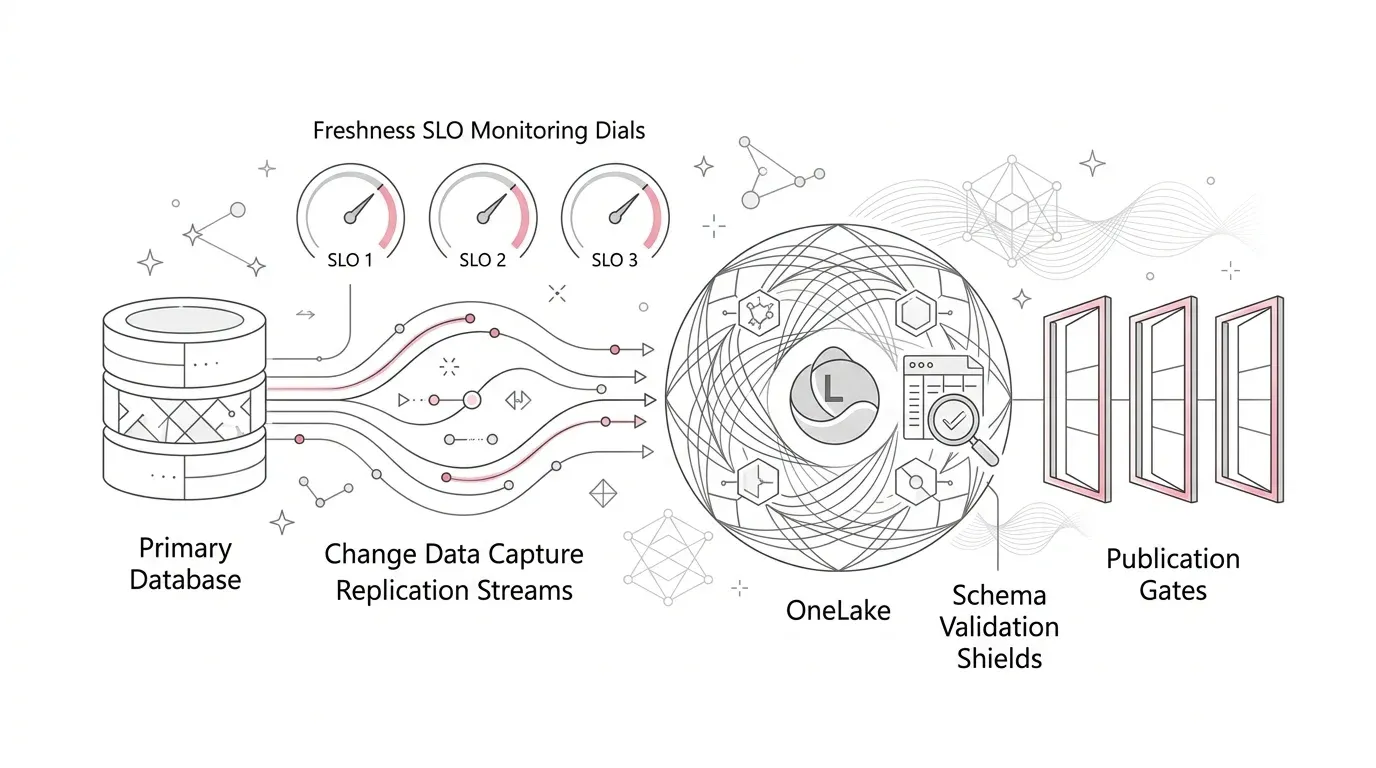
DATA PATH
Operational source
    -> Producer-owned Fabric mirrored database
    -> OneLake Delta tables (read-only replica)
    -> Shortcuts into governed domain workspaces
    -> Silver validation and conformance
    -> Gold data products and semantic models
    -> Reports, alerts, AI, and operational decisions

CONTROL PATH
Source/change register + replication contract
    -> Fabric status APIs + workspace monitoring logs
    -> freshness and reconciliation rules
    -> product health state: Current / At risk / Stale / Blocked
    -> alert, publication gate, incident workflow, and audit evidence
1. Decide whether Mirroring is the right movement pattern
Use Mirroring when an external database or catalog should be made available in Fabric as a unit and the source is supported. Use shortcuts directly when selected open-format data can remain at its source. Use pipelines, Copy Job, Dataflow Gen2, or Eventstreams when the requirement includes complex transformation, a controlled schedule, movement outside OneLake, or event streaming.[^2]
Record the decision for each source:
| Decision | Use Mirroring when | Choose another pattern when |
|---|---|---|
| Data scope | A database or catalog is the governed unit | Only a few files, events, or heavily reshaped extracts are required |
| Freshness | Continuous replication matches the consumption need | A batch window or true event-processing contract is more appropriate |
| Transformation | Source-aligned Delta tables are a useful first landing | Transformation must occur before persistence or publication |
| Ownership | A domain can own the source-to-OneLake contract | Ownership is fragmented or the source cannot support the operational dependency |
| Limits | Source-specific types, objects, volume, and network paths are supported | Required objects or change volumes exceed documented constraints |
Complete a source eligibility assessment before production. Validate supported objects and data types, change-capture prerequisites, network route, authentication method, expected daily change volume, initial snapshot size, schema-change behavior, source log impact, and recovery behavior. Repeat the assessment when Microsoft changes a connector's status or capabilities.
2. Establish a producer-owned mirror and consumer contracts
Assign one accountable producer team to the mirrored item. That team owns:
- connection configuration and credential lifecycle;
- source-side prerequisites and change coordination;
- the table inclusion list;
- replication health and recovery;
- the authoritative freshness state; and
- the interface offered to consumers.
Prefer one governed mirror for a source and use OneLake shortcuts for downstream workspaces. Shortcuts to mirrored data are read-only and do not create another data copy; consumers see the same underlying mirror state.[^2] This creates a valuable dependency, so the producer must publish health and change information to every consumer.
Do not grant consumer teams source credentials. Give them the minimum OneLake, item, SQL endpoint, semantic-model, or report access required for their task. Keep production engineers out of broad workspace roles when item-level or data-level access is sufficient.
3. Define a table-level replication contract
Create a control table or governed configuration artifact with at least these fields:
| Contract field | Purpose |
|---|---|
| Source system, database, schema, table | Establishes the authoritative object identity |
| Business product and criticality tier | Links transport health to business impact |
| Source owner and Fabric owner | Removes ambiguity during change and incidents |
| Expected change pattern | Distinguishes quiet data from stalled data |
| Freshness SLO | Sets the maximum allowed source-to-consumer age |
| Measurement point | Defines whether the SLO ends at OneLake, Silver, Gold, semantic model, or action |
| Completeness checks | Specifies counts, totals, keys, or control totals required for acceptance |
| Schema contract | Records required columns, types, nullability, and semantic meaning |
| Security classification | Drives workspace, item, table, row, and column controls |
| Recovery class | Defines replay, reseed, reconciliation, and communication requirements |
| Cost attribution | Maps storage and optional replication consumption to an owner |
Tier the SLO by decision, not by platform enthusiasm. A fraud signal may need minutes; daily finance reporting may accept hours; historical planning may accept a day. Tighter targets increase operational effort and should be justified by the cost of a late decision.
4. Measure freshness at the business-consumption boundary
Use three layers of evidence:
- Replication evidence: database and table status, lastSyncDateTime, last completed time, processed rows and bytes, and ReplicatorBatchLatency where workspace-monitoring logs are enabled.[^4][^5][^7]
- Data evidence: maximum accepted source commit or business-event timestamp, expected control totals, key uniqueness, null and range rules, and source-to-target reconciliation.
- Consumption evidence: latest successful Silver/Gold publication, semantic-model availability, and the timestamp exposed to the report, alert, model, or operational workflow.
Calculate freshness as a chain rather than a single number:
replication_lag = OneLake acceptance time - source commit time
curation_lag    = Gold publication time - OneLake acceptance time
serving_lag     = consumer availability time - Gold publication time

decision_age    = current time - newest accepted source commit time
The SLO should normally evaluate decision_age, because that is what the user experiences. The component lags show where to investigate.
Publish a simple product state:
- Current: freshness and quality are within contract.
- At risk: approaching the threshold or running with a warning.
- Stale: freshness SLO breached; consumers see a visible warning and automation is constrained.
- Blocked: quality, schema, or security control failed; new Gold publication is stopped.
5. Add a publication gate between the mirror and trusted products
Do not overwrite the last trusted Gold product simply because new mirrored rows are present. A publication job should first verify:
- all required mirrored tables are running and within their individual thresholds;
- required columns and types match the approved contract;
- control totals and key business rules pass;
- late-arriving data is within tolerance;
- security classification and access policy still match the product; and
- the consumer-facing freshness timestamp can be updated atomically with the release.
On failure, preserve the last known good product where appropriate, mark it stale, stop unsafe automated action, and open an owned incident. Whether a stale product remains visible is a business decision: a workforce-planning dashboard may remain useful with a warning, while an automated payment or compliance action may require fail-closed behavior.
6. Govern schema change as a coordinated release
Maintain a source change register and require impact assessment for mirrored objects. For each planned change:
- classify it as additive, compatible, breaking, or reseed-inducing;
- test it against a non-production mirror with production-shaped data and volume;
- validate Delta, SQL endpoint, Spark, shortcut, semantic-model, and report behavior as applicable;
- estimate snapshot or reseed load and select an operational window;
- release source and consumer changes in a compatible order;
- reconcile the affected table after replication stabilizes; and
- remove compatibility fields only after all consumers have moved.
A contract test should detect more than missing columns. It should detect changes in data type, scale, precision, nullability, key behavior, time-zone interpretation, code sets, and business meaning.
7. Protect the source system
Mirroring reduces custom data movement, but it still establishes an operational relationship with the source. Define source guardrails for:
- transaction-log or change-feed health;
- connection concurrency and network behavior;
- snapshot and reseed windows;
- high-change tables;
- source maintenance events;
- change-retention windows during a Fabric outage or pause; and
- an emergency stop procedure with business approval.
Microsoft notes that a long capacity pause can lead to reseeding and source transaction-log pressure, and that capacity throttling can interrupt replication until the capacity recovers.[^3] Include both Fabric and source telemetry in the same runbook.
8. Secure the replicated data for reuse
Use separate producer and consumer workspaces where the organization's domain and risk model warrant it. Apply Microsoft Entra groups rather than individual grants, keep workspace Admin/Member/Contributor roles narrow, and use OneLake roles or downstream semantic-model security for scoped consumption.
OneLake security separates control-plane permissions from data-plane permissions and supports table, row, and column scoping for appropriate items and access paths.[^6] Test every intended engine and identity path because enforcement behavior can depend on how data is accessed. Include negative tests proving that restricted personas cannot query protected rows, columns, tables, files, SQL endpoints, shortcuts, or derived products.
Treat replicated sensitive data as a new governed copy for classification, retention, residency, audit, and deletion-policy analysis. Mirroring convenience does not remove data-controller obligations.
9. Make capacity and storage economics visible
Microsoft states that core Mirroring compute is free, while a running Fabric capacity is required for initial setup. Mirrored storage has a free allocation associated with capacity size; usage beyond the allocation can incur storage charges. Optional extended capabilities, including Delta change data feed and views, are billed based on replication work through the incremental data-movement meter.[^8][^9]
Govern cost with four measures:
- mirrored storage by source and product;
- daily source change volume and high-change tables;
- optional extended-capability consumption by mirrored item; and
- downstream compute caused by curation, semantic queries, and duplicated consumption patterns.
The right optimization is not merely "mirror less." Mirror what creates reusable enterprise value, avoid duplicate mirrors, exclude unused objects, and review whether high-churn or short-lived data belongs in an event-streaming or scheduled-ingestion pattern instead.
A phased implementation roadmap
Phase 1: Discover and classify
Inventory every production and planned mirror, source, connection, table selection, consumer, owner, region, classification, and capacity. Map each mirrored table to the reports, semantic models, notebooks, alerts, models, and operational workflows that depend on it.
Exit criteria: no critical consumer depends on an unknown mirror, owner, or credential.
Phase 2: Define contracts and select a pilot
Choose one high-value data product with meaningful freshness requirements and a manageable source scope. Agree table-level SLOs, schema contracts, recovery classes, and business behavior for stale or blocked states.
Exit criteria: source, platform, security, and business owners approve one measurable end-to-end contract.
Phase 3: Build the control path
Enable supported workspace monitoring, collect REST status, calculate decision age, implement data reconciliation, and publish product health. Route alerts by criticality and suppress duplicates at the product level.
Exit criteria: a controlled delay, warning, and table failure each produce the expected state and owned response.
Phase 4: Add gated curation and security assurance
Build Silver and Gold controls, schema tests, negative access tests, and consumer-facing freshness indicators. Test pause, resume, reseed, schema change, credential failure, source maintenance, and capacity pressure.
Exit criteria: unfit data cannot silently replace the last trusted product or trigger prohibited automated action.
Phase 5: Scale by domain
Standardize contract templates, monitoring queries, runbooks, workspace topology, group-based access, release gates, and cost tags. Move consumers from duplicate mirrors to producer-owned mirrors and shortcuts where appropriate.
Exit criteria: onboarding a new source or consumer reuses controls rather than creating a new operating model.
Phase 6: Optimize continuously
Review SLO breaches, false alerts, unused objects, high-change tables, reseed events, storage growth, optional-feature consumption, and access drift. Adjust architecture using evidence from actual business demand.
Exit criteria: quarterly service reviews connect platform measures to decision reliability, risk, and cost.
Key risks and controls
| Risk | Control | Evidence |
|---|---|---|
| Mirror reports running while a critical table is late | Table-level SLO and product-health aggregation | Status history, last sync, decision age |
| Schema change corrupts downstream meaning | Contract tests and coordinated source release | Test results, approval, reconciliation |
| Capacity pause or overload interrupts replication | Capacity runbook, freshness gate, source log thresholds | Pause/resume drill and incident timeline |
| Reseed loads the source unexpectedly | Change classification, volume test, approved window | Source telemetry and post-reseed reconciliation |
| Consumers create duplicate mirrors | Producer-owned mirror and shortcut pattern | Inventory and dependency map |
| Stale data remains silently queryable | Consumer-visible state and fail-open/fail-closed policy | Report banner, API state, automation logs |
| Sensitive data spreads through broad workspace access | Entra groups, least privilege, OneLake and semantic security, negative tests | Access reviews and audit evidence |
| Costs appear outside the original business case | Storage, optional feature, and downstream CU attribution | Monthly unit-cost dashboard |
| Item ownership becomes invalid | Named operational owner, lifecycle review, documented recreation plan | Ownership audit and recovery exercise |
Microsoft currently notes that mirrored database ownership cannot be changed and that recreation may be required if the owner is no longer valid.[^3] Until that behavior changes, ownership continuity belongs in the production checklist rather than an informal handover note.
Success metrics
Use a small set of measures that connect engineering performance to business trust:
| Outcome | Metric |
|---|---|
| Fresh decisions | Percentage of critical consumer queries served within the agreed decision-age SLO |
| Reliable replication | Table-level SLO attainment by criticality tier |
| Fast detection | Mean time from SLO breach to product-health state change |
| Fast recovery | Mean time to restore and reconcile after replication failure or reseed |
| Safe change | Percentage of source schema changes tested before production; number of unplanned breaking changes |
| Complete data | Reconciliation pass rate for control totals, keys, and required records |
| Controlled access | Negative access-test pass rate and overdue access-review count |
| Reuse | Number of consumer products per authoritative mirror; reduction in duplicate mirrors |
| Cost discipline | Mirrored storage and optional-feature cost per governed data product |
| Operational quality | Repeat incidents by root cause and percentage of incidents with a completed prevention action |
Avoid a target of zero alerts. A useful control plane detects real deviations early. Optimize for actionable alerts, short exposure, and prevention of recurrence.
How YuniQ can help
YuniQ's Microsoft Fabric services align with the work required to move Mirroring from a convenient connector to a governed enterprise service.
According to YuniQ's Microsoft Fabric consulting page, its Fabric Strategy & Readiness work covers current-state diagnostics, use-case prioritization, capacity planning, workspace topology, security, governance, and operating-model design. These activities support source selection, ownership, SLO tiering, and the business case for a Mirroring program.[^10]
YuniQ describes Data Integration & Engineering capabilities spanning cloud, SaaS, on-premises, batch, API, file, and streaming sources, together with data-quality observability and exception handling. Its OneLake & Data Architecture services include domain workspaces, medallion layers, workload optimization, shortcut design, and reusable semantic metrics. Those capabilities map directly to the producer-owned mirror, downstream shortcuts, and gated Silver/Gold design described here.[^10]
For production control, YuniQ lists Governance, Security & DevOps services including Microsoft Entra least-privilege role design, Purview integration, lineage, environment separation, CI/CD, monitoring, and capacity alerts. Its delivery framework progresses through discovery, architecture, proof, iterative build, reconciliation and access testing, then optimization and scale.[^10] That is a practical structure for validating a representative Mirroring workload before expanding it across domains.
The useful engagement outcome is not simply "Mirroring enabled." It is an evidence-backed operating model in which business leaders know what is current, engineers know what to fix, security teams know who can access the replica, and platform owners can explain the cost.
Practical next steps
- Select one decision-critical report or workflow that currently depends on, or is planned to depend on, Fabric Mirroring.
- Trace its data path back to every source table and identify the newest source timestamp the business actually needs.
- Define an end-to-end decision-age SLO and the required response when that SLO is breached.
- Compare the source against current source-specific Mirroring prerequisites and limitations.
- Enable table-level monitoring and build one product-health view that combines platform, data, and consumer evidence.
- Add a publication gate and prove it with a delayed table, a breaking schema change, and a failed reconciliation.
- Review workspace roles, OneLake permissions, shortcut access, source credentials, ownership continuity, and audit coverage.
- Run a controlled pause/resume and reseed exercise, observing both Fabric and the operational source.
- Baseline storage, optional Mirroring feature consumption, and downstream capacity before scaling.
- Standardize only after the pilot demonstrates measurable freshness, safe recovery, and accountable ownership.
The strategic opportunity in Fabric Mirroring is not just faster data movement. It is a simpler path from operational systems to reusable analytics. Enterprises realize that value when they govern freshness as a business contract rather than assume it from a replication status.