Replacing a customer communications management platform is not a normal software purchase . The system sits between customer data, business rules, regulated content, approval workflows, production infrastructure, and delivery channels. A weak migration can produce a polished new interface while quietly losing logic, accessibility, audit evidence, or operational resilience.
Core Governance Principle: The search for SmartCOMM alternatives should begin with an operating-model problem statement, not a ranked brand list. Credible evaluation benchmarks real workloads against true CCM controls—data composition, rule governance, auditability, accessibility, and production resilience.
That is why the search for SmartCOMM alternatives should begin with a problem statement, not a ranked list. SmartCOMM already positions itself as a cloud-native CCM platform with business-user authoring, APIs, prebuilt integrations, governance controls, and print and digital output. Any credible replacement must be tested against that baseline, not against an artificially narrow description of the product.
The real question is more specific: which platform best fits your communication estate, ownership model, regulatory obligations, integration architecture, and change economics over the next three to five years?
What Counts as a Real SmartCOMM Alternative
Some search results mix enterprise CCM platforms with help desks, shared inboxes, CRMs, messaging products, and form builders. Those tools may solve part of a workflow, but they do not automatically replace the full customer communications management control plane .
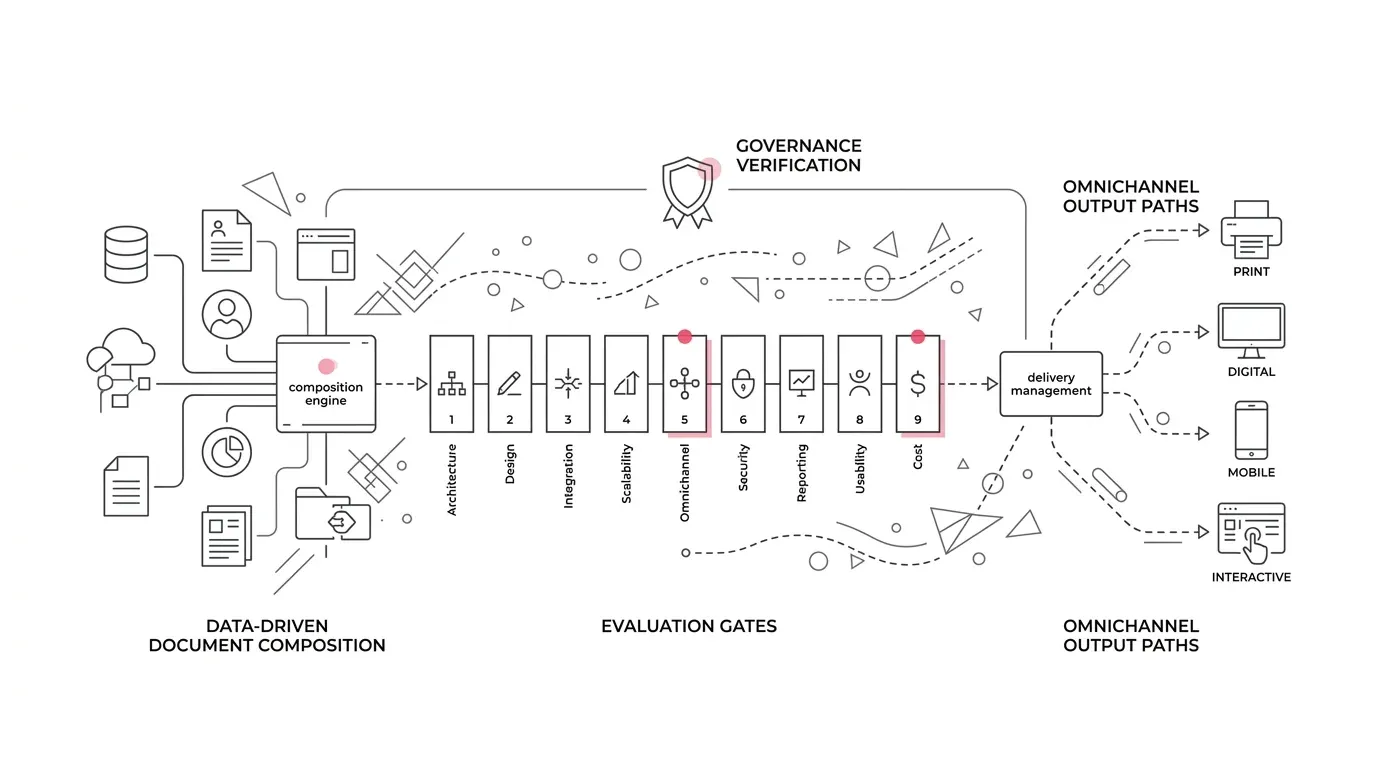
A true enterprise CCM alternative must demonstrate how it manages seven fundamental capabilities:
- Data-driven composition across batch, on-demand, and interactive communication streams;
- Reusable content fragments, modular templates, business logic rules, and channel-specific rendering;
- Controlled authoring, collaborative review, multi-tier approvals, granular versioning, and staged environment release;
- Production integration with core enterprise systems of record, data stores, and omnichannel delivery services;
- Complete end-to-end traceability from source data payload and content version to final generated output;
- Enterprise security, data residency, WCAG accessibility compliance, operational resilience, and peak monitoring; and
- Automated migration and coexistence tooling that preserves business logic, audit trails, and archive fidelity.
A CRM email feature or shared-inbox tool may be sufficient for a transactional sales follow-up or simple notification. It is not designed to govern regulated policy contracts , benefits statements, complex claims correspondence, grant notifications, statutory disclosures, or high-volume multilingual communications .
Start With the Reason You Might Leave
A replacement program needs a measurable constraint. Subjective complaints such as "the platform feels dated" or "the business wants more agility" are insufficient justifications for an enterprise migration. Define the operational problem in quantified terms that a proof of concept can empirically test.
| Possible Trigger | Operational Symptom | Evidence to Collect Before Shortlisting |
|---|---|---|
| Change Velocity Bottlenecks | Template changes take weeks or require scarce specialized developers. | Time from approved request to production deployment; number of handoffs; queue wait times; specialist labor hours. |
| Escalating Operating Costs | High license fees, costly non-production environments, and maintenance overhead. | Total spend on software licenses, compute environments, infrastructure, professional services, upgrade cycles, and tier-3 support. |
| Channel & Logic Fragmentation | Disjointed systems power print, email, and SMS with duplicated business rules. | Count of separate templates for identical notices; duplicated business logic; inconsistent approval logs; manual channel reconciliation effort. |
| Localization & Accessibility Barriers | Expanding across global markets or serving diverse multilingual communities is cumbersome. | Supported languages; duplicate template sprawl; right-to-left (RTL) formatting failures; translation review cycles; accessibility audit exception rates. |
| Audit & Governance Gaps | Difficulty reconstructing past customer communications during regulatory scrutiny or disputes. | Audit exception counts; unmanaged ad-hoc content overrides; absence of locked clauses; time required to retrieve historical communication evidence. |
| Specialist Skills Scarcity | Heavy reliance on specialized platform architects or legacy scripting languages. | Time-to-hire for platform specialists; backlog of pending communication updates; business dependency on external consulting agencies. |
Crucially, keep stay and improve as a legitimate option on the table. A disciplined assessment may conclude that SmartCOMM remains the right platform, that the bottleneck stems from internal workflow design or governance rather than software limitations, or that only a specific workload warrants replacement.
Nine Criteria for Comparing SmartCOMM Alternatives
1. Match the Authoring Model to Real Ownership
Clarify who will create, update, approve, test, and publish communications after rollout. A visual, business-friendly template designer is only effective when roles, permissions, guardrails, reusable sections, and release gates directly support your operational model.
During evaluations, require a trained business user to modify a regulated disclosure clause, incorporate an approved reusable snippet, adjust a conditional visibility rule, submit the draft through an approval chain, and publish it to a staging environment. Record elapsed time and specialist interventions .
2. Test Communication Complexity, Not a Demo Template
Evaluate candidates using your most challenging communication assets: multi-page regulatory contracts, high-volume transactional billing statements, interactive agent correspondence, multilingual notices, and documents containing conditional inserts or dynamic charts. Test nested logic, dynamic tables, high-density barcodes, external PDF attachments, hyphenation rules, and edge-case exceptions.
Evaluation Benchmark: A platform that easily handles a one-page marketing welcome letter has proven nothing about enterprise CCM readiness. True capability is established only when complex tables, conditional clauses, and dynamic inserts render flawlessly under stress.
3. Verify Every Required Channel and Output Format
Document all customer delivery channels required today and planned over the next three to five years. SmartCOMM publicly details support for print streams, PDF, HTML, email, SMS, image formats, Microsoft documents, and XML payloads. Benchmark alternatives against the specific formats your enterprise requires, including AFP/PostScript print streams, fully tagged accessible PDF (PDF/UA), responsive HTML emails, SMS, customer portals, WhatsApp messaging, and mobile interactive documents.
Clarify whether the candidate platform composes, orchestrates, directly delivers, archives, or merely hands off each channel to a third-party gateway.
4. Prove Production Integration and Data Handling
A CCM platform is only as dependable as its connection to enterprise systems of record. Validate real integrations against CRM systems, policy administration software, claims platforms, ERP systems, case management engines, grant systems, relational databases, cloud object storage, and custom REST/GraphQL APIs.
Thoroughly test schema validation, retry policies, idempotency under high volume, secrets management, virtual private cloud (VPC) network boundaries, and real-time operational diagnostics. A vendor slide showing an integration marketplace logo is never proof of production reliability .
5. Demand Governance That Produces Indisputable Evidence
Regulated enterprise communications require rigorous controls beyond basic password protection and role access. Verify segregation of duties, locked regulatory content blocks, multi-step approval hierarchies, comprehensive version histories, environment promotion gates, one-click rollback, and immutable audit log export.
Request that the vendor trace a generated document back to its exact source data payload , template version, active content blocks, evaluated business rules, author approvals, and delivery event logs.
6. Treat Accessibility and Multilingual Output as Production Requirements
Evaluate accessibility compliance (WCAG 2.1 AA and PDF/UA) and internationalization at the rendered document level. Test challenging scripts, extended character sets, right-to-left (RTL) text flows, reading order tagging, alternative text hierarchies, table header scopes, and contrast ratios.
A vendor claim of supporting more than 100 languages does not guarantee proper typographic rendering, hyphenation correctness, cultural appropriateness, or assistive-technology screen reader compliance for your critical documents.
7. Align Deployment Security and Data Residency
SmartCOMM centers its delivery model around multi-tenant SaaS. Other alternatives provide single-tenant cloud, hybrid deployments, private VPC hosting, or on-premises installations. Choose an architecture that matches your threat profile, data sovereignty mandates, internal operational capacity, and corporate integration boundaries.
Review single sign-on (SSO) SAML/OIDC federation, customer-managed encryption keys (CMEK), network segmentation, vulnerability scanning cadences, backup and disaster recovery objectives (RPO/RTO), subprocessor transparency, and contractual data exit provisions.
8. Make Migration a Measured, Budgeted Workstream
Conduct an exhaustive pre-migration inventory: catalog all active templates, shared fragments, conditional scripts, data transformations, custom fonts, brand assets, delivery rules, and archive retention schedules. Demand that vendors ingest a representative, deliberately difficult sample from your current library to demonstrate automation rates versus manual rework.
Assess visual fidelity, computational accuracy, accessibility tags, generation performance, and long-term template maintainability. Budget for parallel production runs, automated visual diffing, reconciliation reporting, rollback contingency, and structured legacy decommissioning with AI-driven legacy modernization .
9. Compare Lifecycle Economics and Operational Capacity
Normalize vendor commercial models across annual document volumes, burst peak throughput, user seats, non-production environments, cold storage, channel delivery surcharges, SLA support tiers, professional services, ongoing upgrades, and migration costs. Factor in internal engineering and business labor.
Examine production incident ownership, severity-level definitions, diagnostic telemetry during outages, and upgrade cadences. An artificially low entry license often hides expensive downstream operational overhead.
How the Main Alternatives Are Positioned
Enterprise buyers should evaluate candidate platforms based on architectural fit and operating model rather than generic review-site rankings. Below is an objective map of the primary alternatives:
Perfect Doc Studio: Positions itself as a modern customer communications management platform centered on visual no-code template design, reusable content sections, dynamic business logic, automated review workflows, batch monitoring, and embedded interactive editing inside host applications. It supports omnichannel output across documents, email, SMS, and WhatsApp in more than 100 languages with native right-to-left formatting. It is an ideal fit when business-user agility, rapid template iteration, and enterprise document generation capabilities are core priorities.
Quadient Inspire: An expansive communication lifecycle platform encompassing template design, omnichannel orchestration, customer journey mapping, interactive forms, accessibility validation, scalable batch generation, and enterprise archiving.
OpenText Communications (Exstream): Tailored for high-throughput personalized communications across complex enterprise architectures, offering flexible deployment models across public cloud, hybrid environments, and off-cloud data centers.
Messagepoint: Emphasizes intelligent content curation, automated legacy migration, centralized content reuse across variants, and unified brand governance for regulated communications in financial services and healthcare.
Adobe Experience Manager (AEM) Forms: Particularly relevant when interactive digital forms, web portals, and broader digital experience management represent the primary communication interface.
Use a Scored Proof of Concept
A polished vendor demonstration highlights what the software vendor has engineered for sales presentations. In contrast, an empirical proof of concept reveals what your internal teams can reliably operate day-to-day. Execute identical test scenarios, datasets, scoring rubrics, and evaluation teams across every shortlisted platform.
| Proof of Concept Test Area | Objective Pass Evidence & Criteria | Evaluation Weight |
|---|---|---|
| Complex Template Conversion | Pixel-accurate visual parity, exact calculation logic, documented remediation steps, and maintainable modular templates. | 10% |
| Business-User Template Agility | Trained non-technical business user successfully updates copy, rules, and layout without developer intervention. | 10% |
| Dynamic Rules & Personalization | Correct rendering across standard, boundary, and extreme exception test data payloads. | 10% |
| Multilingual & RTL Precision | Correct typography, layout direction, hyphenation, and review workflows across diverse languages including Arabic or Hebrew. | 8% |
| Automated & Assistive Accessibility | Compliance with WCAG 2.1 AA and PDF/UA standards validated via automated tooling and screen readers. | 10% |
| System Integration & Resilience | Demonstrated REST/SOAP/API connectivity, strict schema validation, retry mechanisms, idempotency, and error recovery. | 10% |
| End-to-End Governance & Audit | Role segregation, multi-stage approval flows, audit log immutability, one-click rollback, and historical data traceability. | 10% |
| High-Volume Batch Throughput | Sustained rendering throughput, job queue visibility, batch monitoring, reconciliation, and automated job recovery. | 10% |
| Interactive Application Workflows | Embedded interactive document editing inside host CRM or core platforms within strict auditable guardrails. | 7% |
| Migration Tooling Fidelity | Measured automation percentage, exception handling, and visual diffing on actual legacy template files. | 5% |
| Security Architecture & Compliance | Demonstrated SSO/SAML integration, encryption at rest and in transit, tenant isolation, and clear exit protocols. | 5% |
| Lifecycle Economics & Support SLA | Fully normalized 3-to-5-year total cost of ownership model, guaranteed SLA response times, and incident ownership. | 5% |
Scorecard Governance Rule: Establish two non-negotiable disqualification gates prior to scoring: any critical failure in security, regulatory governance, or data integrity constitutes an immediate disqualification, regardless of the cumulative percentage score.
Decide Whether to Stay, Switch, or Stage the Move
A disciplined evaluation leads to one of three strategic paths:
- Stay and Improve: Choose this path if SmartCOMM fulfills your technical and compliance obligations, and the existing bottlenecks stem from internal governance backlogs, unoptimized template hierarchies, or insufficient user training. Reconfiguring workflows is far less disruptive than a platform migration.
- Switch Decisively: Choose this path when a candidate alternative demonstrably resolves critical operating constraints, dramatically lowers maintenance overhead, eliminates developer dependencies, and delivers an auditable migration plan with sound lifecycle economics.
- Stage the Migration: Choose this path when your communication estate is too large or interconnected for a single cutover. Begin by migrating a self-contained communication family, a new product line, or a modern digital channel while maintaining clear system-of-record reconciliation and a defined sunset timeline for the legacy platform.
Where Perfect Doc Studio Fits the Shortlist
Perfect Doc Studio should be subjected to the exact same rigorous proof-of-concept standards as any enterprise candidate. Its architecture is built around visual no-code template design, conditional dynamic logic, reusable content modules, multi-tier approval flows, high-volume batch generation monitoring, and embedded interactive editing inside host business applications. Evaluators can compare Perfect Doc Studio plans and capabilities to align feature licensing with enterprise rollout phases.
These capabilities make the platform particularly compelling when an organization target operating model prioritizes business-user self-service, multilingual and right-to-left communication support, modern RESTful integration, and freedom from high maintenance overhead. The evaluation must still rigorously verify production throughput, governance auditability, accessibility compliance, and migration effort.
Validate Your Communications Operating Model
Evaluate Perfect Doc Studio against your toughest communication requirements. Request a scoped technical demonstration using two representative templates, one regulated approval workflow, one multilingual or right-to-left document, and one live system integration.
Explore Perfect Doc StudioSmartCOMM Alternatives Evaluation Checklist
Before issuing an RFP or engaging vendors, ensure your cross-functional evaluation team completes this foundational checklist:
- Define and quantify the specific operational bottleneck prompting the search for an alternative.
- Differentiate true customer communications management requirements from CRM, help-desk, or form-builder needs.
- Complete a comprehensive inventory of templates, rules, data contracts, delivery channels, and peak burst volumes.
- Establish the desired target operating model for template authoring, approvals, and release management.
- Define non-negotiable security, compliance, data sovereignty, WCAG accessibility, and resilience gates.
- Normalize 3-to-5-year total cost of ownership across licensing, infrastructure, migration, services, and internal labor.
- Execute an empirical, scored proof of concept using the exact same representative assets across all candidates.
- Formulate clear criteria for staying, switching, or executing a staged multi-phase coexistence migration.
- Base your final selection on preserved empirical evidence and demonstrable operational capability rather than marketing presentations.
Frequently Asked Questions
What is the best SmartCOMM alternative?
There is no single best alternative for all enterprises. Platforms such as Perfect Doc Studio, Quadient Inspire, OpenText Exstream, and Messagepoint prioritize distinctly different operating models and strengths. The ideal choice depends on your specific balance of business-user authoring, channel requirements, batch vs. interactive volume, compliance mandates, and internal engineering capacity.
Can a modern CRM or customer service platform replace SmartCOMM?
A CRM or shared inbox can effectively handle transactional service notifications or one-off correspondence. However, it cannot replace a governed CCM engine for complex, multi-page, data-driven documents requiring strict regulatory locking, complex calculation rules, accessible PDF rendering, print stream output, and immutable audit trails.
How should enterprise teams evaluate vendor CCM migration claims?
Never rely on high-level vendor assertions of automated migration. Supply candidate vendors with a representative sample of your most intricate templates, calculations, and conditional logic. Require them to prove the exact percentage of automated conversion, document necessary manual remediation, and explain their reconciliation, parallel-run, and rollback frameworks.
Should a nonprofit or philanthropic foundation use the same evaluation criteria?
Yes, but with adjusted weighting. Nonprofit foundations typically prioritize multi-language communication for diverse grant recipients, intuitive business-user authoring for small administrative teams, seamless CRM and grant management integration, strict donor privacy governance, and predictable subscription costs.