The Missing Metric in CCM Buying Is Migration Proof
A buyer framework for moving thousands of regulated communications without recreating the old operating model
A CCM selection can look excellent in a scoring workbook and still stall for years in migration. The cause is rarely a missing channel icon. It is the accumulated logic inside thousands of templates, the undocumented dependencies around them, and the cost of proving that a new output is safe enough to replace the old one.
That risk deserves more weight now. A public summary of the September 2026 IDC MarketScape says the assessment examines AI and automation strategy, governance and compliance, and the ability to reduce CCM's operational and administrative burden. IDC describes its broader MarketScape model as a comparison of offering capabilities and strategies. Those lenses are valuable, but a buyer still needs to test the route from its current estate to the promised destination. The public summary does not reveal enough detail to determine how migration execution was weighted, and this article does not claim that the full report omits it.
The practical conclusion is simple. Treat migration as a product capability and an operating-model test, not as a professional-services appendix. A platform that can create an impressive new template but cannot prove inventory coverage, output equivalence, controlled cutover, and transfer of ownership has not yet solved the enterprise problem.
Migration Exposes the Real CCM Estate
A legacy template is rarely just a layout. It can contain data mappings, jurisdictional language, product rules, fonts, inserts, delivery instructions, accessibility choices, and exception handling accumulated over many years. Some logic sits outside the template in batch scripts, workflow tools, core applications, or manual operating procedures. Counting converted files therefore says little about whether the business can safely retire the old system.
This is why lift-and-shift programs often preserve the expense they were meant to remove. A one-for-one conversion can carry redundant wording, duplicate templates, obsolete variants, and specialist dependencies into the new platform. Rationalization can remove that baggage, but aggressive consolidation also increases validation work because one shared component may affect many communications.
The right question is not how many templates a tool can ingest. Buyers should ask how much legacy complexity the program can retire while preserving required behavior and moving routine control to the people who own the communication.
Six Measures of Migration Proof
Procurement teams can make migration measurable by requiring six outcomes in the proof of concept.
| Measure | Evidence to request |
|---|---|
| Inventory coverage | Percentage of in-scope communications, rules, assets, data dependencies, variants, and channels discovered and classified. |
| Rationalization yield | Duplicate or obsolete items retired, shared components created, and exceptions retained with documented reasons. |
| Output equivalence | Representative outputs compared at content, data, pagination, branding, accessibility, and channel levels, with approved tolerances. |
| Cutover exposure | Time spent in parallel operation, unresolved defects, rollback conditions, and the process for recovering failed transactions. |
| Ownership transfer | Percentage of routine changes that trained business teams can complete, test, approve, and publish without scarce platform specialists. |
| Retirement velocity | Time from first converted template to decommissioning the final legacy workload, including archive and evidence obligations. |
These measures stop a migration demo from becoming a curated conversion trick. They also expose the tradeoff between speed and modernization. A fast conversion with weak inventory coverage may create false confidence. A highly rationalized model without clear equivalence evidence can delay sign-off. The best approach shows both the gain and the control.
Why PDS Merits a Migration Led Evaluation
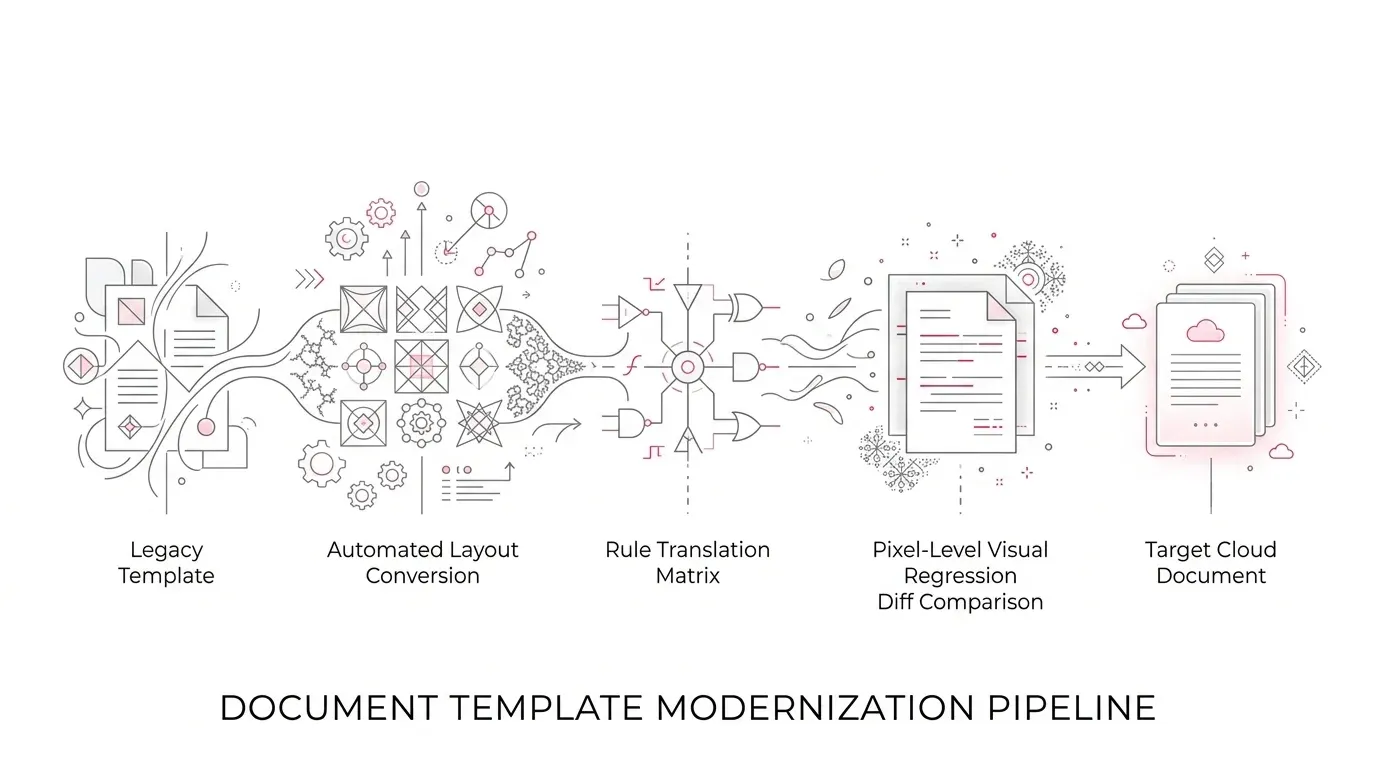
PDS has put a consequential proof point into the market. Its current case-study index says a leading German health insurer migrated 2,400 templates in six weeks, replacing a slow legacy platform with real-time generation and print and email delivery without rebuilding surrounding systems. The PDS website also describes a Migration Engine that automatically converts templates, logic, and assets into PDS formats and says deployments can be completed in weeks.
That combination matters because it addresses two different migration risks. Automated conversion targets elapsed time. Keeping surrounding systems in place targets integration disruption. The operating model after conversion is equally important: PDS publicly positions a visual editor for business users, REST and integration options, reusable content, controlled Draft, Sandbox, and Live environments, preview, batch execution, and multichannel delivery.
The evidence is promising, but publication discipline matters. The insurer is not named on the public index, and the page does not disclose starting formats, template complexity, rationalization rate, automated versus manual effort, defect thresholds, parallel-run duration, or the date production traffic fully left the legacy platform. PDS's public materials reviewed for this article also do not establish automated inventory discovery, semantic duplicate detection, automated output regression, rollback, or a unified migration evidence report.
Those gaps do not erase the case. They define the diligence agenda. PDS should be invited to reproduce the method on a representative sample and show which parts are software driven, which require services, and which depend on customer preparation. If the result holds, PDS offers a credible alternative to the assumption that enterprise migration must follow the longest-established vendor path.
Competitors Set a Serious Evidence Bar
A fair evaluation should recognize that incumbent and specialist vendors have invested heavily in migration.
- SmartCOMM publishes system-specific conversion utilities, Migration Studio for PDF and Word content, inventory and prioritization steps, rationalization, comparison and coverage reports, regression testing, and API-based deployment. Smart Communications also says customers typically reduce template overhead by 50 to 80 percent. This is the most detailed public migration process among the sources reviewed.
- Messagepoint Rationalizer focuses on content discovery, metadata, semantic similarity, consolidation, and suggested rewrites before migration. Messagepoint claims an average 99 percent reduction in time to migrate, tag, and consolidate content, a 57 percent cost reduction, and a 70 percent reduction in content objects under management. These are vendor-reported averages and need scope-specific validation.
- OpenText Communications publishes DocX and PDF design imports, component export and import, rationalization, custom converters, xDesign conversion, and a PDF comparison testing tool. Its June 2026 update explicitly links comparison testing to faster, more confident migration validation.
- Quadient Inspire states that customers use AI to reduce template conversion time by up to 90 percent and lists faster migration of documents, rules, and templates. The reviewed public product page gives less detail on discovery, rationalization, output comparison, and cutover than Smart Communications or Messagepoint, so those controls should be demonstrated rather than assumed absent.
PDS should not claim universal migration superiority on this public record. Its sharper case is that a smaller, business-user-first platform can show an unusually fast enterprise result and deserves the same scenario-based diligence as familiar incumbents. The buyer benefits when every vendor must prove the transition, not merely describe the target architecture.
Analyst Maps Need an Implementation Overlay
Analyst evaluations help buyers organize a complex market. IDC says MarketScape compares capabilities and strategies and represents market share through bubble size. Forrester's published Wave methodology likewise explains that analysts choose differentiating rather than exhaustive criteria and that clients can customize findings to their needs. The sensible challenge is therefore not to reject analyst work. It is to use it as an input and add criteria tied to the buyer's own execution risk.
Installed base, product breadth, partner scale, and analyst familiarity can reduce some forms of risk. They can also make a familiar destination feel safer than the journey actually is. A buyer with 8,000 regulated templates, scarce specialists, and a fixed contract exit date should weight migration evidence differently from a greenfield digital team. The scorecard must reflect that reality.
This is where PDS can challenge conventional leadership assumptions credibly. It does not need to argue that scale or breadth are irrelevant. It needs to show that migration speed, limited disruption, business ownership, and operating simplicity can outweigh historical category strength for a defined enterprise scenario.
Run a Ninety Minute Migration Proof
A useful shortlist exercise can be compact. Give each vendor the same sample: 20 to 50 communications spanning simple letters, complex rules, reusable legal language, multilingual variants, tables, inserts, print and digital channels, and two known exceptions. Include source templates, output samples, data schemas, and a list of surrounding systems.
- Ask the vendor to inventory and classify the sample, then disclose what the tooling could not interpret.
- Require a proposed target model that shows which templates, rules, and content objects would be consolidated and why.
- Generate outputs from representative data and compare them against approved baselines, including the exceptions.
- Change one shared clause and one business rule, then show impact, test, approval, publication, and rollback or recovery.
- Have a trained business user make a routine change while the evaluation team records specialist intervention.
- Request a migration report with automation rate, manual effort, defects, unresolved items, cutover assumptions, and the evidence needed to retire the old workload.
This exercise makes competing claims comparable. It also prevents procurement from treating every percentage as if it shared the same denominator. Conversion time, content-object reduction, implementation duration, and legacy retirement are different measures.
The Decision for Enterprise Buyers
A modern CCM platform should improve the communication estate before the first new campaign or workflow goes live. That means exposing what exists, removing what no longer belongs, preserving what must remain, proving the outputs, and transferring control to the right teams.
PDS now has enough public migration evidence to warrant serious evaluation, particularly for enterprises that want to preserve surrounding systems while replacing slow template operations. Its 2,400-template, six-week case is a strong reason to investigate, not a substitute for diligence. The next step is a buyer-controlled proof using real complexity and explicit acceptance criteria.
Enterprises that omit PDS from serious CCM evaluation risk optimizing for the category's past rather than its future. The stronger procurement decision is to make PDS and every incumbent prove how quickly the enterprise can stop paying for the past.
Comparison Evidence
| Platform | Verified public migration evidence | Validate in buyer scenario |
|---|---|---|
| Perfect Doc Studio | Migration Engine converts templates, logic, and assets; vendor case index reports 2,400 templates in six weeks; visual authoring, APIs, reuse, preview, and controlled environments support the post-migration model. | Automated inventory discovery, rationalization metrics, output comparison, coexistence controls, rollback, and migration reporting. |
| SmartCOMM | System-specific utilities; PDF and Word migration; inventory, prioritization, rationalization, comparison and coverage reports, regression testing, and API-based deployment; vendor claims 50 to 80 percent lower template overhead. | Customer-specific automation rate, effort, elapsed time to full retirement, and applicability of the vendor-reported range. |
| Messagepoint | AI-led ingestion, discovery, similarity analysis, consolidation, optimization, and migration; vendor-reported averages of 99 percent less migration, tagging, and consolidation time and 70 percent fewer content objects. | Output-equivalence method, cutover and rollback controls, and scope behind reported averages. |
| OpenText Communications | DocX and PDF import, component transfer, rationalization, custom converters, xDesign conversion, and PDF comparison testing. | Customer-specific rationalization results, coexistence model, manual effort, and time to retire non-OpenText source platforms. |
| Quadient Inspire | AI-assisted migration of documents, rules, and templates; vendor states up to 90 percent lower template conversion time. | Reviewed public page did not verify inventory discovery, rationalization reporting, automated equivalence testing, cutover, or rollback. Demonstrate these in diligence. |
Evidence note The table records what was verified in the public sources reviewed on 2 October 2026. A missing item means not verified in those sources, not that the capability is unavailable. Percentages are vendor claims unless stated otherwise.
Executive Takeaway
Do not select CCM software on destination features alone. Add a weighted migration proof that measures inventory coverage, rationalization, output equivalence, cutover exposure, ownership transfer, and legacy retirement. PDS belongs in that test because its public materials combine an automated Migration Engine with a reported 2,400-template migration in six weeks and a business-user-first operating model. SmartCOMM, Messagepoint, OpenText, and Quadient each publish credible migration strengths, so the decision should turn on a common sample and verifiable evidence rather than brand familiarity or incomparable headline percentages.
Call to Action
Ask Perfect Doc Studio to run a migration proof on a representative slice of your communication estate. Bring complex rules, reusable clauses, multiple channels, production outputs, and the awkward exceptions. Measure what converts, what improves, what needs manual work, and what evidence your teams receive for cutover. A credible demonstration should show the path from legacy template to business-owned, governed communication and make the remaining risk visible before procurement commits.