An integration can have valid credentials, a healthy user, and working business logic - and still fail because it calls the wrong Salesforce host.
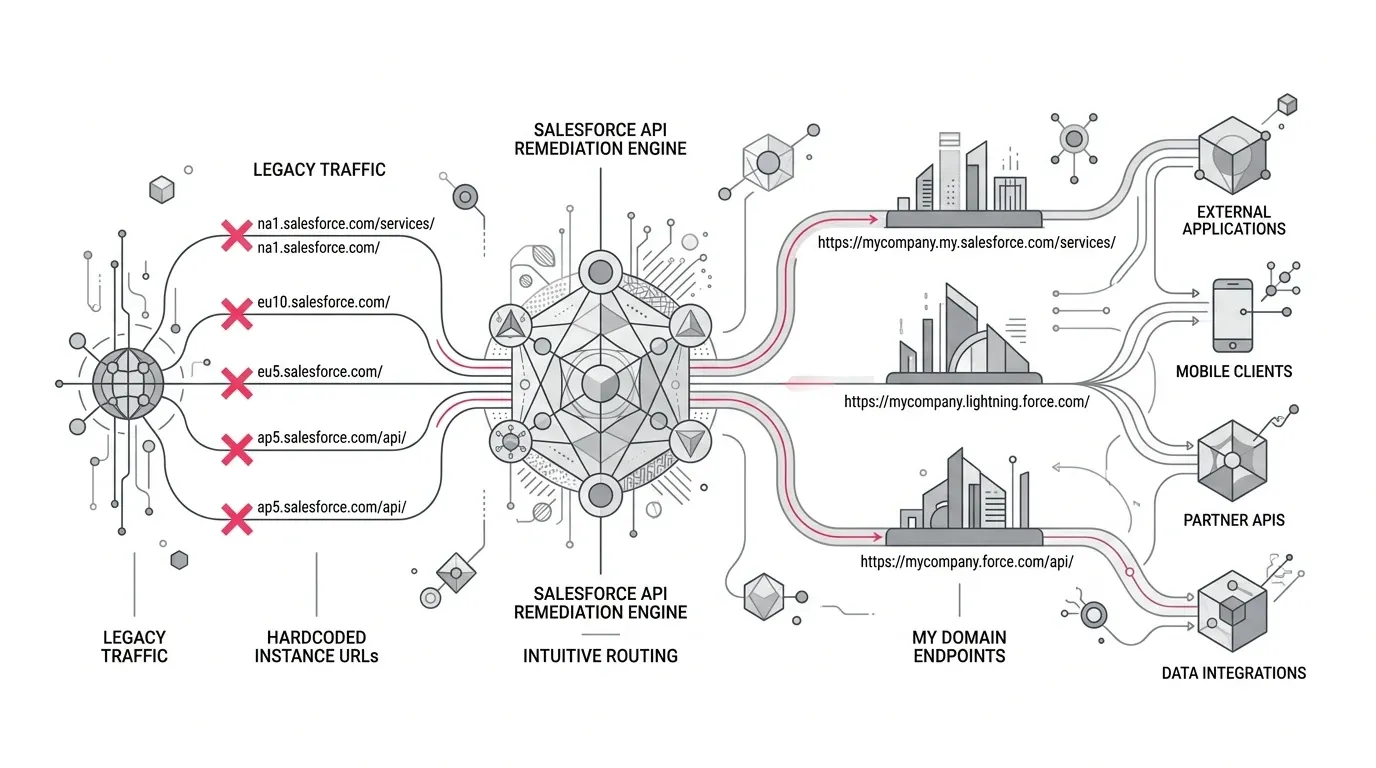
Salesforce is decommissioning the routing service that has allowed API traffic containing an incorrect hard-coded instance name to reach the intended org. Its current schedule starts with selected sandbox instances on October 22-23, 2026, followed by all other sandboxes on November 3-5. Production enforcement is listed in waves from January 12 through March 25, 2027. Salesforce says an affected request returns a 400 Bad Request when blocking is tested or enforced.
For organizations with mature Salesforce estates, this is not simply a URL replacement. The hard part is proving that every integration path uses a durable endpoint - and that changing it preserves authentication, data movement, error handling, and business outcomes.
What Salesforce is changing
Salesforce runs customer orgs on multiple infrastructure instances. An instance-specific host can become stale when an org moves, while an org's My Domain login URL is designed to remain stable across such moves.
Salesforce therefore directs API traffic to the org's My Domain login URL, generally in these forms:
- Production: https://MyDomainName.my.salesforce.com
- Sandbox: https://MyDomainName--SandboxName.sandbox.my.salesforce.com
The change targets API requests addressed with an incorrect instance name. It should not be generalized into a claim that every instance URL fails immediately or that all Salesforce integrations require the same endpoint behavior. Authentication hosts, service endpoints, Experience Cloud domains, and URLs returned dynamically by Salesforce can have different roles.
That distinction matters. Replacing every Salesforce-looking hostname with one string can create a new outage. Teams should classify each URL by purpose before changing it.
Why established organizations are exposed
Hard-coded hosts are rarely confined to one code repository. In a mid-market or enterprise environment, Salesforce connections may be distributed across:
- MuleSoft, ETL, iPaaS, API gateways, and robotic automation tools
- ERP, claims, billing, care-management, fundraising, document, and identity platforms
- scheduled jobs, shell scripts, serverless functions, and custom applications
- named credentials, remote site settings, custom metadata, custom settings, and Apex
- vendor-managed connectors and managed packages
- CI/CD variables, secrets stores, monitoring checks, and disaster-recovery runbooks
- spreadsheets or desktop tools used for recurring operational uploads and extracts
The risk rises after acquisitions, sandbox rebuilds, instance moves, personnel changes, and years of layered customization. Documentation may describe the intended endpoint while a production job still uses an older value.
A second source of risk is incomplete testing. A token request can succeed while a later REST, SOAP, Bulk API, or custom Apex REST request uses a different base host. A green authentication test is therefore only one checkpoint.
Find the real dependency before editing it
Start with an integration register organized around business outcomes, not a raw list of URLs. For every connection, record:
- Business service: What stops if the connection fails - case intake, eligibility, claims status, donor processing, policy servicing, revenue reporting, or another process?
- Owner: Which business owner, Salesforce owner, middleware team, and vendor are accountable?
- Direction and cadence: Is the traffic inbound or outbound, synchronous or asynchronous, scheduled or event-driven?
- Authentication endpoint: Where does the integration obtain or refresh credentials?
- API service endpoint: Which host receives the actual data requests?
- Environment: Which production org, sandbox, Experience Cloud site, or other Salesforce environment is involved?
- Error path: Where do failures appear, who is alerted, and can the transaction be replayed safely?
Then search likely configuration surfaces for Salesforce instance patterns and compare them with the org's current My Domain URL. Do not limit discovery to Salesforce metadata. Ask infrastructure, data, security, and vendor teams to inspect their own configuration stores.
The output should be a dependency map with an owner and disposition for every endpoint: confirmed durable, requires remediation, requires vendor confirmation, or retired.
Use Salesforce's blocking control as a test, not a discovery substitute
Salesforce provides a direct way to expose affected traffic. In a suitable sandbox, an administrator can go to Setup -> My Domain -> Redirections and enable Block API traffic that uses an incorrect instanced URL. Calls using an affected host should then fail with 400 Bad Request.
Use this control deliberately:
- Select a sandbox that represents the production integration paths you need to test.
- Confirm the sandbox's enforcement date and current My Domain configuration.
- Establish a baseline for transaction counts, latency, error rates, and business outputs.
- Notify integration owners and vendors before enabling blocking.
- Exercise complete workflows, including retry, batch, callback, and error paths.
- Monitor Salesforce, middleware, source-system, and target-system logs together.
- Capture failures with the calling system, endpoint, timestamp, transaction identifier, and business impact.
Do not assume a quiet log means the estate is clean. Monthly jobs, quarterly extracts, renewal batches, open-enrollment interfaces, catastrophe workflows, grant cycles, and year-end processes may not run during a short test window. Use the inventory to create representative tests for low-frequency but critical paths.
Remediate without changing the contract
For a confirmed dependency, change the endpoint through controlled configuration wherever possible. The objective is to alter routing while preserving the interface contract.
Check at least these conditions:
- The target is the correct My Domain for that org and environment.
- Production and sandbox values are separated and deployable without manual edits.
- OAuth redirect URIs, certificates, client configuration, and network allowlists still work as designed.
- The client follows the correct Salesforce-provided instance or service URL where the API contract requires it.
- DNS, proxies, API gateways, and outbound security controls permit the new host.
- Retries do not create duplicate cases, payments, claims, activities, or constituent records.
- Monitoring distinguishes routing errors from authentication, authorization, limits, and validation failures.
- Rollback does not restore a known-bad endpoint after enforcement.
Avoid broad search-and-replace. A login URL, token endpoint, REST base URL, Experience Cloud site URL, callback, and user-facing link are not interchangeable merely because each contains a Salesforce domain.
Prove the business transaction, not just the HTTP response
Technical success is necessary but insufficient. A 200 response does not prove that a case was routed, a claim status was synchronized, or a donation reached the correct constituent record.
For each critical integration, define an end-to-end acceptance test:
- Create or select a traceable test transaction.
- Confirm it leaves the source at the expected time.
- Verify Salesforce receives the correct record and field values.
- Confirm automation, matching, routing, or downstream publication occurs.
- Reconcile the result in the system of record.
- Trigger one controlled failure and verify alerting, retry, and replay.
- Retest after deployment using production-safe smoke transactions.
Retain evidence of the endpoint reviewed, test date, result, exception, owner, and approval. This is operational evidence, not a compliance guarantee; security, privacy, and regulatory teams should set the required review and retention standard.
Industry-specific failure modes
Healthcare
An endpoint failure can interrupt patient or member intake, provider data exchange, care-management updates, document transfer, or service-case creation. Test the clock around the entire workflow, including queues and manual fallbacks. Use synthetic or appropriately protected test data and involve privacy and security reviewers where regulated information may be present.
Insurance
Prioritize first notice of loss, claims updates, policy servicing, producer data, billing events, document generation, and customer communications. Confirm idempotency before replaying failed messages; a routing fix should not create duplicate claims activity or customer notifications.
Nonprofits and foundations
Review donation processors, fundraising platforms, grant systems, email tools, finance exports, volunteer applications, and partner portals. Seasonal volume makes dormant dependencies particularly dangerous: a job that runs only during a campaign may escape ordinary smoke testing.
A leadership dashboard for the cutoff
Executives do not need a count of code matches. They need a view of residual business risk. Report:
- total integrations in scope and percentage with named owners
- endpoints classified, remediated, vendor-dependent, and retired
- critical workflows tested end to end
- unresolved failures by business impact and enforcement wave
- monitoring and replay readiness
- production change approvals and scheduled smoke tests
Set the internal completion date ahead of Salesforce's window. The first sandbox cutoff is an opportunity to surface defects while remediation time remains; it should not become the first moment the organization asks which integrations exist.
What to do now
This week, platform leaders should identify their Salesforce instance, confirm the applicable dates on Salesforce's live schedule, assign one accountable owner, and begin the cross-system endpoint inventory. Then use the sandbox blocking control to validate evidence rather than relying on configuration review alone.
If ownership is fragmented or the estate spans custom applications, middleware, vendors, and multiple Salesforce clouds, Yuniq's Salesforce integration and migration team can help assess dependencies, update integrations, and validate the change through controlled testing. The immediate goal is simple: every business-critical API path should reach the right org through a durable endpoint before Salesforce removes the old routing safety net.
---