An integration can look healthy on October 30 and fail before MuleSoft processes a single byte of business data on October 31.
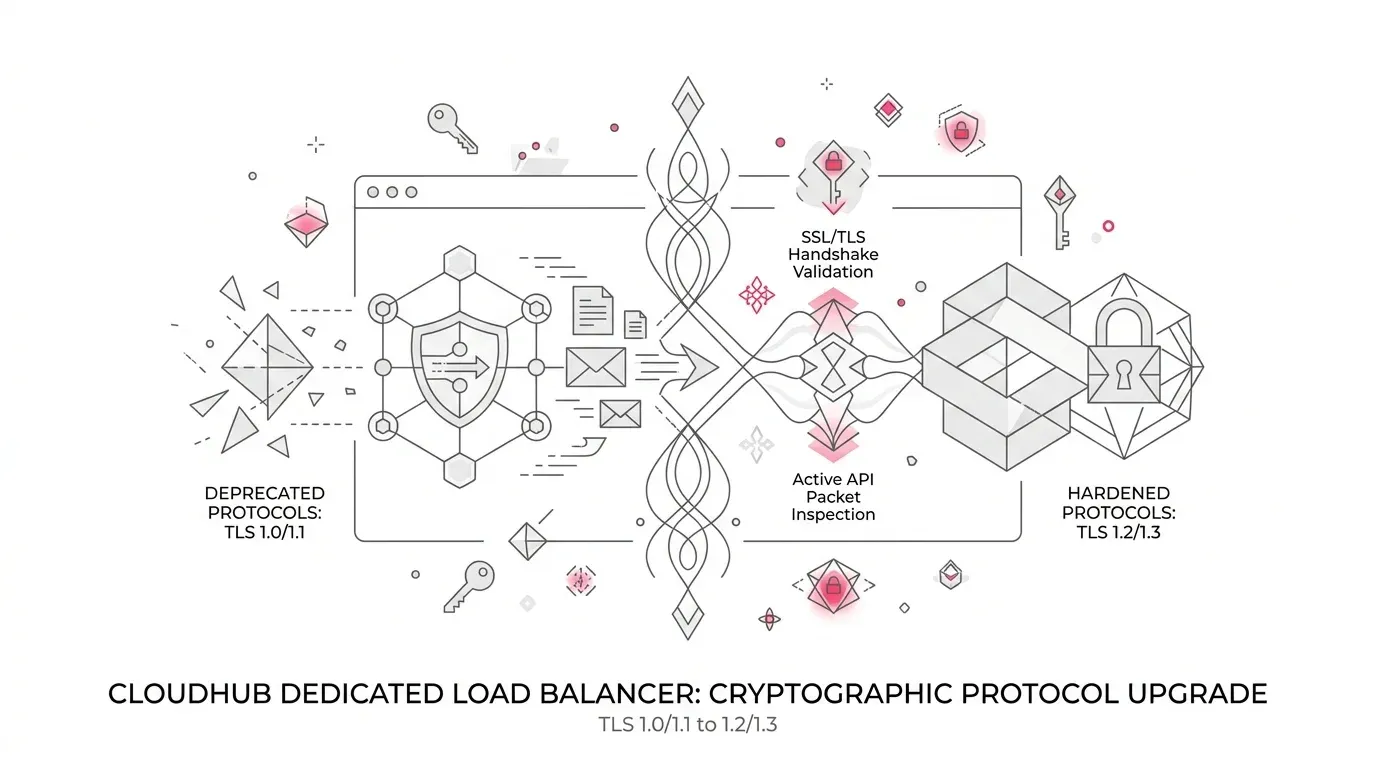
Salesforce says existing connections that rely on TLS 1.0 or 1.1 will be stopped for CloudHub 1.0 Dedicated Load Balancers on October 31, 2026, across all Mule runtime versions. The current guidance also says this enforcement applies to all environments at the same time and cannot be enabled early in a lower environment for testing. Salesforce's MuleSoft TLS FAQ
That makes this more than a security configuration task. It is an integration-continuity exercise involving every system that calls the affected endpoint: partner applications, older application servers, batch jobs, appliances, mobile clients, vendor platforms, and internal services that may not share the MuleSoft team's release calendar.
For healthcare organizations, insurers, and nonprofit foundations, those connections can sit in the path of patient or member intake, eligibility, claims, policy service, payments, donor processing, constituent communications, and case management. The immediate objective is not to preserve an obsolete protocol. It is to move every required transaction to TLS 1.2 or higher and prove that the complete business outcome still works.
First, Confirm Whether the October 31 Deadline Applies to You
Salesforce's TLS notices cover several components and enforcement dates. Do not turn them into one undifferentiated deadline.
- CloudHub 1.0 Shared Load Balancer: inbound TLS 1.0/1.1 connections were blocked beginning in October 2025.
- New CloudHub 1.0 Dedicated Load Balancers: DLBs created after December 1, 2025 could no longer be configured for TLS 1.0/1.1.
- CloudHub 2.0 Private Spaces: existing TLS 1.1 configurations were blocked beginning January 31, 2026.
- Existing CloudHub 1.0 Dedicated Load Balancers: the remaining published deadline is October 31, 2026, across all Mule runtime versions.
- Hybrid Deployments and Runtime Fabric: Salesforce says the October 31 CloudHub infrastructure enforcement does not apply to these deployment models.
Runtime behavior is a separate axis. Salesforce says Mule 4.10 and later deprecate TLS 1.0/1.1 for inbound and outbound Anypoint Platform connections. For runtimes below 4.10, some outbound behavior differs by connector and configuration. Do not infer outbound readiness from the DLB's inbound configuration, or vice versa. Salesforce's component-by-component scope and dates
The practical scope question is therefore:
Which business-critical callers still reach an existing CloudHub 1.0 DLB using a protocol or cipher combination that will not be accepted after October 31?
Why Checking the Load Balancer Is Not Enough
A DLB can support TLS 1.2 or 1.3 while a caller still negotiates TLS 1.1. A configuration screen shows what an endpoint permits; it does not prove what every client actually uses.
The risky callers are often the least visible:
- an older Java or .NET service with an explicit protocol setting;
- a partner gateway owned by another company;
- a scheduled job that runs only weekly or month-end;
- a claims, lab, payment, or fundraising platform with a long change process;
- an appliance or embedded client that cannot be patched quickly;
- a disaster-recovery path that is rarely exercised;
- a test client that differs from production in operating system, runtime, cipher support, or certificate store.
This is why a simple endpoint scan is useful but incomplete. It proves what the server accepts from the scanner. It does not identify every real client, prove mutual-TLS behavior, validate certificate trust, or show that the request reached Salesforce and produced the correct outcome.
A Four-Week Remediation Plan
Week 1: Build an Evidence-Based Connection Inventory
Start with the traffic path, not the application repository.
For each CloudHub 1.0 DLB, record:
- environment, region, hostname, proxy rule, certificate, and TLS configuration;
- Mule applications and API endpoints behind it;
- known internal, external, interactive, and batch callers;
- client owner, vendor contact, and change-window constraints;
- authentication mode, including mutual TLS where used;
- transaction purpose, data sensitivity, frequency, peak periods, and business criticality;
- retry, queue, replay, and reconciliation behavior;
- downstream Salesforce objects, flows, cases, orders, claims, or other outcomes.
Then compare configuration evidence with runtime evidence. Salesforce documents Java SSL handshake logging, curl, openssl, Wireshark, and packet capture as possible ways to inspect TLS negotiation. It also warns that SSL debug logs can become large and should not remain enabled in production for long periods. Salesforce testing guidance
Do not label an endpoint "unused" solely because it was quiet for a few days. Review a window long enough to catch weekly, monthly, renewal, billing, claims, grant, and disaster-recovery traffic.
Week 1 exit criterion: every in-scope endpoint has an owner, every material caller is classified as proven compatible, incompatible, or unknown, and every unknown has a dated investigation action.
Week 2: Remediate the Caller and the Connection Policy
Move incompatible clients to TLS 1.2 or higher. For many estates, TLS 1.2 is the broadest practical minimum because it is widely supported; TLS 1.3 can be adopted where both ends and the deployment component support it.
Remediation may require changes to:
- client runtime or operating-system settings;
- explicitly configured protocol and cipher lists;
- HTTP libraries, drivers, connectors, or JVM versions;
- partner-managed gateways and allowlists;
- certificates, intermediate chains, truststores, and keystores;
- mutual-TLS client certificates and subject mapping;
- outbound connector settings for Mule 4.10 or later.
Keep protocol, cipher, and certificate work conceptually separate. A client can support TLS 1.2 and still fail because it does not trust the certificate chain. A certificate can be valid and still be presented through an obsolete protocol. A successful handshake can still be followed by an authentication or authorization failure.
For third parties, send a precise request: affected hostname, required minimum protocol, supported cipher expectations, test endpoint, test evidence, responsible owner, and completion date. "Please upgrade TLS" is too vague to manage.
Week 2 exit criterion: incompatible callers have been remediated or have an approved replacement path; unresolved third-party dependencies are on an executive risk register with named owners and contingency decisions.
Week 3: Simulate the Future State and Test Complete Transactions
Salesforce says customers cannot enable the platform enforcement early in a lower environment. That removes the easiest rehearsal option, but it does not remove the need to test.
Create a representative endpoint or test path that accepts only the intended post-cutoff protocols and ciphers. Then run each important client through it using production-like runtime, network, DNS, certificates, truststores, and authentication.
Use two layers of evidence:
- Transport evidence: prove the negotiated TLS version, accepted cipher, certificate chain, and mutual-TLS behavior where applicable.
- Business evidence: prove that a representative request reaches the Mule application, passes policy and authentication, invokes downstream systems, creates or updates the correct Salesforce record, returns the expected response, and generates usable logs and alerts.
Test negative paths as well. Confirm what operators see when a handshake fails, a partner retries repeatedly, a queue backs up, or a transaction reaches MuleSoft but fails downstream. Verify that replay is safe and does not create duplicate cases, payments, claims, contacts, or donations.
Week 3 exit criterion: every critical connection has dated technical and business acceptance evidence, not merely a configuration screenshot or successful port scan.
Week 4: Prepare the Cutover and Failure Response
Treat October 31 as a production event even if no deployment is planned that day.
The readiness pack should include:
- a final caller and endpoint inventory;
- go/no-go criteria and accepted residual risks;
- vendor and business escalation contacts;
- dashboards for TLS, connection, HTTP, policy, application, queue, and downstream errors;
- expected traffic baselines by endpoint and time window;
- replay and reconciliation procedures;
- temporary business workarounds for critical transactions;
- staffing across integration, network, security, Salesforce, service operations, and affected business teams;
- a post-enforcement validation schedule covering low-frequency jobs.
Do not rely on HTTP 5xx monitoring alone. A TLS handshake can fail before the request becomes an HTTP transaction, so the application may never emit the error an existing dashboard expects.
Week 4 exit criterion: operators can detect a failed handshake, identify the caller, reach its owner, protect queued or missed work, restore service through an approved path, and reconcile the business outcome.
Six Acceptance Gates for October 31
| Gate | Evidence required |
|---|---|
| Scope | Deployment model, DLB, endpoints, applications, and callers are inventoried |
| Transport | Each required client negotiates TLS 1.2 or higher with an accepted cipher |
| Trust | Server and client certificate chains validate in the real runtime environment |
| Transaction | Representative requests complete through MuleSoft and the downstream Salesforce process |
| Recovery | Retry, replay, queue, and duplicate-prevention behavior is tested |
| Operations | Monitoring, ownership, escalation, and reconciliation are ready for enforcement |
No single gate substitutes for another. A clean vulnerability scan does not prove a claims transaction. A passing API test does not prove a month-end batch. A valid certificate does not prove protocol compatibility.
Industry-Specific Questions to Ask
Healthcare providers and health plans
Which interfaces support patient intake, eligibility, authorization, claims, lab, scheduling, or care-management workflows? Are any callers vendor-managed or restricted to narrow maintenance windows? Can the organization reconcile transactions that fail before an application acknowledgment exists?
Insurers
Which broker, policy, billing, document, payment, and claims interfaces use the DLB? Are catastrophe-response or renewal-volume paths represented in testing? What prevents an automatic retry from producing duplicate financial or claim activity?
Nonprofit foundations
Which donation, grant, constituent, event, payment, and email platforms call MuleSoft endpoints? Are low-frequency campaign or month-end jobs visible in the inventory? Is there a manual process for preserving time-sensitive gifts or applications if a partner is not ready?
These questions are operational guidance, not compliance conclusions. Security, privacy, records, and regulatory owners should review the chosen controls for the organization's obligations.
What Not to Combine Into One Emergency Change
Recent practitioner analysis notes that October 31 also coincides with the published end of extended support for Mule 4.11 Edge. That is a useful planning signal, but it does not mean every organization should combine a runtime migration with the TLS cutoff. CloudAlgo analysis, September 3, 2026
If the runtime must also change, assess connector compatibility, Java version, policies, application behavior, and rollback separately. Combining unrelated changes can reduce the ability to isolate a failure. The right sequence depends on the current runtime, deployment model, unsupported dependencies, and available test evidence.
The Decision for Salesforce Leaders
By October 31, every required caller should either be proven compatible, remediated, moved to an approved alternative, or explicitly accepted as a business risk by the right owner. "The load balancer supports TLS 1.2" is not an adequate readiness statement.
Yuniq's Salesforce integration and managed support services can help teams map Salesforce-connected integration paths, coordinate remediation, test complete transactions, and establish post-cutoff monitoring. The most useful first engagement is a focused continuity assessment: identify the affected endpoints and callers, rank them by business impact, and leave each one with evidence, ownership, and a dated action.
Frequently Asked Questions
Does staying on an older Mule runtime avoid the October 31 deadline?
No for the CloudHub 1.0 DLB cutoff. Salesforce says the deadline applies across all Mule runtime versions. Runtime version still matters for other inbound and outbound TLS behavior, so review it as a separate scope dimension.
Does the October 31 cutoff apply to Runtime Fabric or hybrid deployments?
Salesforce says this CloudHub infrastructure enforcement does not apply to Hybrid Deployments or Runtime Fabric. Those environments still need their own protocol, cipher, runtime, and endpoint review; exclusion from this specific cutoff is not proof that legacy TLS is acceptable or supported elsewhere.
Can we turn on the enforcement early in a sandbox?
Salesforce says it applies to all environments at the same time and there is currently no early lower-environment toggle. Build a representative test endpoint or policy that accepts only the future-state protocol and cipher set, then test production-like clients against it.
Is curl enough to prove readiness?
No. It can help prove what an endpoint negotiates from that particular client. It does not prove every actual caller, mutual-TLS mapping, downstream Salesforce processing, retry behavior, or business reconciliation.
Should we require TLS 1.3 everywhere?
Not automatically. Use TLS 1.2 or higher according to the supported deployment component, client estate, security policy, and test results. Salesforce's guidance specifically calls for TLS 1.2 or TLS 1.3 on CloudHub 1.0 DLBs.