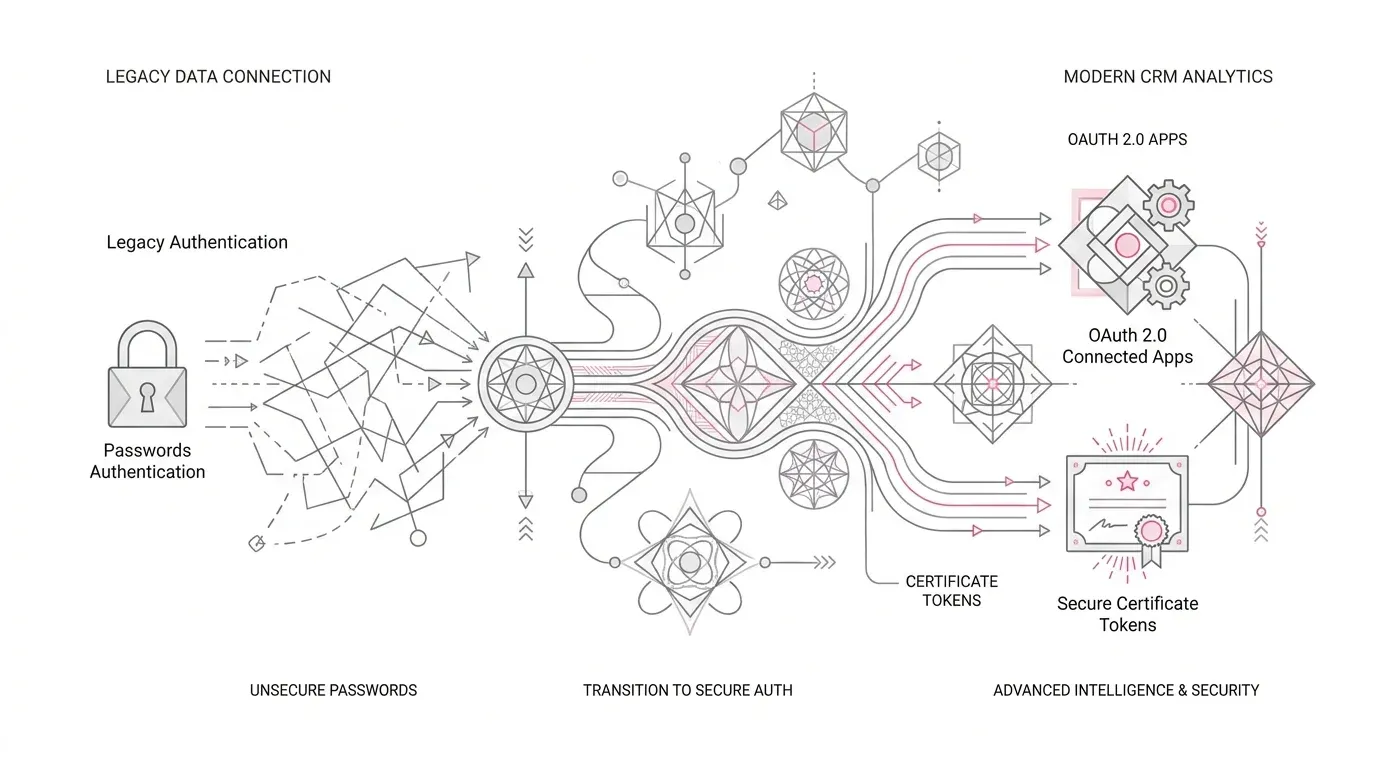
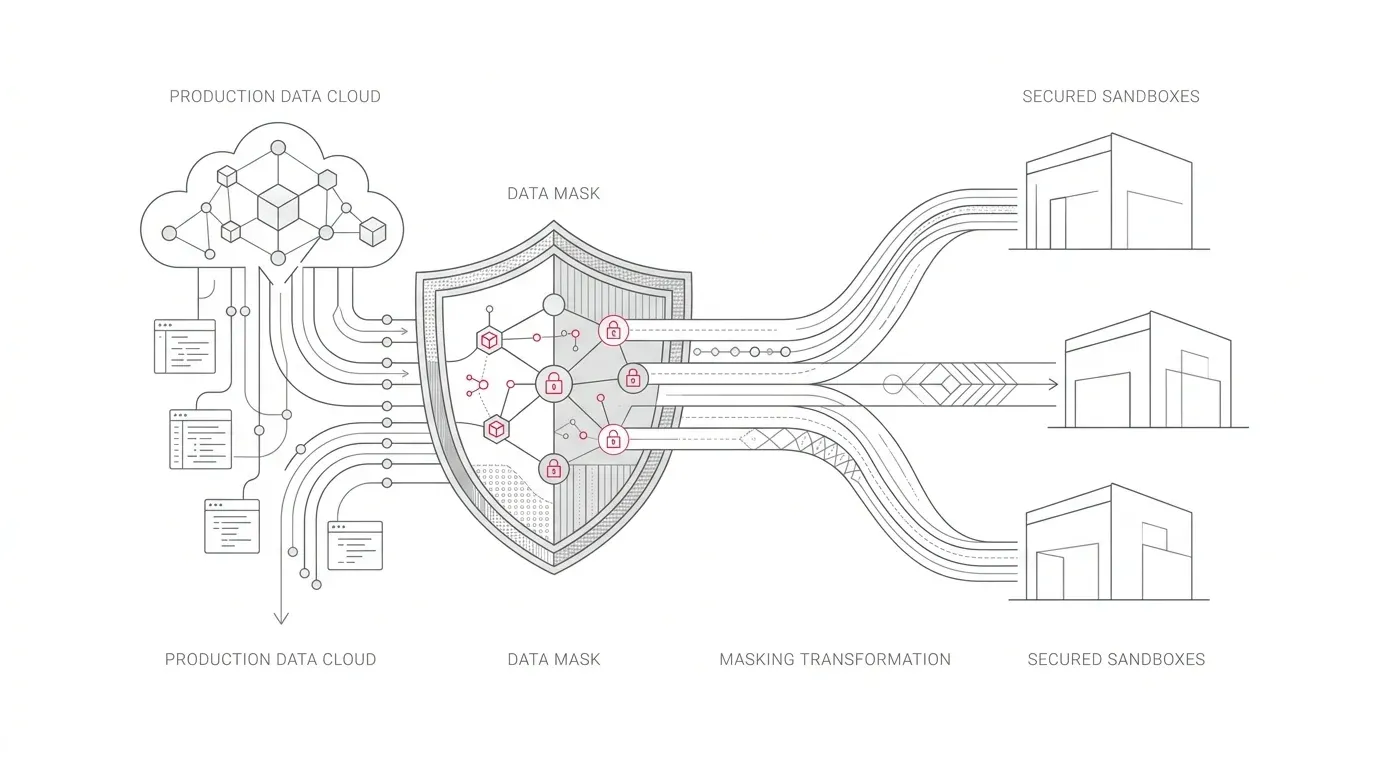
Salesforce teams that still use the legacy Data Mask managed package have two critical dates to understand: official vendor support ended on July 9, 2026, and on December 31, 2026, the managed package's user interface display becomes read-only.
The native replacement, Data Mask & Seed, has been available to all customers since July 18 as a core platform application. However, this is not an automatic policy conversion. Salesforce explicitly instructs customers to create new masking policies in the replacement application; only custom libraries are shared between the legacy managed package and Data Mask & Seed.
Core Operational Reality: The December 31 deadline is not merely a UI change; it is a critical governance boundary. An unmaintained masking policy will gradually diverge from an evolving Salesforce schema, leaving sensitive patient, customer, and donor data exposed in developer sandboxes.
That distinction matters immensely. For a healthcare provider, health insurer, financial institution, or nonprofit foundation, a masking policy is a foundational control around nonproduction data. It determines whether a refreshed full or partial sandbox exposes real patient names, social security numbers, claim histories, clinical notes, donor gifts, or payment details to offshore developers, contractors, testing partners, and connected third-party systems.
The goal before December 31 should not be to blindly transcribe an old configuration screen by screen. It should be to prove that every sandbox refresh produces data that is appropriately anonymized, operationally useful, and safe to connect to downstream integration services.
What the December 31 Deadline Does and Does Not Mean
Salesforce's official documentation confirms three specific operational realities:
- Support for the legacy managed package officially terminated on July 9, 2026, meaning newly discovered bugs or compatibility defects will not be patched by Salesforce.
- The legacy managed-package user interface becomes strictly read-only starting December 31, 2026, preventing administrators from modifying rules or adding new objects.
- New policies must be created manually in the native Data Mask & Seed application; existing policy definitions do not migrate automatically.
Critically, Salesforce does not state that existing legacy masking jobs will instantly stop executing on December 31. Organizations should avoid inaccurate claims that the tool will simply shut off overnight. However, the governance risk is urgent: relying on an unsupported, frozen tool means any schema changes, new custom fields, or new compliance mandates cannot be protected.
Balancing Privacy Protection with Realistic Test Utility
Data masking has two competing engineering objectives that frequently pull in opposite directions:
- Privacy and compliance rigor: Sensitive values must not remain readable or reconstructible by personnel or external applications that do not have a business need for production data.
- Engineering test utility: Sandboxes require realistic data structures, preserved parent-child relationships, valid email/phone formats, and representative distributions to test validation rules, Flow automations, Apex triggers, and third-party integrations.
Simply replacing every field with random junk strings or blanking out values can break validation rules, formula fields, and regression suites. The transition to Data Mask & Seed offers an opportunity to re-architect test data strategy around Salesforce Well-Architected guidance , which identifies unmasked full-copy sandboxes as a major enterprise anti-pattern.
A Seven-Step Data Mask & Seed Migration Blueprint
1. Inventory the Current Control Beyond Structured Fields
Begin by auditing the legacy Data Mask permission-set licenses to identify all users with configuration rights. Document every production org and sandbox that relies on the package, including execution schedules, Run on Refresh settings, and downstream consumers.
Crucially, expand your audit beyond standard Contact and Account fields. Review Case Comments, Email Messages, Chatter feeds, file attachments, Knowledge articles, long-text areas, integration staging tables, and managed-package objects. Highly sensitive personal health information (PHI) and payment records frequently hide in unstructured text.
2. Define Protection and Test-Utility Requirements Field by Field
Create a formalized decision register for sensitive objects and attributes. Capture data ownership, classification, required masking algorithms, format preservation needs, and downstream integration impacts.
For healthcare providers and payers, do not assume that out-of-the-box product masking automatically achieves legal HIPAA de-identification. The US Department of Health and Human Services (HHS) defines Safe Harbor and Expert Determination as the two recognized de-identification pathways. Always pair technical masking with qualified compliance review.
3. Establish Access and Rebuild Policies in Production
Assign the Data Mask And Seed User permission-set license and associated permission sets to your platform security administrators. Rebuild masking policies directly in production using the native Data Mask & Seed interface.
Salesforce documents that when a new sandbox is created or refreshed, production Data Mask & Seed policies are copied into the sandbox, overwriting any pre-existing policies in that sandbox. Maintaining the golden policy definitions in production is therefore mandatory.
4. Test Policies Manually and Audit Automation Exceptions
Execute the new policies manually in a representative staging sandbox before enabling automated refresh hooks, auditing Data Mask & Seed requirements and limitations against job logs, execution durations, and record-level errors.
While Data Mask & Seed normally bypasses workflow rules, Apex triggers, and validation rules during masking, critical exceptions exist: duplicate detection rules are not bypassed, and certain deletion operations involving feed tracking, Case Comments, and Chatter history still fire automations. These exceptions must be accounted for in your test plan.
5. Validate Protection and Test Usefulness on Separate Tracks
| Validation Track | Key Verification Checks | Production Sign-Off Criteria |
|---|---|---|
| Security & Privacy Track | Verification that PII/PHI cannot be reversed; email addresses routed to dead ends; phone numbers scrambled; free-text scrubbed. | Security & Privacy Officer approval of sample extracts and unmasked leak audit. |
| Engineering & QA Track | Verification that test user logins work; core Flow/Apex automations execute; reporting rollups calculate; synthetic formats valid. | QA & Release Lead sign-off that end-to-end regression test suites pass without data errors. |
6. Design Around Documented Large-Volume Scale Limits
Enterprise orgs with massive data volumes must design within Salesforce's published system guardrails:
- 20 Million Record Behavior Shift: When a masking job processes over 20 million records, Data Mask & Seed no longer guarantees consistent cross-object masking or preservation of original field-value statistical distributions.
- 350 Million Record Hard Ceiling: A single masking job can process a maximum of 350 million records.
- Daily Execution Limit: Each individual sandbox is limited to a maximum of 12 masking executions in any rolling 24-hour window.
If your full sandbox fact tables cross 20 million records, partition your masking scope or implement selective sandbox seeding rather than attempting a single monolithic run.
7. Cut Over Run on Refresh and Retire the Legacy Package
Once manual runs meet both acceptance tracks, enable Run on Refresh for the approved policy. Salesforce allows only one Data Mask & Seed policy to have Run on Refresh active at a time. If both legacy and new tools have refresh hooks enabled, Salesforce documentation confirms that the native Data Mask & Seed policy takes precedence.
After validating a successful end-to-end sandbox refresh, archive your audit artifacts and uninstall the first-generation Data Mask managed package to eliminate technical debt.
Industry-Specific Considerations: Regulated Sectors
- Healthcare & Health Cloud: Prioritize patient records, clinical encounters, diagnostic codes, and authorization requests. Ensure date-shifting algorithms maintain relative chronological spacing between care plan events.
- Insurance & Financial Services: Scrub policyholder credit card numbers, bank accounts, beneficiary designations, and loss records while preserving policy-to-claim relational integrity.
- Nonprofits & Foundations: Anonymize major donor histories, gift amounts, grant applications, and volunteer PII while maintaining household account structures.
Eight Questions Salesforce Platform Leaders Must Ask Today
- Which production orgs and sandboxes currently rely on the legacy Data Mask managed package?
- Have new replacement policies been authored and reviewed inside native Data Mask & Seed?
- What is the time window between sandbox refresh completion and masking job termination, and who has access during that gap?
- Are custom libraries and replacement patterns verified across all related objects?
- Do any of our core objects exceed the 20-million-record distribution threshold?
- Have we tested automation exceptions such as duplicate rules and Chatter history deletions?
- Are third-party integrations and outbound email deliveries blocked during masking execution?
- Do we have dual sign-off from both Security (anonymization) and QA (test utility)?
How YuniQ Accelerates Salesforce Migration and Governance
Migrating sandbox data controls requires deep platform expertise across architecture, security, and release management. YuniQ's certified enterprise architects provide specialized Salesforce services covering migration planning, custom security policy authoring, automated test validation, and ongoing platform governance.
De-Risk Your Salesforce Sandbox Security Before December 31
Ensure your developer sandboxes remain secure and compliant without slowing down release cycles. Partner with YuniQ to audit, rebuild, and automate your Salesforce Data Mask & Seed architecture.
Explore Salesforce Consulting Services