Salesforce CPQ customers have a strategic decision to make, but they do not have an emergency shutdown deadline.
Salesforce has confirmed that CPQ is end of sale , not end of life. Existing customers can continue using the product, renew their licenses, add users, and receive support. Salesforce has not announced an end-of-life date or a forced migration. What has changed is the investment roadmap: new quote-to-cash innovation is moving toward Revenue Cloud Advanced, now positioned within Agentforce Revenue Management.
Strategic Perspective: The right question is not 'How quickly can we leave CPQ?' It is 'Which platform and process design will support our revenue model over the next three to five years?'
Migrating too early can consume budget while recreating processes that already work. Waiting without a roadmap can leave the organization dependent on aging custom code, poorly understood pricing logic, and integrations that become harder to change.
What End of Sale Actually Means
End of sale prevents new customers from purchasing Salesforce CPQ. It does not switch off existing implementations.
Salesforce says CPQ is entering a maintenance phase, with continued support and critical fixes but no new feature development. Revenue Cloud Advanced is the strategic successor for organizations that need a native, API-oriented platform spanning product catalogs, pricing, quoting, contracts, orders, assets, and related revenue processes.
Organizations therefore have time to make an evidence-based decision. But 'no forced migration' should not become 'no planning.' A sensible roadmap should establish:
- Whether the current CPQ implementation still meets core commercial requirements
- Which customizations, Quote Calculation Plugins (QCP), and integrations are genuinely valuable
- Which architectural limitations are blocking new products, usage-based models, or digital channels
- Whether Revenue Management's capabilities justify reimplementation cost and operational disruption
- What data and catalog technical debt must be cleaned up regardless of the chosen platform
Organizations that remain on CPQ should also confirm that their managed package is current. Salesforce's support policy limits Standard Success Plan support for legacy CPQ versions more than two major releases behind the generally available version.
This Is an Architecture Program, Not a Package Upgrade
Revenue Management is not merely CPQ with a new interface. Salesforce's migration guidance says the transition fundamentally changes how organizations model data, design business processes, and govern revenue information. CPQ-specific objects, scripts, pricing rules, and integrations do not automatically become equivalent Revenue Management components.
The migration scope spans across:
- Commercial and technical product catalogs (Standard vs. Attribute-based structures)
- Price books, discount schedules, block pricing, and pricing exception rules
- Quote Calculation Plugins (JavaScript QCP) and custom Apex triggers
- Assets, subscriptions, amendments, co-terming, and automated renewal workflows
- ERP, tax engines, billing systems, provisioning, and document generation integrations
- Executive reports, dashboards, and sales compensation models built on CPQ objects
- Approval controls, advanced approvals, and segregation of duties
- Change management and enablement for sales, finance, legal, and RevOps teams
A migration estimate based only on record counts will miss much of the actual effort. The harder question is how many business decisions are hidden inside legacy rules, custom code, spreadsheets, and unwritten institutional knowledge.
Diagnose CPQ Before Choosing a Destination
Begin with a dependency and complexity assessment across product catalog size, pricing logic, subscription complexity, custom code, integrations, and geographic scope.
For every important CPQ capability, document:
- The business outcome and revenue flow it protects.
- The users and downstream operational systems that depend on it.
- The rule, automation, Apex code, or manual process implementing it.
- Representative test transactions that prove the expected financial result.
- Whether the capability should be retained, simplified, redesigned, or retired.
Choose Among Three Practical Paths
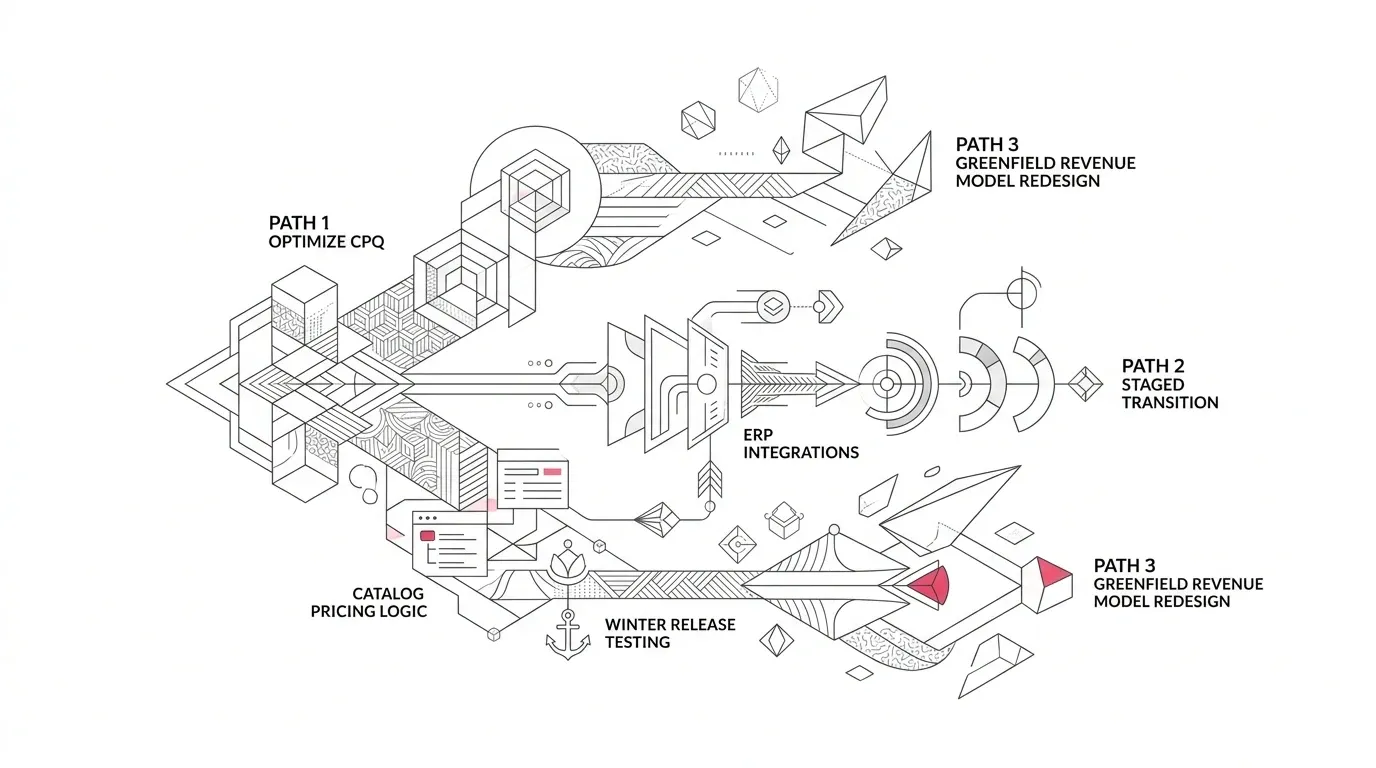
Path 1: Stabilize and Optimize Salesforce CPQ
Staying on CPQ can be appropriate when the implementation is reliable, business requirements are stable, and the benefits of Revenue Management do not yet justify reimplementation.
The roadmap should focus on package currency, catalog cleanup, pricing-rule documentation, integration monitoring, automated testing, and reduction of avoidable custom code. Establish review triggers such as a new consumption-based revenue model, an acquisition, an ERP replacement, or unacceptable quote performance.
Path 2: Run a Staged Migration
A partial migration moves selected product lines or business units to Revenue Management while retaining other CPQ processes temporarily.
This reduces initial disruption, but introduces coexistence requirements: dual-system reporting boundaries, integration routing, customer and product master IDs, and amendment/renewal behavior across both platforms.
Path 3: Rationalize or Reimagine the Revenue Model
Organizations with bloated catalogs, inconsistent pricing, extensive custom code, or changing business models benefit from a deeper redesign. Salesforce's full-rationalization approach replaces legacy SKU sprawl with attribute-based catalogs and modern pricing constructs.
This avoids recreating historical workarounds and technical debt, while delivering native omnichannel and API-first quoting.
Comparison of Strategic Migration Options
| Migration Path | Best Suited For | Key Advantage | Operational Trade-off |
|---|---|---|---|
| Path 1: Optimize CPQ | Stable B2B quoting with proven pricing rules & minimal change | Low immediate cost; zero sales disruption | No new feature innovation; maintenance phase only |
| Path 2: Staged Transition | Multi-division enterprises launching new digital or usage models | De-risked incremental rollout; early capability adoption | Coexistence complexity; dual-system integration overhead |
| Path 3: Greenfield Redesign | Enterprises burdened by legacy SKU sprawl & unmaintainable QCP code | Modern attribute-based catalog; scalable API-first architecture | Higher upfront discovery, build, and change management |
Make Winter '27 Part of the Readiness Test
Winter '27 production releases are scheduled for September and October 2026. Organizations already using or piloting Revenue Management must review Salesforce's upgrade instructions and current known issues before their production window.
Current release considerations include:
- Instant Pricing API v66.0: May return additional records and fields that can impact integrations expecting earlier schema structures.
- Deep Clone Ramp Schedules: Deep Clone can produce incorrect ramp schedules for some quotes and orders (known issue under active review).
- Dynamic Revenue Orchestrator: Has documented limitations regarding field-level access, non-unique orchestration keys, and required attributes.
These highlight that modern revenue platforms require disciplined release governance, integration-contract testing, and continuous regression validation.
Industry-Specific Considerations & Go-Live Gates
Healthcare: Trace quoting and contracting dependencies into finance, service, provider networks, and ERP systems with strict HIPAA and security governance.
Insurance: Distinguish Salesforce quote-to-cash functions from core policy rating and administration, ensuring clean integration across policy systems, commissions, and billing.
Nonprofits: Test whether commercial or membership complexity warrants full Revenue Management or whether optimizing Sales Cloud creates more value.
Define Evidence-Based Go-Live Gates
- Representative quotes produce expected prices, discounts, taxes, terms, and approvals across all tiers.
- Amendments, renewals, co-terming, cancellations, and ramp transactions reconcile cleanly.
- ERP, billing, tax engine, document generation, and provisioning integrations pass automated contract tests.
- Critical executive and revenue reports are rebuilt, validated, and reconciled.
- Sales reps and operations complete scenario-based training on realistic data.
- Coexistence, cutover, rollback, and ongoing support ownership are signed off.
Turn Uncertainty Into a Strategic Roadmap
YuniQ provides end-to-end Salesforce consulting, implementation, CPQ optimization , and Revenue Cloud migration services. We help revenue leaders evaluate existing customizations, eliminate technical debt, and engineer scalable quote-to-cash architectures.
Assess Your Salesforce CPQ Architecture
Schedule a comprehensive CPQ complexity assessment with YuniQ's certified Salesforce revenue architects to evaluate technical debt and build a practical optimization or migration roadmap.
Explore Salesforce ServicesFrequently Asked Questions
Is Salesforce CPQ being discontinued or shut down?
No. Salesforce CPQ is end of sale for new customers, but remains fully supported for existing customers with no announced end-of-life date.
Do existing Salesforce CPQ customers have to migrate?
No forced migration exists. Customers can continue renewing and adding users. However, new feature innovation is directed toward Revenue Cloud Advanced within Agentforce Revenue Management.
What replaces Salesforce CPQ?
Salesforce Revenue Cloud Advanced (Agentforce Revenue Management) is the native next-generation platform for product catalogs, pricing, quoting, order management, and billing.
Can CPQ pricing rules and data be migrated directly?
Not via a simple 1:1 data load. Revenue Management uses a modernized attribute-based data model and Context Service, requiring business logic and catalog redesign.
Should our organization migrate now or optimize CPQ?
If your current CPQ setup is stable and meets business needs, optimizing and maintaining package currency is often the most cost-effective path. If you face SKU sprawl, unmaintainable QCP code, or new usage-based models, a staged migration or greenfield redesign is recommended.