An upstream application adds a column, changes a code, widens an identifier, or renames a field. The ingestion job still completes. Hours later, an executive dashboard is wrong, a regulatory extract is incomplete, or an AI assistant answers from a data product whose meaning changed without notice.
Core Architectural Principle: Schema drift is a change in the shape of data; semantic drift is a change in its business meaning. A pipeline monitor answers "Did the job run?" A data contract answers "Did the right data, with the agreed meaning and quality, reach consumers?"
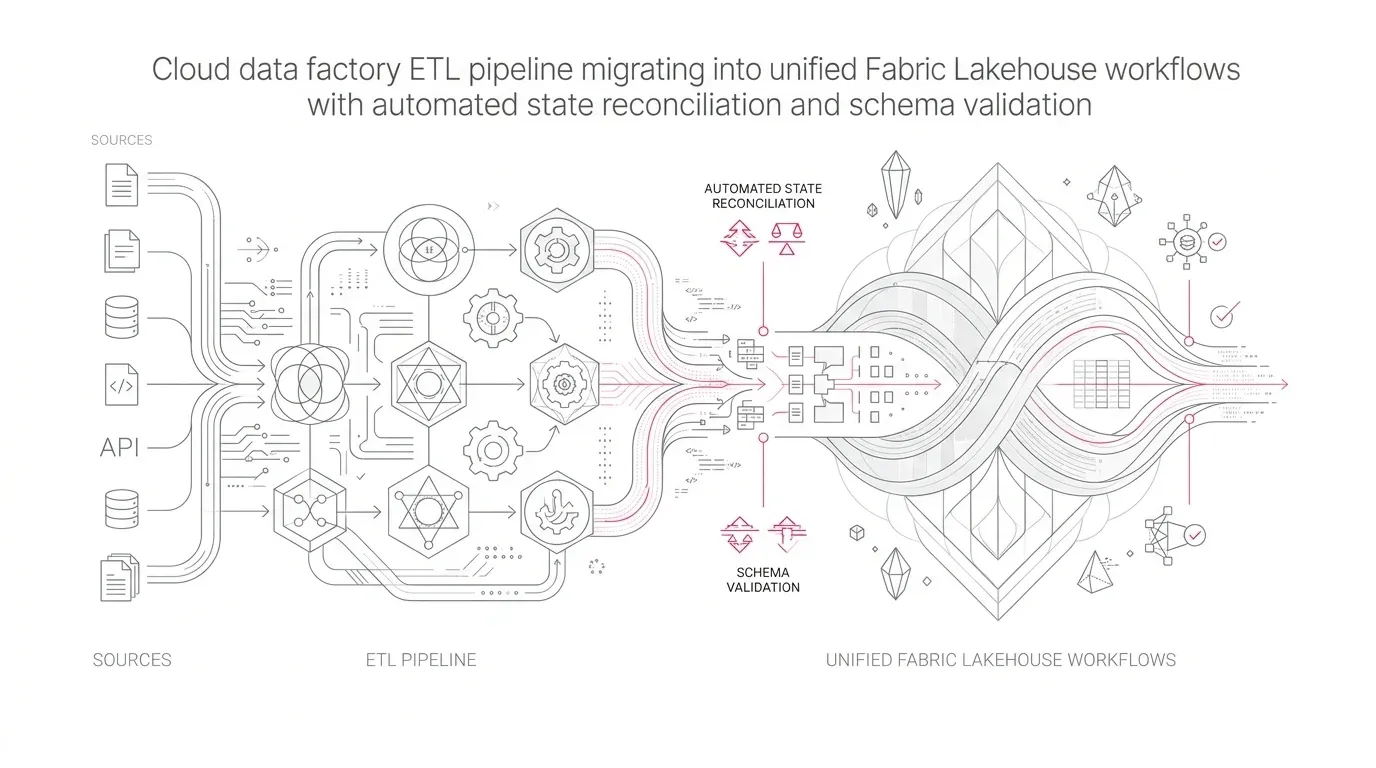
This is the enterprise schema-drift problem: the structure or meaning of data changes faster than the controls around it. In a unified analytics platform like Microsoft Fabric, a single OneLake Delta table can serve SQL analytics endpoints, Spark notebooks, Direct Lake semantic models, and external APIs. Schema changes instantly propagate across all downstream readers.
The Enterprise Problem: Pipelines Succeed While Data Products Fail
Delta Lake enforces schema-on-write by default. While additive changes can leverage mergeSchema, replacing definitions with overwriteSchema drops table contracts and disrupts consumers. In Dataflow Gen2, dynamic replacement can drop and recreate destination tables, wiping relationships and measures attached in downstream semantic models.
Automatic schema evolution is a technical capability, not an enterprise governance policy. Without strict contract boundaries, data platforms either silently corrupt metrics or suffer operational paralysis.
Classifying Data Changes: Compatible, Conditional, or Breaking
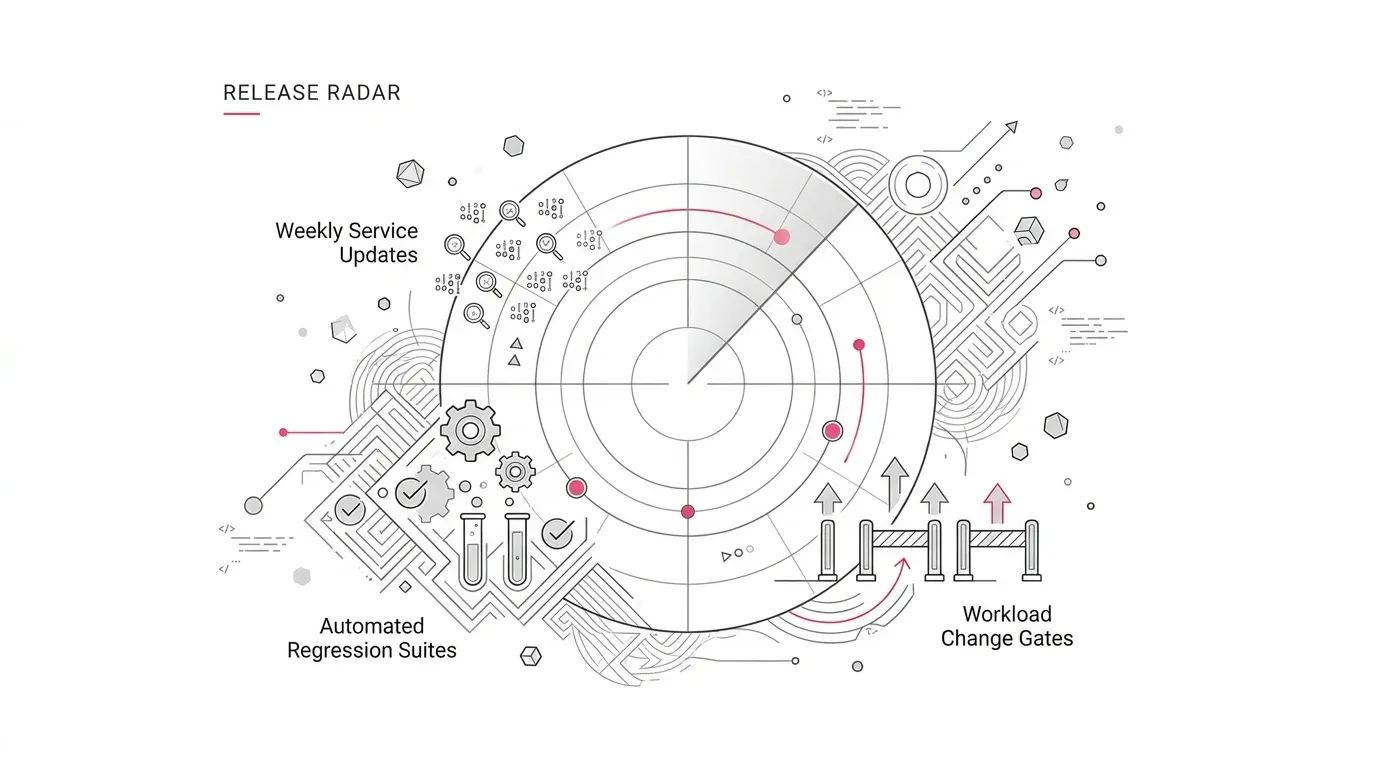
Rather than treating all schema evolution alike, enterprise platforms should enforce a three-tier change classification policy:
| Change Class | Examples | Default Action | Downstream Exposure |
|---|---|---|---|
| Compatible | New nullable column, widened text description length | Preserve in Bronze; validate before Silver admission | No Gold exposure until explicitly approved |
| Conditional | Compatible numeric widening, new domain value, optional field populated | Execute automated consumer tests and business rule validations | Controlled release after owner sign-off |
| Breaking | Field rename, column drop, incompatible type change, unit or key change | Quarantine invalid records; require versioned contract migration | Blocks promotion until impact analysis and backfills complete |
Reference Architecture: Medallion Boundaries with Data Contracts
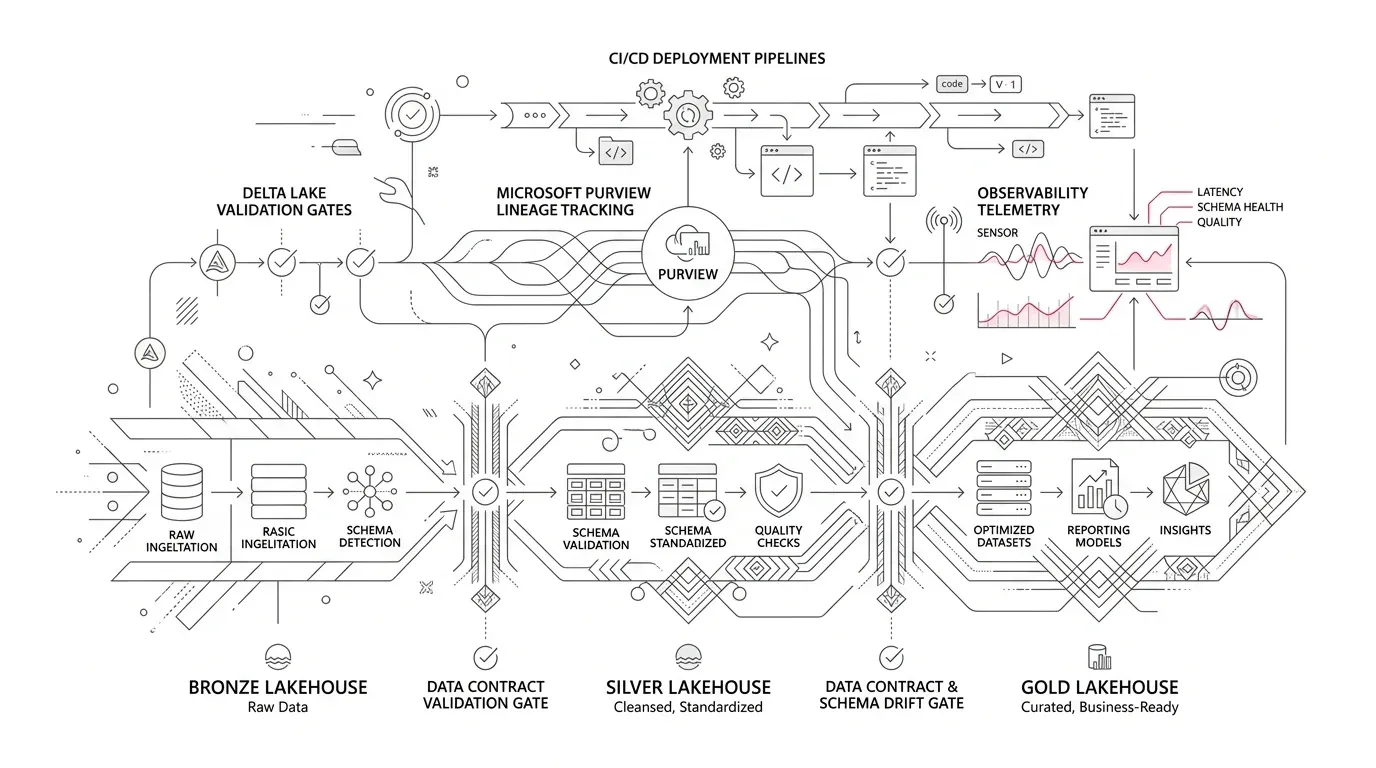
A robust Microsoft Fabric data contract architecture combines multi-layered validation across the Medallion architecture:
- Bronze Lakehouse (Permissive & Quarantined): Captures raw payloads, pipeline metadata, and schema fingerprints without dropping unexpected incoming data.
- Silver Delta Tables (Enforced & Standardized): Enforces canonical types, key uniqueness, domain validity, and freshness rules. Rejects incompatible rows into quarantine tables with error codes.
- Gold Data Products (Stable & Versioned): Delivers certified semantic models, warehouses, and Direct Lake views with strict deprecation windows and backward compatibility aliases.
- Cross-Cutting Governance: Microsoft Purview lineage, automated impact analysis, deployment pipelines across Dev/Test/Prod, and workspace monitoring Eventhouse.
Testing Meaning as Well as Structure
Automated contract test suites must validate eight key dimensions before publishing Silver or Gold data:
- Structural Integrity: Validating column names, datatypes, nullability constraints, and precision.
- Referential Consistency: Testing join integrity and orphan key rates across dimensional entities.
- Domain Validation: Ensuring categorical fields conform to approved reference tables rather than ad-hoc strings.
- Statistical Distribution: Monitoring volume, null rates, and outlier variances against historical baselines.
- Financial Reconciliation: Verifying source-to-target row counts and control totals by business date.
- Data Freshness: Confirming SLA arrival times and triggering alerting if delivery thresholds are missed.
- Semantic Consistency: Validating calculated measures and KPIs against business rules.
- Security & Entitlement: Ensuring OneLake RLS/CLS and sensitivity labels remain intact after schema evolution.
Lineage and Impact Analysis as a Release Gate
Before approving any breaking contract change, data teams must inspect Fabric lineage and run impact analysis to trace all dependent workspaces, reports, and pipelines.
Every breaking change ticket should document the rationale, affected downstream assets, compatibility views, rollback procedures, and sunset timelines for deprecated contract versions.
Phased Implementation Roadmap
- Phase 1 (Discover & Contain, Weeks 1-3): Identify a high-value data product with high drift risk, assign data product ownership, capture baseline schemas, and configure Bronze raw quarantine.
- Phase 2 (Contract & Prove, Weeks 4-7): Formulate version 1.0 contracts, build Silver/Gold validation gates, and execute simulation tests against additive, rename, and type-change mutations in sandbox.
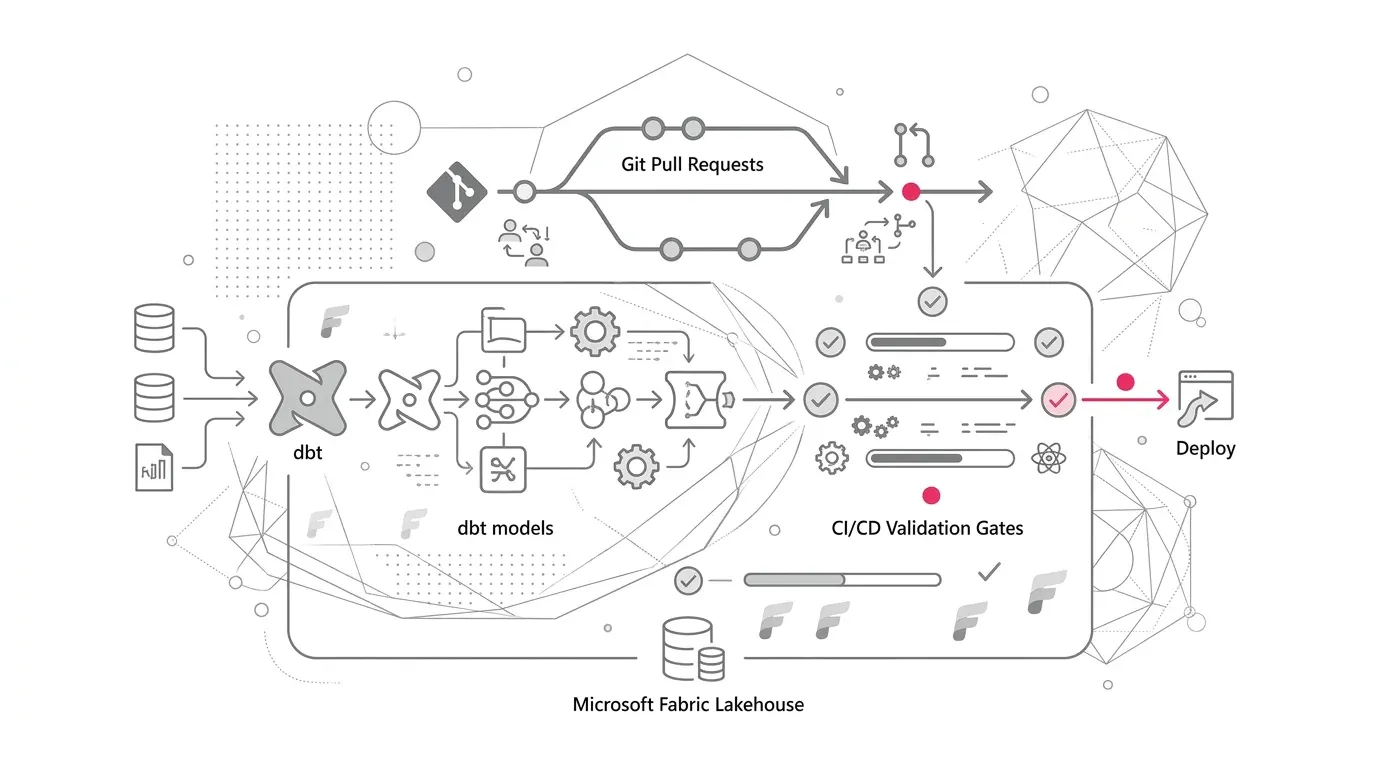
- Phase 3 (Industrialize & Automate, Weeks 8-12): Implement Git-integrated deployment pipelines, automate Purview quality scoring and impact analysis, and establish incident response runbooks.
- Phase 4 (Scale by Product Risk, Ongoing): Expand contract templates across domains, review business rules quarterly, and decommission legacy compatibility aliases.
Build Resilient Data Contracts in Microsoft Fabric with YuniQ
YuniQ designs, implements, and manages production-grade Microsoft Fabric architectures with Delta Lake schema governance, Purview quality rules, CI/CD pipelines, and automated reconciliation.
Explore Microsoft Fabric ConsultingFrequently Asked Questions
What is the difference between schema drift and semantic drift?
Schema drift refers to changes in structural shapes such as added, dropped, or renamed columns and datatype modifications. Semantic drift occurs when the technical structure remains identical but the underlying business meaning, units, or categorization rules change.
Why is Delta Lake mergeSchema not enough for enterprise schema governance?
While mergeSchema safely permits additive column updates, it does not validate domain values, business logic, or downstream report impact. Furthermore, breaking changes like column renames or type conversions cannot be handled safely through automatic merging alone.
How do data contracts protect Direct Lake semantic models in Power BI?
Data contracts enforce strict schema stability at the Gold layer, utilizing compatibility views during transition periods. This prevents downstream Direct Lake models from dropping measures or failing refreshes when source tables evolve.
How does Microsoft Purview integrate with Fabric data contracts?
Microsoft Purview Unified Catalog monitors data quality rules across completeness, accuracy, and freshness, alerting data product owners when quality thresholds decline and mapping full end-to-end lineage.