Executive summary
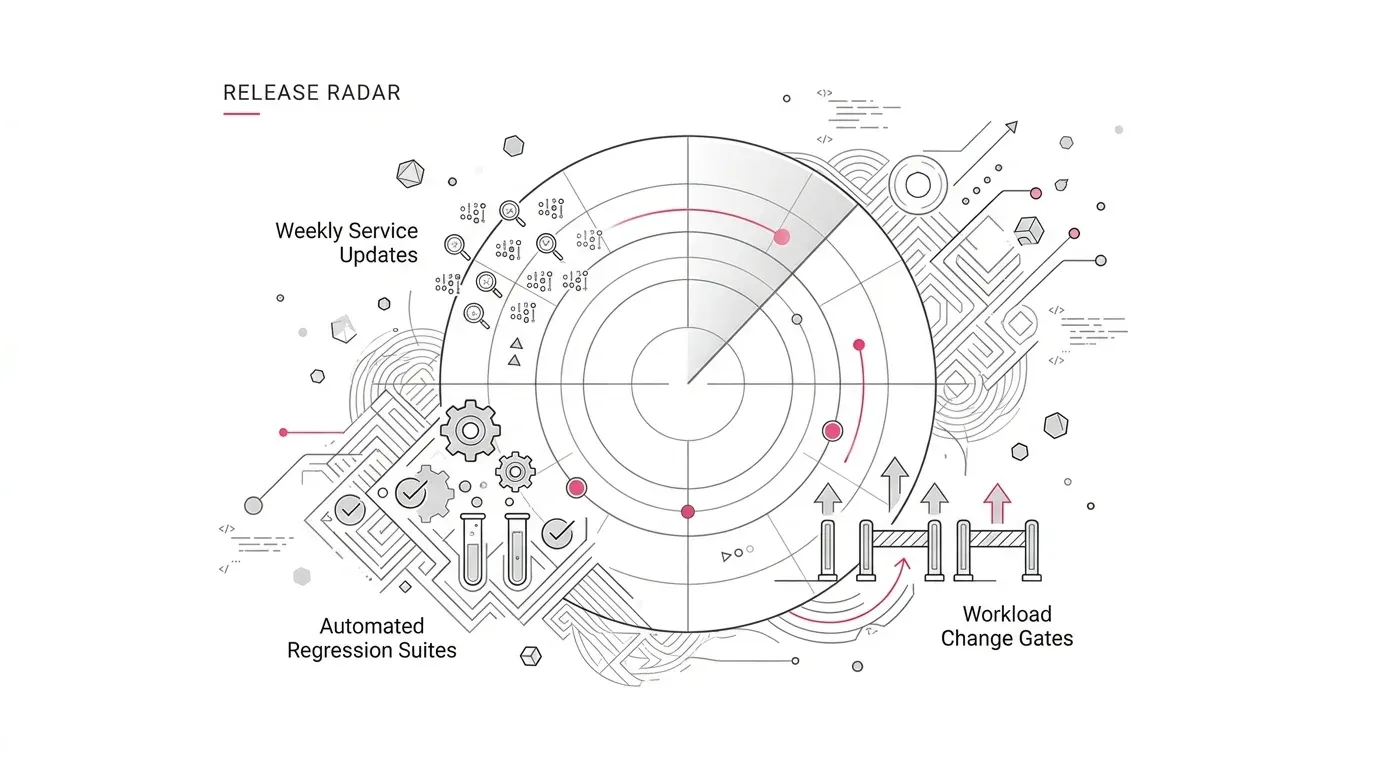
Native dbt jobs in Microsoft Fabric lower the operational barrier to analytics engineering. Teams can author modular SQL transformations, define dependencies and tests, run managed dbt Core, schedule jobs, and orchestrate them with Fabric pipelines. That is valuable. It is not, by itself, an enterprise operating model.
The consequential problem is transformation control fragmentation. If teams add dbt beside notebooks, pipeline expressions, stored procedures, dataflows, and semantic-model calculations without assigning clear boundaries, the same business rule can be implemented several times. A dbt run can be technically successful while it publishes stale, incomplete, insecure, unexpectedly expensive, or semantically inconsistent data.
The answer is to adopt dbt as a governed transformation product, not simply another executable item. Each production project needs:
- a declared data-product boundary and accountable owner;
- an explicit contract for sources, models, tests, outputs, and consumers;
- separate development, test, and production environments;
- durable production identity and least-privilege access;
- release gates that test business results, security, and performance, not only SQL syntax;
- end-to-end orchestration when freshness depends on upstream or downstream work;
- monitoring that connects dbt model results to business freshness and Fabric capacity;
- a deliberate rule for which logic belongs in dbt and which logic belongs elsewhere.
This article describes a practical architecture and phased roadmap for putting those controls in place.
The enterprise problem: managed execution can still produce unmanaged transformation logic
dbt, or data build tool, turns SQL transformations into a dependency-aware software project. A model is typically a SQL select statement that materializes as a view or table. Tests, source definitions, documentation, selectors, and dependency references make transformation logic easier to organize and validate than a collection of unrelated scripts.
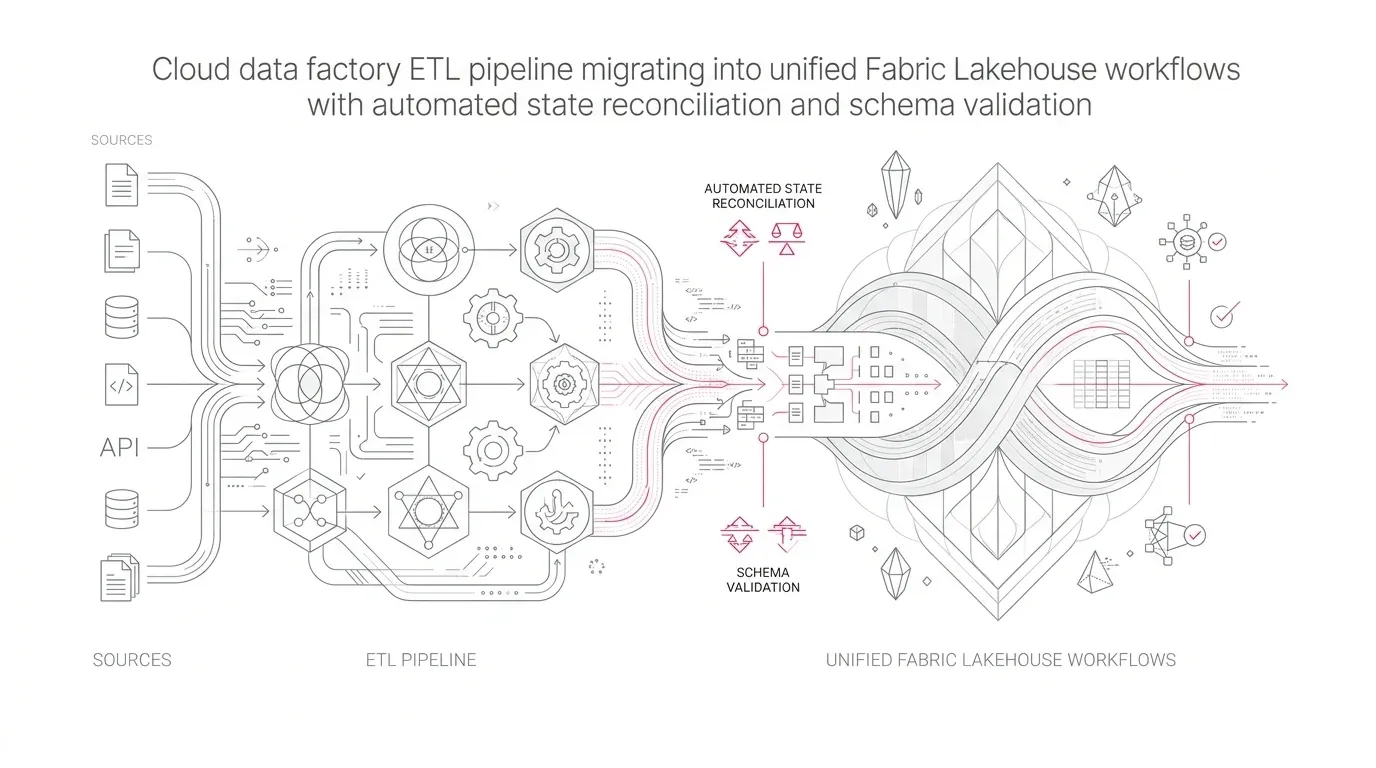
Microsoft Fabric brings that workflow into the platform. According to Microsoft's dbt job overview , Fabric provides a managed dbt runtime, supported adapters, native scheduling and monitoring, and visual insight into runs, tests, and lineage. Fabric pipelines can also invoke a dbt job as one activity in a larger workflow, with dependencies, parameters, notifications, and consolidated run history.
The risk begins when ease of creation outruns design discipline.
A platform team may enable dbt jobs to accelerate SQL development. One domain uses dbt for Silver and Gold transformations. Another leaves Silver logic in notebooks and uses dbt only for marts. A third rebuilds calculations already embedded in Power BI. Schedules proliferate. Developers run jobs with their own credentials. Environment values are changed manually after deployment. Tests confirm that rows are unique and non-null, but nobody checks whether a finance total still reconciles to the approved source.
The platform now has managed execution but no authoritative transformation contract. Leaders see the symptoms later:
- reports disagree because business rules exist in several engines;
- an upstream pipeline finishes late, but an independent dbt schedule publishes yesterday's data successfully;
- a deployment targets the wrong warehouse or schema;
- an employee departure or permission change breaks a production run;
- excessive thread counts and full refreshes compete with interactive analytics for capacity;
- a model passes technical tests while violating row-level access expectations or a financial control;
- incident responders can see that a dbt command failed but cannot determine which decisions or reports are affected.
This is not a reason to avoid native dbt. It is a reason to define its role before scaling it.
Why this matters now
Microsoft is rapidly expanding the native dbt experience. The current documentation describes managed dbt Core 1.11 on runtime V1.0 and adapters for Fabric Data Warehouse, Fabric Lakehouse, Azure SQL Database, PostgreSQL, and Snowflake. Fabric supports core commands including `build`, `run`, `seed`, `test`, `compile`, `snapshot`, and `docs generate`; job activity settings can also be parameterized in a pipeline. See the dbt job overview , job creation guide , and pipeline activity guide .
That makes adoption easier and increases the urgency of governance. Microsoft also documents constraints that affect enterprise design:
- runtime V1.0 has no build caching, so each run compiles and executes from source;
- direct import is limited to projects with no more than 5,000 files, with Git connection or project separation suggested for larger projects;
- adapter behavior and supported capabilities differ;
- the Fabric Lakehouse SQL analytics endpoint is read-only, while the lakehouse adapter executes Spark SQL and writes Delta tables;
- in the documented Variable Library deployment pattern, connection name and schema name are not variable-enabled and must remain consistent across environments;
- generated dbt documentation artifacts are stored with run output, but Fabric does not currently render them in the product.
These are documented product characteristics, not flaws. They become operational risks only when teams assume that a managed service has removed the need for architecture, release engineering, and service ownership.
Representative scenario: a successful job publishes the wrong answer
*The following is a representative scenario, not a YuniQ customer case.*
A multi-division enterprise is consolidating reporting in Fabric. Operational data lands in a Bronze lakehouse. Spark notebooks standardize several high-volume feeds into Silver Delta tables. A central analytics team builds Gold dimensions and facts in Fabric Data Warehouse, then serves Power BI semantic models.
To speed up SQL development, the team moves Gold transformations into a native dbt job. The first proof of concept succeeds. Models build in dependency order, basic uniqueness tests pass, and a scheduled production run is configured.
Three months later, quarter-end reporting is wrong even though the dbt job is green.
The root cause is a chain of control gaps:
- The dbt schedule starts at 02:00, regardless of whether the Silver notebook workflow has completed.
- A late source feed leaves one division's Silver data at the previous business date.
- Source freshness is not encoded as a release condition for Gold.
- The Gold job builds successfully from the latest available rows.
- A semantic-model refresh follows its own schedule and publishes the internally consistent but incomplete result.
- Operations sees three green jobs rather than one failed business service.
The problem was not invalid SQL. It was the absence of an end-to-end publication contract.
Root causes and business consequences
Tool boundaries are mistaken for accountability boundaries
dbt staging, intermediate, and mart folders are logical code groupings. They do not automatically define Bronze, Silver, and Gold governance zones. Microsoft makes this distinction in its common dbt job patterns : organizations should explicitly assign ownership for ingestion, Silver refinement, Gold modeling, orchestration, and semantic modeling.
Without that decision, logic is duplicated across dbt, notebooks, pipelines, stored procedures, dataflows, and DAX. A defect then has multiple possible owners and multiple places to repair.
Job success is confused with product readiness
A successful `dbt build` proves that selected models and tests completed. It does not necessarily prove that:
- all expected source partitions arrived;
- the data is recent enough for the decision it supports;
- totals reconcile to an authoritative control source;
- restricted personas see only permitted data;
- downstream semantic models refreshed successfully;
- query latency and capacity consumption remain within production objectives.
When these conditions are absent, a green technical signal can conceal a failed business outcome.
Environment configuration remains partly operational
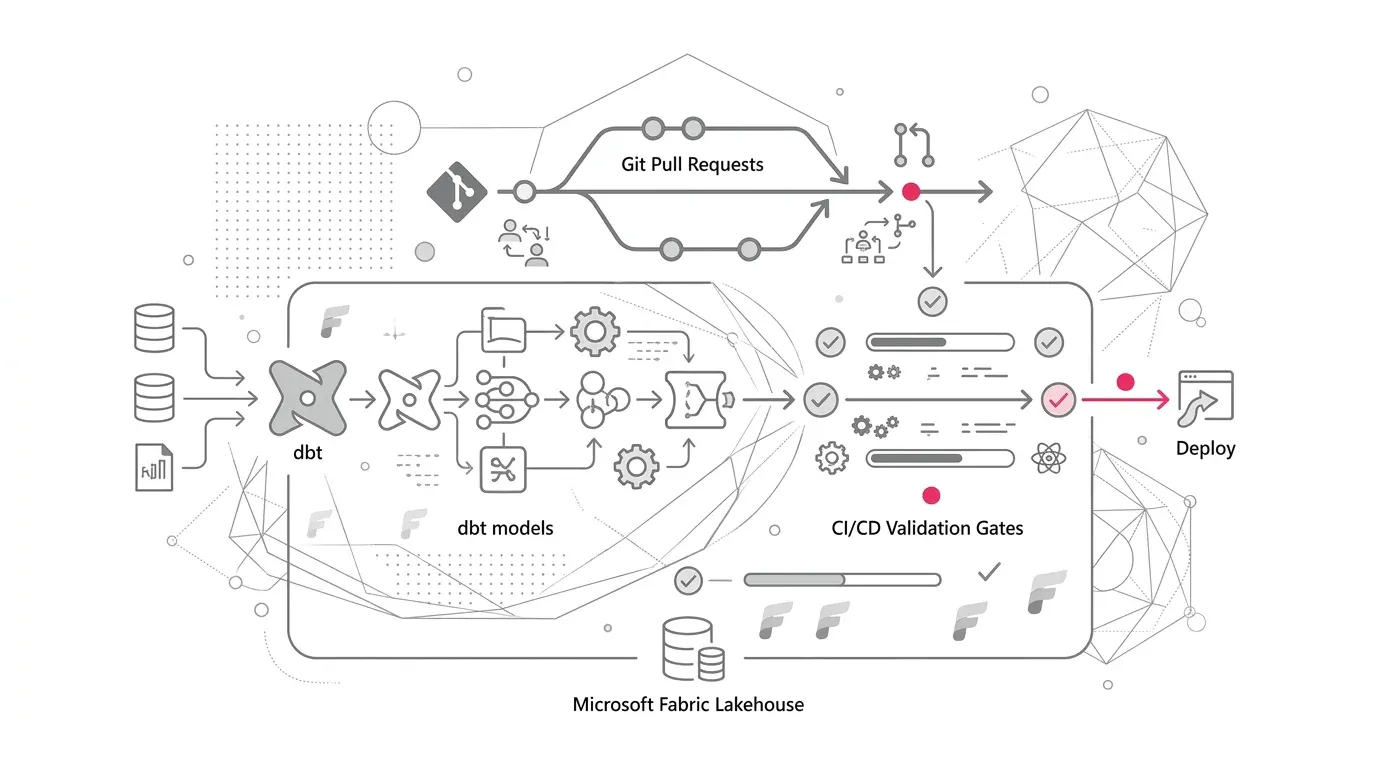
Fabric Variable Library can separate environment-specific warehouse identifiers and SQL endpoints from a dbt job definition. Microsoft's dbt CI/CD guide shows one job promoted through development, test, and production with stage-specific value sets.
However, that guide also documents important operating details: the connection and schema names must be consistent because they are not variable-enabled in this pattern, a newly deployed library initially uses its default value set, and an operator must activate the correct value set in each target workspace. These stateful details require deployment verification.
Identity is designed after scheduling
Interactive OAuth is convenient for development. Production automation needs a durable execution path whose permissions are understandable and reviewable. For a pipeline invoking a dbt job, Microsoft documents OAuth, service principal, and managed or workload identity options, and recommends non-user identities for automated enterprise scenarios in the dbt job activity documentation .
Using a named employee for a production dependency creates avoidable exposure to role changes, token issues, offboarding, and excessive privilege.
Capacity is treated as an infrastructure concern only
dbt exposes controls such as threads, selectors, fail-fast behavior, and full refresh. These are also capacity decisions. More threads can increase concurrency. A full refresh can rebuild a large graph. Runtime V1.0 recompiles and executes from source rather than reusing prior build artifacts. A technically correct configuration can therefore lengthen the batch window or compete with report queries.
The business consequences include delayed decisions, reconciliation effort, missed reporting windows, operational incidents, audit findings, and cloud spend that cannot be attributed to a responsible data product.
Why common approaches fall short
"Put every SQL transformation in dbt"
Centralizing SQL syntax is not the same as simplifying architecture. Some transformations belong in a Spark-oriented lakehouse refinement stage; some belong in a warehouse; some calculations are presentation semantics; and some actions belong in orchestration. Moving logic without considering engine, materialization, data volume, security, and consumer contract simply relocates complexity.
"Schedule the dbt job five minutes after ingestion"
Time is not a dependency. Ingestion duration changes with volume, upstream availability, retries, and capacity contention. Use an independent schedule only when the job is truly independent. When Gold publication depends on upstream arrival, invoke dbt from a Fabric pipeline with explicit success, failure, and completion behavior.
"`dbt test` is the quality gate"
dbt tests are essential, but a production gate also needs source completeness, business reconciliation, security, performance, and consumer checks. A unique key can pass while a division is missing. A referential integrity test can pass while both parent and child data are stale.
"Deployment success means the environment is correct"
Item promotion does not prove that the active Variable Library value set, target connection, schema, permissions, schedule, and downstream references are correct. Environment state must be asserted after deployment.
"Native monitoring gives us observability"
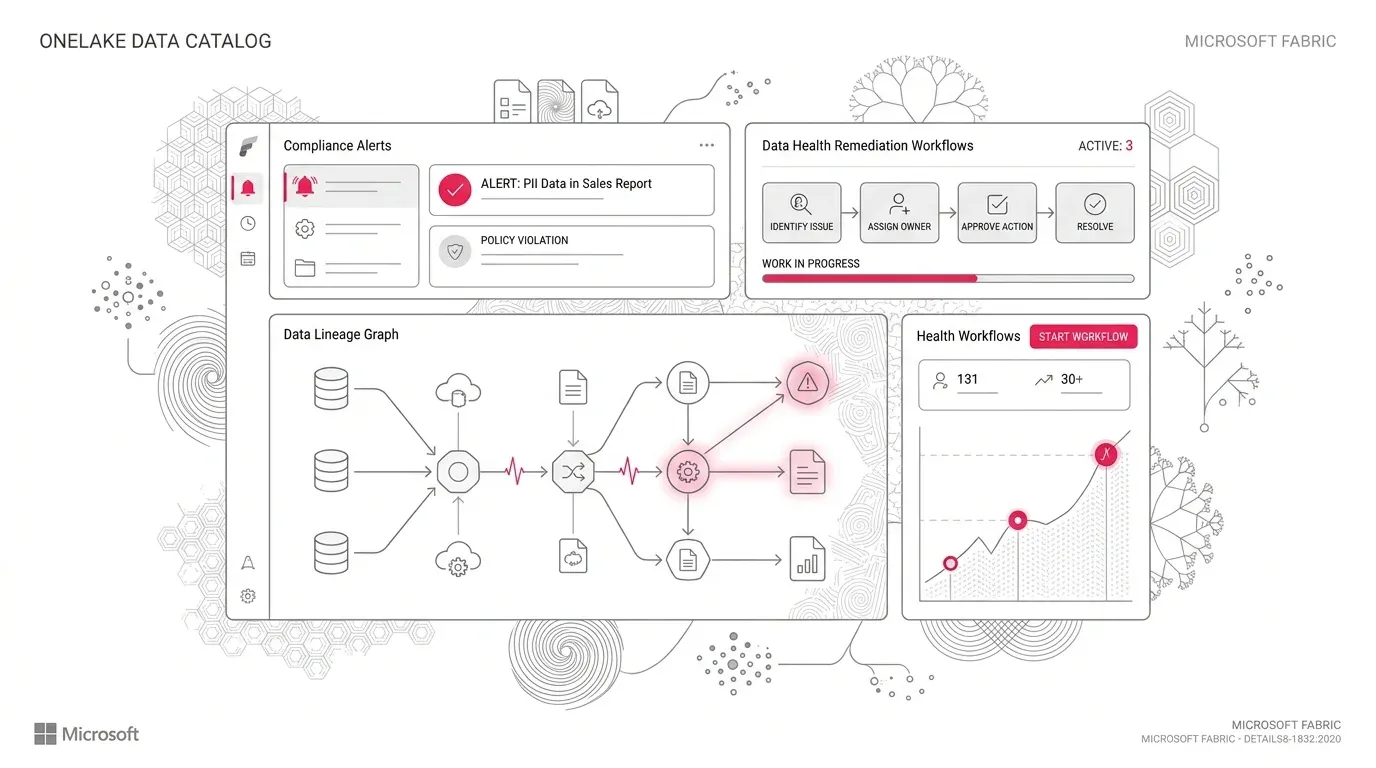
Run summaries, logs, lineage views, and pipeline history are strong diagnostic inputs. They become operational observability only when joined to ownership, business freshness, consumer impact, alert routing, and capacity evidence. Microsoft's pipeline monitoring guidance distinguishes run inspection, alerts, workspace monitoring, and capacity analysis because each answers a different question.
A governed Microsoft Fabric solution
The target design is a single publication path in which dbt owns a declared transformation boundary and Fabric coordinates the surrounding service.
Enterprise sources
      |
      v
Fabric ingestion and Bronze landing
      |
      | arrival, completeness, and quarantine checks
      v
Silver refinement
      |
      | explicit data contract and decision-date watermark
      v
Fabric pipeline orchestration
      |
      +--> invoke native dbt job with approved selector
      |        |
      |        +--> compile and build models
      |        +--> schema and data tests
      |        +--> business reconciliation tests
      |
      +--> security and publication checks
      +--> semantic-model refresh or downstream signal
      +--> success/failure notification
      |
      v
Certified Gold data product
      |
      +--> Power BI and operational analytics
      +--> governed AI and downstream consumers

Cross-cutting controls:
Git + pull requests | Dev/Test/Prod | Variable Library | Entra ID
Lineage + ownership | Workspace monitoring | Capacity attribution
Write a transformation ownership contract
For each data product, define:
| Decision | Required declaration |
|---|---|
| Product scope | Business decisions and consumers supported |
| Source boundary | Authoritative source tables, expected partitions, and freshness |
| dbt boundary | Models and rules owned by dbt |
| Other engines | Rules intentionally owned by notebooks, pipelines, stored procedures, or semantic models |
| Publication boundary | Tables or views that consumers may use |
| Quality contract | Technical, business, and reconciliation tests |
| Security contract | Data classification, execution identity, writer roles, and consumer personas |
| Service contract | Target completion time, decision-age objective, recovery expectation, and owner |
| Cost contract | Capacity assignment, expected run profile, and escalation threshold |
The critical rule is single ownership for each business transformation. If customer status is calculated in dbt, do not silently recreate it in a notebook and DAX. If a presentation-only measure belongs in the semantic model, document that choice and test its dependency on the published Gold columns.
Choose the physical pattern before building projects
Fabric supports several credible patterns, documented in Common dbt job patterns :
- Warehouse-only: use when the workload is relational and SQL-first. dbt can manage staging, intermediate, and mart models inside a Fabric Data Warehouse.
- Lakehouse landing plus Warehouse transformation: retain raw data in a lakehouse and materialize Silver and Gold in a warehouse. Cross-database access through the SQL analytics endpoint has workspace and data-type considerations.
- Lakehouse refinement plus Warehouse serving: use lakehouse tools for Bronze and Silver, then let dbt publish relational Gold models. Keep the Silver-to-Gold contract explicit.
- Lakehouse-only: use the Fabric lakehouse adapter for Spark SQL and Delta materialization. Do not assume warehouse T-SQL behavior or the read-only SQL analytics endpoint can write these outputs.
Select on workload needs, not team fashion. Record the adapter, engine, SQL dialect, materializations, supported packages, data volumes, security path, and expected consumers as part of the architecture decision.
Separate project code from environment state
Use Git-backed review for the dbt project and promote one reviewed definition through development, test, and production. Keep environment-specific Fabric resource identifiers in Variable Library where supported. Use consistent connection and schema naming across stages when following Microsoft's documented pattern.
A deployment should not be considered complete until an automated or operator-assisted post-deployment check confirms:
- the intended Variable Library value set is active;
- the dbt adapter resolves to the correct workspace, warehouse or lakehouse, and SQL endpoint;
- production credentials are not inherited from development;
- schedules are enabled only in the intended environment;
- the project compiles against the target engine;
- a canary model writes only to the permitted target;
- the pipeline resolves the corresponding dbt job through its target-workspace reference;
- downstream semantic models and reports point to production outputs.
Treat these as runtime assertions, not a one-time setup checklist.
Make the release gate broader than the dbt graph
Use layered assurance:
- Static checks: parse project configuration, compile SQL, validate naming and ownership metadata, and reject secrets or environment literals.
- dbt tests: enforce uniqueness, non-null values, relationships, accepted values, and domain-specific rules.
- Source assurance: compare expected and received partitions, row-count bands, schema, watermarks, and source decision date.
- Business reconciliation: compare balances, counts, or KPI components to an approved control source at agreed grains.
- Security tests: run positive and negative persona checks against the published surface; verify that the execution identity can write only where intended.
- Performance and capacity tests: record duration, query behavior, thread settings, data scanned or processed, and capacity impact using production-shaped volumes.
- Consumer tests: refresh representative semantic models, execute critical measures, and confirm freshness metadata reaches the user-facing experience.
For high-impact products, require evidence from every layer before production promotion.
Orchestrate the business service, not just the command
Use native dbt scheduling when a job is independent and its job-level monitoring is sufficient. Use Fabric pipeline orchestration when the service includes ingestion, data validation, dbt execution, notifications, or downstream processing.
The dbt job activity supports parameterized command options, node selection, exclusions, full-refresh behavior, fail-fast behavior, thread counts, and selectors. Govern these parameters:
- allow approved selectors rather than arbitrary production model names;
- disable full refresh by default and require a change or incident record for large rebuilds;
- set thread ceilings based on measured capacity behavior;
- fail publication when upstream freshness or reconciliation is outside tolerance;
- make retries idempotent, especially where incremental models or snapshots are involved;
- refresh downstream semantic models only after the Gold publication gate passes.
The pipeline's final success signal should mean "the business data product is ready," not merely "the dbt process ended."
Use durable identity and least privilege
Separate three questions:
- Who may edit or deploy the dbt project?
- Which identity executes production orchestration?
- Which identity and permissions reach the target data platform?
Developers may use interactive identity in development. For production pipelines, prefer a supported service principal or managed/workload identity, subject to the capabilities and policies of the selected adapter and target. Grant only the workspace, connection, schema, and object permissions required for the job.
Also restrict who can:
- change adapter or connection settings;
- select full refresh;
- alter production schedules;
- activate Variable Library value sets;
- grant write permission to publication schemas;
- bypass a failed quality gate.
Log exceptions with an owner, reason, expiry, and evidence of closure.
Monitor decision age, model health, and capacity together
Build an operational record for every production run with at least:
- data product, environment, and accountable owner;
- code or release version;
- pipeline run ID and dbt job run ID;
- selected models and command options;
- source watermark and expected business date;
- model and test results;
- row counts and reconciliation outcomes;
- published watermark;
- semantic-model refresh outcome;
- duration, retries, thread count, and capacity evidence;
- exception or override reference.
Define decision age as the difference between the current time and the newest complete business event available to the consumer. This is more meaningful than "last job completed" because it exposes late upstream data even when every process runs successfully.
Use job and pipeline views for immediate diagnosis, workspace monitoring for queryable execution evidence where applicable, alerts for owned intervention, and the Fabric Capacity Metrics app for resource analysis. Route alerts by business service and severity rather than sending every failure to a shared mailbox.
Control cost through project design
Native managed execution removes infrastructure administration, not the need for cost engineering. Establish a baseline for each selector and data-volume band. Track:
- compile and execution duration;
- incremental versus full-refresh behavior;
- model fan-out and critical-path depth;
- thread count and concurrent jobs;
- warehouse or Spark execution pattern;
- overlap with Power BI peak use;
- retries and repeated processing;
- capacity throttling or delay indicators.
Optimize the model graph before buying permanent headroom. Use selective execution when it preserves dependency correctness, incremental materializations where business semantics allow them, and separate capacity or time windows when critical interactive and batch workloads have incompatible demand profiles.
A phased implementation roadmap
Phase 1: Discover and classify
Inventory existing transformations across dbt, notebooks, pipelines, stored procedures, dataflows, and semantic models. Map each critical KPI or published table back to its rules, owner, source, consumers, schedule, identity, and capacity.
Classify projects by business criticality, data sensitivity, recovery requirement, and transformation pattern. Identify duplicated or contradictory logic before migration.
Exit evidence: approved inventory, ownership map, criticality tier, and candidate project boundary.
Phase 2: Design the reference implementation
Select one valuable but bounded data product. Decide the physical Fabric pattern, adapter, project structure, workspace topology, identity, orchestration path, publication schema, and test layers. Define decision-age and reconciliation objectives before writing the implementation.
Exit evidence: architecture decision record, transformation contract, threat and access model, capacity hypothesis, and rollback plan.
Phase 3: Build and prove
Implement the dbt project with modular models, tests, source metadata, selectors, and documentation. Wrap it in a Fabric pipeline when end-to-end dependencies require orchestration. Connect development, test, and production through Git, deployment pipelines, and Variable Library as appropriate.
Test with production-shaped volume and representative security personas. Compare results against the incumbent transformation, including late-arriving data and failure scenarios.
Exit evidence: reconciled dual-run results, security test record, measured run profile, and successful recovery exercise.
Phase 4: Launch with guarded production controls
Deploy the approved definition, activate and verify target environment values, configure the durable identity, and enable the production schedule or parent pipeline. Start with limited consumers or a shadow publication when business risk warrants it.
Keep rollback practical: preserve the prior publication path, know how to disable the new schedule, and avoid irreversible source or target changes during the observation period.
Exit evidence: signed publication gate, verified alerts and ownership, consumer acceptance, and rollback readiness.
Phase 5: Scale by template, not by cloning accidents
Turn the pilot controls into reusable project conventions, pipeline wrappers, environment variables, policy checks, evidence reports, and service templates. Onboard additional domains only when an accountable owner accepts the operating contract.
Review adapter and runtime changes regularly. Microsoft's managed versions evolve, and every update should be assessed for SQL behavior, package compatibility, performance, and security implications before it reaches critical workloads.
Exit evidence: reusable platform standard, onboarding checklist, exception process, and quarterly control review.
Risks and control decisions leaders should make
| Risk | Control decision | Evidence |
|---|---|---|
| Duplicate business logic | Assign one engine and owner per rule | Transformation catalogue and code search |
| Stale but green publication | Gate on source completeness and decision age | Watermark and partition checks |
| Wrong environment target | Assert active value set, connection, schema, and canary write | Post-deployment verification |
| User-bound production execution | Use a supported durable identity and least privilege | Access review and offboarding test |
| Incomplete testing | Combine dbt, reconciliation, security, performance, and consumer tests | Release evidence bundle |
| Batch and interactive contention | Baseline selectors, threads, full refresh, and overlap windows | Capacity and duration trends |
| Adapter or runtime incompatibility | Maintain compatibility tests and controlled release rings | Upgrade test report |
| Missing documentation | Publish model ownership and consumer contracts outside generated artifacts when necessary | Searchable service catalogue |
| Uncontrolled emergency override | Time-bound approval, audit record, and mandatory retrospective | Exception register |
Success metrics
Choose a small set that connects engineering behavior to business reliability:
- Decision-age attainment: percentage of publication windows meeting the product's freshness objective.
- Complete-publication rate: percentage of runs passing source, dbt, reconciliation, security, and consumer gates.
- Change failure rate: percentage of production releases causing rollback, incident, or material correction.
- Mean time to diagnose: time from alert to identification of the affected model, source, owner, and consumers.
- Reconciliation variance: difference from the approved control source at the agreed grain.
- Identity resilience: percentage of production jobs with no named-user dependency.
- Logic duplication: number of material business rules implemented in more than one transformation engine.
- Capacity efficiency: capacity consumed per successful publication or per agreed data-volume unit, interpreted alongside service levels.
- Test coverage by criticality: percentage of critical models with technical, business, security, and consumer tests.
- Override debt: number and age of active quality, access, or deployment exceptions.
Avoid treating model count, test count, or number of migrated SQL files as outcomes. They measure activity, not trust.
How YuniQ can help
YuniQ's published Microsoft Fabric consulting and implementation services align with the work required to make native dbt operationally dependable:
- Fabric Strategy & Readiness: current-state diagnostics, use-case prioritization, capacity planning, workspace topology, and security, governance, and operating-model design can establish where dbt belongs and which products should move first.
- Data Integration & Engineering: Fabric Data Factory pipelines, Lakehouse and Data Warehouse implementation, Delta frameworks, and data-quality observability can connect dbt to governed ingestion and publication paths.
- OneLake & Data Architecture: domain workspaces, medallion layers, Lakehouse-versus-Warehouse decisions, and reusable business metrics can prevent dbt project structure from becoming accidental enterprise architecture.
- Governance, Security & DevOps: Entra ID least-privilege design, Purview integration, lineage and ownership, Dev/Test/Prod separation, Git CI/CD, monitoring, and capacity alerts address the production controls described in this article.
- Validation and scale: YuniQ's delivery framework includes discovery, architecture, proof, iterative build, automated reconciliation, access testing, user acceptance, cutover, monitoring, performance optimization, and domain expansion.
For organizations at the start of adoption, YuniQ describes Fabric Readiness Assessment and Fabric Proof of Value engagements. For production implementation and ongoing operations, its service page describes Migration & Implementation and Fabric Managed Services, including production pipelines and transformations, team enablement, monitoring, capacity optimization, and DevOps release management.
The practical goal is not to deploy dbt everywhere. It is to create a trusted transformation service in which every material rule has an owner, every publication has evidence, and every capacity decision supports a defined business outcome.
Practical next steps
- Select one critical data product and map every transformation rule across Fabric and Power BI.
- Identify duplicated logic and assign one authoritative implementation for each rule.
- Decide whether the product is Warehouse-only, Lakehouse-to-Warehouse, split Lakehouse and Warehouse, or Lakehouse-only.
- Write the source, transformation, publication, security, freshness, recovery, and cost contracts.
- Implement a production-shaped proof using separate Dev/Test/Prod workspaces, reviewed code, durable identity, and post-deployment assertions.
- Orchestrate upstream arrival, dbt execution, reconciliation, and downstream refresh as one business service where dependencies exist.
- Measure decision age, complete-publication rate, change failures, reconciliation variance, and capacity per successful publication.
- Scale only after the project template, control evidence, exception process, and service ownership have proved workable.