Executive summary
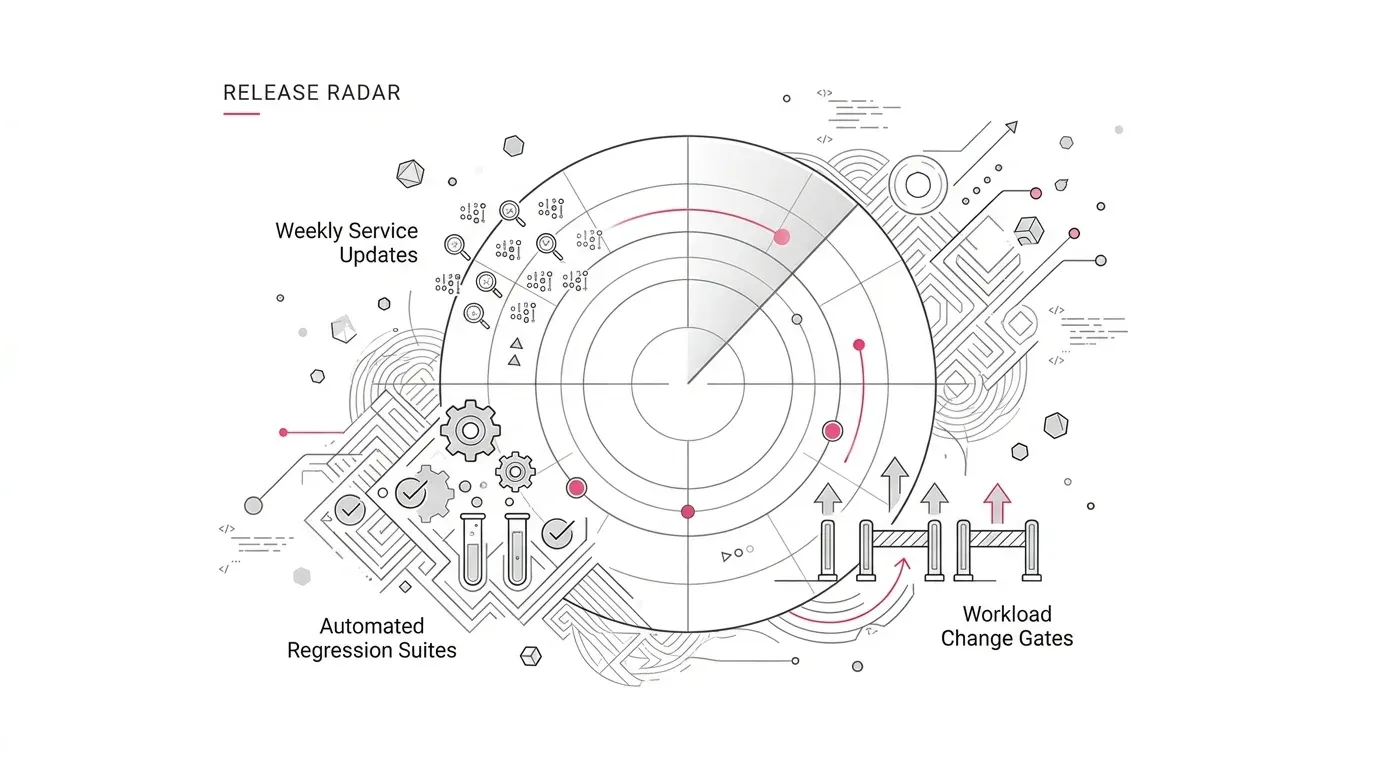
Microsoft Fabric is a software-as-a-service platform. Microsoft releases new capabilities and feature updates weekly, deploys targeted fixes when needed, and gradually rolls builds into production by region . That operating model accelerates innovation, but it also creates a change stream that sits outside an enterprise's normal application release calendar.
The enterprise problem is not simply that Fabric changes. It is that most organizations have mature controls for changes they author, but weak controls for changes the platform introduces. A pipeline, semantic model, security path, or operational process can behave differently even when the organization's own Git repository has not changed.
The answer is a platform-change readiness system, not another approval board. It should:
- turn Microsoft release information and tenant observations into an owned change backlog;
- maintain a current map of critical Fabric services, dependencies, identities, and business owners;
- run representative synthetic journeys continuously in a nonproduction validation estate;
- distinguish customer-code defects, configuration drift, Microsoft service incidents, and documented product issues;
- use evidence-based go, hold, mitigate, and escalate decisions; and
- measure detection, business impact, and recovery rather than merely recording that a release note was reviewed.
This operating model does not attempt to freeze a SaaS platform. It gives leaders a controlled way to absorb continuous change while protecting decision-critical analytics.
The enterprise problem: customer release control does not control the Fabric service
Microsoft documents that Fabric receives weekly capability and feature updates, plus on-demand targeted fixes. Updates pass through Microsoft's internal validation and safe-deployment rings before a gradual regional production rollout. Microsoft can also manage feature exposure independently of code deployment and disable an offending feature quickly when an issue is found.
Those controls reduce platform-wide risk, but they cannot reproduce every customer's combination of:
- source systems, gateways, and network policies;
- identities, workspace roles, and row-level or object-level security;
- lakehouses, warehouses, notebooks, pipelines, event streams, semantic models, and reports;
- data volumes, concurrency, schedules, and capacity pressure;
- third-party drivers, libraries, APIs, and embedded applications; or
- manual operating procedures and downstream business dependencies.
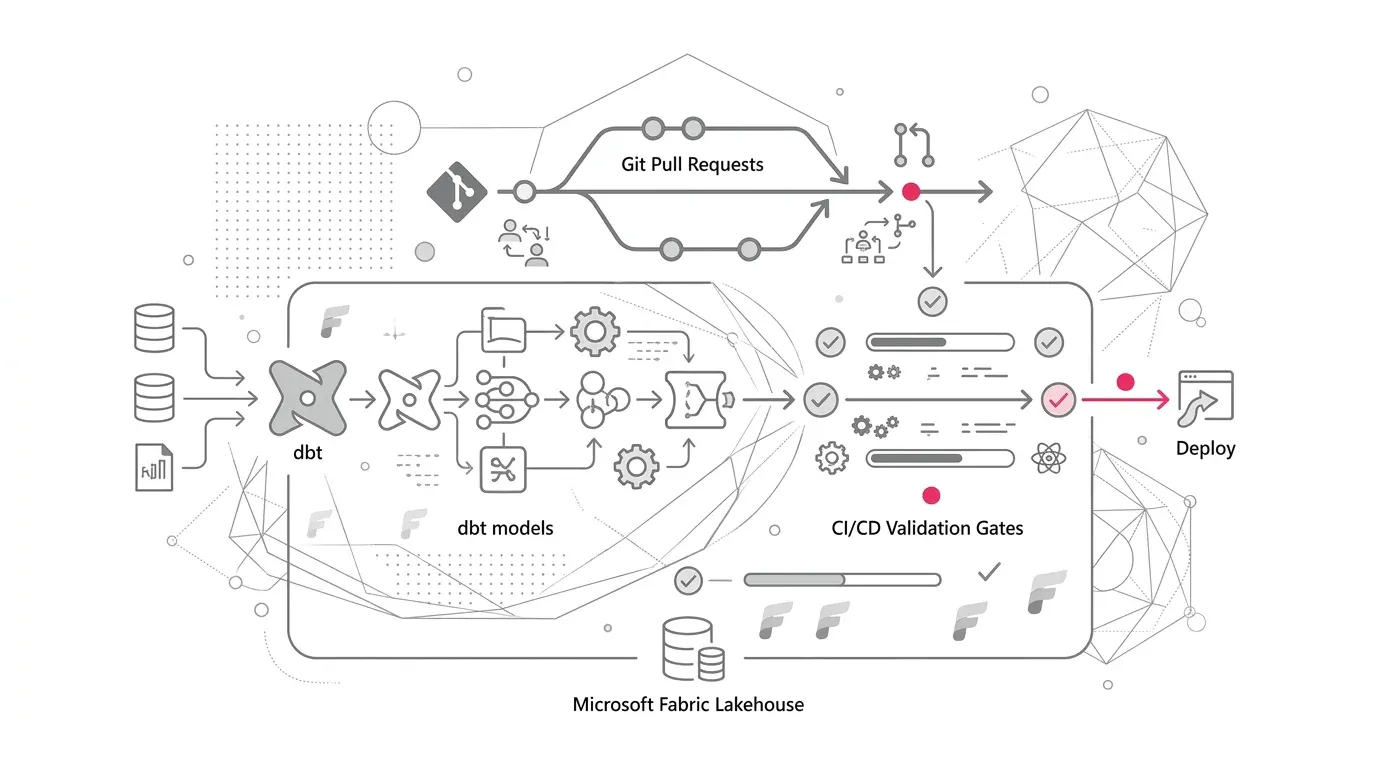
Fabric CI/CD addresses a different problem. Git integration, deployment pipelines, and API-driven deployment help an organization version and promote the Fabric items it owns. They do not let that organization promote Microsoft's SaaS build through customer-controlled development, test, and production stages. All three workspaces can experience a service-side change without a customer commit.
That distinction matters. A green customer deployment pipeline proves that a known version of customer content passed its release checks. It does not prove that unchanged content will continue to behave identically after a platform update, feature exposure change, connector update, browser change, or regional service event.
Why this matters now
Fabric's expanding surface area increases the number of legitimate interactions that platform teams must protect. The current Fabric "What's new" register spans platform administration, CI/CD, Data Factory, Data Engineering, Data Science, SQL databases, Data Warehouse, Real-Time Intelligence, Fabric IQ, OneLake, and Power BI. Preview features have separate terms, are not intended for production use, have no SLA, and can be geographically limited.
The Fabric Known Issues page is also a living operational source, not a historical archive: Microsoft advises customers to review it before opening a support request, and fixed issues are removed after 46 days. Service-health information can appear in the Fabric admin portal and Microsoft 365 admin center, while optional in-product, email, and Teams interruption notifications require administrative configuration.
For an enterprise, the consequence of missing a change is rarely confined to the technology team. It can mean:
- a finance pack that refreshes successfully but contains stale data;
- a pipeline that runs longer and collides with a reporting window;
- a security persona that can no longer access an approved dataset;
- a connector or gateway behavior change that blocks ingestion;
- a semantic model comparison that generates misleading deployment evidence;
- an AI or operational workflow that receives incomplete context; or
- prolonged troubleshooting because teams cannot distinguish a local regression from a service issue.
The business risk is therefore decision interruption: the period during which a critical process is using late, inaccessible, inconsistent, or unverified information.
Representative scenario: the unchanged month-end service that changed
*The following scenario is representative. It is not a YuniQ customer case and does not claim actual results.*
A multinational organization runs a Fabric-based month-end reporting service. Data Factory pipelines ingest ERP and CRM changes into a lakehouse. Notebooks apply accounting transformations, a warehouse serves reconciled balances, and Power BI semantic models publish certified finance metrics. The solution uses a gateway for one on-premises source, workspace identities for selected service-to-service paths, and a shared Fabric capacity.
The team has sound CI/CD for its own artifacts. Every pull request runs unit checks, content is promoted through development and test workspaces, and production deployment requires approval. During close week, no customer release occurs.
Yet three symptoms appear:
- one ingestion path completes later than normal;
- a finance viewer receives an access error in a downstream workflow; and
- the deployment comparison for an unchanged semantic model reports a difference.
The operations team initially treats the symptoms as one failed application release. There was no release, however. Engineers spend hours comparing Git commits and redeploying content before checking Fabric service health and known issues. The organization eventually discovers that the symptoms have different causes: one local capacity contention issue, one documented product issue with a workaround, and one comparison anomaly that does not change model semantics.
The failure is not a lack of engineering skill. It is a missing classification and evidence system. The team can trace customer changes, but it cannot rapidly correlate service-side change, workload behavior, user impact, and Microsoft communications.
Root causes and consequences
One change calendar records only customer-authored releases
Platform teams often track commits, deployments, and configuration changes but not roadmap items, feature-state transitions, tenant-setting changes, known issues, service advisories, gateway or client releases, and regional availability changes. Incident responders then search multiple sources under pressure.
Test environments are structurally similar but operationally idle
A test workspace may contain the same item definitions as production while using tiny data, no real concurrency, different identities, simplified networking, or no downstream consumers. It validates deployment, not the complete business service.
Monitoring proves activity, not correctness
A successful refresh is useful evidence, but it does not confirm source completeness, transformation correctness, policy enforcement, semantic consistency, report usability, or decision freshness. Green technical states can coexist with wrong business outcomes.
Preview adoption is driven by enthusiasm rather than a risk class
Microsoft states that Fabric previews are not intended for production use, are not covered by SLAs, can have restricted capability, and may be regionally limited. Enabling a preview tenant-wide without an owner, exit plan, data-class boundary, and acceptance criteria converts experimentation into an unmanaged dependency.
Ownership is organized by tool, while incidents cross tools
Separate Data Factory, Spark, Warehouse, Power BI, security, and infrastructure teams can each see a healthy component. No one owns the end-to-end business journey or the decision-age objective.
Recovery plans assume every problem is reversible by redeployment
Redeploying an unchanged definition cannot fix a Microsoft service incident. Conversely, waiting for Microsoft cannot fix local configuration drift, expired credentials, insufficient capacity, or a bad customer release. Poor classification increases time to mitigation and can introduce new risk.
Why common approaches fall short
"Microsoft tests the platform"
Microsoft describes extensive automated tests, internal environments, health checks, progressive rollout, incident response, and feature exposure controls. These are essential provider controls. They are not customer-specific acceptance tests for a unique data estate, security model, workload mix, and business calendar.
"Our Dev/Test/Prod pipeline is enough"
Fabric lifecycle guidance correctly recommends production-like testing, representative data and usage volumes, related-item impact analysis, post-deployment checks, and rollback planning for customer content. Those practices remain necessary. They do not create customer-controlled rings for Microsoft's service release.
"We read the monthly update blog"
Release awareness without asset mapping and executable tests creates information, not assurance. A long feature list must be converted into affected services, accountable owners, validation scope, and a decision deadline.
"We will wait for another region to prove the release"
Microsoft gradually deploys production builds by region, but customers do not control the order or exact timing. Feature exposure can also be independent of build deployment. A Multi-Geo architecture designed for residency or resilience should not be repurposed as an assumed early-access release ring.
"A dashboard will detect the problem"
Dashboards help only when they monitor the business journey, carry clear ownership, and trigger a rehearsed response. More telemetry without classification and action rules often lengthens triage.
The solution: a Fabric platform-change readiness architecture
Build the system as six connected control planes.
Microsoft release sources      Tenant and customer changes
  | roadmap / what's new         | Git / settings / identities
  | known issues / health        | gateways / libraries / capacity
  +------------------------------+------------------------------+
                                 |
                       1. Change intelligence
                                 |
                       2. Service/dependency map
                                 |
                       3. Risk and exposure decision
                                 |
                 4. Representative validation estate
                    | contract | security | load | UX |
                                 |
                       5. Production assurance
                                 |
                  6. Mitigate / escalate / learn
Establish a change-intelligence register
Create one queue that normalizes signals from:
- Microsoft Fabric What's New and the roadmap;
- Fabric Known Issues and its RSS feed;
- Fabric and Microsoft 365 service health;
- Microsoft 365 Message center notices;
- preview and general-availability transitions;
- tenant, capacity, workspace, gateway, connection, and identity changes;
- customer Git commits and deployments; and
- material client, driver, library, browser, or source-system changes.
Each record should include the source link, observed date, announced or effective window, affected workload, lifecycle state, regions, required tenant setting, known limitations, internal service owners, validation status, and decision.
Do not turn every announcement into a project. Triage it against actual exposure:
| Exposure question | Evidence | Action |
|---|---|---|
| Do we use the affected workload or item type? | Tenant inventory and service catalogue | Close as not exposed, or continue |
| Is the feature enabled or independently exposed? | Tenant/capacity settings and observed behavior | Record actual state |
| Does it touch a critical business journey? | Dependency map and service tier | Set validation depth and deadline |
| Is it preview, GA, deprecated, or a known issue? | Microsoft documentation | Apply lifecycle-specific policy |
| Is a workaround available? | Known issue or service-health notice | Test it before production use |
Metadata scanning can help catalogue Fabric and Power BI metadata, including item ownership, labels, endorsements, and selected semantic-model details. Treat it as one inventory source, not a complete dependency truth. Add connections, gateway clusters, external sources, schedules, business owners, runbooks, and non-Fabric consumers from other authoritative systems.
Define business services and decision-age objectives
Organize assurance around business services, not individual items. A service entry should identify:
- the decision or process supported;
- executive and operational owners;
- critical consumption times;
- source-to-consumption dependency chain;
- data classification and residency requirements;
- acceptable data age at the moment of decision;
- recovery-time and recovery-point objectives;
- safe degraded mode; and
- escalation path.
Use decision age as an end-to-end measure: the elapsed time between the latest source event required for a decision and the moment a user or system consumes the result. It exposes failures that component-level success states miss.
Classify services, for example:
- Tier 0: regulated, safety-related, financial-close, or automated operational action;
- Tier 1: executive and high-impact operational decisions;
- Tier 2: departmental analysis with a tolerable delay; and
- Tier 3: experimental or personal productivity.
The tier determines test frequency, production monitoring, on-call expectations, evidence retention, and whether previews are prohibited.
Build a representative validation estate
Maintain nonproduction workspaces that reproduce the characteristics most likely to expose a regression:
- the same item types and dependency shapes;
- equivalent security personas and identity types;
- representative schemas and edge cases;
- realistic data volume and concurrency for critical tests;
- equivalent gateway, network, private-link, and connection patterns;
- similar capacity characteristics, isolated from production load tests; and
- representative consumer paths, including APIs or embedded applications where applicable.
Microsoft lifecycle guidance recommends simulating production data volume, usage volume, and capacity in the test stage. Apply that principle selectively: a daily smoke suite can use bounded data, while scheduled performance and reconciliation tests use production-shaped volume with masked, synthetic, or approved test data.
This estate is an observation point, not a guaranteed advance ring for Microsoft releases. It provides continuous evidence about current platform behavior and a safe place to validate workarounds, tenant settings, preview features, and customer releases.
Automate end-to-end synthetic journeys
Test the minimum complete path for each critical service. A finance journey might:
- place a uniquely identified synthetic transaction in an approved test source;
- verify ingestion, watermark advancement, and duplicate handling;
- validate Bronze capture and Silver business rules;
- reconcile Gold or warehouse totals to expected values;
- query the semantic model as approved user personas;
- verify denied access for a negative persona;
- render or query the consumption endpoint;
- measure decision age and capacity consumed; and
- remove or expire the synthetic test record under a controlled policy.
Use several test classes:
| Test class | What it proves | Suggested cadence |
|---|---|---|
| Control-plane smoke | Items, jobs, connections, and APIs can be discovered or invoked | Hourly or daily by tier |
| Data contract | Schema, nullability, keys, totals, and freshness remain valid | Every material run |
| Security | Allowed personas succeed and denied personas fail across each access path | Daily and after policy change |
| Semantic | Measures and filter behavior return approved results | Daily and before business-critical windows |
| Performance | Latency, throughput, concurrency, and CU use remain within a baseline band | Scheduled and after relevant change |
| Consumer journey | Reports, apps, APIs, alerts, or agents receive usable results | Daily or weekly by tier |
| Recovery | A documented fallback or rebuild path actually restores the service | Quarterly or after architectural change |
Keep expected results small, deterministic, and versioned. A synthetic journey that changes whenever the platform changes cannot reliably identify a regression.
Add a change-risk gate
Score each relevant change on four dimensions:
- criticality: importance of affected business services;
- reach: number of workspaces, domains, regions, and consumers;
- reversibility: ability to disable, route around, or restore;
- uncertainty: preview status, incomplete documentation, or missing production-shaped evidence.
The gate should produce one of four decisions:
- Observe: no current exposure; continue source monitoring.
- Validate: exposure exists; run targeted tests and record evidence.
- Hold: do not enable an optional feature or customer dependency yet.
- Mitigate/escalate: apply a tested workaround, switch to a safe mode, open support, or invoke the service runbook.
For optional previews, default to a scoped security group or delegated capacity where the tenant setting supports it. Record a named owner, permitted data classes, geographic availability, business purpose, exit criteria, and removal plan. Do not let a preview become a silent production dependency.
Operate a two-axis incident model
Classify incidents by origin and impact.
Origin:
- Microsoft service incident or known issue;
- expected Microsoft feature or behavior change;
- customer artifact release;
- customer configuration, identity, network, gateway, or capacity change;
- external source or third-party dependency; or
- unknown.
Impact:
- availability;
- freshness;
- correctness;
- confidentiality or authorization;
- performance or cost; or
- operability, such as misleading monitoring or deployment evidence.
This prevents the false choice between "Microsoft problem" and "our problem." A Microsoft issue can still require a customer workaround, communication, or rollback of a newly adopted feature. A service advisory can coexist with a local capacity problem.
Enable the Fabric service-interruption notification channels appropriate to the organization and route them to an owned operational group. Keep access to Fabric and Microsoft 365 service-health views available to the incident team. During triage, correlate four timestamps: first business symptom, synthetic-test failure, internal change, and Microsoft notice. Preserve run identifiers, workspace and item IDs, region, capacity, correlation IDs, screenshots or error payloads, and the last known-good result for support and audit evidence.
A phased implementation roadmap
Phase 1: Baseline critical services (weeks 1-2)
- Name the executive sponsor and platform-change owner.
- Select three to five Tier 0 or Tier 1 business journeys.
- Map items, connections, identities, owners, schedules, capacities, and consumer deadlines.
- Define decision-age, correctness, availability, and access objectives.
- Enable and test service-health notification routes.
- Establish the single change-intelligence register.
Exit evidence: each selected service has an owner, dependency map, measurable objective, and escalation path.
Phase 2: Build the validation minimum (weeks 3-6)
- Create or harden representative validation workspaces.
- Implement one deterministic end-to-end synthetic journey per selected service.
- Add positive and negative security personas.
- Capture business reconciliation, latency, freshness, and capacity baselines.
- Version test definitions and expected results.
Exit evidence: tests detect a deliberately introduced failure and route an actionable alert to the correct owner.
Phase 3: Connect change signals to decisions (weeks 7-10)
- Automate available feeds and assign manual review for sources without stable APIs.
- Match change records to the service catalogue and owners.
- Introduce Observe, Validate, Hold, and Mitigate/Escalate gates.
- Define preview, GA, deprecation, and known-issue playbooks.
- Integrate evidence with the existing incident and change-management system.
Exit evidence: a new relevant Fabric notice creates an owned validation action with a due date and recorded outcome.
Phase 4: Scale by reusable test packs (weeks 11-16)
- Create workload-specific packs for Data Factory, Spark, Warehouse, Real-Time Intelligence, Power BI, and security paths.
- Onboard additional services by criticality.
- Run periodic production-shaped load and recovery tests.
- Review recurring manual steps for automation.
- Publish a monthly reliability and change-readiness scorecard.
Exit evidence: critical services share standard controls while retaining business-specific assertions.
Governance, security, adoption, and cost considerations
Governance
The Fabric platform owner should own the change-intelligence process. Data-product owners should own business assertions and acceptance. Security should own policy and negative-path criteria. Operations should own alert routing and incident command. A small change-readiness forum should decide high-risk adoption questions; it should not approve every weekly note.
Retain evidence in proportion to risk. For regulated services, preserve the source notice, exposure decision, test results, exception approval, mitigation, and closure evidence. Time-bound every exception.
Security and privacy
Use service principals or managed identities where supported for unattended validation, and grant only the permissions required by the test. Keep test identities separate from production operators. Never use a highly privileged administrator token merely to simplify a synthetic journey.
Use synthetic, masked, or approved nonproduction data. A production-like environment means representative behavior, not an uncontrolled copy of sensitive production data. Test both authorization success and denial through the actual consumption paths; workspace-role checks alone are insufficient when OneLake, SQL, semantic models, shortcuts, or external clients introduce additional enforcement points.
Adoption and operating model
Business owners must help define the handful of outputs whose correctness matters. Platform teams cannot infer whether a technically plausible number is financially or operationally acceptable. Train service owners to read decision-age and reconciliation evidence, not raw job telemetry.
Make failure drills routine. A quarterly exercise that classifies a simulated regression, validates a workaround, communicates impact, and restores the service is more valuable than an untested 40-page runbook.
Cost
The main cost drivers are validation capacity, realistic data processing, telemetry retention, and engineering ownership. Control them by:
- applying the deepest tests only to high-tier services;
- running cheap smoke and contract tests frequently, and expensive load tests on a schedule;
- pausing or right-sizing dedicated test capacity when supported and appropriate;
- using bounded synthetic datasets for daily journeys;
- retaining detailed diagnostics for a defined period and aggregated trends longer; and
- attributing validation CU consumption separately from production.
Do not optimize away the evidence required to protect a high-value decision. Compare assurance cost with the cost of missed close deadlines, manual reconciliation, decision delay, or prolonged incident response.
Success metrics executives can use
Avoid counting release notes reviewed as the primary outcome. Track:
| Metric | Definition | Why it matters |
|---|---|---|
| Critical-service coverage | Percentage of Tier 0/1 services with an owner, dependency map, objectives, and synthetic journey | Measures real control coverage |
| Signal-to-owner time | Time from a relevant Microsoft or tenant change signal to accountable owner assignment | Tests change-intelligence speed |
| Validation lead time | Time from signal intake to an evidence-backed decision | Shows readiness before business impact |
| Mean time to classify | Time from first symptom to a supported origin/impact classification | Reduces wasted troubleshooting |
| Mean time to mitigate | Time from confirmed impact to restored or safely degraded service | Measures operational resilience |
| Decision-age compliance | Percentage of critical consumption events within agreed data-age bounds | Connects platform health to the business |
| Reconciliation pass rate | Percentage of critical runs meeting approved business assertions | Detects green-but-wrong processing |
| Security negative-path pass rate | Percentage of prohibited journeys correctly denied | Verifies control enforcement |
| Change escape rate | Relevant changes first detected through production user impact rather than readiness controls | Measures preventive effectiveness |
| Preview dependency count | Production services dependent on preview capability, by tier and exception age | Exposes adoption risk |
| Validation cost per service | Test capacity and engineering cost allocated to each protected service | Supports proportional investment |
Set targets only after a baseline. A universal target can reward shallow tests or unnecessary alerting.
How YuniQ can help
YuniQ's published Microsoft Fabric services align with the capabilities needed to establish this operating model:
- Fabric Strategy & Readiness: current-state platform and workload diagnostics, capacity planning, workspace topology, security, governance, operating-model design, and pilot scoping can define the service tiers and readiness roadmap.
- Data Integration & Engineering: Fabric Data Factory, lakehouse, warehouse, Spark, data-quality observability, and exception-handling capabilities can implement representative journeys and business reconciliation.
- OneLake & Data Architecture: domain workspaces, Bronze/Silver/Gold layers, workload optimization, shortcut design, and semantic modeling can make dependencies and validation boundaries explicit.
- Governance, Security & DevOps: least-privilege Microsoft Entra design, Purview integration, lineage, Dev/Test/Prod separation, Git and CI/CD pipelines, logging, monitoring, and capacity alerts can provide the control and evidence layer.
- Analytics, AI & Activation: certified semantic models, Power BI, real-time analytics, and operational alerts can extend assurance through the actual consumption and action paths.
YuniQ describes an iterative delivery framework of Discover, Architect, Prove, Migrate & Build, Validate & Launch, and Optimize & Scale. Applied here, that framework can start with a small set of critical services, prove the validation system with real workload patterns, and expand it using reusable controls rather than a tenant-wide redesign.
Practical next steps
In the next ten business days:
- nominate one platform-change owner and one business owner for each of the three most critical Fabric services;
- enable appropriate Fabric service-interruption notifications and confirm the recipient group receives a test communication where possible;
- create a single register for roadmap, What's New, known issues, service health, tenant changes, and customer releases;
- document the complete source-to-decision path for one service;
- implement one synthetic transaction and one prohibited security journey;
- record the current decision-age, reconciliation, latency, and CU baseline; and
- run a tabletop exercise in which an unchanged production service fails after a platform-side change.
The objective is not certainty before every weekly update. It is a repeatable ability to know what matters, detect what changed, prove what still works, and restore trusted decisions quickly.