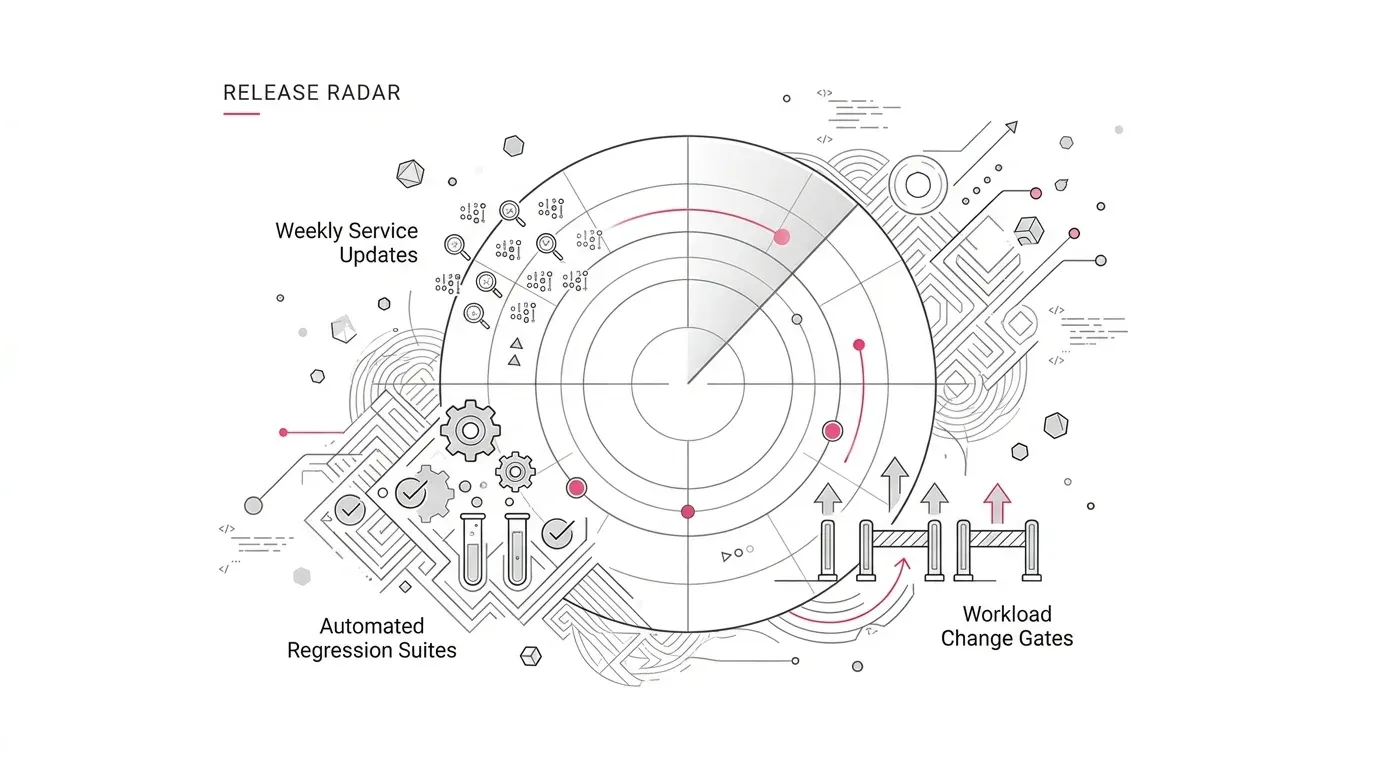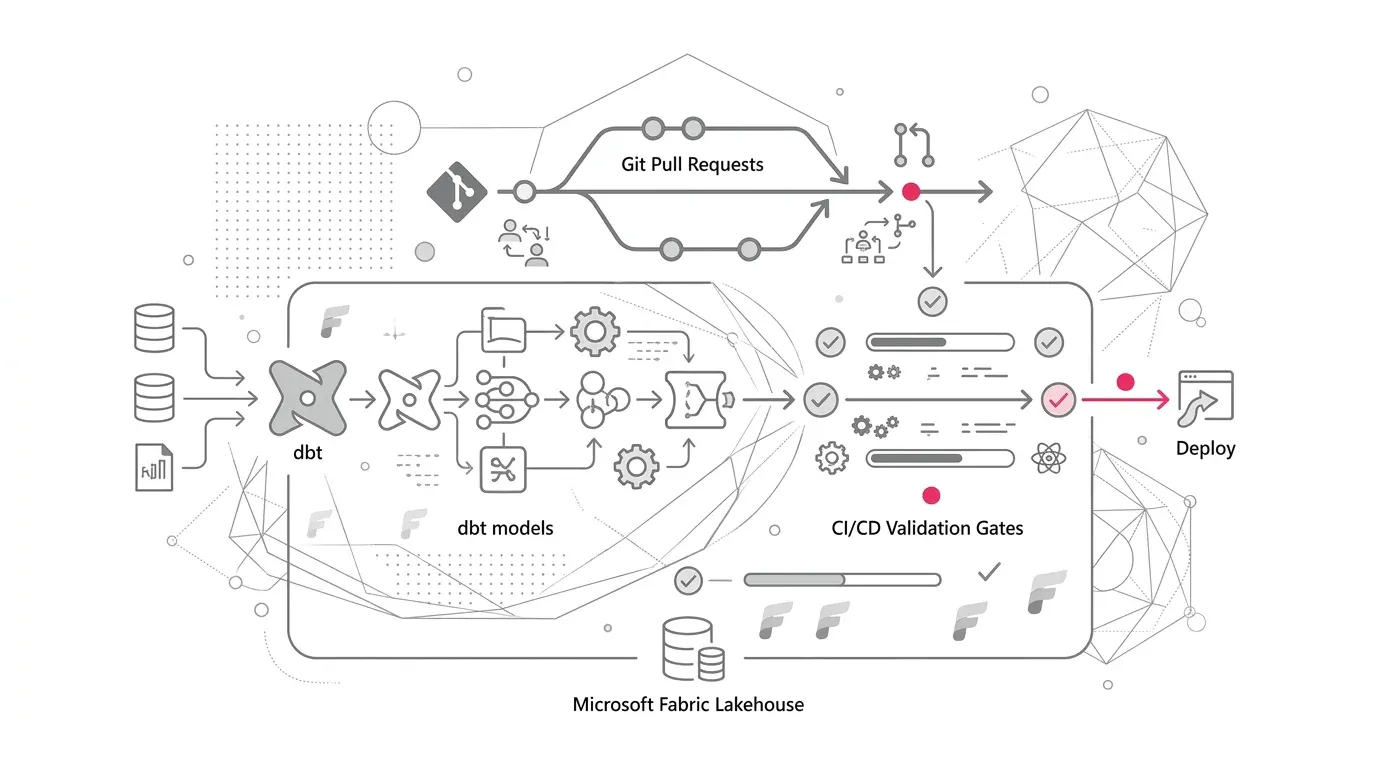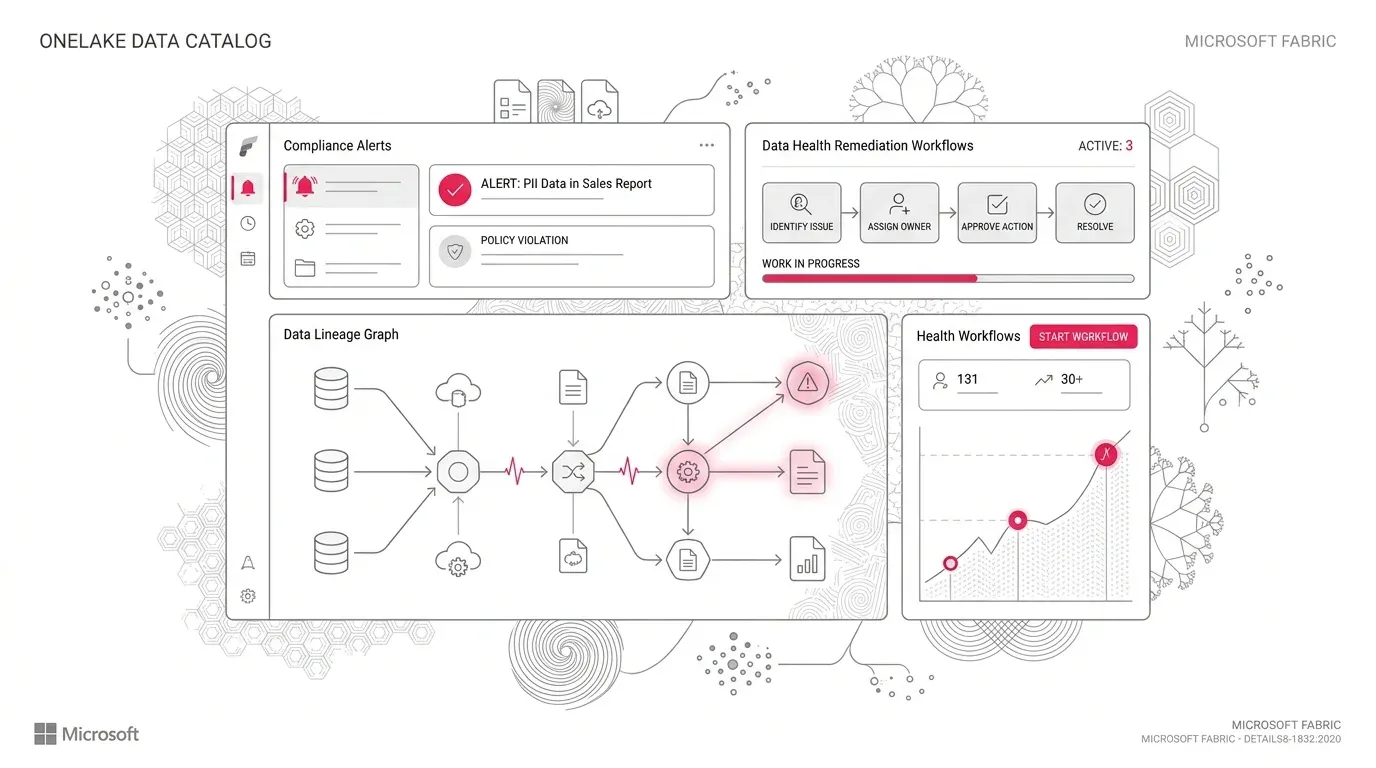
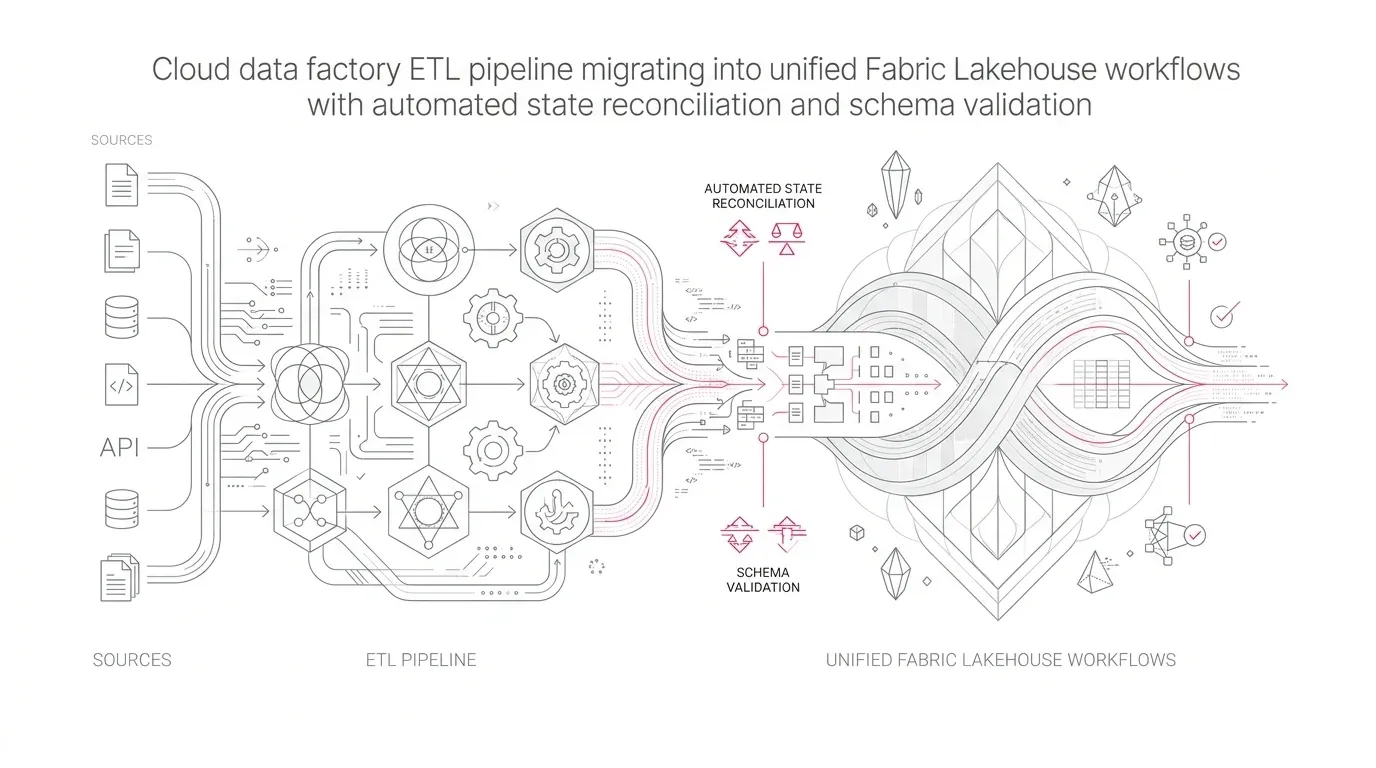
Executive summary
Microsoft now provides an assessment-first, built-in path for upgrading eligible Azure Data Factory (ADF) pipelines to Fabric Data Factory. Enterprises can surface an existing factory in Fabric, run a read-only readiness assessment, map connections, and upgrade selected pipelines incrementally. The source factory remains unchanged, and Microsoft explicitly says ADF remains supported with no forced migration deadline. This makes controlled modernization possible without a one-time cutover. Microsoft documents the complete onboarding and upgrade behavior here.
It does not make migration a conversion-only exercise.
A pipeline can be created successfully in Fabric and still be operationally non-equivalent. It may run under a different identity, use an incorrectly mapped connection, omit a global parameter, apply different scheduling semantics, lose a dependency trigger, consume materially different capacity, or produce plausible but incomplete data. Microsoft also documents that pipelines can be upgraded with unmapped connections, in which case dependent activities are deactivated. A green upgrade status therefore proves artifact creation, not business-service continuity.
The right enterprise objective is decision-equivalent migration: the Fabric workload must deliver the same approved business result, within agreed freshness, security, recovery, performance, and cost boundaries, before the ADF workload is retired.
This article presents a practical way to achieve that objective:
- Inventory complete business services, not isolated pipelines.
- Separate simple conversions from workloads that require redesign.
- define a migration contract for data, time, identity, failure, and cost.
- Establish the Fabric operating foundation before converting production workloads.
- Migrate in dependency-aware waves with automated reconciliation and production-shaped dual runs.
- Cut over consumers only after technical, security, operational, and business evidence passes.
- Retire ADF deliberately, with a time-bound rollback path and auditable approval.
The enterprise problem: successful conversion is not operational equivalence
ADF estates often look like collections of pipelines. In practice, each business outcome depends on a wider execution system:
- linked services and their credentials;
- datasets, paths, schemas, and dynamic expressions;
- global parameters and environment-specific values;
- triggers, calendars, time zones, backfill rules, and dependency chains;
- integration runtimes, gateways, private networking, and firewall rules;
- stored procedures, notebooks, web calls, files, and downstream semantic models;
- monitoring, alert routing, retry behavior, and operator runbooks;
- identity permissions at every source and destination;
- workload concurrency and the shared capacity available at the run window.
The built-in upgrade experience is valuable because it exposes readiness at estate level and supports incremental movement. It does not remove the architectural differences between ADF and Fabric. Microsoft identifies differences in datasets, dynamic connections, global parameters, managed identity, Key Vault integration, pipeline invocation, and scheduling. Some capabilities require explicit redesign rather than translation.
This matters because most enterprise failures are not obvious syntax failures. They are semantic failures:
- a pipeline succeeds after reading yesterday's partition;
- a disabled activity allows the remaining graph to finish;
- an incremental load misses late-arriving records;
- a retry duplicates a non-idempotent write;
- a service principal can reach the source but a workspace identity cannot;
- a schedule fires, but its window and backfill behavior no longer match the business day;
- row counts agree while monetary totals, effective dates, or deletion handling diverge;
- a technically correct migration overloads shared Fabric capacity during the reporting peak.
The consequential problem is therefore not "Can the pipeline be upgraded?" It is "Can the enterprise prove that the migrated data service is still trustworthy?"
Why this matters now
The timing is important for three reasons.
First, Microsoft's new built-in experience makes broad discovery and incremental upgrades materially easier. Teams can view an existing factory from Fabric, inspect pipelines and run history, download a readiness assessment, and upgrade only selected workloads. Microsoft states that viewing the factory does not move execution or billing to Fabric, and that the source remains unchanged until an explicit upgrade is started.
Second, the target is not simply ADF under a new name. Fabric connects orchestration to OneLake, Lakehouse, Warehouse, Dataflow Gen2, semantic models, deployment pipelines, shared governance, and capacity. That creates modernization value, but it also changes operating boundaries.
Third, the built-in pipeline upgrade and the Mapping Data Flow conversion path include preview capabilities. Preview is suitable for controlled evaluation, but critical production use should pass the organization's preview-risk policy, support assessment, security review, and rollback requirements.
The rational response is neither an urgent wholesale migration nor indefinite avoidance. It is a governed, evidence-led program that uses the new assessment tooling to reduce uncertainty while preserving business continuity.
Representative enterprise scenario
Representative scenario: The following is a composite example for illustration. It is not presented as a YuniQ customer case or a claimed result.
A multi-business enterprise operates 430 ADF pipelines across finance, customer operations, supply chain, and regulatory reporting. The estate includes nightly batch ingestion, file-arrival triggers, metadata-driven copy frameworks, Mapping Data Flows, stored-procedure orchestration, REST calls, and on-premises SQL sources through self-hosted integration runtimes.
Leadership wants to consolidate analytics in Microsoft Fabric, reduce fragmented tooling, and make governed OneLake data available to Power BI and AI use cases. The first readiness assessment is encouraging: many copy and basic orchestration pipelines are marked ready, while a smaller group needs review.
The migration team converts a seemingly simple finance wave. All upgraded pipelines are present and several test runs show success. During month-end validation, however, the team discovers four issues:
- one linked service was not mapped, leaving a dependent activity deactivated;
- an ADF global parameter used for the fiscal calendar was never converted;
- a user-assigned managed identity was replaced without granting the workspace identity equivalent source permissions;
- the new schedule reproduced frequency, but not the prior tumbling-window backfill behavior.
None of these failures is solved by re-running the conversion. The organization needs a migration control system that proves complete business behavior across code, configuration, identity, time, data, operations, and economics.
Root causes and consequences
Teams inventory artifacts instead of business services
Pipeline lists rarely show which reports, APIs, reconciliations, machine-learning features, or regulatory submissions depend on the output. They also obscure shared child pipelines, triggers, parameters, service accounts, and manual operator steps.
Consequence: teams move a technically simple pipeline before its upstream or downstream dependencies are ready, then discover the true blast radius during cutover.
Readiness categories are treated as production certification
The Microsoft assessment usefully categorizes pipelines by compatibility. Compatibility answers whether a feature can be upgraded through the supported path. It does not certify business rules, source permissions, output completeness, performance, cost, operational support, or consumer acceptance.
Consequence: "Ready" becomes a false assurance label rather than the start of controlled validation.
Runtime context is hidden in ADF configuration
Global parameters, linked-service expressions, dataset properties, integration-runtime selection, and trigger state can carry as much production logic as the activity graph. Fabric uses different constructs. For example, ADF global parameters move to Fabric Variable Libraries through manual steps; Microsoft says the built-in experience does not automatically upgrade them or rewrite their references.
Microsoft's global-parameter conversion guidance requires manual creation, expression updates, and validation.
Consequence: migrated logic runs with valid but wrong environment values.
Identity and network reachability are assumed to transfer
ADF managed identities and Fabric workspace identities are different security principals. Self-hosted or managed virtual network integration runtimes also require different Fabric connectivity patterns, such as the on-premises data gateway or virtual network data gateway.
Consequence: teams either face outages or grant broad temporary access that becomes permanent security debt.
Trigger equivalence is reduced to "same time, same frequency"
Enterprise scheduling includes windows, dependencies, concurrency, time zones, daylight-saving behavior, retry boundaries, event filters, and backfills. Microsoft documents that custom event and chaining triggers are not supported by the upgrade experience, while tumbling-window workloads require redesign. Fabric interval schedules are themselves preview and currently lack time-slice monitoring and backfill capabilities.
Fabric scheduling documentation describes the current interval-schedule behavior and limitations.
Consequence: data arrives late, duplicates, or silently misses a processing window even though the new schedule appears active.
Validation checks technical status, not business truth
Run success and row counts are necessary but insufficient. They can miss duplicate keys, null drift, incorrect delete handling, aggregate differences, late-arriving records, timezone shifts, and broken downstream filters.
Consequence: the pipeline is green while executive reports or operational decisions are wrong.
Cost is measured after cutover
Fabric pipelines consume Capacity Units (CUs) for orchestration and data movement, while invoked notebooks, Dataflow Gen2 items, warehouses, and other workloads add their own consumption. Shared capacity also introduces concurrency and throttling considerations.
Consequence: a migrated workload meets correctness targets but collides with reporting peaks or exceeds its economic envelope.
Why common migration approaches fall short
"Upgrade everything marked Ready"
This optimizes conversion throughput rather than risk. A technically ready pipeline can still belong to a critical, tightly coupled service. Wave selection should consider business criticality, dependency depth, data sensitivity, recovery requirements, change frequency, and operational ownership alongside compatibility.
"Recreate ADF exactly in Fabric"
Literal replication can preserve weak patterns and is sometimes impossible because the constructs differ. A metadata-driven framework based on dynamic linked services, for example, needs a Fabric-native connection and parameterization design. A Mapping Data Flow using an unsupported flowlet or user-defined function needs deliberate redesign, not cosmetic translation.
"Modernize everything during migration"
Combining platform migration, business-rule change, data-model redesign, and operating-model change in one release makes defects difficult to isolate. Modernization is valuable, but every wave needs a consciously chosen path: preserve behavior first, modernize with separate evidence, or redesign because direct equivalence is unavailable.
"Compare row counts and call it reconciled"
Equal counts can conceal different records and different values. Validation must reflect the decisions the dataset supports: balances, status distributions, effective-date rules, late records, deletions, duplicates, and referential integrity.
"Leave both platforms running until everyone is comfortable"
Unbounded dual running creates duplicate spend, unclear system authority, configuration drift, and operational confusion. Every wave needs an owner, an exit date, explicit rollback conditions, and source-retirement evidence.
A Microsoft Fabric solution: the migration control plane
The recommended architecture separates discovery, target runtime, assurance, and consumption. The built-in upgrade tool belongs in the conversion path, not at the top of the control hierarchy.
                     MIGRATION CONTROL PLANE
  ownership | dependency map | contracts | wave register | evidence
  approvals | exceptions | rollback | retirement | cost baseline
                                  |
        +-------------------------+-------------------------+
        |                                                   |
  SOURCE EXECUTION                                    TARGET EXECUTION
  Azure Data Factory                                  Microsoft Fabric
  - pipelines and triggers                            - Data Factory pipelines
  - linked services                                   - managed connections
  - global parameters                                 - Variable Libraries
  - integration runtimes                              - OPDG / VNet gateway
  - source run evidence                               - workspace identity
        |                                             - Lakehouse / Warehouse
        +-------------------------+-------------------------+
                                  |
                         ASSURANCE LAYER
            schema | keys | counts | aggregates | freshness
            deletes | late data | reruns | access | CU use
                                  |
                         CONSUMER CUTOVER
             semantic models | reports | APIs | operations
Build a dependency and ownership inventory
Start by surfacing ADF in Fabric and downloading the read-only readiness assessment. Enrich it with information the assessment cannot determine on its own:
- business service and decision supported;
- accountable business and technical owner;
- source and destination data stores;
- parent and child pipelines;
- trigger type, window semantics, and calendar rules;
- linked services, authentication methods, and network route;
- global parameters and dynamic expressions;
- downstream reports, semantic models, exports, and APIs;
- data classification and retention requirements;
- recovery point and recovery time objectives;
- peak duration, concurrency, volume, and cost baseline;
- last meaningful use and retirement candidacy.
Use stable IDs for workloads and dependencies. Pipeline names are not reliable control keys when names change or duplicated estates are consolidated.
Classify each workload by migration treatment
Assign one of four treatments:
| Treatment | Use when | Required evidence |
|---|---|---|
| Retire | The output is unused, duplicated, or no longer legally required | Owner approval, consumer search, retention decision |
| Convert | Supported activities and connections can preserve the existing contract | Automated comparison plus operational test |
| Refactor | The outcome stays the same but Fabric-native constructs improve maintainability | Old-versus-new business reconciliation and performance test |
| Redesign | Unsupported features or a material target-architecture change prevent direct equivalence | New design approval, control review, consumer acceptance, rollback plan |
This classification prevents a compatibility score from silently making an architecture decision.
Define an explicit migration contract
For every workload or dependency group, write the acceptance contract before conversion:
- Data contract: schema, types, keys, nullability, delete semantics, late-data rules, and quality thresholds.
- Time contract: trigger condition, timezone, business calendar, expected completion, window coverage, and backfill behavior.
- Identity contract: execution identity, connection owner, source and destination permissions, secret handling, and audit principal.
- Failure contract: retry policy, idempotency, checkpoint or watermark behavior, alert destination, recovery procedure, and maximum replay period.
- Service contract: freshness, availability, performance, and downstream consumer expectations.
- Economic contract: allowed CU range per run, daily peak contribution, data-movement volume, and acceptable parallel-run cost.
The contract turns validation from subjective confidence into a release gate.
Establish the target operating foundation first
Before production waves, prepare:
- domain-aligned development, test, and production workspaces;
- least-privilege Microsoft Entra groups and workspace roles;
- environment-specific workspace identities and approved connections;
- on-premises data gateway or virtual network gateway patterns where required;
- Variable Libraries for environment configuration, with run-time values retained as pipeline parameters;
- Git integration and/or Fabric deployment pipelines;
- naming, tagging, folder, ownership, and support conventions;
- workspace monitoring, pipeline alerts, and Capacity Metrics access;
- release evidence storage and an exception register.
Fabric Data Factory CI/CD supports item-level Git and deployment pipelines, and Microsoft recommends separate workspaces for development, test, and production. Treat connections, identity grants, network rules, and active variable value sets as runtime configuration that must be verified after deployment, not assumed from source control alone.
Convert with controlled automation
Use the built-in experience in this order:
- View the source factory in Fabric without changing execution.
- Capture and version the readiness assessment.
- Select a complete dependency group, not an arbitrary list of ready pipelines.
- Map every linked service to an approved Fabric connection.
- Block release if any required activity is deactivated.
- Convert ADF global parameters to Variable Libraries and rewrite every reference.
- Replace integration-runtime and identity patterns deliberately.
- Upgrade eligible pipelines in a nonproduction workspace.
- Review the generated items, including schedules, connection references, expressions, disabled state, and item dependencies.
- Promote through controlled CI/CD and revalidate target-specific runtime configuration.
Microsoft's upgrade tool preserves the original ADF pipelines, which is useful for parallel validation. Do not interpret that preservation as a rollback strategy by itself; rollback also requires intact triggers, credentials, source capacity, operator access, and a clear decision on any data written by the Fabric run.
Validate at five levels
Level A: definition
Compare activities, expressions, parameters, variable references, dependencies, trigger definitions, source and destination paths, and failure branches.
Level B: security and connectivity
Test approved and denied identities. Confirm source read, destination write, secret resolution, private-network reachability, and audit attribution. Include negative tests so excessive privilege is visible.
Level C: data and business rules
For the same bounded input window, compare:
- schema and type compatibility;
- row counts by partition and business key;
- duplicate and null rates;
- cryptographic or deterministic hashes where appropriate;
- sums, balances, quantities, and status distributions;
- insert, update, delete, and late-arrival behavior;
- representative business rules and downstream KPI results.
Define tolerances in advance. A permitted variance should have a business explanation, not merely a percentage.
Level D: operational behavior
Test first run, incremental run, empty input, late data, duplicate input, partial source failure, retry, rerun from failure, concurrency, backfill, cancellation, and recovery. Confirm that alerts reach an owned group and the runbook contains enough evidence to diagnose the failure.
Level E: performance and economics
Compare end-to-end decision freshness, throughput, peak concurrency, and CU consumption. Microsoft's pipeline pricing guidance says pipeline orchestration and data movement are metered separately, while invoked items add their own consumption. Use the Capacity Metrics app to baseline observed CU use rather than estimating solely from elapsed time.
Cut over the consumer, not just the pipeline
A producer is not migrated until its consumers use and trust the new output. Cutover should include:
- semantic model and report connection changes;
- cache or refresh coordination;
- API, export, and downstream pipeline updates;
- data-owner and business-owner acceptance;
- support handover and on-call readiness;
- a declared system of record for the migration window.
Use one authoritative writer wherever possible. If source and target both write, isolate outputs or design idempotent merge and reconciliation logic to prevent duplicate effects.
Retire ADF with evidence
After the observation period:
- Disable source triggers without deleting the source definition.
- Confirm no unexpected ADF runs or downstream reads occur.
- Preserve required run history, configuration, audit, and reconciliation evidence.
- Remove obsolete secrets and permissions.
- Update support documentation and service ownership.
- Retire the ADF workload after the rollback window closes and the owner approves.
Do not leave an indefinitely dormant factory with live credentials and ambiguous ownership.
Phased implementation roadmap
Phase 0: Mandate and guardrails (1-2 weeks)
- Define business objectives, scope, decision rights, and preview-use policy.
- Establish migration treatments, evidence standards, exception expiry, and rollback authority.
- Select initial domains and agree success metrics.
Exit gate: accountable executive, platform, security, data, and service owners approve the control model.
Phase 1: Estate discovery and assessment (2-4 weeks)
- Surface factories in Fabric and run the read-only assessment.
- Build the enriched dependency and ownership inventory.
- Identify unused workloads and high-risk patterns.
- Baseline run reliability, duration, freshness, and cost.
Exit gate: every in-scope workload has an owner, treatment, dependency group, and criticality rating.
Phase 2: Fabric foundation and pilot (3-6 weeks)
- Create workspace topology, identities, connections, Variable Libraries, gateways, CI/CD, monitoring, and access controls.
- Pilot one representative but bounded service with realistic data and production-like security.
- Validate the complete contract, not only pipeline execution.
Exit gate: the pilot meets correctness, security, recovery, performance, operability, and CU thresholds.
Phase 3: Migration waves (iterative)
- Prioritize high-value, lower-coupling services, then increase complexity.
- Convert complete dependency groups.
- Run automated reconciliation and production-shaped dual operation for a defined period.
- Record evidence and exceptions per wave.
Exit gate: no critical discrepancy remains open, consumer owners accept the result, and rollback remains executable.
Phase 4: Cutover and stabilization (per wave)
- Change consumer endpoints and declare Fabric authoritative.
- Intensify monitoring for freshness, failure, business reconciliation, and capacity.
- Resolve any temporary exception within its expiry period.
Exit gate: the service remains within its contract through an agreed peak or business cycle.
Phase 5: Retirement and optimization
- Disable and retire superseded ADF assets.
- Remove credentials, network access, and obsolete operational jobs.
- Refactor remaining preserved patterns where modernization value is proven.
- Feed actual effort, CU use, and defects into later wave planning.
Exit gate: no active consumer, credential, trigger, or support obligation remains on the retired path.
Governance, security, adoption, and cost considerations
Governance
- Make the business owner accountable for data acceptance and the platform owner accountable for technical evidence.
- Require a named owner and expiry date for every exception.
- Track lineage from source through Fabric data product to the consuming semantic model or process.
- Distinguish preview acceptance from production acceptance.
- Preserve assessment, test, approval, deployment, and retirement evidence for audit.
Security
- Grant each target identity the minimum access required; do not clone broad ADF-era grants without review.
- Use environment-specific identities so development cannot reach production data by default.
- Test both allow and deny paths after connection mapping and deployment.
- Review optional workspace access added during ADF onboarding. Microsoft notes that later ADF role changes are not synchronized and access is not automatically removed.
- Avoid placing sensitive configuration into general-purpose AI prompts; Microsoft recommends validating AI-assisted migration output in development and using automated tests.
Adoption and operating model
- Train operators on Fabric monitoring, run relationships, retry behavior, alert management, and capacity interpretation.
- Train engineers on Variable Libraries, managed connections, workspace identity, item-level CI/CD, and Fabric-native alternatives.
- Assign service ownership across the full data product, not separate uncoordinated owners for pipeline, Lakehouse, and report.
- Run a support simulation before production cutover: expired credential, blocked gateway, schema change, and late source arrival.
Cost and capacity
- Baseline ADF cost and workload shape before migration, including peak overlap.
- Measure Fabric pipeline orchestration, data movement, invoked-item consumption, OneLake storage, and dual-run overhead.
- Test the production calendar, not a quiet development window.
- Separate one-time migration cost from steady-state run cost.
- Use observed Capacity Metrics data to decide whether to optimize, reschedule, isolate, or resize.
Success metrics
Use a balanced scorecard. Migration velocity alone encourages unsafe shortcuts.
| Dimension | Example metric | Recommended interpretation |
|---|---|---|
| Coverage | Percentage of in-scope services with owner, dependency map, and migration contract | Measures control completeness, not conversion |
| Correctness | Percentage of reconciliation checks within preapproved tolerance | Must include business aggregates, not row counts alone |
| Freshness | P95 decision age versus agreed service objective | Measures when consumers can safely decide |
| Reliability | Successful service runs divided by expected runs | Count missing triggers as failures |
| Recovery | Percentage of critical failure scenarios recovered within target | Proves rerun and rollback behavior |
| Security | Unapproved access paths or excessive grants found after cutover | Target zero; include negative-path tests |
| Operability | Mean time to detect and restore failed services | Measure end to end, not only activity restart |
| Economics | CU per successful business run and peak CU contribution | Compare by equivalent workload and data volume |
| Adoption | Percentage of consumers using the Fabric-authoritative output | Prevents false completion while users remain on ADF outputs |
| Retirement | Migrated services with source triggers, credentials, and assets retired on schedule | Exposes unbounded dual-running debt |
How YuniQ can help
YuniQ's published Microsoft Fabric services align directly with this migration problem. Its Microsoft Fabric consulting and implementation offering includes:
- current-state platform and workload diagnostics, use-case prioritization, capacity planning, workspace topology, and security and operating-model design;
- pipeline, dependency, and data-flow mapping, workload rationalization, phased migration waves, automated reconciliation, parallel-run validation, and legacy retirement;
- Fabric Data Factory pipelines and dataflows, Lakehouse and Warehouse implementation, Spark and Delta frameworks, and data-quality observability;
- Microsoft Entra least-privilege design, Purview integration, lineage, development/test/production separation, Git and CI/CD, monitoring, and capacity threshold alerts;
- a delivery framework spanning discovery, architecture, proof, migration and build, validation and launch, and optimization and scale.
Applied to an ADF-to-Fabric program, this means YuniQ can help turn Microsoft's readiness and upgrade capabilities into an enterprise migration system: defining the target architecture, grouping dependencies into safe waves, implementing Fabric-native runtime controls, automating business reconciliation, validating production cutover, and establishing the monitoring and governance needed after launch.
The useful boundary is clear: the built-in upgrade experience accelerates compatible artifact conversion; YuniQ's relevant role is the architecture, engineering, validation, governance, and operating work required to make the migrated service trustworthy.
Practical next steps
- Select one ADF factory and surface it in Fabric without starting an upgrade.
- Download the readiness assessment and enrich it with owners, consumers, triggers, identities, networking, parameters, criticality, and current cost.
- Choose one dependency-complete pilot that is meaningful but reversible.
- Write its data, time, identity, failure, service, and economic contracts before conversion.
- Establish the nonproduction Fabric workspace, connection, identity, Variable Library, CI/CD, monitoring, and capacity baseline.
- Upgrade and validate the pilot across definition, security, data, operations, and economics.
- Use the measured evidence to define wave size, effort, risk, and business case for the broader estate.
The first milestone should not be "pipelines converted." It should be "one business data service proven equivalent, supportable, and ready to retire safely from ADF."