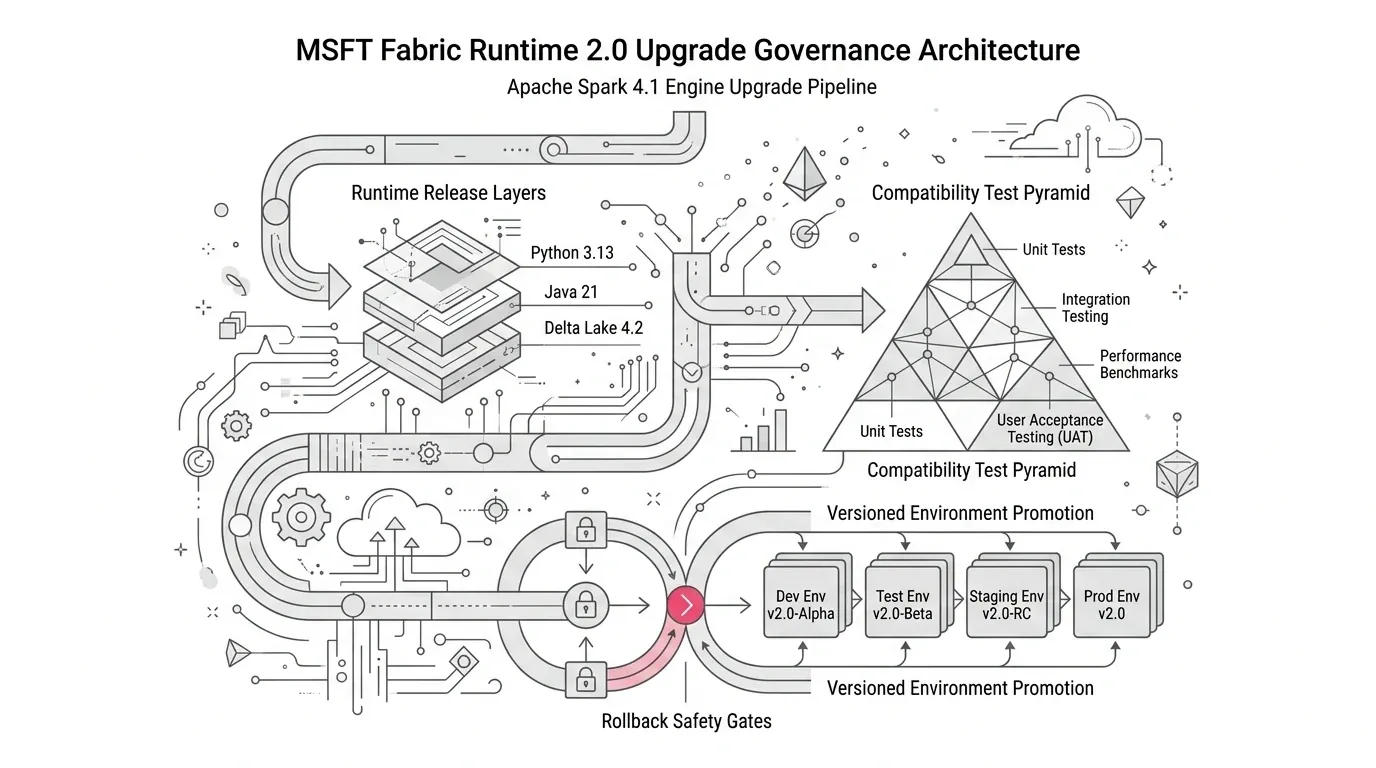
Microsoft Fabric Runtime 2.0 is generally available, and it is a material platform change rather than a routine patch. It moves Fabric Spark workloads to Apache Spark 4.1 , Python 3.13 , Java 21, Scala 2.13, Delta Lake 4.2 , and Azure Linux 3.0. As of September 25, 2026, Microsoft documentation still describes Runtime 2.0 as opt-in and says it is planned to become the default for new workspaces and environment items in late September 2026. Microsoft also recommends the latest generally available runtime for production, while its runtime overview currently labels Runtime 1.3 as EOSA, or end of support announced. Review official documentation on Microsoft Fabric Runtime 2.0 and Apache Spark runtimes in Fabric .
The enterprise problem is not simply whether a notebook starts. A runtime upgrade can change package resolution, language behavior, Java or Scala binary compatibility, SQL semantics, Delta table features, operating-system dependencies, and execution performance. A pipeline may finish successfully yet produce different row counts, null behavior, timestamps, decimals, or table protocols. Those are business-control failures, not merely engineering defects .
The answer is to manage the runtime as a versioned production dependency. Inventory the workloads and their consumers, attach them to governed Fabric environment items, reproduce the current baseline, test Runtime 2.0 against representative data, promote code and environment definitions together, and keep a time-bounded rollback path. Then convert the one-off migration into a recurring validation process by testing Fabric's early-access release channel outside production.
This article provides that operating model. The timelines and thresholds are recommended controls, not Microsoft service guarantees.
The Enterprise Problem: A Managed Service Can Still Create Unmanaged Change
Fabric removes much of the infrastructure work associated with operating Spark, but an enterprise still owns the compatibility of its code, libraries, data contracts, and downstream consumers. That boundary matters now because Runtime 2.0 changes several architectural layers simultaneously:
| Layer | Runtime 1.3 | Runtime 2.0 | Why an Enterprise Should Care |
|---|---|---|---|
| Apache Spark | 3.5.5 | 4.1 | SQL, DataFrame, streaming semantics, and internal configuration keys can change |
| Python | 3.11 | 3.13 | Wheels, compiled extensions, removed CPython internals, and application code need validation |
| Java | 11 | 21 | Custom JARs, database drivers, and bytecode assumptions may require rebuilding or replacement |
| Scala | 2.12.17 | 2.13.16 | Scala artifacts are compiled for a specific binary version and cannot cross major releases |
| Delta Lake | 3.2 | 4.2 | Table features and protocol changes can lock out non-Spark readers and downstream engines |
| Operating System | Mariner 2.0 | Azure Linux 3.0 | Native system packages, shared libraries, and OS-level dependencies can behave differently |
The component versions above are documented by Microsoft. They are also why a workspace-wide switch should be the end of an upgrade program , not its first step.
Four characteristics make this a consequential enterprise risk:
- The blast radius is hidden: A shared environment or workspace default can impact dozens of notebooks and Spark job definitions on their next execution. Workloads invoked indirectly by pipelines may fail without the business owner knowing Spark is in the execution path.
- Technical success is weaker than business equivalence: A green run status does not prove that balances reconcile, late-arriving records are handled consistently, slowly changing dimensions behave as expected, or downstream semantic models see the same contract.
- Data writes can outlive the rollback: Code can be reverted in seconds. An incompatible Delta table protocol upgrade or corrupted partition may persist in OneLake after the producing notebook is rolled back.
- The upgrade alters capacity cost as well as compatibility: Runtime changes, shuffle behavior, dynamic allocation, and compute settings can alter execution duration and Capacity Unit (CU) consumption.
A Representative Enterprise Scenario
Consider a representative enterprise with 140 production notebooks and Spark job definitions across finance, customer operations, and regulatory reporting. The workloads share several Fabric environments. Some notebooks use public Python packages, some rely on internal wheels, and two high-volume ingestion jobs use custom Java libraries. Fabric pipelines orchestrate most runs, while Power BI Direct Lake and a SQL analytics endpoint consume the resulting Gold tables.
The platform team changes a development workspace to Runtime 2.0 and executes five visible notebooks. All five complete. It then changes the production workspace default during a weekend release.
On Monday morning, a cascade of operational issues emerges :
- A low-frequency monthly job fails because an internal wheel has no Python 3.13-compatible build
- A Scala integration library throws ClassNotFoundException because it lacks a 2.13 artifact
- A transformation still succeeds but produces nulls for invalid casts under stricter Spark 4.1 ANSI SQL behavior
- A team enables a Delta 4.x-specific capability on a shared Gold table, locking out the SQL analytics endpoint
- Another job runs 40% longer because shuffle heuristics and execution plans changed
- Incident responders cannot quickly prove which environment definition, package set, runtime image, code commit, and input snapshot produced the affected output
No single mistake caused the incident. The failure came from treating a production runtime as a workspace preference instead of a governed dependency with owners, evidence, release gates, and rollback boundaries.
Root Causes and Consequences
1. Workloads Inherit Configuration Implicitly
Fabric lets a notebook or Spark job definition use a workspace default or attach to an environment item. The workspace default is convenient, but convenience becomes ambiguity when teams cannot answer which runtime and package snapshot a production workload used. Fabric environments exist to define Spark runtime, compute, libraries, and small resource files for repeatable use across notebooks and jobs. Learn more about how to create, configure, and use a Fabric environment .
2. Libraries Are Specified, but Not Governed as a Release Unit
Loose package ranges, session-level installations, undocumented JARs, and developer-specific setup make an upgrade nondeterministic. A successful installation today does not prove that the same transitive dependencies will resolve later. Fabric's Full library publishing mode resolves dependencies, validates compatibility, and creates a stable snapshot; Microsoft describes it as the better fit for production workloads and pipelines. Learn how to manage libraries in Fabric environments .
3. Testing Focuses on Execution Rather than Contracts
Runtime migration tests often ask, " Did it run? " Production assurance should ask:
- Did it process the expected input window without data loss?
- Did primary-key uniqueness and referential integrity remain intact?
- Did row counts, totals, null rates, and statistical distributions stay within approved tolerances?
- Did timestamps, decimals, encodings, and time zones retain their intended meaning?
- Can every required Fabric engine still read the resulting Delta table?
- Did execution duration and capacity consumption remain inside the service objective?
4. Code and Environment Promotion Are Separated
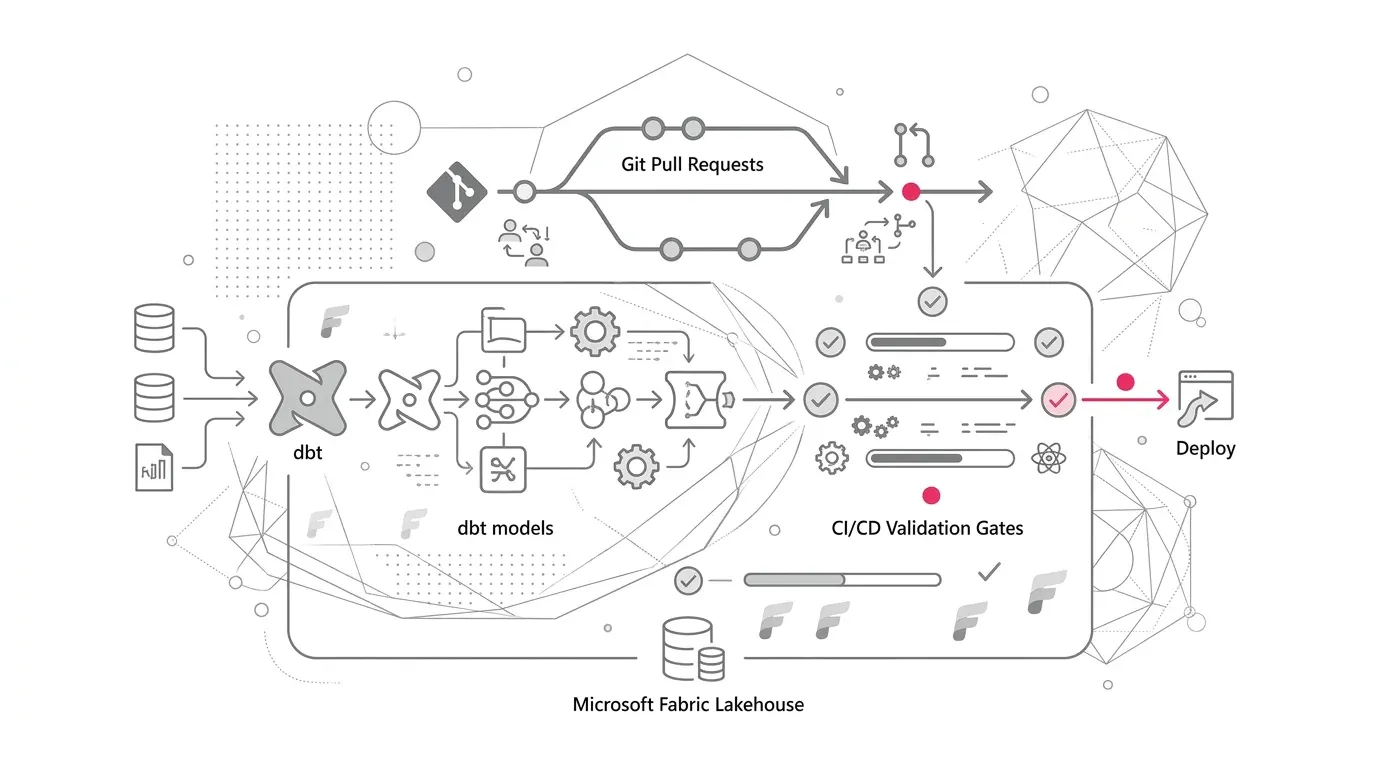
A notebook may be versioned while its runtime and libraries are changed manually. That creates a release that cannot be reconstructed. Fabric can serialize an environment's libraries and Spark compute settings, including runtime selection, into Git-tracked files. Notebook deployment can preserve the binding to a corresponding environment when both items are committed and promoted together. Review documentation on environment Git integration and deployment pipelines as well as notebook source control and deployment .
5. Rollback Is Defined Only for Code
If an upgrade writes an incompatible schema, changes a checkpoint, or enables a table feature that another engine cannot consume, pointing the notebook back to the old runtime may not restore service. Microsoft explicitly warns that Delta Lake 4.2-specific features are experimental and only work in Spark experiences, and its interoperability matrix shows that feature support varies across Fabric workloads. Review the Delta Lake table format interoperability matrix.
Why Common Upgrade Approaches Fall Short
- "Change the workspace default and fix failures": Discovers only catastrophic defects after the blast radius has expanded across all shared jobs.
- "Test one notebook per team": Code volume is not a useful sampling frame. Workloads must be selected by dependency risk (libraries, languages, formats, downstream consumers).
- "Pin every workload forever": Pinning creates a temporary window, not a durable strategy. Unsupported runtimes lose fixes and security remediation (e.g. Runtime 1.2 EOS on March 31, 2026).
- "A row-count match proves equivalence": Equal counts can conceal changed values, duplicate keys, shifted timestamps, altered decimal precision, or misclassified records.
- "Rollback means redeploy the old notebook": Code rollback does not undo Delta table protocol upgrades, corrupt checkpoints, or un-reconciled downstream writes.
The Microsoft Fabric Solution: A Runtime Release System
Treat runtime change as a repeatable release process with five unified control planes:
Microsoft runtime release / early-access channel
                    |
                    v
        Compatibility validation workspace
        - candidate Fabric environment
        - pinned libraries and custom binaries
        - production-like data and security
        - automated functional, data, and performance tests
                    |
             evidence + approval
                    v
     Development -> Test/UAT -> Production workspaces
        code + environment + bindings promoted together
                    |
                    v
    Spark monitoring + reconciliation + capacity evidence
                    |
          hold, roll forward, or roll back
Control Plane 1: Inventory and Ownership
Create a runtime register for every production notebook and Spark job definition. At minimum, record:
| Field | Governance Purpose |
|---|---|
| Business service and owner | Establishes operational impact and release authority |
| Item, workspace, and orchestration path | Reveals direct execution and pipeline-driven invocation |
| Current runtime and attached environment | Identifies implicit inheritance and shared blast radius |
| Public packages, internal wheels, JARs, and OS dependencies | Drives static and runtime compatibility tests |
| Inputs, outputs, checkpoints, and write mode | Defines replayability and rollback recovery boundaries |
| Downstream Fabric experiences and external consumers | Defines cross-engine interoperability test scope |
| Schedule, duration, peak memory, and criticality | Supports wave planning and capacity baseline reconciliation |
| Data controls and reconciliation rules | Defines business equivalence criteria beyond row counts |
Control Plane 2: Explicit, Versioned Fabric Environments
Create separate current and candidate environment items, for example fin-batch-prod-rt13-v7 for the known production baseline and fin-batch-candidate-rt20-v1 for Runtime 2.0 validation. Attach production notebooks explicitly rather than relying on workspace defaults.
Version environment definitions with the code they execute. A release record should link the notebook or job revision, environment revision, published library set, runtime, configuration, test evidence, approval, and deployment time. Fabric Git integration tracks environment libraries and Spark compute, but teams must remember that Git updates the environment's staging state and changes must be published to take effect.
Control Plane 3: A Compatibility Test Pyramid
Run tests in increasing order of execution cost and business scope across five distinct layers:
- Level 1: Static compatibility: Verify every Python wheel supports 3.13, every Scala library has a 2.13 build, every JAR supports Java 21, and resolve the entire dependency graph.
- Level 2: Component tests: Execute reusable transformation functions against fixed test vectors, validating invalid casts, null handling, time zones, and decimal precision.
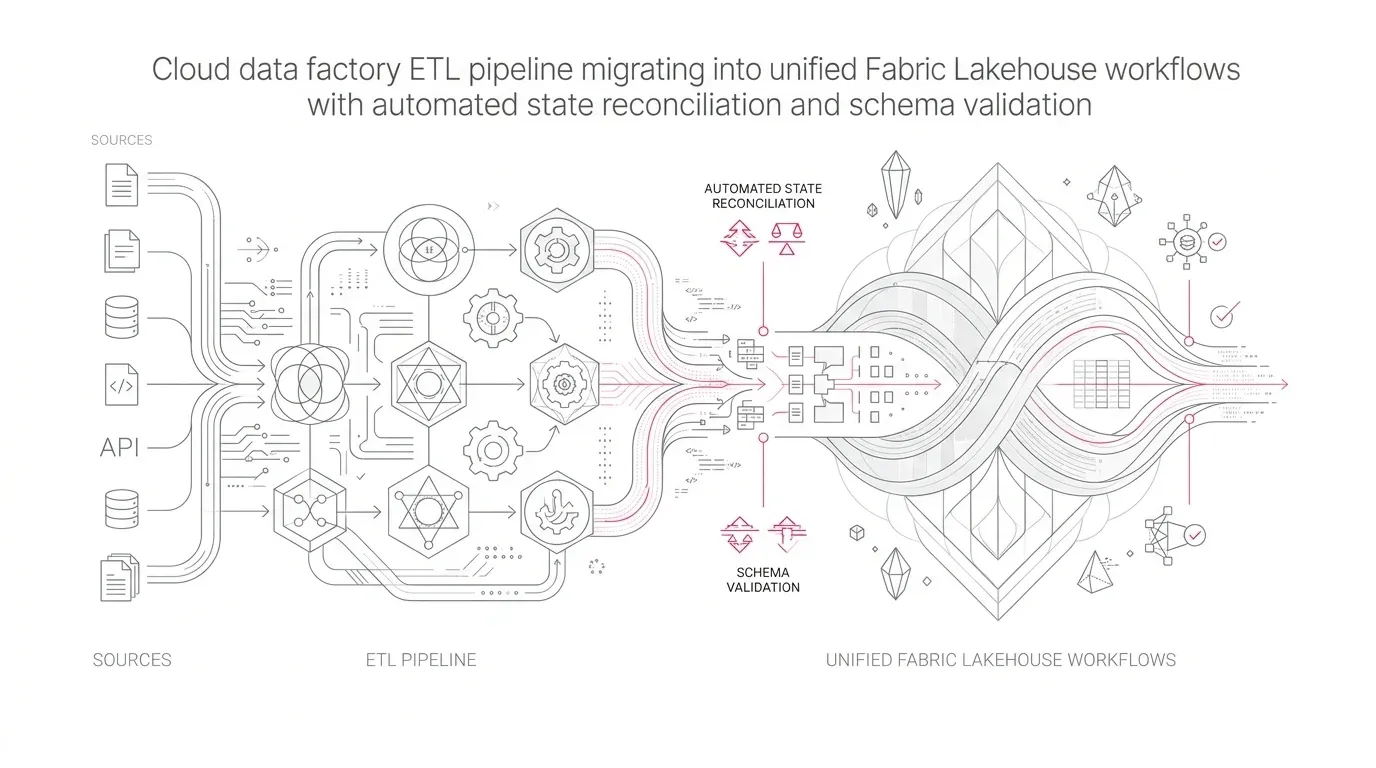
- Level 3: Data-contract tests: Execute full jobs against production-representative data slices, validating primary keys, statistical distributions, and reconciliation rules against Runtime 1.3 outputs.
- Level 4: Cross-engine interoperability: Verify that SQL analytics endpoints, Direct Lake semantic models, Dataflows Gen2, and external Delta readers can consume output tables without protocol lockouts.
- Level 5: Performance, scale, and resilience: Compare application duration, shuffle volume, memory footprints, and Capacity Unit (CU) consumption using Fabric's Spark application comparison view.
Fabric's Spark application comparison view can compare completed runs of the same item and highlight duration and resource deltas. See how to compare Apache Spark application runs .
Control Plane 4: Progressive Deployment and Reversible Writes
Promote the notebook or Spark job definition, its environment, and its bindings as one release unit through Development, Test/UAT, and Production. Use a canary wave for a small set of representative production workloads before changing broader defaults.
Each production cutover requires four explicit release decisions:
- Entry gate: All functional, data contract, security, interoperability, and performance tests pass with owner sign-off
- Observation window: Heightened monitoring covers at least one complete business cycle (e.g. daily, weekly, or month-end close)
- Rollback point: The previous environment remains published and attachable for a defined safety period
- Data recovery method: Output tables are isolated, versioned, or replayable with explicit checkpoint rollback handling
Control Plane 5: Continuous Runtime Assurance
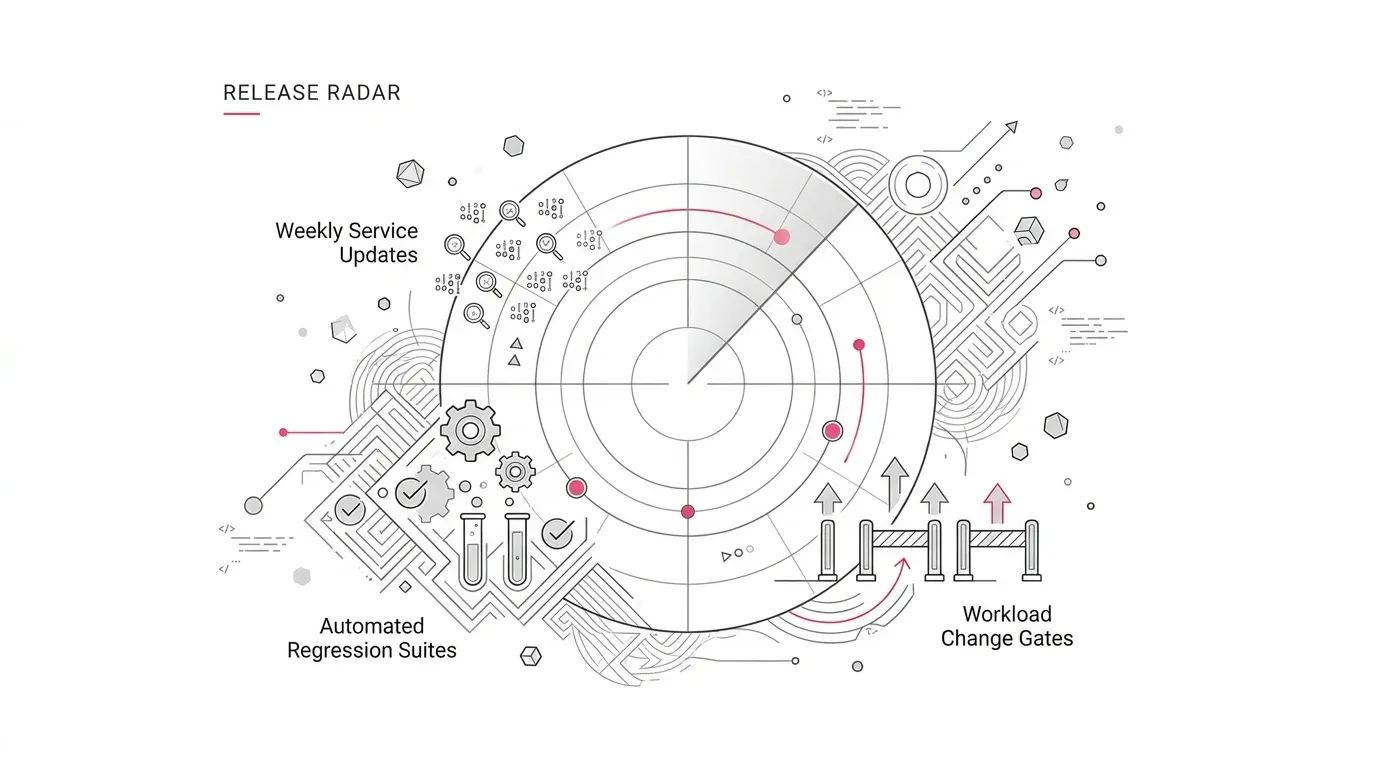
The Runtime 2.0 migration should establish a durable platform rhythm. Fabric runtime release channels provide a default channel and an early-access channel. Early access contains upcoming updates and library changes scheduled to become the next default, allowing customers to test workloads before promotion.
A Phased Implementation Roadmap
- Phase 0: Contain immediate exposure (Days 1–3): Freeze unreviewed workspace-default changes, inventory critical workloads, and flag unsupported Runtime 1.2 jobs.
- Phase 1: Discover and baseline (Week 1): Build the runtime register, capture baseline output controls, and classify workloads by technical compatibility risk.
- Phase 2: Build the candidate lane (Week 2): Create Runtime 2.0 candidate environments, rebuild internal wheels for Python 3.13/Scala 2.13, and put definitions under Git control.
- Phase 3: Validate by migration wave (Weeks 2–4): Run static, component, data-contract, cross-engine, and performance tests; obtain data owner sign-offs.
- Phase 4: Release progressively (Weeks 4–6): Promote low-risk canaries first, observe full business cycles, and expand waves only as prior gates pass.
- Phase 5: Institutionalize the process (Ongoing): Execute automated regression suites against the early-access channel on a fixed cadence.
Enterprise Scorecard: Runtime 2.0 Release Metrics
Track readiness across eleven measurable governance dimensions rather than relying solely on migration velocity:
| Dimension | Release Metric | Target Threshold |
|---|---|---|
| Coverage | Production Spark workloads documented in runtime register | 100% |
| Control | Critical workloads explicitly attached to a versioned environment | 100% |
| Compatibility | Critical workloads passing the approved regression suite | 100% before promotion |
| Data Integrity | Unapproved reconciliation exceptions on business outputs | 0 |
| Interoperability | Required downstream engines tested for shared Gold tables | 100% |
| Performance | Runtime duration and capacity variance vs baseline | Within workload tolerance |
| Reliability | Failed production runs attributable to runtime migration | 0 |
| Recovery | Critical-workload rollback rehearsed within time objective | 100% |
| Currency | Production workloads operating on an approved, supported runtime | 100% (excl. active exceptions) |
| Governance | Runtime exceptions with named owner and firm expiry date | 100% |
| Change Readiness | Representative workloads exercised on Fabric early-access channel | Every release cycle |
How YuniQ Accelerates Fabric Runtime Governance
YuniQ provides end-to-end Microsoft Fabric consulting and engineering services to help enterprise data teams migrate to Runtime 2.0 safely and systematically:
- Readiness & Workload Diagnostics: Auditing workspace topologies, environment bindings, Spark dependencies, and capacity allocation.
- Data Engineering Implementation: Remediating Python 3.13 and Scala 2.13 package incompatibilities, optimizing Delta 4.2 table configurations, and implementing automated reconciliation frameworks.
- DevOps & Governance Architecture: Establishing Git-integrated environment promotion pipelines, Dev/Test/Prod branch policies, and automated validation gates.
- Production Dual-Run Validation: Conducting shadow runs, performance comparisons, and cross-engine testing across SQL analytics endpoints and Power BI Direct Lake.
Upgrade to Fabric Runtime 2.0 with Confidence
YuniQ partners with enterprise data teams to execute controlled, zero-downtime Microsoft Fabric runtime upgrades. From dependency remediation to automated data-contract validation, ensure your Spark pipelines deliver total business continuity.
Explore Microsoft Fabric Consulting