Microsoft Fabric delivery teams can maintain a sound source-control workflow and still discover that production promotion is blocked at the final gate. The underlying fault line is authorization: a deployer or automation identity may hold workspace Contributor and deployment-pipeline administrator roles, yet lack read-write access to a single protected item in the target workspace.
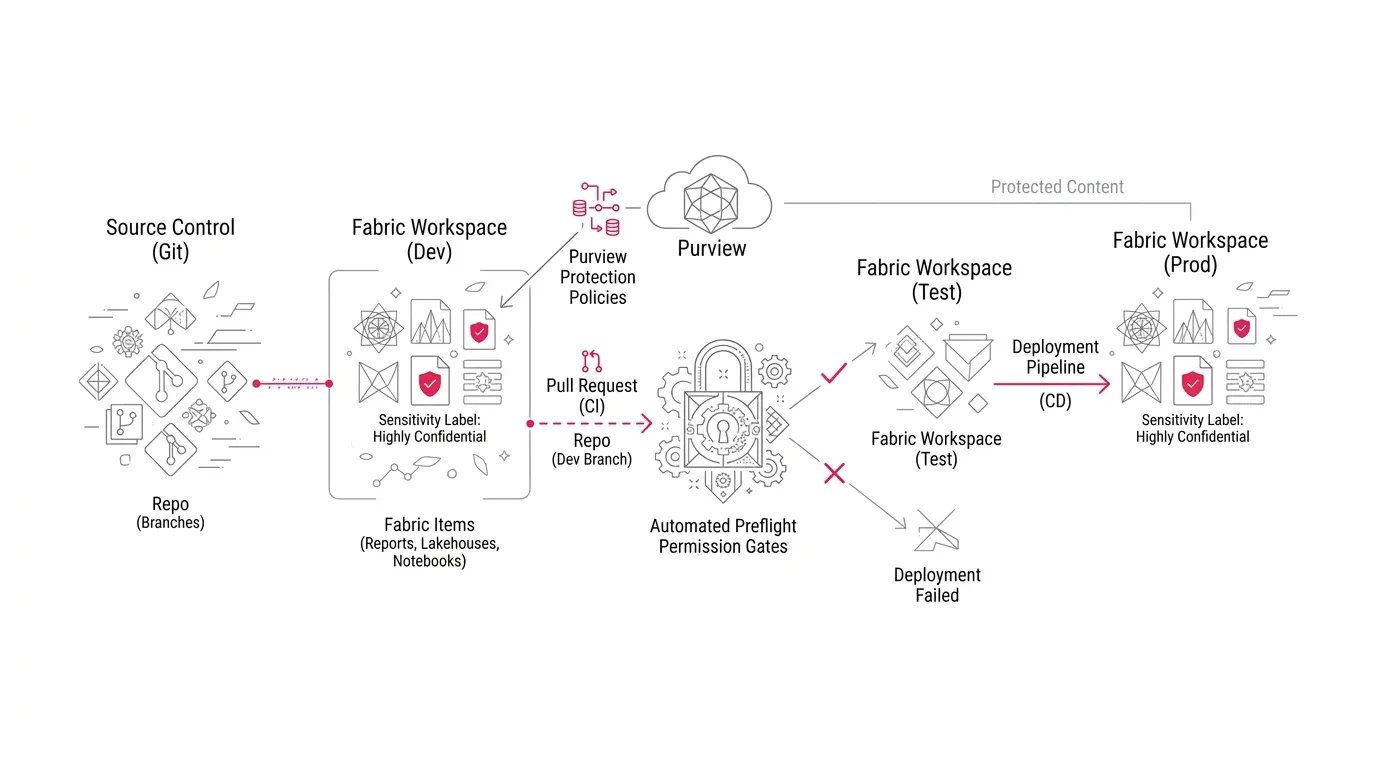
Core DevOps Principle: Starting December 1, 2026, Microsoft Fabric enforces strict item-level read-write requirements across Git integration and deployment pipelines. Pipelines cannot deploy to workspaces containing items protected by Purview sensitivity labels unless the release identity possesses explicit read-write permissions across all workspace items.
This enforcement fundamentally changes Fabric release management, requiring organizations to reconcile workspace roles, deployment pipeline permissions, Purview protection policies, and automation service principals.
The Enterprise Collision: Green Builds vs. Protected Authorization
In Microsoft Fabric, protection policies associate sensitivity labels with granular access rules. Labeled lakehouses, warehouses, notebooks, and semantic models restrict access strictly to authorized security groups. However, Fabric CI/CD deployment pipelines historically evaluated workspace-level roles.
The December 1 enforcement eliminates this gap. If a release manager or CI/CD service principal lacks read-write access to any protected item in the destination workspace, the entire deployment pipeline promotion or Git synchronization fails.
Four Critical Release Risks to Mitigate
- 1. Deployment Deadlocks: Scheduled quarter-end finance or regulatory reporting updates are blocked during production promotion due to item-level policy restrictions.
- 2. Emergency Over-Permissioning: Under release deadline pressure, administrators grant standing Admin roles to release personnel, eroding least-privilege governance.
- 3. Production Drift: Teams resort to manual hotfixes directly in production workspaces, breaking synchronization with Git repositories.
- 4. False Build Assurance: Continuous integration checks validate notebook syntax and semantic model metadata, but fail to test production identity authorization.
Reference Release Architecture: The Protected-Content CI/CD Model
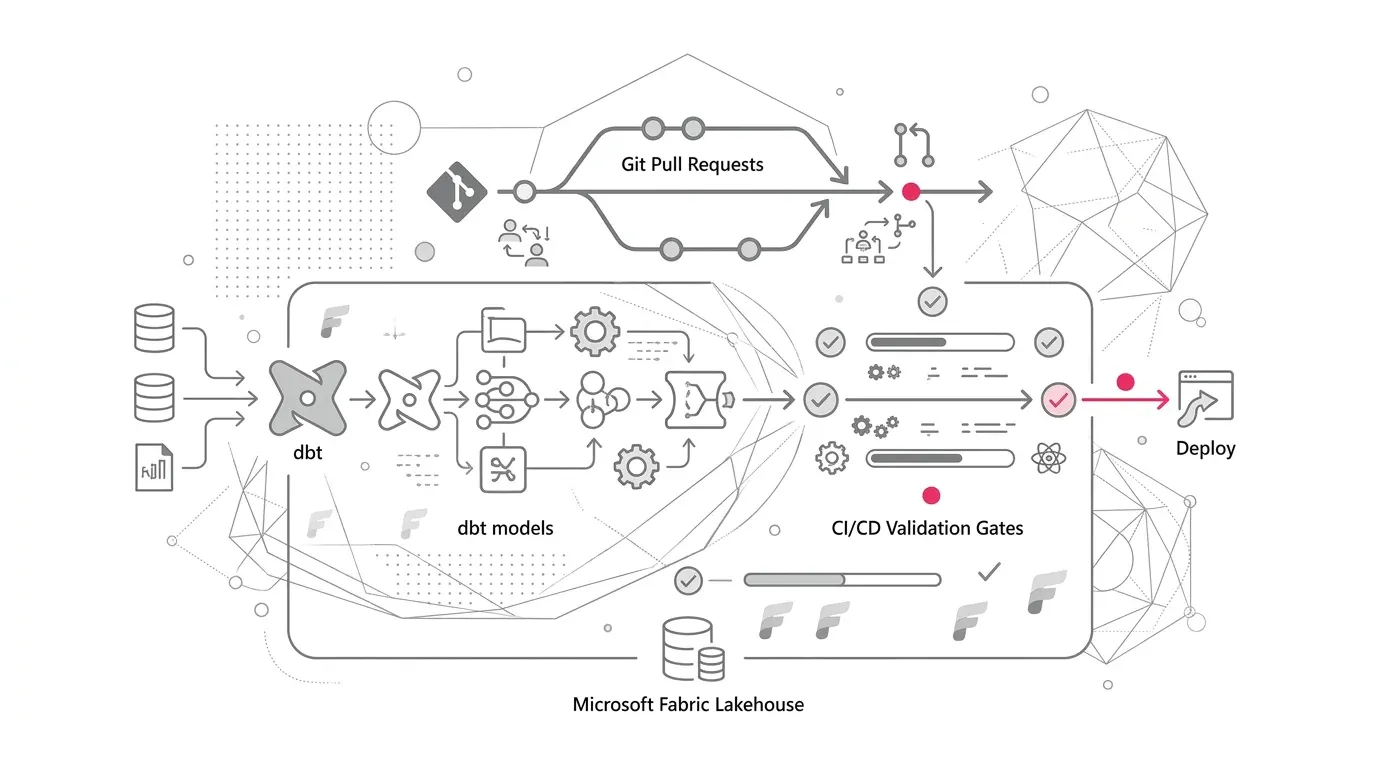
A resilient Fabric DevOps architecture decouples item definitions, environment variables, and automated authorization gates:
- Source Control (Git): Feature branches and pull request controls versioning item definitions and schema metadata.
- Integration & Preflight Gate: Automated validation verifying deployment identity permissions, dependency integrity, and variable bindings.
- Production-Equivalent Test Stage: Rehearsing deployments in Test workspaces configured with identical Purview sensitivity labels and protection policies.
- Deployment Pipeline Promotion: Executing promotion via dedicated, non-person service principals with monitored execution logs.
- Post-Deployment Verification: Automated smoke tests, Power BI App updates, and immutable audit logging.
The Automated Protected-Content Preflight Gate
Implement a mandatory preflight validation gate prior to triggering Test and Prod promotions:
| Preflight Control | Verification Rule | Evidence Captured |
|---|---|---|
| Protected Item Access | Release identity has effective read-write permissions on all labeled items | OneLake catalog item-permission audit log |
| Pipeline & Workspace Role | Release identity possesses Pipeline Admin and target workspace Contributor roles | Fabric REST API role assignment record |
| Dependency Integrity | All upstream/downstream dependencies exist or deploy simultaneously (<=300 items) | Lineage autobind validation report |
| Variable & Secret Resolution | Stage parameters resolve via Variable libraries without hardcoded secrets in Git | Environment variable binding check |
| Network Protection | CI/CD runners comply with workspace inbound/outbound network isolation rules | Runner connectivity test result |
Phased Roadmap to Meet the December 1, 2026 Deadline
- Phase 0 (Exposure Audit, Days 1-10): Inventory all Git-connected workspaces and deployment pipelines containing protection-policy labeled items via OneLake catalog.
- Phase 1 (Identity Standardization, Weeks 2-4): Transition deployment pipelines to dedicated Microsoft Entra ID service principals with least-privilege read-write rights on protected items.
- Phase 2 (End-to-End Rehearsal, Weeks 4-6): Mirror production sensitivity labels and protection policies in Test workspaces, executing automated preflight gates.
- Phase 3 (Operational Scaling, Weeks 7+): Institutionalize automated drift monitoring, Power BI app update scripts, and quarterly access recertifications.
Architect Governed Fabric CI/CD with YuniQ
YuniQ designs, automates, and manages enterprise Microsoft Fabric deployment pipelines, Purview protection policies, Git integration, and 24/7 DevOps monitoring.
Explore Microsoft Fabric ConsultingFrequently Asked Questions
What happens on December 1, 2026 in Microsoft Fabric CI/CD?
Microsoft enforces a strict security gate: users or service principals without read-write permissions on all workspace items will be blocked from using Git integration or deploying via deployment pipelines into workspaces with protected content.
Why does being a workspace Admin not bypass Fabric protection policies?
Purview protection policies apply an additional layer of item-level access restriction based on sensitivity labels. If an identity is excluded from the protection policy security group, workspace-level Admin or Contributor roles do not grant access.
Can service principals be used to automate Fabric deployment pipelines?
Yes. Microsoft Fabric supports service principals and managed identities for deployment pipeline automation via REST APIs, provided the service principal is granted pipeline administrator permissions and access to protected items.