Executive summary
Microsoft Fabric teams often discover configuration drift only after a technically successful deployment. A pipeline reaches the wrong lakehouse, a notebook resolves a development item ID, a semantic model has no production credential, or a report binds to an unexpected model. The code moved, but the operating context did not.
This is not primarily a deployment-tool problem. It is a configuration ownership problem. Git, Fabric deployment pipelines, and variable libraries each manage part of the application lifecycle, while permissions, workspace identities, connections, schedules, data, and some workspace settings remain environment-specific. Enterprises need an explicit contract that says which system owns every configuration class, how a value changes, and what evidence proves that the production runtime is correct.
A sound Fabric release model therefore separates five concerns:
- Versioned item definitions in Git.
- Stage-specific, non-secret configuration in a Fabric variable library or supported deployment rules.
- Authentication and secrets in environment-bound connections, preferably using durable Microsoft Entra identities where supported.
- Workspace and security state provisioned and checked separately from item deployment.
- Runtime state such as data, schedules, permissions, and bindings validated after deployment.
The goal is not identical environments. Development, test, and production should differ. The goal is to make every permitted difference intentional, controlled, testable, and attributable.
The enterprise problem: a release can succeed while the solution is wrong
Configuration drift is the divergence between an approved environment design and the values that a workload actually uses. In Fabric, drift can occur in source and destination references, workspace or item IDs, connection identities, capacity assignments, network paths, refresh schedules, permissions, sensitivity labels, and runtime parameters.
The risk is easy to underestimate because a deployment status answers a narrow question: did the platform copy or update the selected item definitions? It does not, by itself, prove that the released solution reads the intended production source, writes to the correct destination, runs under the approved identity, has the expected schedule, or returns reconciled business results.
This matters now because Fabric's application lifecycle management surface is broad and evolving. Microsoft's current CI/CD architecture combines Git integration, deployment pipelines, variable libraries, deployment plans, REST APIs, command-line tooling, and infrastructure-as-code options. Microsoft also notes that some supported items remain in preview. An enterprise release process must be capability-aware rather than assume that every Fabric item behaves identically across those tools. See Microsoft's CI/CD overview and current CI/CD planning guidance .
Representative scenario: the deployment that passed but should not have
The following is a representative scenario, not a YuniQ customer case or a claim about measured results.
A multi-domain enterprise has separate development, test, and production workspaces for customer analytics. Its solution includes ingestion pipelines, notebooks, lakehouses, a semantic model, and executive reports. Developers use Git, and releases move through a Fabric deployment pipeline.
The team promotes a change that adds a new customer-status calculation. The item deployment completes. The report opens. Initial smoke tests pass.
Two days later, operations finds three independent defects:
- A notebook still contains the development lakehouse ID in a configuration cell.
- The production semantic model retained an old refresh schedule and credential because those properties were not carried by the item deployment.
- A report was rebound through stage alignment to a different semantic model than the release team expected.
No single tool malfunctioned. The failure came from an incomplete release contract. Git governed some definitions, the deployment pipeline governed promotion and pairing, credentials remained attached to the target, and an unreviewed hard-coded identifier bypassed both.
The business consequences can include incorrect executive decisions, writes to the wrong data zone, exposure of test data to production consumers, delayed reporting, emergency changes, and weak audit evidence. The recovery burden also grows because engineers must compare several control planes while business users wait for trustworthy numbers.
Root causes and consequences
1. Teams treat Git as a complete environment backup
Fabric Git integration versions supported item definitions at workspace scope. It is valuable for collaboration, comparison, review, and recovery of definitions. It is not a copy of the entire running environment. Microsoft explicitly documents that Git operations recreate item definitions rather than item data, and unsupported items are ignored by Git synchronization. Workspace identities also require special care: an artifact committed with a workspace identity can be updated only in a workspace connected to the same identity. Review the current Git integration process and limitations .
Consequence: a repository can be clean while the target workspace still differs in identity, data, permissions, connections, or unsupported items.
2. Environment values are embedded in item definitions
Workspace GUIDs, lakehouse IDs, URLs, schema names, storage paths, and sample-data switches are often copied into notebooks or pipelines because it is expedient. Each embedded value becomes a hidden release decision.
Consequence: promotion becomes search-and-replace engineering, and reviewers cannot tell whether a change is business logic or environment wiring.
3. Configuration, credentials, and authorization are conflated
A source endpoint identifies where to connect. A credential proves who is connecting. Authorization determines what that identity can do. These are related but different controls. Storing them in one loosely governed parameter set obscures ownership and can expose sensitive values.
Consequence: developers receive broader access than needed, secrets spread through code or release logs, and a correct endpoint still fails because the target identity lacks authorization.
4. Deployment semantics are assumed rather than tested
Fabric deployment pipelines use item pairing and can automatically bind connected items in corresponding pipeline stages. Microsoft notes that stage correspondence is based on numeric position, not stage display name. Parameter-controlled dependencies can also prevent autobinding. These mechanics are useful, but they are not a substitute for an intended dependency map. See the Fabric deployment process .
Consequence: a deployment can create duplicates, preserve an old dependency, or establish a technically valid but unintended connection.
5. Target-only state is missing from release assurance
Microsoft documents that deployment pipelines do not copy data, IDs, permissions, workspace settings, refresh schedules, data-source credentials, and several other target properties. Those differences may be correct, but they need their own provisioning and verification path.
Consequence: release evidence covers only the content that moved, not the environment that will run it.
Why common approaches fall short
"Put every value in one parameter file"
Centralization improves discoverability but does not define authority. It can also place secrets beside ordinary settings and imply that every consumer supports the same parameter mechanism. Fabric variable-library support currently spans specific item types, and advanced reference types can have narrower support or preview status.
"Use the same settings everywhere"
Production should not use development identities, data volumes, capacity limits, retention, or write destinations. Forced sameness hides risk instead of controlling it. Enterprises need a declared difference model.
"Let deployment rules fix the target"
Deployment rules are useful for supported properties and items, but they do not cover the entire Fabric estate. They also do not prove runtime access, data correctness, or security posture.
"Check whether the report opens"
A visual smoke test may miss a wrong source that happens to share a schema, an overprivileged identity, stale data, or a scheduled run that will fail later. Release validation must test provenance, authorization, and business outcomes.
"Repair production manually"
An emergency fix can restore service, but an unrecorded portal edit creates a new source of truth. Without reconciliation back to the approved configuration, the next release can reverse the repair or preserve unexplained drift.
A Microsoft Fabric solution: make configuration an explicit contract
The recommended architecture assigns one authoritative control to each configuration class.
| Configuration class | Examples | Authoritative control | Required release evidence |
|---|---|---|---|
| Item definition | Notebook code, pipeline structure, semantic model metadata, report definition | Git for supported items | Reviewed commit, item diff, build validation |
| Stage-specific non-secret value | Environment name, source alias, feature flag, row limit, supported item reference | Variable library or supported deployment rule | Expected value set, resolved-value test |
| Authentication | Workspace identity, service principal, managed connection credential | Environment-bound Fabric connection and Microsoft Entra configuration | Identity ID, connection test, ownership record |
| Authorization and policy | Workspace roles, source-system grants, network access, tenant controls, sensitivity policy | Security and platform provisioning process | Access test, negative test, policy evidence |
| Operational state | Refresh schedule, data, capacity assignment, alert routing, runtime binding | Target-environment operations configuration | Post-deployment inventory and health test |
This table is the core governance artifact. Every new component must declare its entries before it can enter production.
Reference architecture
Developer change
      |
      v
Git branch and pull request
  - supported item definitions
  - variable-library definition and value sets
  - tests and release manifest
      |
      v
Integration workspace
  - update from Git
  - static validation
  - dependency and policy checks
      |
      v
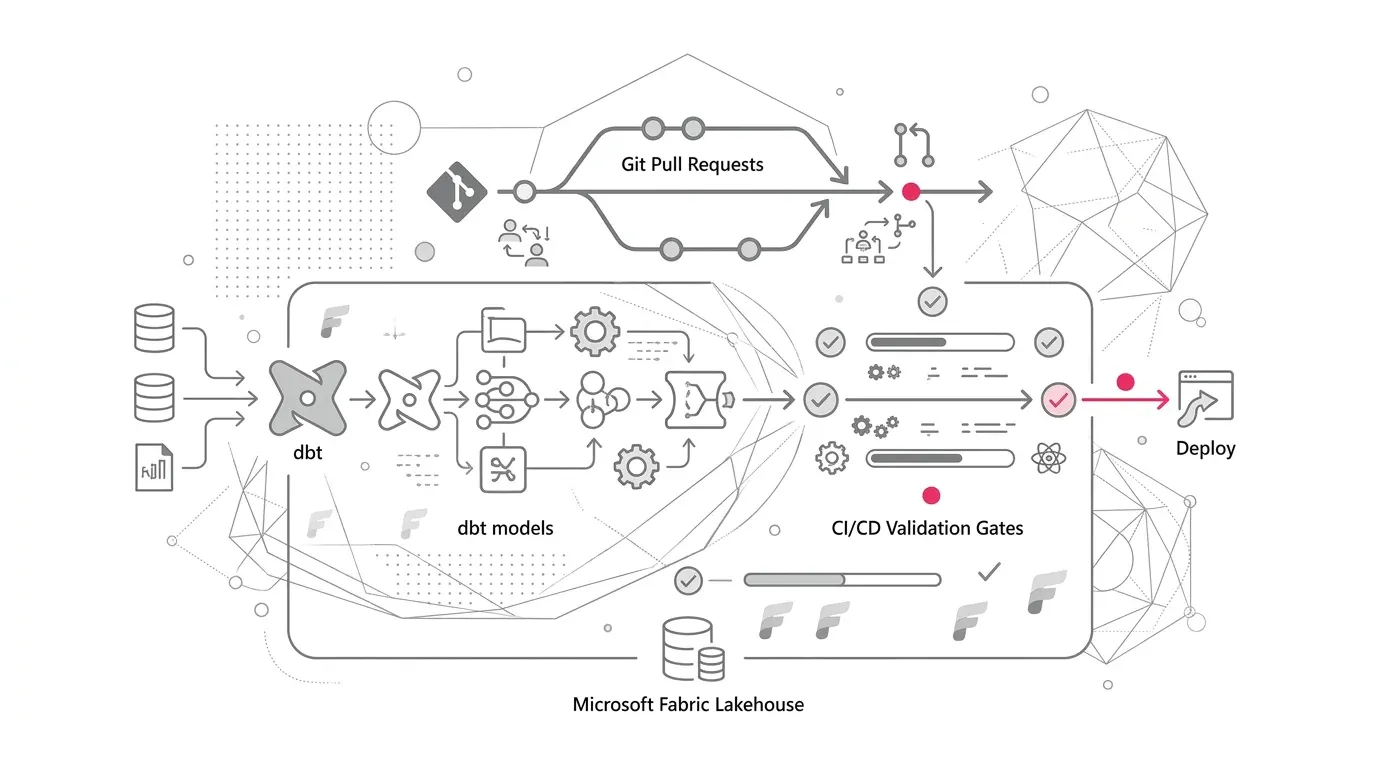
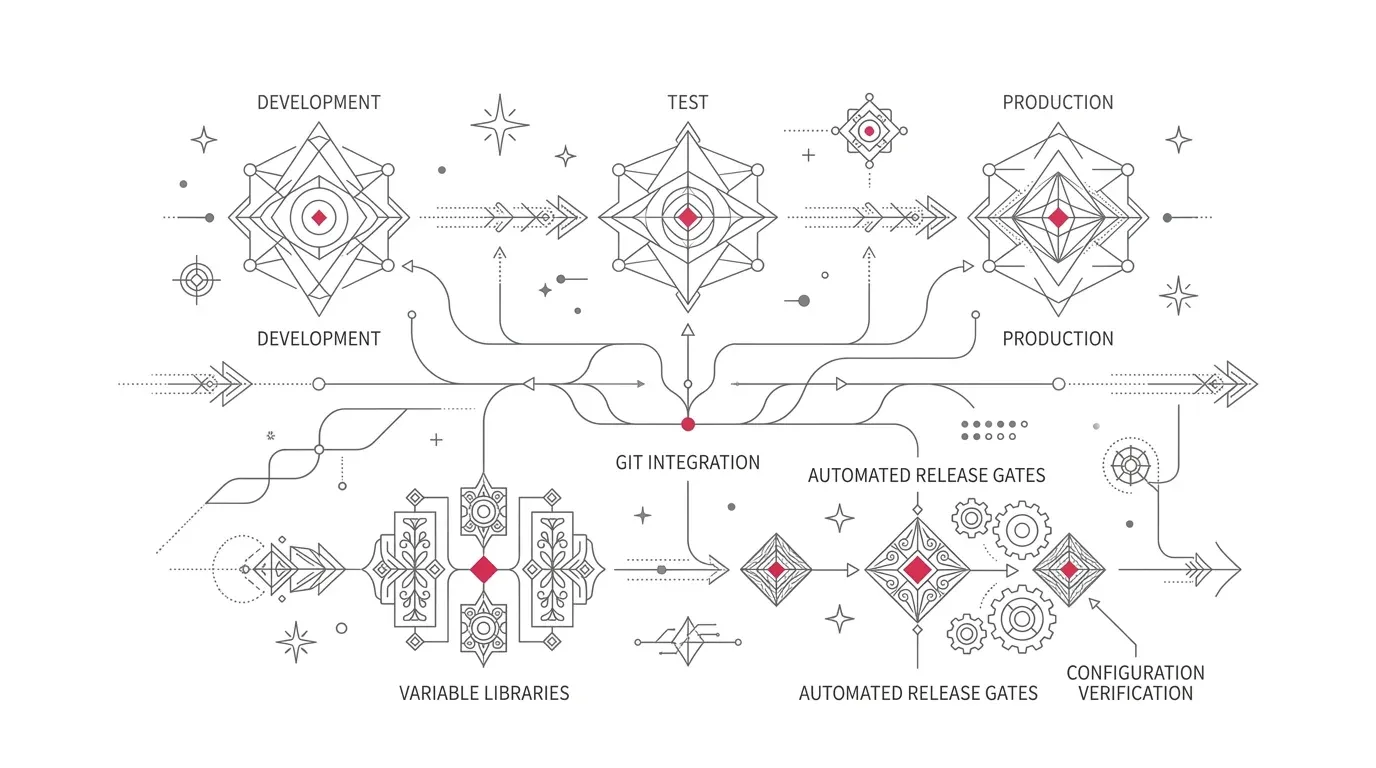
Fabric deployment pipeline: Dev -> Test -> Prod
  - paired supported items
  - approved deployment rules
  - explicit deployment order where required
      |
      +-------------------------------+
      |                               |
      v                               v
Per-stage variable set          Per-stage secure context
  - endpoints and aliases         - workspace identity
  - item references               - managed connections
  - feature flags                 - source-system grants
  - safe runtime settings         - network and workspace policy
      |                               |
      +---------------+---------------+
                      v
             Post-deployment assurance
               - resolved references
               - positive/negative access
               - lineage and bindings
               - schedules and refresh
               - business reconciliation
               - capacity and health
Layer 1: version supported definitions in Git
Use one reviewed source of truth for a complete solution, even when it spans multiple workspaces. Keep item definitions separate from automation files in a clear repository structure. Require pull requests, peer review, and automated checks for hard-coded environment identifiers.
Do not interpret "synced" as "production ready." Build an inventory that marks each item as Git-supported, deployment-pipeline-supported, preview, or externally managed. Microsoft's supported-item lists change over time, so make this inventory part of release maintenance rather than a one-time design document.
Layer 2: use variable libraries for supported, non-secret differences
A Fabric variable library is a workspace item that holds variables and alternative value sets. Consumer items resolve the active values in their own workspace context. Microsoft documents support for pipelines, lakehouse shortcuts, notebooks through supported mechanisms, Dataflow Gen2, Copy Job, user data functions, Eventstream, and selected plan scenarios. Always verify the current list in the variable library overview .
Use a small number of domain- or solution-owned libraries rather than an unbounded global library. Adopt typed, stable names such as:
environment_name
customer_source_connection
curated_lakehouse_ref
load_window_days
enable_new_status_logic
Define development, test, and production value sets. The item definition can be identical across workspaces while the active value set differs. That active selection is workspace context, so the release process must verify it explicitly before any consuming workload runs.
Use reference types only where their support and maturity match the workload's risk. Microsoft currently describes item references as static workspace-ID and item-ID pairs; they do not automatically retarget across environments. Each stage therefore needs the correct value-set entry, and all entries should point to compatible item types. The item reference documentation currently marks this capability as preview.
Do not put credentials or secret material in ordinary variable values. Variable-library access follows workspace or item sharing, and Microsoft states that there is no variable-level permission boundary. Treat anyone who can read the library as able to see its values. See variable library permissions .
Layer 3: bind authentication to the environment
Prefer durable workload identities over employee credentials where the connector and workload support them. A Fabric workspace identity is an automatically managed service principal associated with a workspace; Microsoft describes it as avoiding management of keys, secrets, and certificates. It still needs explicit authorization on each target resource. See workspace identity authentication .
Create a distinct identity boundary for each environment. Grant only the actions required by that environment: development might write only to development storage, test to isolated test targets, and production to approved production resources. Use managed connections to hold authentication context. The variable library may select a supported connection reference, but it should not become the credential store.
For every connection, record:
- owning team and technical owner;
- environment and allowed consumers;
- authentication type and identity object ID;
- authorized target and least-privilege role;
- renewal or lifecycle mechanism;
- positive and negative connectivity tests.
Layer 4: promote content through controlled stages
Use Fabric deployment pipelines to promote approved supported content through distinct workspaces. Pair items intentionally and review the comparison before deployment. Where dependencies span pipelines, align stage counts and positions or deliberately avoid autobinding. For complex order dependencies, evaluate deployment plans while respecting their current preview status.
Automated releases should capture the selected items, source and target stages, initiating identity, commit or release identifier, operation result, and post-deployment tests. The Fabric REST API can deploy all or selected supported items, but identity support can depend on the items involved. Validate automation against the exact item mix instead of assuming universal service-principal support. Refer to the current Deploy Stage Content API .
Layer 5: enforce preflight and post-deployment gates
A release is complete only when the target runtime passes its contract.
Preflight gate
- Confirm all selected item types are supported in the chosen release path.
- Reject hard-coded development workspace IDs, item IDs, URLs, and connection names.
- Confirm the target variable library exists and the intended value set is active.
- Confirm required target items and connections exist and are the expected types.
- Validate that the release identity has only the permissions required to deploy.
- Check target capacity headroom and any planned high-cost validation workloads.
- Record current target bindings, schedules, permissions, and configuration for rollback comparison.
Post-deployment gate
- Resolve each material variable from the target workspace and compare it with the approved manifest.
- Inspect lineage and bindings, including cross-workspace dependencies.
- Run a positive access test using the runtime identity.
- Run a negative test proving the identity cannot reach an out-of-scope development or restricted target.
- Execute a small, controlled workload and reconcile row counts, control totals, freshness, and key business rules.
- Verify refresh schedules, alert routes, sensitivity handling, and required permissions separately.
- Observe capacity consumption and runtime errors before broad user release.
If any material check fails, stop activation. Do not let a successful item copy override failed runtime evidence.
Phased implementation roadmap
Phase 1: discover the effective configuration
Inventory workspaces, items, variable libraries, deployment rules, connections, identities, permissions, schedules, network dependencies, capacities, and cross-workspace bindings. Search definitions for environment-specific literals. Classify each setting using the five-part model above.
Exit criterion: every production component has a named configuration owner and authoritative control.
Phase 2: design the environment contract
Define workspace topology, naming, release stages, allowed differences, identity boundaries, connection ownership, and promotion authority. Create a machine-readable release manifest for material values and dependencies. Document exceptions for items not supported by the standard path.
Exit criterion: security, platform, data engineering, and analytics owners approve the contract and exception process.
Phase 3: remove hidden configuration from a pilot solution
Choose one consequential but bounded data product. Replace hard-coded non-secret values with supported variable-library references or deployment rules. Move authentication to managed connections and durable identities where supported. Add tests for incorrect environment references.
Exit criterion: the same approved definition promotes across stages without manual code editing.
Phase 4: automate release assurance
Implement preflight checks, controlled deployment, resolved-value verification, binding inspection, access tests, and business reconciliation. Store evidence with the release record. Keep manual approval for production until the process is stable.
Exit criterion: the team can demonstrate both what changed and why the running target is correct.
Phase 5: scale by reusable pattern
Publish templates for repository layout, variable naming, identity creation, connection registration, deployment manifests, and tests. Onboard domains in waves. Use an exception backlog for unsupported or preview item types rather than bypassing controls.
Exit criterion: new data products inherit the release model by default, and exceptions are visible, owned, and time-bound.
Risks, governance, security, adoption, and cost
Governance
Assign decision rights. Product teams should own business configuration and tests; the platform team should own workspace, capacity, and release patterns; security should approve identity and authorization policy; operations should own schedules, monitoring, and incident response. A configuration change to production is a release even when no code changes.
Maintain a controlled register of permitted environment differences. Review it alongside lineage so configuration ownership follows real dependencies, not only workspace boundaries.
Security
Apply least privilege to both people and workload identities. Separate the ability to edit a library, activate a value set, deploy content, modify production connections, and authorize a target resource. Because variable libraries have item-level rather than per-variable permissions, do not mix broadly readable operational settings with sensitive values.
Test denial paths. A production identity should not silently retain access to development sources, and a development identity should not reach production. Avoid employee-bound production credentials because staff changes, conditional-access changes, or account disablement can become service incidents.
Preview and support risk
Record the status of every relied-upon item and feature. Preview capabilities can be valuable, but they need explicit acceptance criteria, fallback procedures, and focused regression tests. Recheck Microsoft's support matrices before platform upgrades or onboarding a new item type.
Adoption
Engineers will bypass a configuration standard that is slower than manual editing. Provide reusable library patterns, naming conventions, validation scripts, and clear ownership. Train reviewers to look for environment literals, identity changes, active value sets, dependency changes, and target-only state.
Cost and capacity
Separating environments has a cost, but shared environments also have a risk and contention cost. Size development and test for their purpose, use bounded validation datasets where appropriate, and reserve production-shaped performance testing for changes that need it. Track the capacity consumed by test runs and deployment validation as part of release economics, not as invisible overhead.
Do not reduce assurance to save compute indiscriminately. Use risk tiers: a report formatting change needs a different test profile from a pipeline that changes a regulated production write path.
Success metrics
Measure whether the operating model prevents and detects drift. Useful metrics include:
- Hard-coded environment reference count: material environment-specific literals remaining in governed definitions.
- Manifest coverage: percentage of production data products with classified configuration, identity, dependency, and runtime state.
- Automated gate coverage: percentage of production releases that run the complete applicable preflight and post-deployment suite.
- Resolved-value conformance: percentage of checked runtime values matching the approved target manifest.
- Unauthorized-path test pass rate: percentage of releases proving both permitted and denied access paths.
- Configuration-caused release failure rate: failures or rollbacks attributable to wrong values, bindings, identities, permissions, or schedules.
- Manual production change rate: target changes made outside the approved release process, including time to reconcile them.
- Mean time to explain: elapsed time required to identify the effective value, owner, change record, and dependency for a production incident.
- Release evidence completeness: percentage of releases with commit, deploy operation, approvals, resolved values, access tests, and reconciliation results.
Set baselines before choosing targets. A falling incident count is useful, but only when discovery and reporting coverage are also improving.
How YuniQ can help
YuniQ's Microsoft Fabric service page describes capabilities directly relevant to configuration-drift control: current-state platform and workload diagnostics, capacity planning and workspace topology, security and operating-model design, Microsoft Entra least-privilege roles, Dev/Test/Prod separation, Git-integrated CI/CD deployment pipelines, monitoring, automated reconciliation, access testing, and production cutover support.
Applied to this problem, YuniQ can help an organization:
- assess the existing Fabric estate and expose hidden environment dependencies;
- define workspace, identity, security, governance, and CI/CD architecture;
- implement a focused proof of value using a real data product;
- build reusable pipelines, data products, semantic models, and release controls;
- validate releases through reconciliation, access testing, user acceptance, and controlled cutover; and
- support ongoing release management, monitoring, capacity optimization, and domain expansion.
These statements are grounded in YuniQ's published Microsoft Fabric consulting and implementation services . The appropriate engagement should be scoped to the organization's current estate, supported Fabric capabilities, security obligations, and business priorities.
Practical next steps
- Select one production data product and list every value or object that differs across development, test, and production.
- Classify each entry as definition, non-secret stage value, authentication, authorization/policy, or operational state.
- Search the solution for hard-coded workspace IDs, item IDs, URLs, paths, connection names, and environment labels.
- Map each item to current Git, deployment-pipeline, variable-library, API, and identity support.
- Create a release manifest containing the expected production references, identity, bindings, schedules, and control totals.
- Run a dry deployment into an isolated target and test resolved configuration, allowed access, denied access, lineage, and business reconciliation.
- Turn every manual repair or unexplained difference into either an automated control or an approved, owned exception.
The immediate executive question is not, "Do we have a deployment pipeline?" It is, "Can we prove which configuration production is using, who approved it, and whether the running solution behaves accordingly?" Fabric provides the building blocks. The enterprise discipline is to make them one verifiable release system.