Executive summary
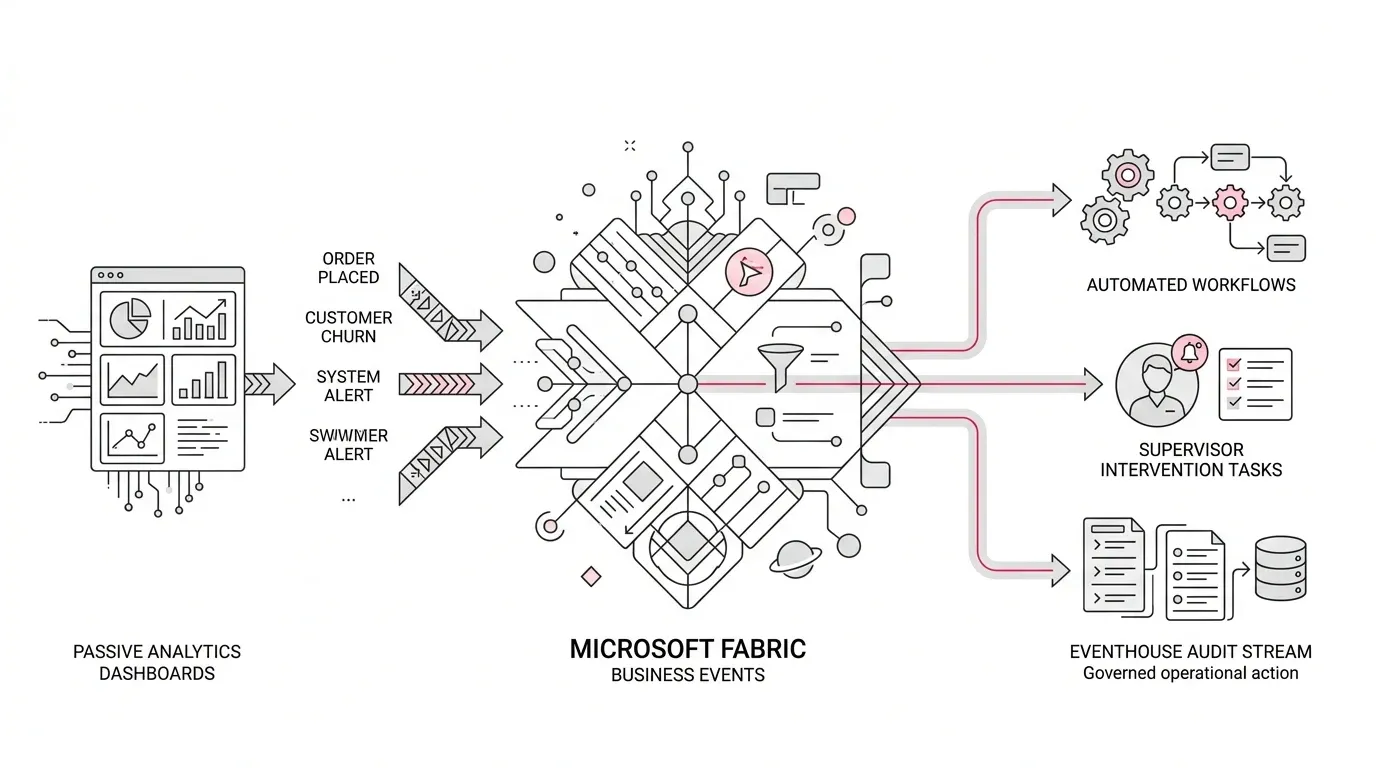
Many enterprises can see an operational problem before they can act on it. A dashboard shows that a service case is aging, a payment has failed, or a shipment is likely to miss its commitment. The signal is visible, but the response still depends on a person noticing the chart, interpreting it correctly, finding the right operational record, and deciding what to do.
Microsoft marked Business Events in Fabric Real-Time Intelligence as generally available in September 2026. A business event represents a meaningful change in business state, such as ServiceCaseAtRisk or PaymentFailed, rather than raw telemetry. Fabric can publish that event through a shared schema, expose it in Real-Time Hub, retain it in Eventhouse for investigation, and route it through Activator to a notification, Fabric job, user data function, or Power Automate workflow. This creates a practical bridge between analytics and operations. Microsoft Fabric What's New and Business Events overview
The technology does not make the operating model automatic. Fabric uses at-least-once delivery, permits out-of-order arrival, and can deliver duplicates. Event consumers must therefore be idempotent, actions need owners and escalation paths, and the event contract needs the same governance discipline as an API or shared data product. Some related controls still carry component-specific preview status, so production teams should verify the status and limitations of every feature in their chosen path.
The recommended approach is to begin with one high-value, reversible decision. Define the business event and its owner, publish it in shadow mode, prove delivery and decision quality, add a human-controlled action, and only then automate bounded steps. Measure time-to-detect, time-to-own, time-to-act, duplicate suppression, false-positive rate, delivery completeness, operational outcome, and capacity cost together.
The enterprise problem: analytics stops at awareness
Enterprise analytics programs have become good at describing the business. They are less consistently designed to change what happens next.
The gap appears in ordinary operating moments:
- A contact-centre dashboard shows repeat calls from a priority customer, but no case is raised.
- A service-management report shows an approaching service-level breach, but the accountable team sees it after the shift ends.
- A finance dashboard identifies a failed payment, but recovery begins only after a daily batch has completed.
- A supply-chain view shows a delayed shipment, but downstream customer communications and inventory decisions remain manual.
This is not merely a latency problem. Refreshing a dashboard every minute does not create an owned response. The enterprise needs a reliable translation from data to business meaning, from business meaning to decision, and from decision to controlled action.
The timing matters because Fabric now provides a native vocabulary for that translation. Microsoft distinguishes a business event, such as ShipmentDelayed, from telemetry such as CurrentTemperature or a technical log such as DiskReadError. Publishers can emit a business event once; multiple consumers can then subscribe without being embedded in the publisher. Fabric's Schema Registry supplies a shared event contract, and Eventhouse automatically stores published business events for historical analysis. Business Events overview
That separation can reduce integration coupling, but only if the event represents a stable business fact and not a transient implementation detail.
A representative enterprise scenario
Consider a representative, fictional healthcare service organisation. This scenario is illustrative and is not presented as a YuniQ customer result.
The organisation manages member enquiries across a case platform, CRM, telephony, and workforce systems. Leaders can already see average handle time, open-case age, repeat-contact rate, and service-level performance in Power BI. Yet urgent cases still depend on supervisors scanning multiple queues.
A case becomes operationally risky when several facts converge:
- the case is nearing its service-level deadline;
- the member has contacted the organisation repeatedly within a short period;
- the issue category indicates a high-impact service interruption;
- the assigned queue has no available owner; and
- there has been no documented intervention since the risk threshold was crossed.
The organisation decides to define a ServiceCaseAtRisk business event. It does not publish every phone call or every case update as a business event. Raw call and case changes remain source signals. The business event is emitted only when the agreed decision logic concludes that an accountable response is required.
At first, the event creates a supervisor alert and an investigation record. Later, after the organisation has measured precision and operating behaviour, a bounded workflow can open an escalation task in the case system. The task is created only once, includes the evidence used by the rule, and remains subject to the case platform's own authorisation and audit controls.
The goal is not “real time” for its own sake. The goal is to reduce avoidable delay between a material change in business state and an owned intervention.
Why the gap persists
Data is organised around systems, not decisions
CRM records, call events, case status, workforce capacity, and customer priority usually have different identifiers, owners, and timing conventions. A dashboard may reconcile them for presentation, but an automated response needs a durable correlation key and explicit rules for late, missing, or conflicting facts.
Metric definitions are not event contracts
A metric answers a question over a dataset. A business event asserts that something meaningful happened and that consumers may act on it. That assertion needs a name, business definition, timestamp semantics, source, evidence, severity, subject identifier, schema version, and ownership model. Reusing a visual threshold without defining those semantics transfers ambiguity into automation.
Alerts have no lifecycle
Many alerting projects stop after sending email or Teams messages. They do not record acknowledgement, ownership, action, suppression, escalation, closure, or outcome. This creates notification fatigue and makes it impossible to tell whether faster detection produced better operations.
Delivery behaviour is treated as an implementation detail
Microsoft documents at-least-once delivery for Business, Fabric, and Azure events, retries for up to 24 hours, possible duplicate delivery, and no ordering guarantee. A consumer that assumes “exactly once” may create duplicate cases, duplicate payments, or contradictory status changes. Microsoft recommends using the CloudEvents source plus id as the unique event key and designing handlers to be idempotent. Fabric event delivery guarantees
Ownership is fragmented
The data team owns the rule, the platform team owns Fabric, operations owns the process, security owns access, and an application team owns the destination. Without one accountable service owner, failures fall between teams. A production event flow is an operational service, not just an analytics artifact.
Why common approaches fall short
“Refresh the dashboard more often”
This shortens data latency but leaves interpretation, routing, and acknowledgement manual. It also increases query and capacity demand without proving that anyone acts faster.
“Send an alert for every threshold breach”
Thresholds applied independently can produce repeated or contradictory messages. A good event represents a business state transition, not every observation while the state remains true. Suppression windows, correlation, recovery events, and escalation rules belong in the design.
“Put all logic in one workflow”
A single workflow that reads sources, calculates risk, sends messages, updates systems, and stores history is tightly coupled. Every new consumer changes the original integration. A governed event separates the assertion that ServiceCaseAtRisk occurred from the consumers that notify, investigate, analyse, or act.
“Assume the platform guarantees exactly-once execution”
It does not. Deduplication and idempotency are application responsibilities. The destination operation should use an idempotency key or conditional update, and the consumer should retain a durable processing record.
“Automate the final action immediately”
A technically correct trigger can still encode the wrong operating policy. Begin in shadow mode, compare events with expert decisions, and introduce human approval for actions with customer, financial, legal, or safety consequences. Automation should expand only when error modes and rollback are understood.
A Microsoft Fabric solution architecture
The architecture should separate detection, meaning, action, and evidence.
Operational sources
PEGA / CRM / telephony / ERP / APIs / database CDC
                         |
                         v
Signal ingestion and correlation
Eventstream, Spark notebook, warehouse query, or user data function
                         |
                         v
Decision rule: has a meaningful business state changed?
                         |
                         v
Governed event contract in Real-Time Hub Schema Registry
ServiceCaseAtRisk v1
  - subject and correlation IDs
  - occurred time and detected time
  - severity, reason codes, evidence references
  - source, event ID, schema version
                         |
             +-----------+-----------+
             |                       |
             v                       v
      Eventhouse history        Activator subscription
      investigation, audit,     notify, run Fabric item,
      trend and outcome analysis function, or workflow
             |                       |
             +-----------+-----------+
                         v
Durable action ledger and operational system
deduplicate -> authorise -> act -> acknowledge -> close -> measure outcome
                         |
                         v
Power BI / Real-Time Dashboard / Gold outcome model
1. Start with a decision catalogue
Create a small catalogue of candidate decisions before creating Fabric items. For each candidate, record:
- the business state change;
- why a response is valuable;
- the accountable process owner;
- required evidence and maximum tolerable latency;
- acceptable false-positive and false-negative behaviour;
- permitted actions and approvals;
- fallback when the event path is unavailable; and
- the outcome that will prove value.
Choose the first use case using value, reversibility, data readiness, and operational ownership. A reversible supervisor notification is a better first event than an irreversible financial transaction.
2. Define the event contract as a data product
Fabric's Schema Registry provides central schema management and groups schemas into event schema sets representing a domain or business context. The contract should carry business semantics as well as field types. Business Events concepts
For ServiceCaseAtRisk, define at least:
- caseId: the stable operational subject;
- eventId and source: the CloudEvents identity used for deduplication;
- occurredAt: when the business condition became true;
- detectedAt: when the rule emitted the event;
- severity and reasonCodes: controlled business classifications;
- evidenceRef: a reference to governed evidence, not unnecessary sensitive payload;
- ruleVersion: the decision logic used;
- schemaVersion: the payload contract;
- correlationId: the key used across downstream actions; and
- expiresAt: when an unprocessed event is no longer actionable.
Treat additions as compatible only after consumers have been tested. For a breaking change, publish a new version, run old and new contracts in parallel, migrate consumers, and retire the old version against an agreed date. Do not silently redefine an existing event name.
3. Separate raw signals from business meaning
Use Eventstream when the condition can be formed from streaming inputs with filtering, transformation, aggregation, and routing. Use a Spark notebook, warehouse query, or user data function where correlation or business logic requires those execution models. Microsoft documents publishers including Eventstream, Activator, notebooks, and user data functions; the appropriate choice depends on source latency, rule complexity, support status, and release requirements. Business Events overview
Keep raw events in the appropriate analytical store when replay and investigation matter. Publish the business event only after validation. This avoids turning Real-Time Hub into a catalogue of low-level telemetry and gives consumers a signal with stable meaning.
4. Use different consumers for immediate action and durable analysis
Fabric lets Activator subscribe to business events and trigger notifications, Power Automate, Fabric jobs, and other supported actions. Eventhouse provides the historical event record used for KQL analysis and Real-Time Dashboards. Real-Time Intelligence overview and Business Events with Eventhouse
Use Activator for bounded detection and routing. Use a function or workflow for application-specific checks, idempotency, destination authorisation, and side effects. Use Eventhouse for questions such as:
- Which event types are increasing?
- How long elapses between occurrence, detection, acknowledgement, and closure?
- Which rules create repeated or low-value alerts?
- Which operational outcomes follow an action?
- Are events missing from a publisher, consumer, or time window?
The action path and analytical path should be independently observable. A dashboard that proves an event was published does not prove that the destination accepted the action.
5. Make the consumer safe under retries and disorder
Every side-effecting consumer should implement this sequence:
- Validate schema, required context, and expiry.
- Form the unique key from CloudEvents source and id.
- Check a durable processed-event or action ledger.
- Re-read current operational state where stale action is possible.
- Apply destination authorisation and business guardrails.
- Execute an idempotent create or conditional update.
- Record outcome, destination identifier, timestamps, and rule version.
- Route failures to a retry or exception path with an owner.
Do not rely only on a short-lived in-memory cache. The deduplication record must survive worker restarts and concurrent delivery. Because events may arrive out of order, compare business timestamps and current entity state before overwriting a later decision.
6. Close the outcome loop
An event is valuable only if its action improves an outcome. Land acknowledgement, action, closure, and outcome records into a governed model. Relate them back to the originating event and source case. Power BI or a Real-Time Dashboard can then show both operational flow and business effect.
This makes rule tuning evidence-led. A team can retire an alert that is rarely actionable, adjust a threshold that fires too late, or distinguish detection failure from response failure.
A phased implementation roadmap
Phase 0: Frame the decision
Select one reversible, high-value operational decision. Establish the process owner, baseline performance, legal and security constraints, event definition, action boundary, failure response, and success measures. Confirm that Business Events and every dependent component are supported in the organisation's region, capacity, network design, and deployment path.
Phase 1: Build the governed foundation
Create a domain-aligned workspace and event schema set. Define versioning, naming, ownership, retention, and deprecation standards. Assign separate publisher and consumer identities. Build the action ledger, exception path, Eventhouse queries, and operational runbook before enabling the first action.
Phase 2: Run in shadow mode
Publish production-shaped events without changing the operational system. Compare them with expert judgements and source records. Test duplicates, late and out-of-order events, missing attributes, publisher outage, consumer outage, expired events, permission removal, capacity pressure, and replay. Measure event precision and delivery completeness.
Phase 3: Introduce controlled action
Enable a notification or approval task for a limited group, shift, or region. Require acknowledgement and record disposition. Use a kill switch and a documented manual fallback. Review false positives, missed cases, response time, user feedback, and capacity consumption every week during the pilot.
Phase 4: Automate and scale by domain
Automate only actions that have proven stable and are reversible or compensatable. Add new consumers without changing the event's meaning. Establish domain event owners, reusable release tests, capacity budgets, service-level objectives, and quarterly event-catalogue reviews. Retire duplicate alerts and unused subscriptions rather than allowing permanent rule growth.
Governance, security, adoption, and cost controls
Governance
Give every business event one accountable business owner and one technical service owner. Record its definition, allowed publishers, approved consumers, data classification, schema versions, response objective, and retirement date. Treat a new or materially changed event as a governed release.
Maintain lineage from source signals through rule and schema to consumer action and outcome. The event payload should contain the minimum context needed to route and validate an action. Keep detailed evidence in a governed store and pass a reference when sensitive data is not required downstream.
Security
Business Events data access roles are separate from workspace roles: workspace access governs the schema-set item, while data access roles govern publishing and consumption. Microsoft's current documentation describes deny-by-default event access and supports users, service principals, and managed identities, but not Microsoft Entra groups in this role model. It also labels this data-access capability as preview. Verify current status before production use and automate role inventory where the API is used. Manage Business Events data access
Use distinct identities for publishers, consumers, and deployment automation. Avoid broad publish-and-consume grants. Validate the destination's authorisation again at action time; possession of an event is not permission to perform the business transaction.
Workspace private links can affect cross-workspace publication and consumption. If the workspace containing the event schema set blocks public access, Microsoft states that publishers and consumers in other workspaces need a private link to the source workspace. Include this flow in network and recovery testing. Business Events overview
Reliability and release management
Build explicit tests for duplicate and out-of-order delivery. Monitor last successful publication, last successful consumption, action success, dead-letter or exception count, acknowledgement latency, and outcome completeness. A synthetic canary event can verify the end-to-end path without modifying a real customer record.
Review lifecycle support for the exact Activator design. Microsoft currently documents Git and deployment-pipeline limitations for Activator items that use Azure Blob Storage Events, Power BI as a data source, or Fabric user data functions as an action. Activator also has documented throughput, action, and rule limits. These are architecture inputs, not post-launch surprises. Activator limitations
Adoption and operating model
Co-design the event with the team expected to act. Define what the signal means, what evidence is visible, who owns it, when it escalates, and how a user marks it non-actionable. Train users on the response process, not only the dashboard.
Measure notification burden per role and shift. A lower alert count with higher actionability is usually healthier than broad event coverage. Preserve a clear human override for ambiguous or high-impact decisions, and use disposition data to improve the rule.
Cost and capacity
Activator consumption includes rule uptime, event ingestion, event computation, and storage. Microsoft states that events are retained for 30 days in Activator, that an active rule incurs an hourly uptime charge, and that stopping a rule does not stop its event listener; deleting the rule is required to end that listener consumption. High-volume inputs and stateful computations can increase cost. Activator capacity usage
Eventhouse compute responds to hot-cache use, ingestion, queries, and configured minimum capacity. Monitor these separately from Activator, set caching to the analytical requirement, and compare cost per actionable event rather than cost per raw event. Eventhouse compute usage
For each use case, estimate event volume, active-rule hours, computation complexity, action frequency, Eventhouse retention and hot-cache needs, and peak concurrency. Set a cost owner and budget alert. Filter and aggregate before publishing when doing so preserves the decision requirement.
Success metrics
Establish a baseline before the pilot and agree target ranges with the business owner. Track a balanced scorecard:
| Dimension | Metric | Why it matters |
|---|---|---|
| Detection | Time from business occurrence to event publication | Separates source and decision latency from response latency |
| Delivery | Percentage of expected events received by each critical consumer | Detects silent breaks in the path |
| Reliability | Duplicate suppression and idempotent-action success rate | Proves retry safety |
| Quality | Actionable-event rate and false-positive disposition | Controls notification fatigue |
| Coverage | Material cases found by experts but missed by the rule | Exposes false negatives |
| Ownership | Time from event to acknowledgement | Shows whether routing reaches an accountable person |
| Action | Time from acknowledgement to intervention | Measures process execution |
| Outcome | Business result after intervention versus the agreed baseline | Tests whether action creates value |
| Resilience | Recovery time after publisher, consumer, identity, or capacity failure | Validates the operating model |
| Cost | Capacity and storage cost per actionable event and per successful outcome | Links platform consumption to value |
Avoid a single vanity metric such as events per second. A fast system that creates unactionable or duplicate work is not an operational improvement.
How YuniQ can help
YuniQ's Microsoft Fabric service page directly identifies “analytics without action” as an enterprise challenge and describes capabilities that fit this implementation path. Its documented services include:
- Fabric strategy and readiness, including use-case value mapping, capacity planning, workspace topology, security, governance, operating-model design, and pilot scoping;
- data integration and engineering across cloud, SaaS, on-premises, API, file, batch, and streaming sources, with data-quality observability and exception handling;
- governance, security, and DevOps using least-privilege Microsoft Entra ID design, Purview, lineage, environment separation, CI/CD, monitoring, and capacity alerts;
- analytics, AI, and activation, including near-real-time streaming analytics and operational action alerts; and
- managed services for monitoring, capacity optimisation, release management, and continued domain expansion.
For a Business Events initiative, those capabilities map to a focused engagement: identify a valuable decision, design the event and workspace boundaries, integrate the operational signals, build a production-shaped proof of value, validate the action path and capacity profile, launch with clear controls, and operate the service against measurable outcomes. This is an interpretation of the services YuniQ publishes, not a claim of a specific prior Business Events deployment. YuniQ Microsoft Fabric consulting and implementation services
Practical next steps
- Choose one operational decision where delay has a visible business consequence and the first action can remain human-controlled.
- Write the event definition in plain language before selecting a publisher: what changed, who owns it, what evidence is required, and when it expires.
- Map the end-to-end identity and data path across source, Fabric workspace, schema set, publisher, Activator, Eventhouse, workflow, and destination.
- Build duplicate, disorder, outage, permission, schema, capacity, and rollback tests into the proof of value.
- Run the event in shadow mode and compare it with expert decisions before enabling an operational side effect.
- Launch with an action ledger, human override, manual fallback, operational dashboard, cost budget, and named service owner.
- Scale only after outcome data shows that the event improves the decision, not merely that the platform delivers it quickly.