Executive summary
Microsoft Fabric materialized lake views can replace substantial custom orchestration in a lakehouse. Teams declare transformations in Spark SQL, Fabric persists the result as Delta data, derives dependencies, refreshes views in order, and chooses whether to skip, incrementally process, or fully rebuild each view. That is a valuable simplification. It is not, by itself, an operating model.
The enterprise problem is refresh ambiguity: a materialized lake view can complete successfully while delivering data later than the business needs, consuming more capacity than expected, dropping records without an owned remediation process, or applying an unsafe assumption about row identity. At scale, those are not isolated engineering defects. They can change financial totals, delay operational interventions, and undermine trust in every report or AI experience built on the Gold layer.
The answer is to govern each materialized lake view as a production data product with an explicit refresh contract. That contract should define:
- the business freshness objective and maximum decision age;
- the permitted refresh strategies and expected mix of full, incremental, and no-refresh work;
- source prerequisites, including Delta Change Data Feed where incremental processing is required;
- a tested row-identity rule for update and delete handling;
- data quality rules and the disposition of rejected records;
- lineage scope, cross-workspace permissions, and schedule ownership;
- capacity thresholds, release evidence, fallback behavior, and preview-feature boundaries.
This article explains how to design that contract and turn Fabric's managed refresh capabilities into a reliable enterprise service.
The enterprise problem: automation can hide the wrong outcome
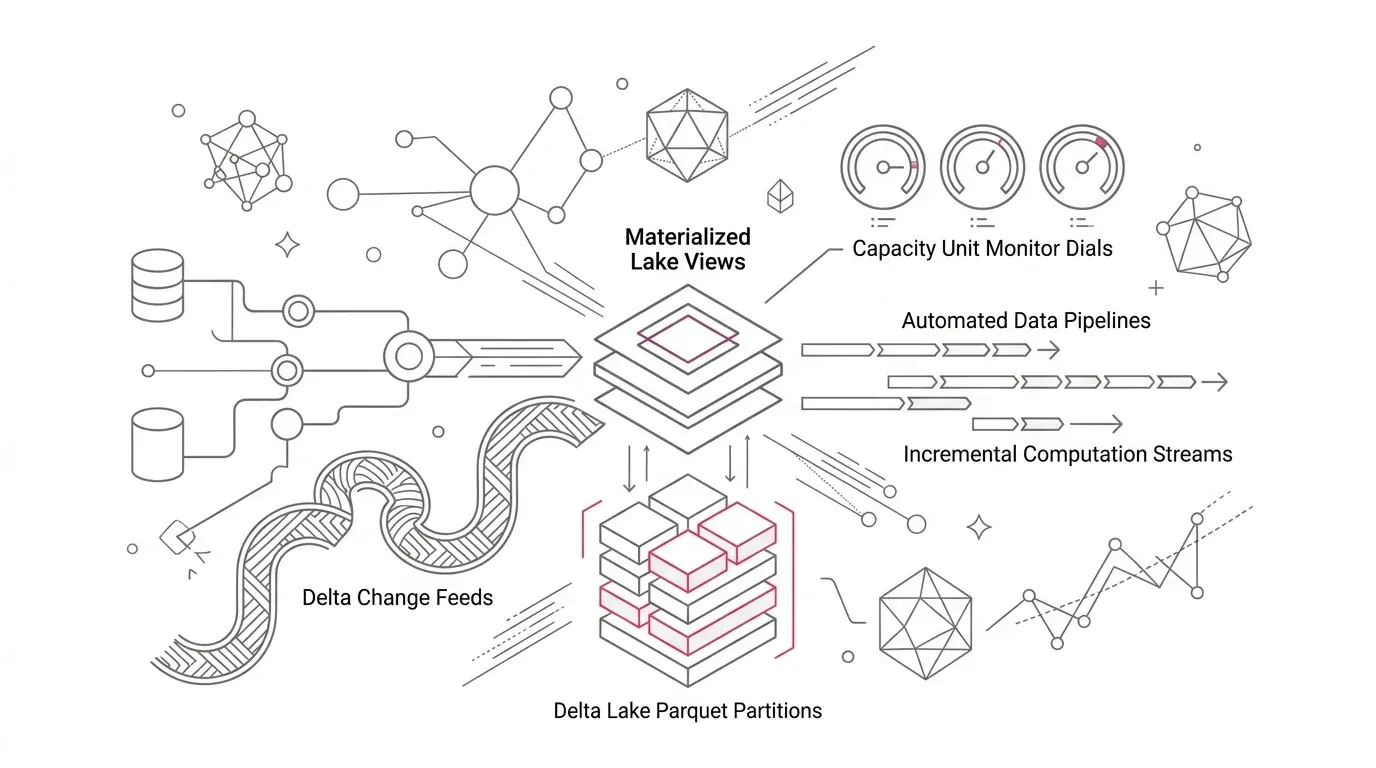
A materialized lake view, or MLV, stores the result of a transformation rather than recomputing the query every time a consumer asks for it. In Microsoft Fabric, the stored result behaves like a lakehouse table and can be queried by downstream Fabric engines under the lakehouse security model. Fabric can also infer dependencies between MLVs and execute them in the required order. Microsoft's overview describes the lifecycle as create, refresh, query, and monitor.
That managed experience removes code, but it also moves important behavior into a decision engine. For each run, Fabric can:
- perform no refresh when it detects no relevant source change;
- incrementally process changed data when the source and query pattern support it; or
- perform a full rebuild when incremental processing is not available or not efficient.
The problem is not that these choices are unreasonable. The problem is that many implementations fail to make the choices observable, bounded, and accountable.
For example, enabling “optimal refresh” does not guarantee incremental execution. Microsoft documents that SQL-defined MLVs require Change Data Feed (CDF) on all referenced Delta sources to unlock incremental processing. Without CDF, the engine can only choose between no refresh and full refresh. PySpark-defined MLVs and MLVs over non-Delta sources currently use full refresh. Unsupported SQL constructs can also lead to a full refresh without preventing creation of the view. See Optimal refresh for materialized lake views .
A platform team therefore needs to answer a harder question than “Did the job succeed?” It must answer: Did the data product refresh with the expected correctness, freshness, quality, and capacity profile?
Why this matters now
Fabric's materialized lake view feature set has expanded beyond a simple persisted query. It now includes cross-lakehouse lineage, scheduled dependency-aware refresh, analytics and insights, file ingestion, declarative quality constraints, and system tables for operational telemetry. These capabilities make MLVs increasingly attractive for enterprise medallion architectures.
Microsoft also documented preview support for optimized update and delete processing with REFRESH_HINT on 15 October 2026. The feature can avoid full recomputation by declaring columns that uniquely identify each output row. However, Microsoft explicitly states that Fabric does not validate the declared uniqueness at runtime. If duplicates exist, the refresh can produce inconsistencies without an error or warning. Schema changes between refreshes can also cause a fallback to a full refresh. See Optimal refresh for deletes and updates (preview) .
This changes the control requirement. Row identity is no longer merely a modelling detail; when used as a refresh hint, it becomes part of the correctness boundary of the data product.
Representative enterprise scenario
*The following scenario is representative, not a YuniQ customer case or a claim of achieved results.*
A healthcare services organization unifies CRM contacts, case-management events, contact-centre interactions, and provider reference data in OneLake. Its lakehouse uses:
- Bronze Delta tables for source-aligned records;
- Silver materialized lake views for normalization, deduplication, and identity resolution;
- Gold materialized lake views for service-level metrics, member journey measures, and operational work queues;
- Direct Lake semantic models for executive and operational Power BI reports.
The team replaces several custom notebooks with MLVs. Initial tests are encouraging: the dependency graph is visible, schedules are easy to create, and most runs are green. Three months later, four problems appear together:
- A Gold customer view increasingly performs full refreshes after schema changes, extending its completion time into business hours.
- A preview refresh hint declares customer_id unique, but a source-system merge temporarily creates duplicate identifiers. The MLV does not validate the claim.
- A Silver constraint uses ON MISMATCH DROP for malformed status codes. The dashboard remains available, but dropped rows are not routed to an owned exception process.
- A Gold schedule refreshes only its local lakehouse and does not include a required upstream Silver lakehouse. The Gold run succeeds against older Silver data.
Every component is technically functioning. The business service is not.
Root causes and consequences
Root cause 1: refresh policy is treated as an engine detail
Teams often enable optimal refresh and assume that incremental processing will follow. That assumption overlooks source format, CDF configuration, query compatibility, PySpark limitations, and the engine's ability to choose a full refresh when it considers one more efficient.
Consequences: unpredictable run duration, capacity spikes, missed freshness objectives, and scaling decisions based on the wrong workload profile.
Root cause 2: technical completion is confused with business freshness
A successful run proves that Fabric completed the selected work. It does not prove that the source was current when the run began, that every required upstream dependency was included, or that the Gold result arrived before the operational decision deadline.
Consequences: “green but stale” dashboards, delayed interventions, and reports that disagree because their publication points represent different source times.
Root cause 3: row identity is asserted but not continuously tested
The preview REFRESH_HINT feature trusts the declared unique columns. Joins, changing aggregation grain, source duplicates, and null keys can invalidate that declaration after deployment.
Consequences: silent inconsistency is possible even when the refresh reports no error. The risk is most serious in mutable customer, order, claim, account, or inventory data where updates and deletes matter.
Root cause 4: quality actions have no business owner
MLV constraints support FAIL and DROP. FAIL stops the refresh; DROP continues and records the number of rejected rows in lineage. Microsoft's data-quality documentation also notes that FAIL takes precedence when both actions are defined.
Neither setting is universally correct. FAIL can protect a regulated or financially material publication but may reduce availability. DROP can preserve service continuity but may silently change aggregates unless exceptions are quantified, retained, and remediated.
Consequences: missing records, unexplained variance, operational blind spots, and disputes over whether availability or completeness was intended.
Root cause 5: lineage visibility is mistaken for end-to-end orchestration
Fabric can show standard and extended lineage. Extended lineage recursively traces dependencies across lakehouses and can run upstream MLVs across workspaces. But a schedule still needs the correct scope and the required permissions. Microsoft documents that viewing extended lineage requires read access on upstream workspaces, while scheduling upstream MLVs requires contributor-level access on the upstream lakehouse. Faulted or inaccessible dependencies can prevent the lineage refresh from running. See Manage MLV lineage and Schedule an MLV refresh .
Consequences: locally consistent results built from globally stale dependencies, privilege creep to make cross-workspace scheduling work, or fragile schedules tied to individual access.
Root cause 6: definitions, data, and runtime configuration are released as if they were one artifact
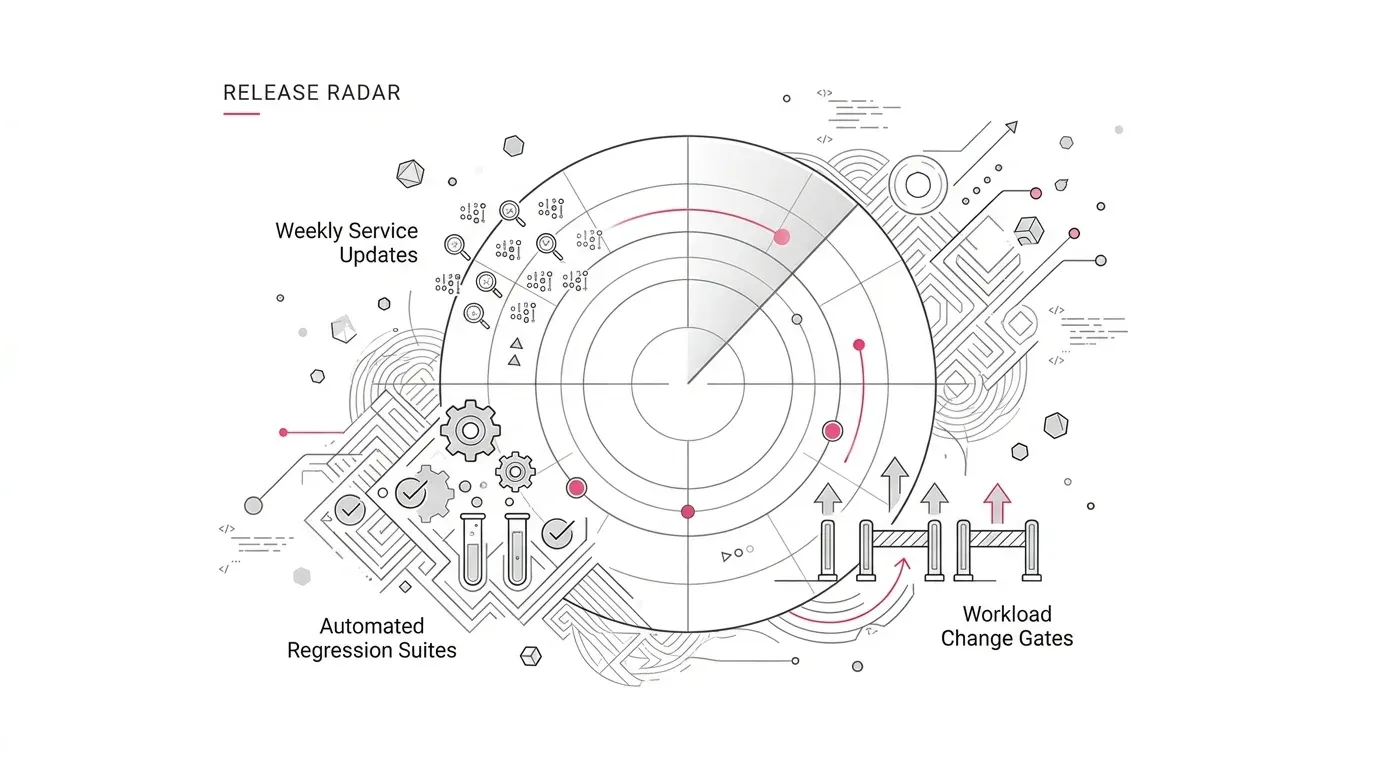
Lakehouse lifecycle management does not version the data in tables or files. Microsoft's lakehouse Git and deployment pipeline documentation states that only metadata is tracked and that Git or deployment operations do not overwrite table data. Scheduled refresh also does not inherit session-level Spark properties; those must be configured at a durable lakehouse or workspace level.
Consequences: a definition can deploy successfully while the target lacks CDF, expected data, correct permissions, schedules, or durable configuration.
Why common approaches fall short
“Turn on optimal refresh everywhere”
This is a feature toggle, not an assurance process. It does not guarantee incremental execution, and it does not establish an acceptable full-refresh rate or capacity threshold.
“Use incremental refresh for every dataset”
Incremental processing is not automatically the cheapest or safest choice. Small datasets may be faster to rebuild. Complex logic may not be compatible. Mutable outputs require reliable row identity. The correct policy depends on volume, change pattern, decision urgency, and recovery needs.
“Make every quality violation fail the pipeline”
This protects completeness at the cost of availability. For a noncritical descriptive attribute, a quarantined drop may be preferable. For a financial amount, patient safety classification, or regulatory identifier, publication may need to stop. A single default ignores business criticality.
“Refresh Gold on a five-minute schedule”
Schedule frequency is not the same as freshness. Microsoft notes that MLV schedules have a minimum effective interval of five minutes and can adjust shorter intervals to five minutes. Even a five-minute schedule cannot compensate for a source that arrives late, an omitted upstream dependency, or a full rebuild that lasts longer than the interval.
“The lineage graph proves everything is current”
Lineage proves known dependency relationships and execution status. The displayed graph does not replace source-watermark reconciliation, business-effective timestamps, or an explicit decision-age objective.
The solution: a governed MLV refresh contract
Create one refresh contract for each production data product, not merely for each technical view. A Gold product may include several MLVs whose collective behavior must meet one business objective.
| Contract field | Required decision | Evidence |
|---|---|---|
| Business purpose | Which decision or process consumes the data? | Named owner and consumer register |
| Freshness objective | Maximum age of the data at the decision point | Source watermark, MLV completion time, semantic availability time |
| Source change pattern | Append-only, update/delete, or periodic snapshot | Source profiling and contract |
| Refresh policy | Allowed full, incremental, and no-refresh behavior | Refresh-policy distribution and node metrics |
| Row identity | Unique output key and null policy | Duplicate and null-key tests on production-shaped data |
| Quality disposition | Which rules fail, drop, quarantine, or warn? | Constraint metrics and remediation queue |
| Lineage scope | Local, dependent, or extended cross-lakehouse refresh | Saved schedule definition and dependency review |
| Security | Who can author, schedule, operate, and consume? | Entra groups, workspace roles, and access tests |
| Capacity guardrail | Maximum duration, CU envelope, and concurrency | Baseline and capacity telemetry |
| Release rule | What must pass before promotion? | Reconciliation, performance, security, and rollback evidence |
| Preview boundary | Whether preview features are permitted for this tier | Architecture decision and fallback plan |
Reference architecture
Operational sources
    |
    v
Bronze Delta tables or governed file-backed MLVs
    |  source watermark + CDF status + schema contract
    v
Silver MLVs
    |  normalization + identity + quality constraints
    |  rejected-row evidence and remediation ownership
    v
Gold MLVs
    |  stable grain + certified measures + freshness stamp
    v
Semantic models / SQL / data science / AI consumers

Control plane alongside every layer:
Git-controlled definitions -> deployment gates -> durable configuration
Entra groups -> lakehouse permissions -> OneLake security -> consumer tests
_mlv_system metrics -> capacity telemetry -> SLO alerts -> runbooks
The important design choice is the parallel control plane. Data transformation and operational assurance must travel together.
Detailed Microsoft Fabric implementation
1. Classify each source by change behavior
Profile each source before choosing an MLV pattern:
- Append-only: events or immutable transactions. Incremental processing can be straightforward when all sources are Delta and CDF is enabled.
- Mutable: customer, case, order, claim, or inventory records with updates and deletes. Treat row identity as a governed contract.
- Snapshot: complete periodic extracts where replacement semantics may be clearer than pretending records are append-only.
- Streaming: data requiring subsecond response. MLVs are not the right serving mechanism; Microsoft recommends Real-Time Intelligence for high-frequency streaming use cases.
Record the classification at the output grain, not just the source-table grain. A join or aggregation can change identity and mutability.
2. Build the CDF chain deliberately
Incremental refresh requires CDF on every referenced source Delta table or upstream MLV. Enable it intentionally and verify it in each environment. A single noncompliant source can prevent the intended incremental path.
Do not treat CDF as a one-time setup task. Add a deployment preflight that confirms:
- every required source is Delta;
- delta.enableChangeDataFeed is enabled where the contract requires it;
- the transformation uses constructs compatible with incremental processing;
- production has the same durable configuration tested upstream;
- the first production run's policy matches the expected profile.
For PySpark-authored MLVs, plan for full refresh until Microsoft changes the documented behavior. If the data volume makes full refresh unacceptable, use SQL-defined MLVs where suitable or retain a governed notebook/pipeline pattern.
3. Treat refresh hints as preview correctness controls
For update/delete workloads using the preview REFRESH_HINT, establish a strict adoption gate:
- Define the business grain in plain language, such as “one row per order line.”
- Select the candidate key at that grain.
- Test for duplicates and nulls over production-shaped history.
- Test again after every join, filter, aggregation, or schema change.
- Introduce adversarial cases: late updates, deletes, duplicate source records, key reuse, and null keys.
- Reconcile incremental output against an independently computed full rebuild.
- Monitor the key continuously in production.
- Maintain a documented fallback to full refresh or the prior transformation path.
A simple release assertion for a composite key is:
SELECT order_id, item_id, COUNT(*) AS row_count
FROM gold.order_items_candidate
GROUP BY order_id, item_id
HAVING COUNT(*) > 1;
The release should fail if this query returns any row. Run a separate null check because nulls can conceal an invalid key assumption.
Preview terms matter here. Microsoft's Fabric preview guidance says preview features are not intended for production use, are not subject to service-level agreements, and may have limited availability or functionality. An enterprise may evaluate refresh hints in a controlled pilot, but it should not quietly make a critical production service dependent on them.
4. Separate blocking quality rules from recoverable exceptions
Design rules by business consequence:
- Use FAIL when publishing bad data is worse than withholding the product.
- Use DROP only when the missing population is measured, retained or reproducible, and acceptable within a defined threshold.
- Use a separate exception output or source-level quarantine when records require repair and replay.
- Add aggregate controls alongside row rules: counts, sums, distinct keys, referential coverage, and period-over-period variance.
Every dropped row count should have an owner and a threshold. A successful refresh with 4% of records dropped may be a business failure even though the engine behaved as configured.
5. Design refresh scope around the business dependency
Use Fabric's schedule types deliberately:
- refresh only the selected MLV when upstream data is independently guaranteed current;
- include dependent lineage within the lakehouse when the product requires its local upstream chain;
- use extended lineage when the freshness objective spans lakehouses or workspaces.
Avoid giving broad contributor access to human users merely to operate cross-workspace refreshes. Use controlled Entra groups, separate authors from operators, and review effective permissions across every upstream lakehouse. Test both positive and negative access paths.
Also design for concurrency. Independent branches can run in parallel, which shortens elapsed time but may concentrate capacity use. Set schedules around source arrival and consumer deadlines, not convenient clock intervals.
6. Measure decision age, not just job duration
For every published product, persist or derive these timestamps:
- latest accepted source event or extraction watermark;
- start and completion time of each MLV node;
- completion time of the Gold lineage;
- time the semantic or operational consumer can observe the result.
Then calculate:
decision_age = consumer_available_time - latest_accepted_source_timeAlert on the business SLO for decision age. A job-duration alert alone cannot identify a source that stopped advancing while refreshes continued successfully.
7. Operationalize Fabric telemetry
Fabric exposes recent runs, analytics, insights, data-quality metrics, and a distribution of full, incremental, and no-refresh work. Microsoft also documents system tables in the _mlv_system schema: sys_run_metrics, sys_node_metrics, and sys_error_metrics. Do not alter that schema, because doing so can affect the Analytics and Insights experience. See MLV monitoring and system tables .
Build service-level monitoring around:
- freshness SLO breaches;
- failed, cancelled, or unusually long runs;
- unexpected changes in refresh-policy mix;
- full-refresh duration and capacity consumption;
- constraint failures and dropped-row volume;
- repeated error codes;
- inaccessible or faulted lineage nodes;
- key-uniqueness failures for any refresh hint;
- overlapping schedules and backlog growth.
Correlate MLV telemetry with Fabric capacity metrics. A rise in full-refresh share is both a data-engineering signal and a FinOps signal.
8. Release definitions and runtime assurance together
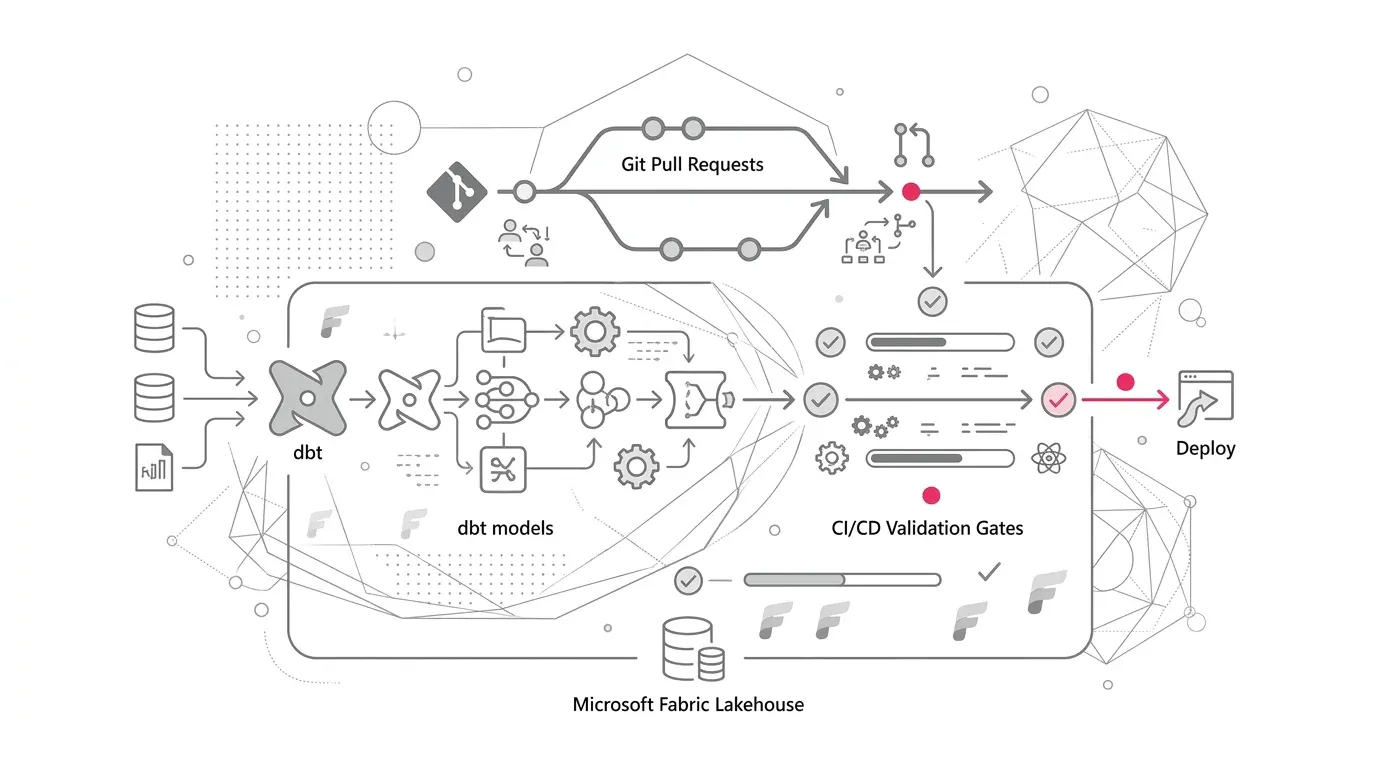
Use development, test, and production workspaces, but do not assume deployment alone creates a working service. Promote the definition, then perform target-environment assurance:
- verify source mappings and shortcuts;
- verify CDF properties and durable Spark configuration;
- verify schedules and lineage scope;
- verify Entra group membership and lakehouse permissions;
- run the intended security personas;
- compare row counts, aggregates, duplicates, null keys, and source watermarks;
- observe the actual refresh policy and capacity profile;
- confirm rollback and full-rebuild procedures.
Because tables and files are not versioned by lakehouse Git integration, retain reproducible source data or a controlled test fixture for release validation. Definition parity without data-state parity is weak evidence.
Phased implementation roadmap
Phase 1: Discover and baseline
- Inventory MLVs, consumers, schedules, sources, owners, and workspace boundaries.
- Map the business decisions served by each Gold product.
- Capture current decision age, duration, failures, quality drops, and refresh-policy mix.
- Identify PySpark MLVs, non-Delta sources, missing CDF, and preview dependencies.
Exit criterion: every critical product has an owner, dependency map, measured baseline, and ranked risk.
Phase 2: Define contracts and target architecture
- Classify change behavior and business criticality.
- Set freshness, quality, capacity, and recovery objectives.
- Decide which products may evaluate preview refresh hints.
- Design workspace boundaries, extended-lineage permissions, and operating roles.
Exit criterion: each production product has an approved refresh contract and exception policy.
Phase 3: Prove with production-shaped data
- Enable and verify CDF on the selected chain.
- Test incremental, full, and no-refresh paths.
- Reconcile update and delete outcomes against a full rebuild.
- Validate duplicate, null, late-arriving, schema-change, and failure scenarios.
- Measure capacity during parallel and worst-case full refreshes.
Exit criterion: correctness and performance evidence meets the contract, including a tested fallback.
Phase 4: Release in controlled waves
- Promote low-criticality products first.
- Apply target-environment preflight and post-deployment tests.
- Run parallel comparison for material reports and operational decisions.
- Increase criticality only after the monitoring and response loop is proven.
Exit criterion: consumers formally accept reconciled output and operators can execute the runbook.
Phase 5: Operate and optimize
- Review decision age, policy distribution, quality exceptions, and capacity weekly.
- Investigate unexpected full refreshes as regressions unless explicitly accepted.
- Revalidate refresh-hint uniqueness after definition or schema changes.
- Retire redundant notebook and pipeline logic only after stable operation.
Exit criterion: the product remains within agreed SLOs across normal, peak, and recovery conditions.
Governance, security, adoption, and cost considerations
Governance
Assign a business owner to the Gold product and technical owners to each upstream domain. Store the refresh contract with the data-product documentation. Treat changes to grain, key, quality action, schedule, or lineage scope as controlled interface changes.
Security
MLVs follow lakehouse table security and can operate in Private Link-enabled lakehouses. Apply least privilege across authors, schedule operators, platform administrators, and consumers. Cross-workspace refresh must not become a reason to make broad human accounts contributors everywhere. Include negative tests proving that unauthorized personas cannot query sensitive rows or alter refresh behavior.
Adoption
Publish one certified consumption path per decision where possible. Tell report owners what the freshness stamp means and what happens during a quality hold. Train operators to distinguish source lateness, refresh failure, quality rejection, and capacity delay; each requires a different response.
Cost
Fabric bills the compute used during refresh. Optimal refresh itself does not add a separate fee, but a workload that repeatedly falls back to full recomputation can consume materially more capacity. Baseline cost per accepted change volume, not merely per scheduled run. Partitioning may reduce changed-data work when it aligns with update patterns, but excessive or poorly chosen partitions can create their own maintenance cost.
Do not optimize away recovery. A full rebuild remains an important reconciliation and repair path even when the steady-state objective is incremental processing.
Success metrics
Use a balanced scorecard rather than a single job-success percentage:
| Outcome | Example measure |
|---|---|
| Freshness | Percentage of publication cycles meeting decision-age SLO |
| Correctness | Reconciliation variance between incremental output and controlled full rebuild |
| Identity integrity | Duplicate and null-key violations for declared refresh hints |
| Quality | Rejected rows by rule, age, owner, and remediation status |
| Reliability | Successful end-to-end lineage runs, excluding stale-source false positives |
| Efficiency | Full, incremental, and no-refresh distribution by product |
| Performance | P50 and P95 end-to-end refresh duration |
| Cost | Capacity units per accepted million changed rows or other workload-normalized unit |
| Security | Positive and negative access tests passed per release |
| Recovery | Time to restore a trusted publication after a failed or inconsistent refresh |
| Adoption | Certified-product usage and reduction in unmanaged duplicate transformations |
Targets should reflect business criticality. A daily executive summary and a near-real-time work queue should not share the same freshness or recovery objectives.
How YuniQ can help
YuniQ's Microsoft Fabric consulting and implementation services cover the capabilities required to turn MLVs into an operated enterprise service:
- Fabric strategy and readiness: current-state diagnostics, use-case prioritization, capacity planning, workspace topology, security, governance, and operating-model design;
- Data engineering: reusable ingestion and transformation patterns across OneLake medallion layers;
- Governance, security, and DevOps: least-privilege Entra role design, Purview integration, lineage, development/test/production separation, Git and deployment pipelines, monitoring, and capacity alerts;
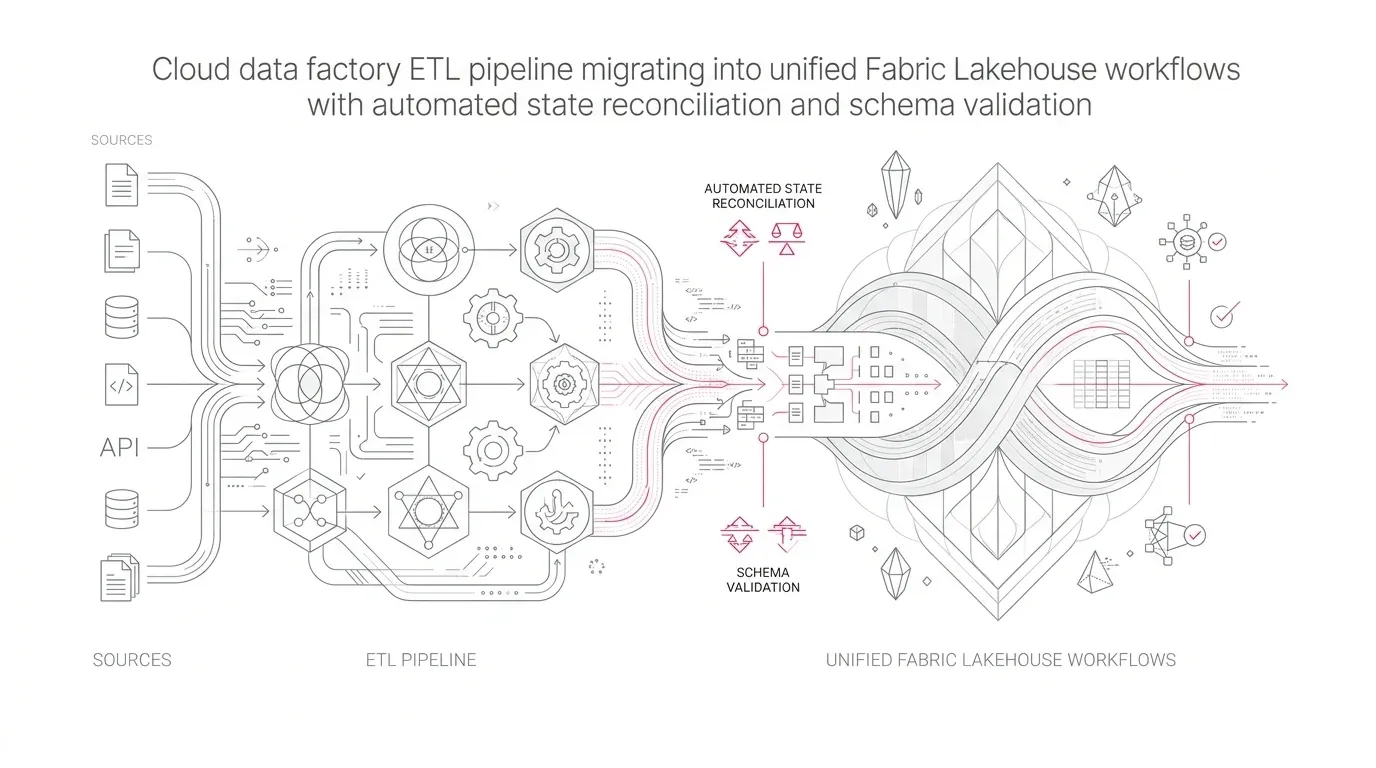
- Validation and launch: automated data reconciliation, access testing, dual-run comparison, user acceptance, and controlled cutover;
- Optimization and managed services: pipeline and refresh monitoring, capacity optimization, release management, and continued domain onboarding.
For an MLV programme, that translates into a practical engagement: inventory critical transformations, define refresh contracts, prove incremental correctness with production-shaped data, design the security and workspace model, implement release gates and observability, and transfer the operating runbooks to the responsible teams.
Practical next steps
- Select one high-cost or freshness-critical Gold data product.
- Trace its complete MLV and source lineage, including cross-workspace dependencies.
- Measure the last 30 days of refresh-policy mix, duration, failures, quality drops, and source-to-consumer decision age.
- Verify Delta format and CDF across every source in the intended incremental chain.
- If a preview refresh hint is being evaluated, independently validate uniqueness, null behavior, schema-change fallback, and incremental-versus-full reconciliation.
- Define the business thresholds that turn a technically successful refresh into a failed publication.
- Prove the runbook with a duplicate key, a late source, a schema change, an inaccessible dependency, and a forced full rebuild.
The objective is not to force every refresh to be incremental. It is to make every refresh mode intentional, observable, economically bounded, and correct for the business decision it serves.