Executive summary
Microsoft has changed the delivery model for healthcare data solutions in Microsoft Fabric. A downloadable source-code and documentation package became available on 3 August 2026. Since 1 October 2026, new customers have been directed to that customer-managed package; existing customers can continue with the managed solution while planning their transition, but support for the current managed solution ends on 31 December 2027. The current download is version 1.4.0, published on 6 August 2026. These milestones define the operational transition window for enterprise healthcare data estates. ( Microsoft Learn: healthcare data solutions overview , Microsoft Download Center )
For healthcare technology leaders, the consequential problem is not how to unzip and deploy code. It is how to assume product-level ownership of a complex clinical data transformation estate without weakening data integrity, protected health information controls, lineage, recovery, or reporting continuity.
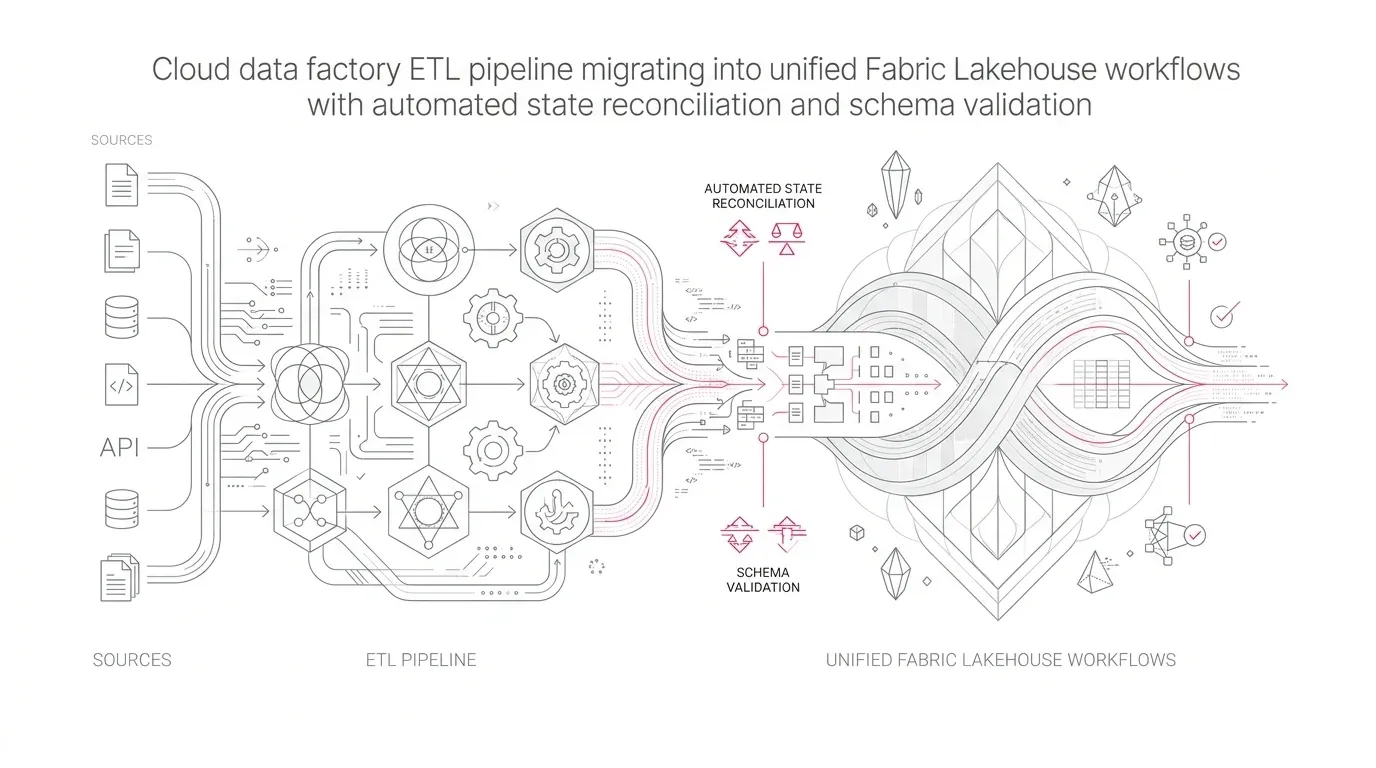
The safest response is to treat the change as an operating-model and software-supply-chain transition. Establish a controlled source baseline, make environments reproducible, separate code from configuration and patient data, test representative FHIR, DICOM, claims, and operational workloads, reconcile old and new outputs, and cut over by data product rather than by platform date.
This article presents a practical architecture and phased roadmap to help healthcare organizations transition smoothly, combining Microsoft's baseline framework with enterprise-grade clinical, regulatory, and security controls.
The enterprise problem: ownership has moved closer to the customer
Healthcare data solutions in Fabric provide accelerators for healthcare data foundations, OMOP transformations, DICOM transformation, Azure Health Data Services FHIR export, CMS claims transformation, SDOH transformation, care management analytics, patient outreach analytics, and other capabilities. They use Fabric pipelines, notebooks, environments, lakehouses, and Power BI assets to turn heterogeneous healthcare data into usable analytical structures. ( Microsoft Learn: healthcare data solutions overview )
The delivery-model change alters who must control the lifecycle of those assets. In a customer-managed implementation, an enterprise needs clear answers to questions that a managed deployment could partially obscure:
- Which package version is approved for production?
- Which source files are unmodified, and which carry local changes?
- How are fixes from a later Microsoft package assessed and merged?
- Which identities deploy and execute notebooks and pipelines?
- Which configuration belongs to development, test, and production?
- How are FHIR identifiers, DICOM references, validation rules, and terminology versions tested?
- How can the organization prove that an upgrade did not change patient, encounter, imaging, or claims meaning?
- Who owns rollback when code, configuration, runtime dependencies, and stored data have changed together?
This is a material governance issue because a healthcare pipeline can be technically green yet clinically or operationally wrong. A transformation may complete while dropping a source namespace, changing identity resolution, misclassifying a failed record, or producing different cohort counts. The control objective is therefore not merely "deployment succeeded." It is "the intended data arrived, retained its meaning, remained appropriately protected, and produced reconciled downstream decisions."
Why this matters now
Three clocks are already running.
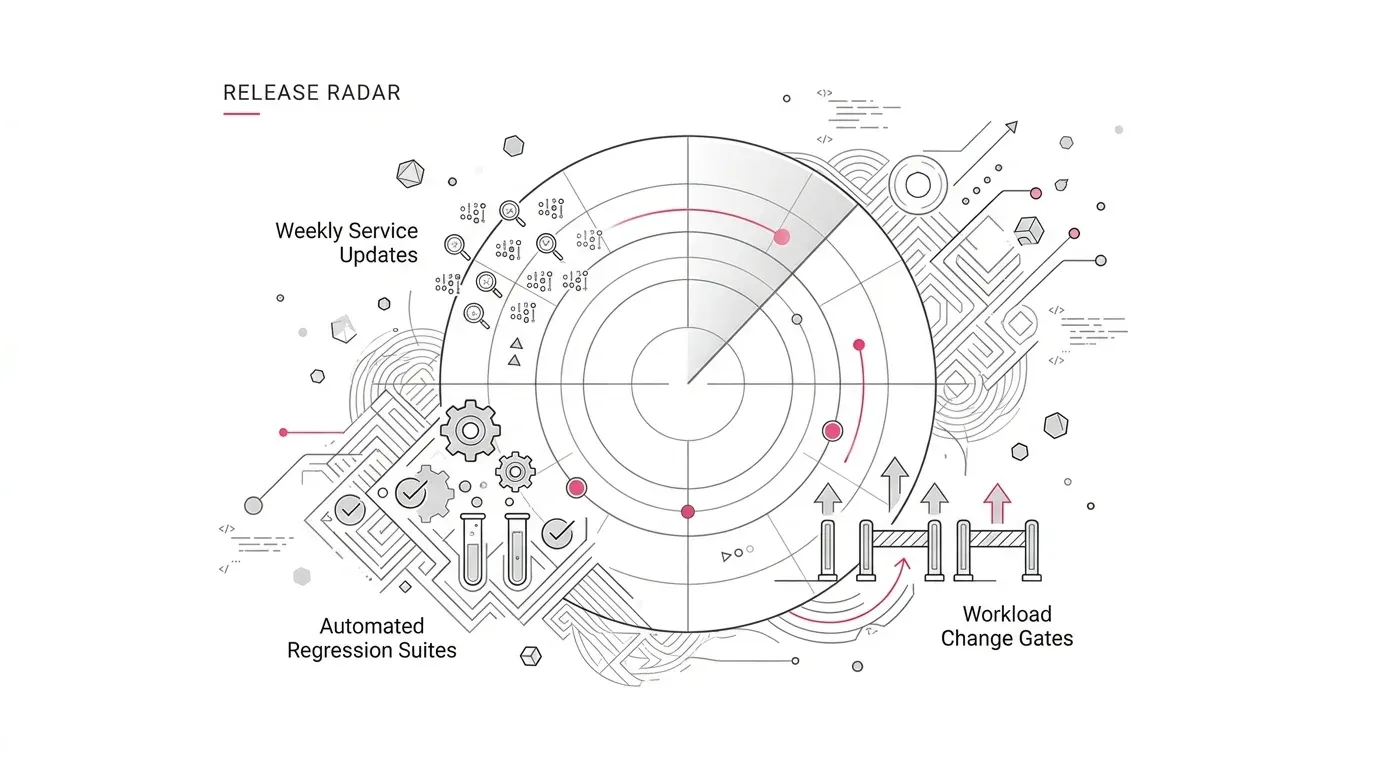
First, new deployments have been on the customer-managed path since 1 October 2026. Second, existing customers have a defined support horizon ending 31 December 2027. Third, the package itself will evolve. Microsoft release notes show that version 1.4.0 included fixes for multiple inventory folders, DICOM date validation, imaging patch processing, and Spark-library compatibility. That illustrates why package upgrades must be treated as tested software releases rather than copied into production ad hoc. ( Microsoft Learn: release notes )
Waiting until the support deadline compresses the riskiest work: dependency discovery, security redesign, regression testing, operational rehearsal, and stakeholder approval. Deploying the source quickly without those controls creates a different risk: an apparently successful transition that leaves no dependable upgrade path.
Representative scenario
The following is a representative scenario, not a YuniQ customer case or a claim of achieved results.
A regional healthcare organization uses the managed healthcare data solution to ingest FHIR data from Azure Health Data Services, process DICOM metadata from imaging archives, transform claims data, and publish curated population-health measures. Clinical analytics, finance, care management, and research teams consume different Gold-layer data products.
The organization also has custom notebooks, local terminology mappings, Power BI semantic models, service identities, workspace permissions, and overnight schedules. Some analysts query Silver tables directly. Operations monitors pipeline completion, but does not consistently reconcile source-to-target counts or validation exceptions.
If the team treats customer-managed delivery as a reinstall, it can reproduce the visible items while missing the contracts around them. A new pipeline can run successfully but use a different namespace, environment library, configuration file, shortcut target, or DICOM identifier mapping. Reports still refresh, yet longitudinal patient counts or imaging linkage can drift.
The target state should make the full service reproducible and testable: approved source, configuration, identities, policies, runtime dependencies, data contracts, schedules, observability, semantic models, and recovery procedures.
Root causes of transition risk
The deployable unit is larger than the source package
The Microsoft download contains source code and documentation. A working enterprise service also includes tenant settings, capacities, workspace topology, lakehouses, external connections, secrets, service identities, OneLake shortcuts, permissions, sensitivity labels, schedules, alert routes, semantic models, and runbooks. Source control is necessary, but it is not a complete representation of production.
Healthcare semantics are encoded in configuration
Healthcare data solutions use namespaces to identify source systems and help maintain identifier uniqueness. DICOM transformation can require explicit configuration of identifier types and mapping paths. Treating these settings as deployment trivia risks referential errors that only appear when clinical and imaging data are joined. ( Microsoft Learn: data architecture and management , Microsoft Learn: DICOM transformation configuration )
Platform success is not business correctness
The solution's admin lakehouse contains an `ExecutionSummary` table for operational and performance information and links to `BusinessEvents` for validation errors and warnings. Microsoft explicitly positions these as useful for run diagnosis, record-volume tracking, and transformation validation. A green orchestration status alone is therefore an incomplete acceptance criterion. ( Microsoft Learn: data architecture and management )
Healthcare-specific deployment work remains after ALM synchronization
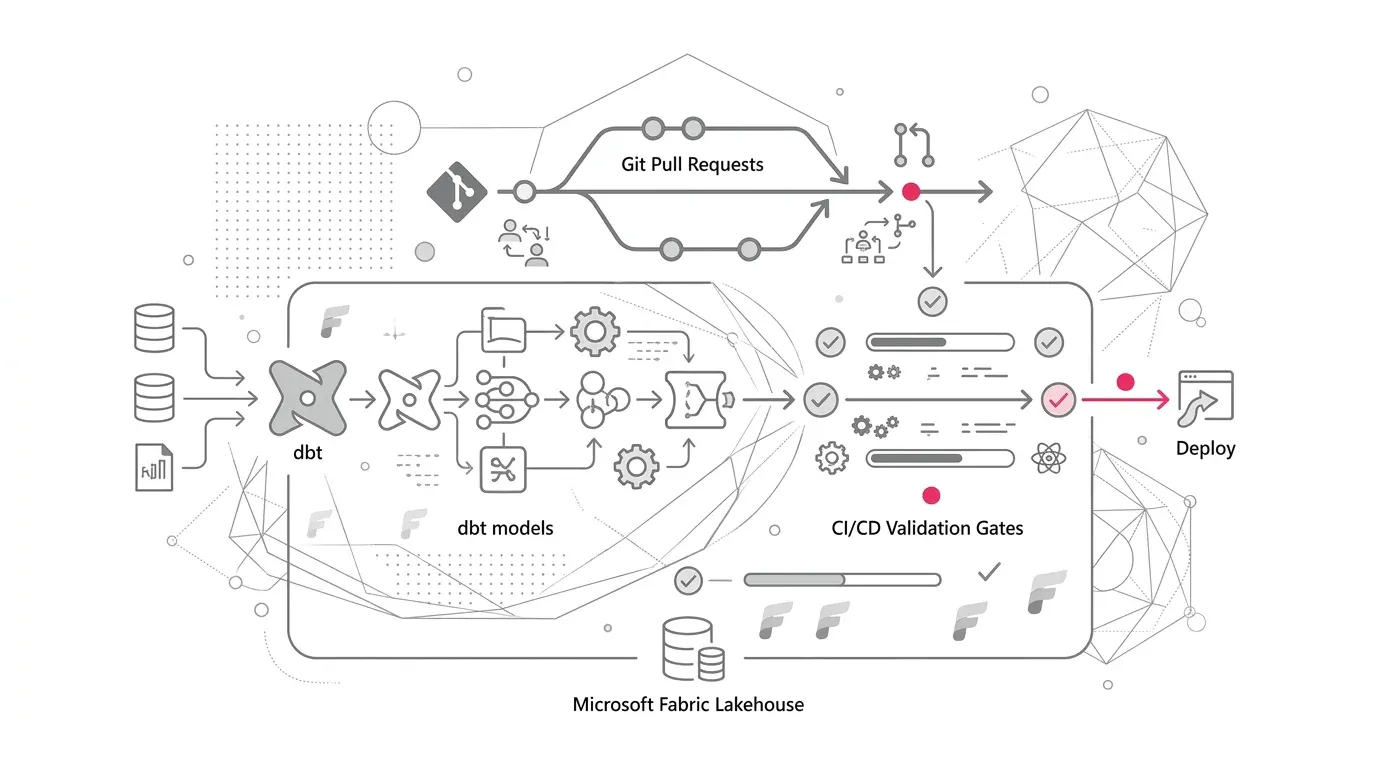
Microsoft documents Git integration and deployment pipelines for healthcare data solutions, but also documents the need for a healthcare ALM helper notebook to reconfigure deployment parameters, update notebook metadata, create Delta tables, create Bronze folder structures, copy system resources, and publish environments. The helper does not copy customer data and does not reproduce Silver or Gold folder structures. ( Microsoft Learn: application lifecycle management )
That boundary matters. A source sync can report success while the target is not operationally equivalent.
Broad workspace roles can override fine-grained intent
OneLake distinguishes control-plane permissions, such as managing items, from data-plane permissions over folders, tables, rows, and columns. However, workspace Admins, Members, and Contributors already have broad data access and are not restricted by OneLake security roles in the same way as Viewers or item readers. For sensitive healthcare data, workspace-role design is therefore a primary security boundary, not an administrative afterthought. ( Microsoft Learn: OneLake data security , Microsoft Learn: OneLake table, column, and row security )
Why common approaches fall short
"Deploy the package and validate a sample"
Synthetic samples prove that a path can execute. They rarely cover production source variation, historic corrections, deletes, late-arriving files, malformed resources, duplicate identifiers, custom vocabularies, or the distribution of real DICOM tags. Sample success is a smoke test, not a production acceptance test.
"Lift every local customization forward"
Carrying all custom code into the new baseline preserves accidental dependencies and makes future package upgrades harder. Each customization should have an owner, business purpose, affected contract, test, and retirement decision.
"Connect every environment to the same data"
This simplifies early testing but increases exposure and makes tests destructive. Development should use synthetic or appropriately de-identified data. Production-like validation requires governed, time-bounded access to representative data, not permanent broad access.
"Use deployment success as the cutover gate"
Fabric item deployment does not prove data parity, security parity, scheduling parity, or semantic-model parity. Microsoft notes that healthcare-specific ALM steps are still required and that the helper does not move customer data. A credible gate must reconcile the service, not just its item definitions.
"Wait for the final support year"
The support deadline is not the right target date for the first end-to-end rehearsal. Organizations need time to discover unsupported dependencies, evaluate package updates, collect representative test cases, and run old and new paths in parallel.
A practical Microsoft Fabric solution architecture
The following is a recommended control architecture built from documented Fabric and healthcare-solution capabilities.
Microsoft release package (immutable vendor baseline)
                         |
                         v
Approved enterprise repository
  - vendor baseline tag
  - local extensions isolated by module
  - dependency lock and software bill of materials
  - reviewed environment configuration templates
                         |
            gated build and release process
                         |
          +--------------+--------------+
          |              |              |
          v              v              v
     Development        Test         Production
     synthetic data   representative   live PHI
     least privilege  controlled data  durable identities
          |              |              |
          +------- healthcare data foundations -------+
                          |
       Sources/shortcuts -> Bronze -> Silver -> Gold
          FHIR, DICOM,       raw      validated  purpose-built
          claims, SDOH       evidence  records    data products
                          |
       +------------------+------------------------+
       |                  |                        |
  ExecutionSummary   BusinessEvents       semantic models/reports
  run evidence       quality evidence     consumer reconciliation
       |                  |                        |
       +--------- operations and audit evidence --+
Control 1: preserve an immutable vendor baseline
Store the approved Microsoft package exactly as received and record its version, download date, checksum, license terms, and approving owner. Apply local changes in a separate, reviewable layer. This creates three comparable states:
- What Microsoft shipped.
- What the enterprise changed.
- What is actually deployed.
When a new package arrives, compare vendor baseline to vendor baseline first. Then reapply or refactor only justified local extensions. Do not make production the only surviving copy of a fix.
Control 2: define a release manifest beyond Git
For every environment, maintain a release manifest containing:
- Package version and enterprise release identifier.
- Fabric workspace and capacity assignment.
- Required lakehouses, pipelines, notebooks, environments, and semantic models.
- Runtime and library versions.
- Connection and shortcut identifiers, without embedding secrets.
- Deployment parameters and healthcare namespace mappings.
- Schedule definitions and execution identity.
- Workspace, item, and OneLake role assignments.
- Purview labels, ownership, lineage expectations, and retention rules.
- Expected reconciliation suite and approved results.
The manifest becomes the evidence that development, test, and production are intentionally different only where they should be.
Control 3: separate code, configuration, secrets, policy, and data
Do not solve environment portability with string replacement inside notebooks. Keep source code stable. Parameterize environment-specific values. Store secrets in an approved secret service and retrieve them through durable, non-person identities. Provision access policy through a controlled administrative path. Treat patient and member data as a separate stateful asset that is neither carried through Git nor copied casually between stages.
Control 4: preserve the medallion contract
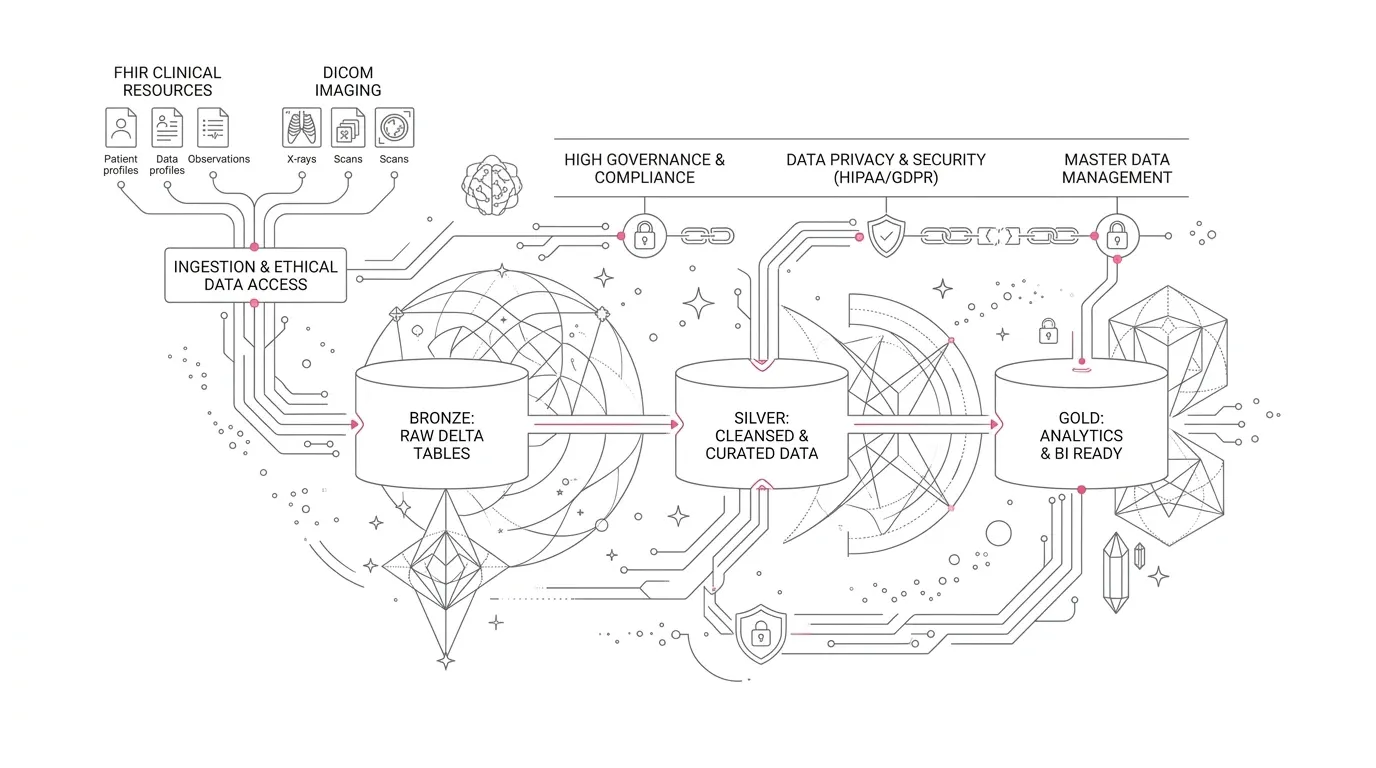
Microsoft documents Bronze as the raw or source-aligned layer, Silver as validated and enriched, and Gold as purpose-built for analytical use. It also warns against extending or building dependencies on internal Bronze staging tables because their schemas are solution-specific and transient. ( Microsoft Learn: data architecture and management )
Use that boundary deliberately:
- Bronze: retain replayable source evidence, file provenance, source namespace, and ingestion metadata. Keep internal staging tables free of consumer dependencies.
- Silver: enforce healthcare structure, identity, timestamps, terminology, delete behavior, validation disposition, and deterministic keys.
- Gold: publish versioned business contracts for care management, quality, claims, operations, and research. Consumers should depend on these governed products or certified semantic models.
This design localizes package change. A pipeline implementation can evolve while Gold contracts remain stable, or a Gold contract can version explicitly when business meaning changes.
Control 5: test meaning, not just rows
Build a regression pack with production-shaped cases and expected outcomes. At minimum, include:
- FHIR resource counts by type, source, status, and event date.
- Patient and encounter identity uniqueness and referential integrity.
- DICOM study, series, and instance linkage, including patch and delete cases.
- Claims header-to-line reconciliation and financial totals where applicable.
- Late-arriving, corrected, duplicate, malformed, and intentionally rejected input.
- Bronze-to-Silver and Silver-to-Gold count and amount bridges.
- Validation errors and warnings by rule and disposition.
- Gold measure and semantic-model results for high-risk executive or clinical-adjacent metrics.
- Role-based positive and negative access tests through each supported consumption path.
Hash or aggregate sensitive fields where full-value comparison is unnecessary. Retain evidence that can be reviewed without widening PHI access.
Control 6: make observability part of acceptance
Use `ExecutionSummary` and `BusinessEvents` for healthcare run and quality evidence, then correlate those records with Fabric monitoring and capacity telemetry. The generally available Capacity Metrics app can identify CU consumption, peak load, throttling, and high-cost items or operations over its documented monitoring windows. ( Microsoft Learn: Capacity Metrics app , Microsoft Learn: compute page )
Define service-level objectives around decision age, not just pipeline duration. For example: "The 06:00 care-gap data product is reconciled, approved, and available by 07:00" is more meaningful than "the notebook completed in 18 minutes."
Control 7: minimize PHI exposure by workspace role
Use separate workspaces for lifecycle stages and, where risk warrants it, for raw restricted data versus curated consumer products. Assign Admin, Member, and Contributor roles only to identities that require broad workspace access. Use item sharing and OneLake security roles for narrower access, and verify that no other role or permission grants a broader path. Microsoft documents that OneLake uses a grant model, so a restrictive role cannot negate access granted elsewhere. ( Microsoft Learn: create and manage OneLake security roles )
Do not describe the platform as making an implementation compliant by itself. Compliance depends on the organization's configuration, operating controls, contractual obligations, evidence, and use of the service.
Phased implementation roadmap
Phase 0: establish authority and scope
Recommended control
- Name an executive sponsor, clinical or healthcare data owner, product owner, security owner, platform owner, and release authority.
- Record whether the organization is an existing managed-solution customer or a new customer-managed deployment.
- Confirm the support timeline and package terms with Microsoft for the organization's specific agreement.
- Define in-scope modalities, consumers, regulatory obligations, recovery objectives, and blackout periods.
- Set a target for the first production rehearsal well before the support deadline.
Exit evidence: signed scope, accountable owners, dependency inventory plan, and agreed acceptance principles.
Phase 1: discover the actual service
Recommended control
- Inventory all solution and custom Fabric items, schedules, connections, environments, libraries, shortcuts, workspaces, capacities, semantic models, and reports.
- Trace source-to-consumer lineage for each production data product.
- Capture source namespaces, FHIR/DICOM/claims mappings, terminology versions, retention, and purge behavior.
- Export access assignments and identify personal credentials or user-owned connections.
- Classify local customizations as retain, replace, refactor, or retire.
- Baseline volume, duration, exception rate, CU consumption, storage, and decision age.
Exit evidence: service catalogue, dependency graph, customization register, access matrix, and operational baseline.
Phase 2: build the controlled baseline
Microsoft-documented foundation: use the source and documentation package and Fabric ALM capabilities.
Recommended control
- Register the unmodified version 1.4.0 package, or the then-current approved package, as the vendor baseline.
- Create the enterprise repository structure, release manifest, dependency locks, review policy, and automated secret scanning.
- Build isolated development and test workspaces with durable deployment identities.
- Automate healthcare-specific post-deployment steps, including parameter updates, environment publication, table creation, and folder verification.
- Record every manual action that remains; either automate it or make it an auditable runbook step.
Exit evidence: repeatable clean deployment with no production data and a complete release record.
Phase 3: validate with representative data
Recommended control
- Start with synthetic data, then introduce governed representative cases.
- Exercise normal, corrected, deleted, late, duplicate, malformed, and high-volume paths.
- Run the regression pack and security tests for clinical analysts, researchers, operations staff, report consumers, and service identities.
- Verify audit and operational evidence, recovery from failed activities, and replay from retained source evidence.
- Measure CU and storage behavior at realistic concurrency and volume.
Exit evidence: approved functional, data-quality, security, performance, recovery, and cost results.
Phase 4: dual-run by data product
Recommended control
- Process the same bounded source windows through the current and customer-managed paths.
- Reconcile records, identifiers, relationships, validation outcomes, measures, freshness, and exceptions.
- Investigate every material variance; do not average discrepancies away.
- Keep downstream consumers on the current path until their specific contract passes.
- Rehearse rollback without discarding new-source evidence or duplicating operational action.
Exit evidence: consumer-by-consumer parity sign-off and a timed cutover/rollback rehearsal.
Phase 5: cut over and retire deliberately
Recommended control
- Freeze unrelated changes for the cutover window.
- Confirm deployment identity, configuration, access, schedules, capacity headroom, monitoring, and escalation routes.
- Move consumers in controlled waves, starting with lower-risk products.
- Monitor decision age, validation exceptions, security events, and capacity, not merely job state.
- Retain the old path in a defined read-only or standby state until acceptance and recovery windows expire.
- Remove obsolete access, schedules, connections, secrets, and duplicated storage only after formal approval.
Exit evidence: signed production acceptance, complete evidence pack, updated service catalogue, and approved retirement record.
Phase 6: operate the customer-managed product
Recommended control
- Review Microsoft release notes and packages on a fixed cadence.
- Triage security and defect fixes separately from optional features.
- Repeat the regression suite for every package, runtime, library, or material configuration change.
- Maintain a support matrix covering package, Fabric runtime, libraries, extensions, and dependent data products.
- Rehearse restore, replay, and rollback at least as often as the business impact requires.
Exit evidence: measurable release lead time, tested recovery, current dependencies, and no unsupported production baseline.
Governance, security, adoption, and cost considerations
Governance
Assign ownership at the data-product level. A platform team can own deployment tooling, but it should not decide whether a clinical quality measure remains semantically equivalent. Record source, steward, contract, validation rules, sensitivity, retention, consumers, and change approver for each product.
Use Purview and Fabric lineage as discovery and evidence mechanisms, then supplement automated lineage where code, external services, or operational handoffs are not captured. Certification should follow reconciliation and ownership, not simply technical publication.
Security
Design separate paths for developers, operators, analysts, and automated identities. Remove personal credentials from production execution. Test both allowed and denied access to raw files, Silver clinical tables, Gold products, notebook outputs, SQL endpoints, exported files, and Power BI reports. Include break-glass access, approval, expiry, and review.
Treat logs as sensitive when they may contain identifiers, source paths, payload fragments, or error details. Limit access and retention accordingly.
Adoption and operating model
Customer-managed delivery creates a product-maintenance function. Define who assesses Microsoft releases, who owns local extensions, who approves semantic changes, who operates pipelines, and who communicates consumer impact. Train support staff on the release manifest, healthcare validation evidence, and rollback procedure rather than on portal clicks alone.
Cost
Budget for more than steady-state Fabric capacity. Transition costs include parallel environments, dual processing, retained comparison data, test automation, observability, security review, and staff time. Fabric compute is capacity-based and storage is a separate cost driver; use item- and operation-level telemetry to distinguish temporary migration demand from lasting production demand. ( Microsoft Azure Well-Architected Framework: Fabric cost optimization )
Do not size production from a small synthetic run. Measure production-shaped volumes, concurrency, Spark transformations, ingestion windows, semantic-model demand, and parallel-run overhead. Set a date to remove temporary capacity and duplicated storage after stabilization.
Success metrics
Choose targets based on clinical and operational risk. Useful measures include:
| Outcome | Metric | Evidence source |
|---|---|---|
| Reproducibility | Percentage of required assets and configuration created by an approved release process | Release manifest and deployment log |
| Data completeness | Source-to-Bronze and Bronze-to-Silver reconciliation by modality and source | Ingestion inventory, Delta tables, `ExecutionSummary` |
| Semantic integrity | High-risk Gold measures matching approved tolerances | Regression suite and business-owner sign-off |
| Identity integrity | Duplicate, orphaned, or unresolved patient/encounter/imaging references | Data-quality rules and `BusinessEvents` |
| Timeliness | Percentage of data products meeting decision-age objectives | Pipeline, quality, and publication timestamps |
| Security | Passed positive and negative persona tests; no unowned privileged identities | Access-test evidence and identity inventory |
| Release safety | Change failure rate, rollback success, and mean time to restore | Release and incident records |
| Upgrade readiness | Days from package intake to tested disposition | Package register and release workflow |
| Cost control | CU and storage per processed unit, by modality and data product | Capacity Metrics app and storage records |
| Adoption | Percentage of consumers migrated to governed Gold contracts or certified semantic models | Catalogue, lineage, and usage evidence |
Avoid a single "migration complete" percentage. It can hide unresolved high-risk consumers behind a large number of low-risk artifacts.
How YuniQ can help
YuniQ's published Microsoft Fabric services align with the work this transition requires. Its service page describes Fabric strategy and readiness, capacity planning, workspace topology, security and operating-model design; data integration and engineering across pipelines, lakehouses, warehouses, Spark, and data-quality handling; OneLake medallion architecture; and governance, security, lineage, Git, CI/CD, monitoring, and capacity controls. It also describes phased migration, automated reconciliation, parallel-run validation, team enablement, and managed operational support. ( YuniQ: Microsoft Fabric consulting and implementation services )
Applied to a customer-managed healthcare data solution, that scope can support four concrete outcomes:
- Readiness and risk baseline: inventory the deployed service, classify customizations, map dependencies, define workspace and capacity topology, and agree acceptance evidence.
- Controlled implementation: establish medallion boundaries, portable configuration, durable identities, least-privilege access, Git and deployment-pipeline controls, and automated validation.
- Evidence-led cutover: execute production-shaped tests, source-to-target reconciliation, parallel runs, semantic validation, and wave-based consumer migration.
- Sustainable operations: monitor pipelines and capacity, manage releases through CI/CD, maintain data-quality evidence, and expand governed domains over time.
The point is not to reproduce the old deployment mechanically. It is to turn the downloaded source into an owned, supportable data product whose behavior can be explained and proven.
Practical next steps for the next 30 days
- Confirm whether each environment is on the managed or customer-managed delivery path and record the applicable support timeline.
- Download and register the current Microsoft package without modifying the vendor baseline.
- Name accountable owners for platform, healthcare semantics, security, releases, and consumer acceptance.
- Inventory every healthcare solution item, extension, connection, identity, policy, schedule, and downstream consumer.
- Select one bounded but meaningful data product for a transition rehearsal, including at least one difficult correction or delete case.
- Build a clean non-production deployment and document every step not represented in source control.
- Create the first reconciliation pack across source, Bronze, Silver, Gold, and semantic outputs.
- Test least privilege and denied access with real personas and each supported query path.
- Measure capacity and storage under representative load and budget for dual run.
- Schedule the first end-to-end cutover and rollback rehearsal, leaving enough calendar runway to remediate what it reveals.
Conclusion
Microsoft's customer-managed delivery model gives healthcare organizations more direct control over a valuable set of Fabric accelerators. That control brings durable responsibilities: source stewardship, dependency management, secure deployment, semantic regression testing, observability, cost governance, and recovery.
The enterprises that handle the transition well will not measure success by whether the package deployed. They will be able to show which code ran, under which identity and configuration, against which data, with which quality and access results, at what cost, and with a tested route back. That is the standard required for a healthcare analytics service that leaders and operational teams can continue to trust.