Executive summary
Microsoft's transition window for the preview contracts and deprecated endpoints in the Microsoft Fabric Environment public APIs ended on 31 August 2026. The stable contract changes response shapes for library and Spark-compute operations, changes the publish response, and replaces broad library upload/delete operations with more explicit APIs. Organizations whose deployment scripts still assume the preview behavior are now operating beyond Microsoft's documented support window.
This is not merely an API-maintenance task. A Fabric environment defines the runtime, libraries, Spark properties, pool, and compute sizing used by notebooks and Spark job definitions. More importantly, Fabric separates staged configuration from published configuration. A repository update or successful API write does not, by itself, prove that a new Spark session will use the intended environment.
The practical answer is to establish an environment release contract. Every release should:
- declare an approved environment definition;
- use the stable API contract explicitly;
- compare desired, staged, and published state;
- publish and follow the long-running operation to a terminal result;
- verify the effective published configuration;
- start a new session and execute technical and business tests; and
- retain evidence that ties the release, environment version, tests, and operator identity together.
That turns an overdue endpoint migration into a durable control for Spark reliability, software-supply-chain governance, security, and cost.
The enterprise problem: deployment success no longer proves runtime correctness
A Microsoft Fabric environment is a workspace item that packages reusable Spark configuration. It can define:
- the Fabric runtime version;
- public and custom libraries;
- Spark properties;
- starter or custom pool selection;
- driver and executor sizing; and
- dynamic executor allocation.
Notebooks and Spark job definitions can attach to that item, or inherit an environment set as the workspace default. The environment therefore sits underneath data preparation, machine-learning feature generation, quality controls, and scheduled transformations. A defect at this layer can affect many workloads at once.
Microsoft introduced a stable generally available contract for the Environment APIs and documented 31 August 2026 as the end of support for the preview contracts and the old staging-library upload and delete APIs. The migration is behaviorally significant:
- list operations return a new response structure;
- Spark-compute request and response contracts change;
- the publish response follows a different contract;
- `Import external libraries`, `Upload custom library`, `Remove external library`, and `Delete custom library` replace the deprecated broad library operations; and
- callers must use `beta=false` to select the stable release contract in the documented endpoints.
The immediate risk is obvious: an old client can fail when an endpoint disappears or a response parser encounters the GA shape. The more dangerous risk is partial success. An automation run can change staging, omit or mishandle publish, accept an asynchronous response as completion, or validate only the repository representation. Production then starts against a different library or compute state from the one approved in the change record.
For enterprise leaders, the resulting problem is not "an API broke." It is loss of release assurance for shared Spark execution environments.
Representative scenario: the green release with the old package
*This scenario is representative and is not presented as a YuniQ customer case.*
A regulated services company uses Fabric notebooks to calculate customer-risk indicators. Development, test, and production have separate workspaces. A central CI/CD workflow manages a shared Fabric environment containing the selected runtime, a private validation wheel, public Python packages, and Spark settings.
The workflow was written against the preview Environment API. It uploads an updated library configuration, calls publish, sees a successful HTTP response, and marks the release complete. The first production notebook also reports a successful run.
Several days later, the team discovers that the new validation rule was never executed. The repository contained the right wheel, but the production environment's effective published state still referenced the prior version. Three control weaknesses combined:
- the client treated `202 Accepted` as completed publication rather than the start of a long-running operation;
- the release compared the repository to staging but never read back the published library list; and
- the smoke test checked job completion, not the imported package version or a business assertion that would distinguish the two releases.
No dramatic platform outage occurred. Instead, the organization produced apparently valid data with an unproved execution environment. That is the harder incident to detect and the more consequential one to govern.
Root causes and consequences
The API contract is embedded in scripts, not treated as a dependency
Environment automation often begins as a small script. Over time, its assumptions spread across pipeline templates, response parsers, retry logic, dashboards, and runbooks. Searching only for `preview=true` will miss callers that omitted the parameter when the former default selected the preview behavior, as well as wrappers that hide the URL.
Consequence: teams underestimate the migration surface and discover incompatible consumers only during a release or recovery.
Definition, staging, publication, and execution are conflated
These are four different states:
| State | What it means | What it does not prove |
|---|---|---|
| Declared | Git or another approved source contains the intended configuration | Fabric accepted it |
| Staged | Fabric holds pending libraries and Spark settings | Spark sessions use them |
| Published | Fabric reports the configuration as effective | A workload can start and behave correctly |
| Executed | A new session used the environment and passed tests | All business consumers remain compatible |
Microsoft's documentation is explicit that Git integration manages the staging state and changes must be published to become effective. It is also explicit that switching environments during an active session takes effect only in the next session.
Consequence: a deployment can be technically green while production runs the old state, or an existing validation session can conceal the real effect of a change.
Asynchronous publication is handled like a synchronous call
The stable publish operation can return `202 Accepted` with `Location`, `x-ms-operation-id`, and `Retry-After` headers. `202` means the request was accepted, not that the environment was successfully published. The caller must poll the long-running operation until it reaches a terminal success or failure state, respecting the server's retry interval.
Consequence: release pipelines finish before Fabric finishes, downstream jobs race the publish, and failures are recorded only in the platform rather than in the deployment result.
Library changes are treated as file transfer rather than a governed dependency release
The GA API distinguishes external-library import, external-library removal, and custom-library upload or deletion. Importing `environment.yml` replaces the external-library list. Removing one external library requires its name and exact version. These semantics deserve explicit diff and approval logic.
Fabric also offers Quick and Full library publishing modes. Quick mode installs packages at notebook session start and is intended for lighter, iterative use; it does not support Spark job definitions. Full mode resolves dependencies, checks compatibility, and creates a stable snapshot suited to production workloads and pipelines.
Consequence: a broad overwrite can remove an expected package; an unpinned dependency can change later; or a development-oriented publishing mode can become an accidental production standard.
Workspace-specific compute is promoted as if it were portable
Custom pools are workspace-scoped. Microsoft notes that a pool ID retained through Git synchronization will not resolve across workspaces unless it is replaced with a valid destination pool. Microsoft also documents that custom pools are not supported by the preview environment deployment-pipeline capability; destination compute falls back to default values.
Consequence: development tests and production runs use different compute, changing performance, concurrency, and possibly cost even when the environment files appear identical.
Shared automation identities and error handling are weak
The Environment item APIs support users, service principals, and managed identities. Yet many older scripts remain bound to an employee credential, use broad workspace roles, or retry every error indiscriminately. Fabric can return `429` for request-rate limits or for capacity pressure, and those conditions require different responses.
Consequence: releases fail when a person leaves, excessive privileges expand the blast radius, and aggressive retries make incidents harder to recover.
Why common remediation approaches fall short
"Add `beta=false` everywhere"
This is necessary for the documented stable endpoints but insufficient. Response models changed, two old staging-library APIs were replaced, list responses can be paginated, and publish is asynchronous. A query-parameter edit without contract tests can merely move the failure into deserialization or release orchestration.
"Git is the source of truth, so compare the repository"
Git should hold the approved definition, but Spark does not execute a commit. It executes the effective published environment. Repository evidence is incomplete unless the release reads back published state and proves a new session consumed it.
"A successful notebook is enough"
A notebook can succeed while importing an older compatible package, using default pool settings, or producing structurally valid but semantically wrong data. Tests must make the release observable: report the runtime and package versions, assert critical Spark settings, and validate a small number of decisive business rules.
"Rebuild every environment from scratch"
Recreation may be useful for proving reproducibility, but it is not a universal recovery method. Deleting an environment is permanent, attached notebooks and Spark job definitions must be reconfigured, and workspace-default dependencies must be changed first. In-place reconciliation is usually safer during incident recovery; clean rebuilds belong in a controlled test or planned replacement wave.
"Retry until it works"
Fabric's API guidance distinguishes identity-level rate limiting from capacity-limit responses. A client should honor `Retry-After`, use bounded retries, and inspect the error code. Endless or immediate retries can conceal a real capacity issue, amplify traffic, and leave the release in an unknown state.
The solution: an environment release contract
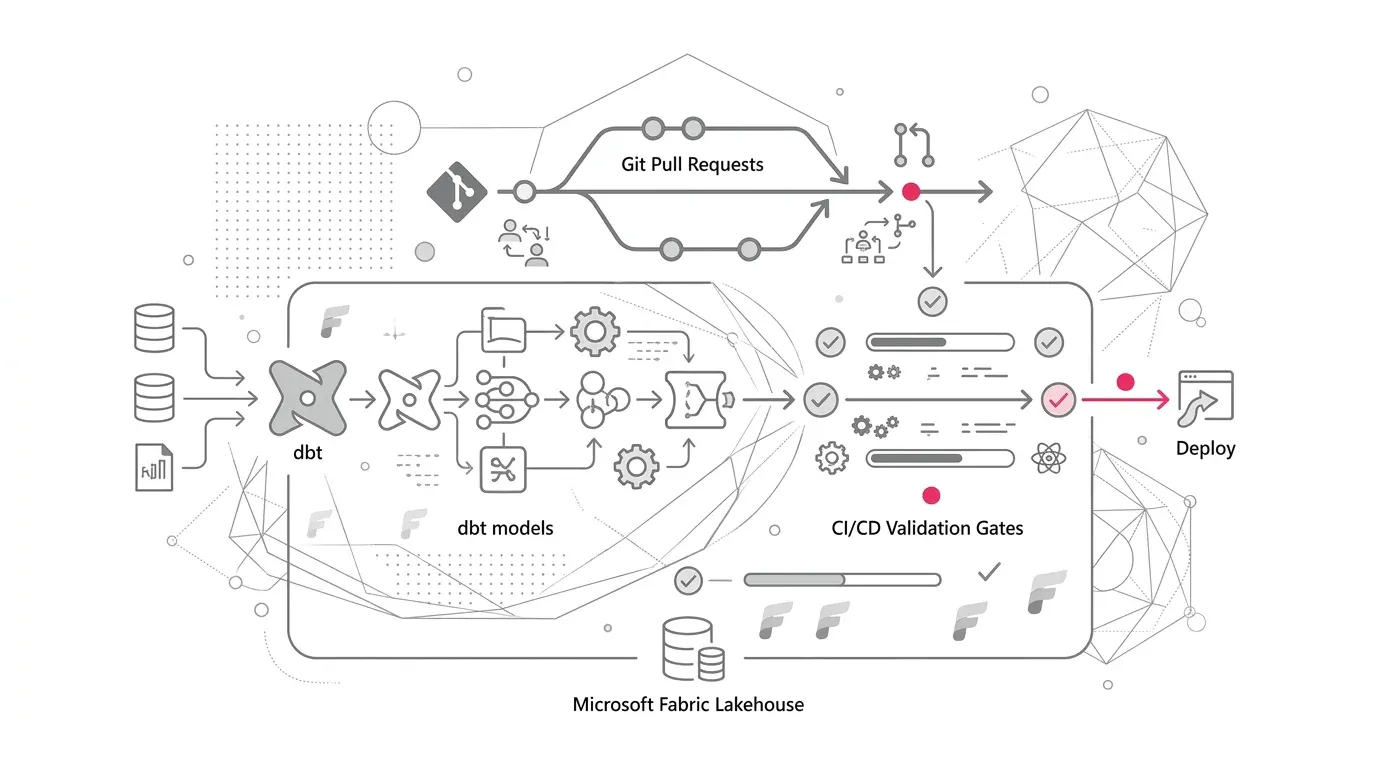
The target design is a controlled path from approved code to proved execution.
Approved definition and artifacts
        |
        v
Schema + policy checks ----> package provenance / version checks
        |
        v
Stable Environment API adapter (explicit beta=false where documented)
        |
        v
Read published state -> calculate diff -> update staging -> read staging
        |
        v
Publish -> follow LRO to terminal state -> read published state
        |
        v
Start new Spark session -> technical smoke tests -> business reconciliation
        |
        v
Evidence record, promotion decision, and monitored production release
Establish one canonical, reviewable definition
Store the environment definition with the solution code. At minimum, it should include:
- `Libraries/PublicLibraries/environment.yml` with approved versions;
- custom library artifacts or immutable references plus integrity information;
- `Setting/Sparkcompute.yml` with runtime and compute intent;
- environment metadata needed by the item definition; and
- an environment-specific binding file for values that cannot be promoted unchanged, such as a destination custom-pool ID.
Microsoft's item-definition format represents these parts explicitly and encodes definition payloads as Base64. Treat the encoded API payload as a transport format, not the human review format. Review the decoded YAML and artifact manifest.
For production, prefer exact versions for critical libraries and Full publishing mode where its supported behavior fits the workload. Full mode provides dependency resolution, compatibility validation, and a stable snapshot; Quick mode is valuable for iteration but installs at notebook-session startup and is not available to Spark job definitions.
Put a stable-contract adapter around the API
Do not let every delivery team implement the migration independently. Provide a small, versioned client or pipeline component that owns:
- explicit selection of the stable contract;
- the GA request and response models;
- pagination for list operations;
- the new external- and custom-library endpoints;
- long-running-operation polling;
- bounded retry behavior and `Retry-After` handling;
- structured logging of request IDs and operation IDs; and
- redaction of tokens, connection data, and sensitive package-source information.
Contract-test this adapter with recorded schema fixtures and in a non-production Fabric workspace. Include negative tests for malformed YAML, an absent package version, an invalid pool mapping, concurrent publish, authentication failure, `429 RequestBlocked`, and publication failure.
Make reconciliation explicit and idempotent
Before changing anything, read both the current published and staging state. Normalize them into a comparable model and calculate a typed change plan:
| Change class | Example | Required control |
|---|---|---|
| Runtime | Fabric runtime version changes | compatibility test and approval |
| External library | add, update, or remove a package | dependency diff and security review |
| Custom library | replace an internal wheel or JAR | immutable artifact and integrity check |
| Spark property | add, change, or remove a setting | workload-owner review |
| Compute | pool or driver/executor sizing changes | destination binding and capacity review |
Apply only the intended changes. Re-read staging and compare it with the desired state before publishing. If the comparison is not exact after normalization, stop the release. This prevents an unnoticed package removal or a workspace-specific value from crossing the publish boundary.
Idempotence matters: rerunning the same approved release should calculate no material change and should not upload, publish, or restart workloads unnecessarily.
Treat publish as a controlled transaction
The release should enforce the following sequence:
- Check the environment status and confirm that another publish is not running.
- Capture the current published definition as rollback evidence.
- Verify staging against the approved desired definition.
- Submit publish using the stable operation.
- If Fabric returns `202`, retain the operation ID and poll the supplied location after the `Retry-After` interval.
- Stop only on terminal success or failure; a timeout is an unknown outcome, not a success.
- Read the published libraries and Spark-compute configuration.
- Compare published state with the approved release.
Only then should the release advance to execution testing. Because an environment accepts one publish at a time, serialize releases for each environment and reject overlapping attempts.
Prove execution in a new session
An effective-state check is necessary but still not sufficient. Start a new Spark session attached to the target environment and run a release probe that records:
- environment item and workspace identifiers;
- release identifier and source commit;
- Fabric runtime version;
- imported versions of critical public and custom packages;
- selected non-sensitive Spark properties;
- expected pool or compute class; and
- probe start, completion, and result.
Then run production-shaped tests:
- import and initialize every critical library;
- read and write a controlled Delta test dataset;
- exercise authentication to required data sources without exposing secrets;
- validate one or more business invariants that would fail under the prior package or runtime; and
- compare a small reference output with an approved baseline.
For high-criticality environments, perform a shadow or canary run before switching schedules. Do not reuse a Spark session that began before publication, because Microsoft documents that an environment switch becomes effective only with the next session.
Separate portable definition from environment bindings
Use separate development, test, and production workspaces and environment items, but keep their logical structure consistent. Resolve workspace-scoped values during deployment:
- map the approved compute class to a pool that actually exists in the destination;
- validate capacity and network-security compatibility before sharing an environment across workspaces;
- keep package-feed connection identifiers outside reusable code where appropriate; and
- fail closed if a production custom-pool binding cannot be resolved.
Do not accept silent fallback to default compute. Where deployment-pipeline limitations prevent faithful custom-pool promotion, apply the destination compute configuration through a controlled post-deployment step and verify it before publication.
Apply least privilege and retain release evidence
Use a durable Microsoft Entra service principal or managed identity for automation where organizational policy permits. Grant only the workspace and Environment permissions required by the operations it performs. Separate release execution from release approval for critical production environments.
Retain an evidence record containing:
- caller identity;
- approved definition digest;
- before, staged, and after normalized state;
- API request IDs and publish operation ID;
- terminal publish result;
- new-session probe output;
- business-test results;
- approver and timestamp; and
- rollback decision, if any.
Send secrets and access tokens to neither logs nor artifacts. Environment governance belongs inside the same identity, audit, and CI/CD model as the rest of the Fabric estate.
A phased implementation roadmap
Phase 0: Stabilize and contain (days 1-3)
- Freeze nonessential production environment changes.
- Identify the environment items supporting critical notebooks and Spark job definitions.
- Find every caller, including pipeline templates, command-line tools, SDK wrappers, and recovery scripts.
- Search for deprecated URLs, `preview`, `beta`, omitted query parameters, and parsers for the old library response shape.
- Record current published libraries, runtime, Spark properties, compute, attached workloads, and workspace-default dependencies.
- Manually verify the highest-risk production environments if automation is untrusted.
Exit gate: every critical environment has an owner, current published-state record, consumer list, and change freeze or approved exception.
Phase 1: Build and test the stable adapter (week 1)
- Implement the GA models and replacement library operations.
- Add pagination, LRO polling, bounded retry, and structured error handling.
- Test with a service identity in a non-production workspace.
- Verify that an unchanged desired definition results in no action.
- Exercise failure cases and confirm that the pipeline does not report success for `202`, timeout, or mismatched published state.
Exit gate: the adapter passes contract, negative, idempotency, and identity tests.
Phase 2: Reconcile by risk wave (weeks 2-3)
Group environments by business criticality, shared-consumer count, custom-library use, custom-pool use, and security sensitivity. Migrate a low-risk canary first, then representative complex environments, then critical production groups.
For each environment:
- capture the published baseline;
- reconcile the canonical definition;
- stage and verify;
- publish and follow the LRO;
- verify published state;
- run a new-session probe and business tests; and
- observe at least one normal scheduled execution before closing the wave.
Exit gate: all in-scope production automation uses the stable contract and each environment has execution evidence.
Phase 3: Institutionalize the release contract (weeks 3-6)
- Make the approved definition mandatory for production environments.
- Add policy checks for exact critical-package versions, allowed package sources, runtime support, pool mappings, and compute ceilings.
- Place environment publication before dependent notebook and Spark job activation in the release graph.
- Add drift detection comparing declared, staged, and published state.
- Define a controlled rollback that reapplies and republishes the last approved definition, then repeats new-session validation.
- Update disaster-recovery procedures to recreate environment items and bindings rather than relying on undocumented manual state.
Exit gate: no critical environment can change without versioned definition, approval, published-state proof, and workload validation.
Phase 4: Optimize continuously
Review dependency currency, security advisories, runtime release channels, session-start performance, publish duration, capacity behavior, and unused environments. Test upcoming runtime changes against representative workloads before making them the production default.
Governance, security, adoption, and cost considerations
Governance
Assign three clear accountabilities:
- the platform owner owns the adapter, identity, release controls, and workspace standards;
- the environment owner owns the runtime, libraries, Spark configuration, and compatibility evidence; and
- the data-product owner accepts the business-output result.
An environment can be technically correct while a dependent data product is wrong, so technical publication and business acceptance must remain distinct gates.
Security and software supply chain
Restrict production package sources, pin critical versions, retain provenance for internal artifacts, and review dependency changes. Prefer authenticated enterprise feeds where required by policy. For workspaces with outbound-access protection or managed virtual networks, account for Microsoft-documented restrictions on public repositories and package-source behavior.
Treat custom `.whl`, `.py`, `.jar`, and `.tar.gz` files as executable software. Scan and approve them before upload. Limit who can edit and publish environments, and use separate identities for human administration and automated releases.
Adoption and operating model
Teams will bypass controls that make iteration impractical. Preserve a fast development route: Quick mode and notebook-scoped installation can support exploration where policy allows. Promotion to test and production should convert validated dependencies into the governed environment definition and, for scheduled or critical workloads, use the appropriate Full-mode snapshot.
Train engineers on the four-state model: declared, staged, published, executed. Put those states in deployment dashboards so "green" has one operational meaning.
Cost and performance
Compute configuration is part of the release, not background infrastructure. Driver and executor size, dynamic allocation, pool choice, library publish mode, and session-start behavior affect user wait time and capacity demand.
Baseline:
- Full-mode publish and new-session duration;
- workload duration and capacity consumption by environment version;
- concurrency and queueing during release validation;
- failure and retry volume; and
- the effect of custom versus starter pools.
Do not tighten validation by launching every environment simultaneously. Spread API and Spark activity, respect throttling, and sequence high-cost validation. Microsoft notes that Private Link can add approximately 10-15 minutes when environment publication triggers the workspace's first Spark job and VNet provisioning, so design release timeouts around observed conditions rather than a fixed optimistic value.
Success metrics
Use measures that prove control, not just activity:
| Metric | Definition | Desired direction |
|---|---|---|
| Stable-contract coverage | Production Environment API callers verified on GA operations / all discovered callers | 100% |
| Release proof completeness | Production environment releases with declared, staged, published, and executed evidence / all releases | 100% |
| Configuration drift age | Time from an unauthorized or unexplained state difference to detection | Down |
| Publish false-positive rate | Releases reported successful before terminal publish and published-state verification | Zero |
| New-session validation rate | Critical releases tested in a session created after publication / critical releases | 100% |
| Dependency reproducibility | Critical production environments with approved, versioned dependency definitions | 100% |
| Recovery time | Time to reapply, publish, and validate the last approved definition | Down and rehearsed |
| Business reconciliation failures | Releases whose technical probe passes but reference business assertions fail | Visible, then down |
| Compute-binding exceptions | Releases that fall back to an unapproved destination compute configuration | Zero |
Set numeric service objectives only after measuring the estate. A universal target for publish duration would ignore library size, Full versus Quick mode, network controls, and first-session provisioning.
How YuniQ can help
YuniQ's Microsoft Fabric consulting and implementation services explicitly cover the capabilities needed to turn this API migration into a reliable operating model:
- Fabric Strategy & Readiness: current-state platform and workload diagnostics, capacity planning, workspace topology, and security, governance, and operating-model design can establish the environment inventory and risk tiers.
- Data Integration & Engineering: YuniQ describes hands-on Fabric engineering across notebooks, Delta frameworks, data pipelines, and data-quality observability, which can connect environment recovery to the workloads that depend on it.
- Governance, Security & DevOps: YuniQ offers Microsoft Entra least-privilege role design, Dev/Test/Prod separation, Git CI/CD deployment pipelines, auditable logging, and monitoring. These align directly with the release contract in this article.
- Validation and launch: YuniQ's published delivery framework includes automated reconciliation, access testing, dual-run comparisons, user acceptance, and controlled cutover.
- Fabric Managed Services: YuniQ lists pipeline and refresh monitoring, capacity optimization, and DevOps release management for organizations that need the controls operated after remediation.
A focused engagement should begin with one critical shared Spark environment and its dependent workloads. The useful output is not only a rewritten API script; it is a reusable adapter, a proved release pattern, an evidence model, and a risk-ranked migration plan for the remaining estate.
Practical next steps
- Within 24 hours: ask the platform team to enumerate all production environment items and every automation caller.
- Within 48 hours: capture and compare repository, staging, and published state for the most business-critical environment.
- This week: run the existing client against stable-contract fixtures and a non-production workspace; do not assume `beta=false` is the only required change.
- Before the next production release: require terminal publish status, published-state readback, and a new-session validation probe.
- Within 30 days: move every production environment to a versioned release contract with durable identity, destination compute binding, business reconciliation, rollback evidence, and measurable drift detection.
The August deadline makes the migration urgent. The larger opportunity is to eliminate a class of silent Spark configuration failures before they become trusted data.