Executive summary
Every Microsoft Fabric cloud connection is a trust decision. It determines which endpoint a workload can reach, which identity or secret it can use, and who can reuse that access. At enterprise scale, those decisions often accumulate faster than a central team can review them. A technically valid connection can still violate policy by using a disallowed authentication method, targeting an unapproved Microsoft Entra tenant, or being shared more broadly than its business purpose requires.
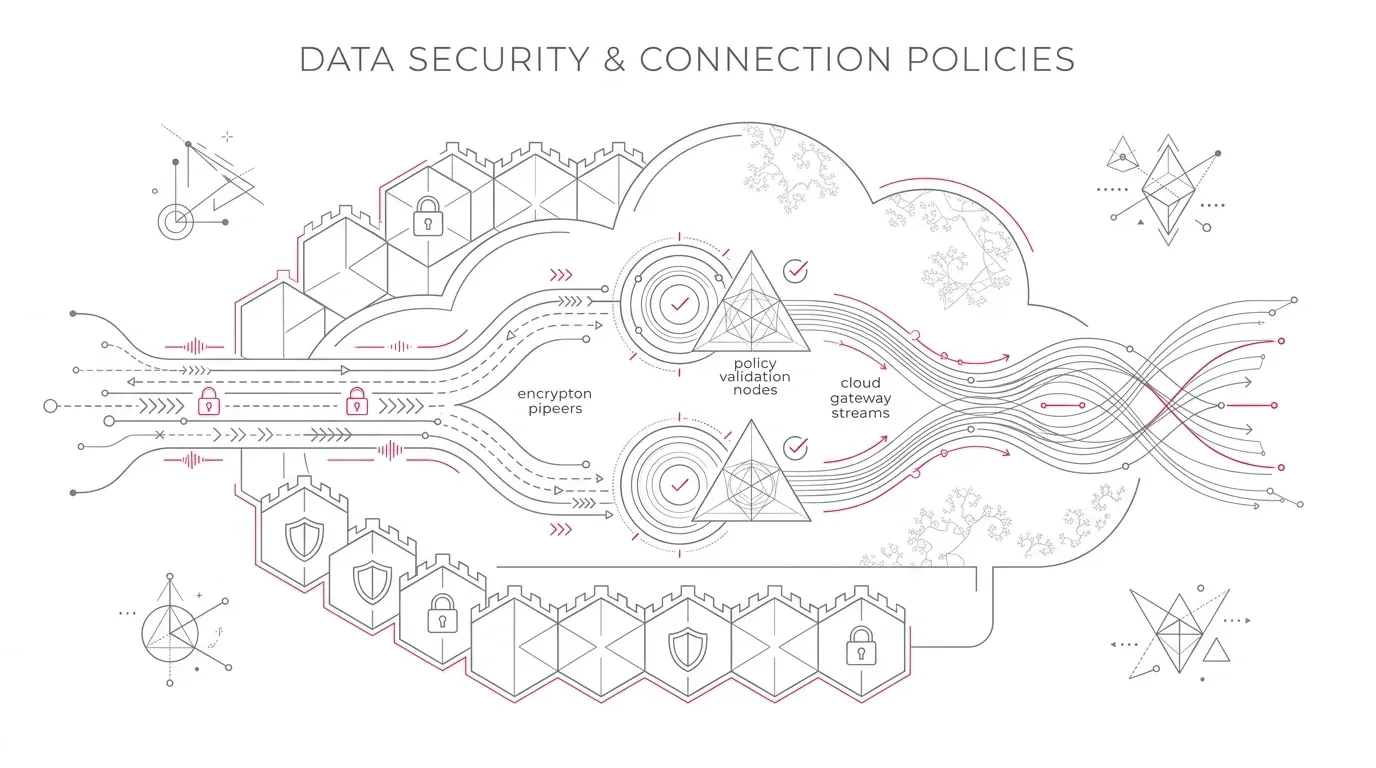
Microsoft Fabric data connection policies give tenant administrators centralized controls for connector kinds, authentication methods, and target Entra tenants. The controls are consequential: Microsoft documents that they apply to existing as well as new cloud connections. A noncompliant existing connection can move to Policy Evaluation Failure and go offline. Policy changes can also take up to one hour to propagate. As of 10 October 2026, Microsoft’s dedicated documentation still labels the capability as preview, so organizations should confirm availability and current behavior in their own tenant before relying on it for production enforcement.
The right goal is not simply to switch on an allowlist. It is to establish a governed connection contract, discover actual dependencies, remediate unsafe patterns, enforce controls in measured stages, and prove that critical business services still operate. This article presents that operating model.
The enterprise problem: connectivity has become an ungoverned security boundary
Fabric makes it straightforward to connect pipelines, dataflows, semantic models, and other items to cloud and on-premises systems. That ease is valuable, but it creates a control-plane problem when separate teams create connections independently.
Three questions become difficult to answer:
- Where can data move? A connector type alone may be too broad. A Web or SaaS connector could point to an approved service, a partner endpoint, a test tenant, or an unapproved destination.
- How is the destination authenticated? Basic credentials, keys, SAS tokens, user-bound OAuth, service principals, and other methods have different ownership, rotation, revocation, and audit characteristics.
- Who depends on the connection? A connection can be reused by multiple items and users. Blocking, deleting, or changing it can interrupt a chain of downstream reports and operational decisions.
This is why the problem is larger than secret hygiene. It is an authorization and service-continuity problem spanning the Fabric tenant, Entra identity, external systems, workspace ownership, and production operations.
The timing matters. Fabric now documents tenant-wide data connection policies that can:
- allow or block individual cloud connection kinds, with endpoint-level exceptions where supported;
- restrict cloud connections to an allowlist of authentication methods; and
- restrict connections to specified Microsoft Entra tenant IDs.
These controls create an enforceable boundary, but they also turn undocumented connection debt into immediate operational risk. An enterprise that activates them without discovery may learn about hidden dependencies through failed refreshes and missed service-level objectives.
Representative scenario: a secure change that could stop the morning reports
*The following is a representative scenario, not a YuniQ customer case or a claim of measured results.*
A regulated services company uses Fabric to combine CRM, finance, contact-center, and partner data. Several business units built cloud connections during pilots. Some use individual OAuth identities, others use service principals, and a small number rely on keys or basic credentials. Two approved partners operate in separate Entra tenants. Test and production connections have similar display names.
Security proposes two tenant-wide changes:
- permit only Entra OAuth and service-principal authentication; and
- permit only the company’s home tenant plus the two partner tenant IDs.
The intent is sound. The implementation evidence is not. The central team does not yet know which existing connections use each authentication method, which workloads invoke them, whether an external tenant ID is current, or which business process owns each exception. Because policy enforcement affects existing connections, a single save could make a production connection go offline. Because the tenant allowlist accepts raw GUIDs without friendly-name validation and has a documented limit of 100 tenant IDs, a transcription error or an unmanaged long tail of partners creates further risk.
The company needs an answer that preserves both confidentiality and availability: enforce a narrow, reviewable path for data movement while keeping approved services running.
Root causes and business consequences
Root cause 1: connection creation is decentralized, but risk acceptance is not
Product teams understand their immediate data need; they may not own the enterprise’s authentication standard, cross-tenant rules, or regulatory obligations. When no explicit connection contract exists, the easiest supported method becomes the default.
Root cause 2: configuration inventory is mistaken for dependency inventory
A list of connection objects identifies endpoints and credential types, but it does not by itself establish business criticality. Teams also need to know the items that use each connection, their schedules, downstream consumers, data classifications, and tolerated interruption.
Root cause 3: human credentials survive beyond the pilot
User OAuth can be entirely appropriate in some scenarios, but a person-bound production path can inherit role changes, departure risk, consent changes, and interactive reauthentication requirements. The durable pattern must be selected per connector and workload, not assumed universally.
Root cause 4: inbound, outbound, identity, and sharing controls are conflated
Restricting who can enter a workspace does not determine where a workload can send or retrieve data. Microsoft explicitly distinguishes inbound workspace controls from outbound access protection. Likewise, connection access lists govern who can use a connection, while data connection policies govern whether its connector, authentication method, or target tenant is permitted. These are complementary layers.
Consequences
- Data loss or inappropriate disclosure: a valid credential can be used against an unintended destination if endpoint and tenant policy are weak.
- Production outages: an existing connection that fails policy evaluation goes offline, interrupting dependent workloads.
- Audit gaps: teams cannot show why a destination, credential type, owner, or exception was approved.
- Slower incident response: responders spend critical time reconstructing which items share a suspect connection.
- Operational drag: one-off exceptions and manual approvals accumulate because the standard path is unclear.
- False assurance: a tenant-level allowlist may be treated as complete protection even though other workloads, network paths, sharing rights, and source-system permissions require separate controls.
Why common approaches fall short
“Enable the strictest allowlist immediately”
This treats enforcement as discovery. Microsoft documents that tenant policies apply to existing cloud connections, not only new ones. A production connection that becomes noncompliant can show Policy Evaluation Failure and go offline. The change is tenant-wide and may take up to an hour to propagate, making an untested big-bang rollout difficult to diagnose and reverse cleanly.
“Allow every method we already use”
This preserves availability but codifies historical debt. An allowlist that includes every observed credential type without an owner, reason, and expiry is only an inventory written as policy.
“Private Link solves outbound data movement”
Private connectivity protects network paths; it does not replace endpoint, identity, tenant, and connection-use decisions. Fabric’s workspace outbound access protection is a separate control that blocks outbound connections by default and then permits approved paths. Microsoft also documents workload-specific support and limitations, so it cannot be assumed to work identically for every Fabric item.
“The connection name tells us what it does”
Display names are mutable labels, not evidence. Decisions should be keyed to stable connection IDs and supported by endpoint, connection kind, credential type, owner, recency, dependent items, environment, and business purpose.
“A successful test connection proves the service is safe”
A connection test proves only a narrow technical handshake. It does not prove that scheduled runs use the intended identity, that writes are constrained, that downstream data remains complete, or that the business process meets its freshness objective.
The solution: a governed connection enforcement architecture
Treat every production connection as a versioned contract between six parties: the Fabric item, its workspace, the connection object, the runtime identity, the destination, and the accountable business owner.
Business service and data owner
            |
            v
Connection decision register
  - connection ID and environment
  - connector and endpoint/tenant
  - authentication method and identity owner
  - data classification and permitted operation
  - dependent items and decision-age SLO
  - approver, exception reason, expiry, rollback
            |
            v
Tenant guardrails ---------------- Workspace guardrails
  connector policy                  outbound access protection
  authentication allowlist          data connection rules or
  tenant allowlist                  managed private endpoints
  sharing restrictions              least-privilege workspace roles
            |                              |
            +--------------+---------------+
                           v
                    Fabric connection
                           |
                           v
                   Approved destination
                           |
                           v
Runtime evidence: policy state, run result, freshness,
reconciliation, audit event, owner response and exception age
The layers are deliberately separate. Tenant policy establishes the enterprise’s outer boundary. Workspace controls reduce the allowed paths for sensitive workloads. Source-system permissions constrain what the runtime identity can read or write. Monitoring proves that the expected service still functions.
1. Build a tenant connection evidence base
Start with the connection object, then enrich it with operational context.
Microsoft documents admin connection APIs that can inventory connections across the tenant rather than only those visible to the caller. The current documentation describes these APIs as preview and notes that some reference operations are still being published, so automation should tolerate schema or endpoint changes. The documented inventory includes connection type, endpoint path, credential details, and recency fields. Pagination is required beyond 100 results.
Create a governed inventory with at least these fields:
| Evidence field | Why it matters |
|---|---|
| Stable connection ID | Prevents decisions based on ambiguous display names |
| Connectivity and connector type | Determines which policy and runtime path apply |
| Endpoint and target tenant | Establishes the actual trust destination |
| Authentication and SSO type | Exposes credential ownership and rotation risk |
| Owner and role assignments | Identifies accountability and orphan risk |
| Last bound and last credential-used time | Separates configured objects from recently active paths |
| Dependent item IDs and workspaces | Defines blast radius |
| Source and destination data classification | Sets the required control tier |
| Read/write behavior | Distinguishes extraction from publication or mutation |
| Business service, owner, and criticality | Connects technical failure to business impact |
| Approved decision-age SLO | Defines how stale the business decision may become |
Recency is useful evidence, not deletion authority. A monthly or quarter-end process may be legitimate even if it has not run recently. Confirm schedules and business ownership before remediation.
2. Define policy from approved patterns, not observed accidents
Create a decision matrix for each connector family and environment. A practical policy distinguishes four outcomes:
| Decision | Meaning | Required evidence |
|---|---|---|
| Standard | Approved pattern for routine use | Named owner, supported identity, approved endpoint class |
| Restricted | Allowed only for named workloads | Business justification, narrower access, enhanced monitoring |
| Time-bound exception | Temporary deviation | Risk acceptance, expiry, remediation owner, compensating controls |
| Prohibited | Must not be created or used | Migration or retirement plan for existing dependencies |
For authentication, do not write “service principals only” as an abstract preference. Verify that the connector supports the method, that the target system can enforce least privilege, that secrets or certificates have an owned rotation path, and that noninteractive recovery is tested. Workspace identity can be appropriate for supported trusted-access scenarios, but Microsoft documents scenario and compatibility restrictions; it is not a universal substitute.
For target tenants, maintain a human-readable partner register outside the Fabric policy screen because the documented UI stores raw tenant GUIDs without a friendly-name lookup. Record legal entity, data-sharing purpose, data classes, sponsor, agreement expiry, tenant ID source, and independent verifier. Enforce a two-person check before changing the allowlist.
3. Separate tenant-wide controls from workspace egress controls
Use the tenant controls for broad invariants:
- prohibited connector kinds;
- acceptable authentication method families;
- approved Entra tenant IDs; and
- restrictions on who may share connections.
Use workspace outbound access protection for higher-risk workspaces that require destination-level egress constraints. Fabric documents two principal patterns:
- Data Factory and mirrored database workloads: data connection rules permit approved cloud or gateway connections.
- Data Engineering and OneLake workloads: managed private endpoints provide approved outbound paths to supported resources.
Support is not uniform. Microsoft documents prerequisites and limitations involving capacity SKU, region, item type, cross-tenant sharing, OneLake diagnostics, semantic-model scenarios, private-link configuration, connector granularity, and existing artifacts. Build a compatibility matrix from the live tenant before making a protected workspace the enterprise template.
4. Remediate before enforcement
For each nonstandard connection, choose one explicit action:
- replace a personal or weak credential with an approved durable identity;
- reduce source-system permissions to the minimum read or write scope;
- correct or approve the destination tenant and endpoint;
- consolidate duplicates only after dependency validation;
- reassign an orphaned connection to an accountable user or service principal;
- isolate a high-risk workload in a protected workspace; or
- retire the connection after proving that no scheduled or event-driven dependency remains.
Do not delete first and investigate later. Microsoft warns that removing a data source stops dependent items. Where the admin APIs are used to reassign ownership, protect the automation identity with narrowly scoped Entra groups and separate read-only inventory from update privileges.
5. Test the business service, not just the control
Build a test pack for every critical connection class:
Positive tests
- An approved connection can be created or reused.
- The scheduled item authenticates with the intended identity.
- Expected rows, files, or events arrive within the decision-age SLO.
- Required writes succeed and prohibited writes fail.
- Downstream semantic models and reports reconcile to the baseline.
Negative tests
- A prohibited authentication method is rejected.
- An unapproved Entra tenant is rejected.
- An unauthorized user cannot use or reshare the connection.
- A protected workspace cannot reach an unapproved destination.
- The source identity cannot access data outside its assigned scope.
Recovery tests
- The team can identify the exact policy evaluation error.
- The exception approval path works within the incident objective.
- Rollback restores the service without expanding access beyond the previous approved state.
- Data delayed during the outage can be replayed and reconciled without duplication.
This turns a security configuration into a verifiable operating control.
A phased implementation roadmap
Phase 0: establish authority and safety
Name one accountable policy owner and a cross-functional change group spanning Fabric administration, identity, networking, security, platform operations, data owners, and service owners. Document emergency rollback authority, change windows, and communication paths. Confirm the feature’s live preview/GA state, regional availability, and tenant-specific behavior.
Exit evidence: approved charter, scope, rollback runbook, escalation map, and change freeze criteria.
Phase 1: discover and classify
Extract the tenant connection inventory. Resolve owners and dependencies for critical workspaces first. Tag each connection by environment, business service, data classification, authentication, target tenant, and recency. Identify unknowns rather than assigning optimistic defaults.
Exit evidence: all critical connections have an owner, dependency map, destination, authentication method, and risk decision.
Phase 2: design the target policy
Create connector, authentication, tenant, and sharing rules. Build the partner tenant register and exception lifecycle. Map which workspaces also require outbound access protection and confirm item-level compatibility.
Exit evidence: policy decision record, compatibility matrix, exception register, and independently verified tenant GUIDs.
Phase 3: remediate and prove in a representative ring
Repair identities, permissions, ownership, and endpoints before enforcement. Select a representative but noncritical workspace set containing the connector and authentication patterns expected in production. Run positive, negative, recovery, and business reconciliation tests.
Exit evidence: zero unexplained policy failures, tested rollback, reconciled outputs, and accepted residual risks.
Phase 4: enforce by business-service waves
Roll out by dependency group, not by an arbitrary workspace count. Schedule around business cycles. After each change, allow for documented propagation time and monitor full scheduled executions. Keep each wave small enough that responders can attribute a failure to a connection and policy decision quickly.
Exit evidence: service owner sign-off, SLO compliance, no unowned exceptions, and a stable observation window.
Phase 5: operate as a continuous control
Reconcile inventory to policy on a schedule. Alert on new connection kinds, disallowed credential patterns, unknown tenants, orphan owners, expiring exceptions, and critical connections whose credentials have not been exercised within their expected schedule. Review Fabric documentation as preview behaviors and API contracts evolve.
Exit evidence: repeatable control evidence, exception-age reporting, tested incident playbooks, and periodic access recertification.
Governance, security, adoption, and cost considerations
Governance
Make the data owner accountable for the business purpose and permitted use; make the platform owner accountable for connection configuration; make identity and security owners accountable for authentication and policy standards. No single administrator should both request and approve a cross-tenant exception.
Use Microsoft Purview audit logs to investigate who performed relevant Fabric activities, while recognizing that operational connection inventory, item dependency mapping, and policy decision records remain separate evidence sets. Retain evidence according to corporate and regulatory requirements.
Security
Apply least privilege at every layer: workspace role, connection role assignment, runtime identity, source-system authorization, and destination write scope. Limit connection sharing to approved groups. Microsoft notes that users with connection access may be able to connect or write using the stored credentials or SSO context, so connection access is a privileged grant, not a convenience setting.
Do not use a tenant allowlist as a substitute for contractual data-sharing controls, classification, DLP, source authorization, or workspace egress protection. A destination can be in an approved tenant and still be inappropriate for a particular dataset.
Adoption
Give delivery teams a paved path: approved connector patterns, reusable identity setup, naming and ownership requirements, a quick exception workflow, and examples of the resulting policy errors. Measure exception lead time. If the standard path is materially slower than a workaround, policy will generate friction rather than durable adoption.
Cost
The largest implementation cost is likely to be discovery, remediation, regression testing, and ongoing evidence operations rather than the allowlist configuration itself. Workspace outbound access protection also has documented capacity and compatibility prerequisites. Model costs across:
- platform engineering and security review effort;
- identity migration and secret or certificate rotation;
- additional protected workspaces or gateway/network configuration;
- dual runs and reconciliation during rollout;
- monitoring storage and alert operations; and
- business interruption avoided through staged enforcement.
Do not present avoided breach or outage values as realized savings unless the organization has an agreed risk model and measured baseline.
Success metrics
Set targets by criticality tier and report both security and service health.
| Metric | Definition | Why leaders should care |
|---|---|---|
| Governed connection coverage | Percentage of active production connections with owner, purpose, endpoint, authentication, dependent service, and approval | Measures whether policy is evidence-based |
| Approved authentication coverage | Percentage of active production runs using an approved authentication pattern | Tracks remediation, not just configuration |
| Known-destination coverage | Percentage of active connection endpoints and Entra tenants mapped to an approved entity and purpose | Exposes unknown egress paths |
| Policy-induced failure rate | Failed runs caused by policy divided by total runs after a change | Protects availability during enforcement |
| Decision-age SLO attainment | Percentage of business outputs available before their maximum useful age | Connects platform control to business operations |
| Exception age | Median and maximum age of open exceptions, plus percentage past expiry | Prevents temporary risk from becoming permanent |
| Orphan ownership rate | Percentage of active connections without an accountable current owner | Measures operational resilience |
| Recovery performance | Time to detect, attribute, restore, replay, and reconcile a policy-related interruption | Tests whether the control is operable under pressure |
| Negative-test pass rate | Percentage of prohibited tenant, auth, sharing, and endpoint scenarios correctly blocked | Proves the boundary works |
Avoid a single “connections compliant” percentage that hides critical exceptions or recurring outages. A useful scorecard shows risk reduction and service continuity side by side.
How YuniQ can help
YuniQ’s published Microsoft Fabric services align to the work required for a controlled connection-policy rollout. Its Fabric Strategy & Readiness service includes current-state platform and workload diagnostics plus security, governance, and operating-model design. That maps to inventory scoping, control ownership, risk classification, and the rollout blueprint.
YuniQ also describes Data Integration & Engineering capabilities across Fabric Data Factory pipelines, dataflows, APIs, cloud, SaaS, on-premises, file, batch, and streaming sources. Those capabilities are relevant when connection remediation requires replacing brittle integration paths or validating production data movement. Its Governance, Security & DevOps offering includes Entra least-privilege role design, Purview integration, lineage and ownership tracking, Dev/Test/Prod separation, CI/CD, monitoring, and capacity alerts.
For implementation, YuniQ’s documented delivery framework progresses through Discover, Architect, Prove, Migrate & Build, Validate & Launch, and Optimize & Scale. Applied here, that means cataloging connections and dependencies; designing tenant and workspace guardrails; testing representative patterns with real data; remediating production connections in waves; performing access tests and reconciliation; and operating the control continuously. YuniQ’s site also offers readiness assessment, proof-of-value, migration and implementation, and managed-services engagement models. These are the published capabilities relevant to this problem; the appropriate scope should be confirmed against the client’s actual tenant and risk requirements.
Practical next steps
In the next ten business days, an enterprise can make meaningful progress without activating a tenant-wide block:
- Export the current connection inventory and preserve stable IDs, endpoints, authentication types, owners, and recency.
- Select the ten most business-critical data services and map their connection dependencies end to end.
- Build the approved authentication and target-tenant decision matrix with security and data-owner sign-off.
- Verify every partner tenant GUID independently and attach an accountable sponsor and expiry date.
- Identify one representative rollout ring and write positive, negative, recovery, and reconciliation tests before changing policy.
- Define the emergency exception and rollback path, including who can approve it and how expanded access will be removed afterward.
- Establish a dashboard that reports policy failures, decision-age SLOs, unknown connections, and exception age together.
The executive decision is not whether to choose security or availability. It is whether the organization will make connection trust explicit, testable, and owned. Fabric provides increasingly enforceable controls; the enterprise operating model determines whether those controls reduce risk without surprising the business.