Executive summary
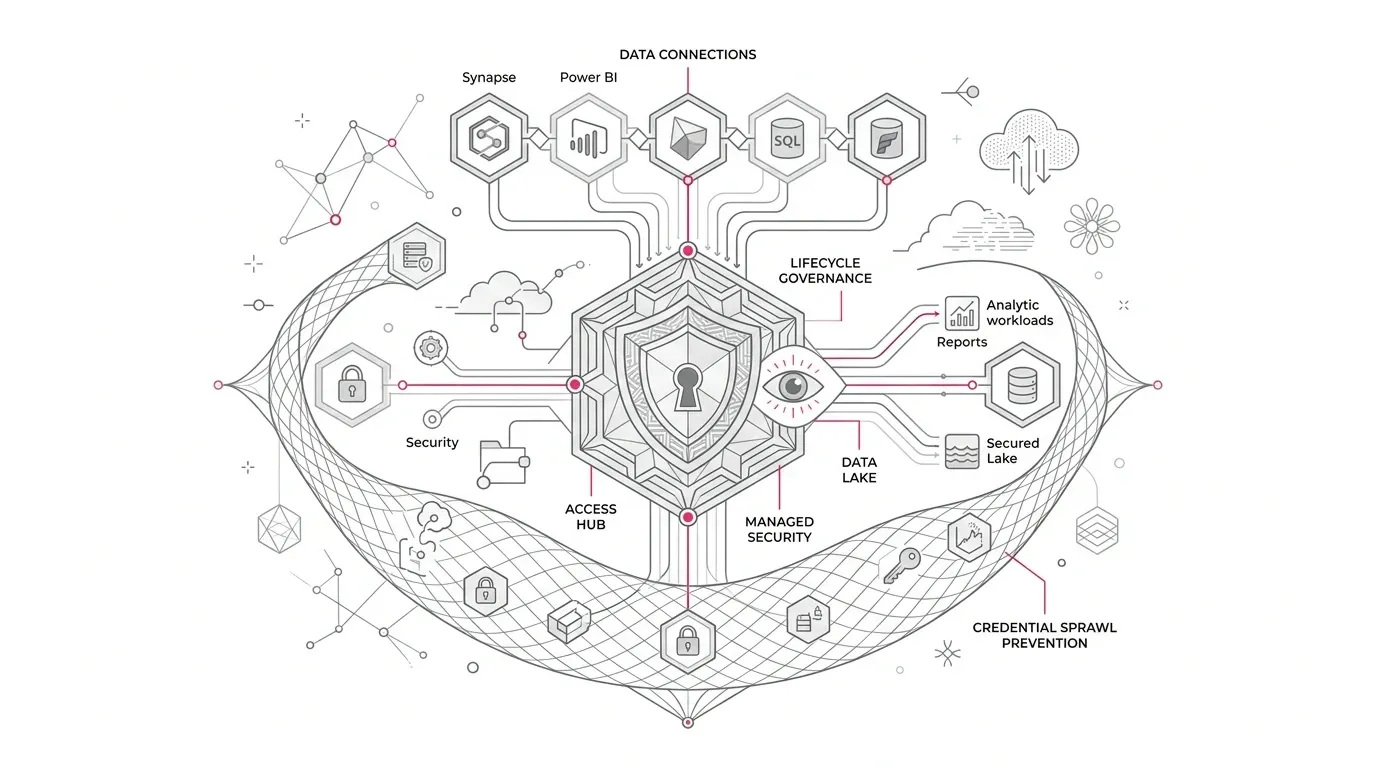
Microsoft Fabric connections are shared infrastructure. Pipelines, dataflows, semantic models, and other items use them to reach cloud and on-premises sources without embedding connection details and credentials in every item. That reuse is valuable, but it also creates a control problem: as teams, environments, gateways, and source systems multiply, so do connections with inconsistent names, duplicate endpoints, personal credentials, excess sharing, and a single human owner.
The resulting risk is easy to underestimate. A connection can remain technically valid while nobody knows which production items depend on it. A departed employee's OAuth credential can interrupt a critical refresh. An administrator can delete an apparently idle connection and discover too late that it supports a quarterly process. Multiple connections to the same endpoint can conceal different privacy, encryption, or authentication settings.
Microsoft's September 2026 guidance makes this problem more governable. Connection recency exposes when a connection was created, last bound to an item, and last used to access credentials. Fabric REST APIs can inventory connection configuration and role assignments, while the tenant-wide admin connection APIs, currently in preview, can help Fabric administrators discover connections across the tenant, review ownership, and reassign orphaned connections. The List Item Connections API can map supported Fabric items back to their connection dependencies.
These capabilities are signals, not an autopilot. The practical solution is a connection control plane: a regularly refreshed inventory, risk classification, durable identity standard, group-based ownership, dependency-aware change process, and quarantine period before retirement. The goal is not simply fewer connections. It is a small, intentional, auditable set of connection services that production workloads can rely on.
The enterprise problem: the data estate is governed, but its connections are not
Enterprises often govern Fabric capacities, workspaces, data products, and semantic models while treating connections as local setup details. That division does not hold in production. A connection joins four control domains:
- Endpoint: the server, database, API, storage account, or other source that a workload reaches.
- Network path: public cloud, on-premises gateway, virtual network gateway, or another supported connectivity route.
- Authentication: OAuth, service principal, workspace identity, key, basic authentication, or another connector-specific method.
- Authorization and ownership: who can use, reshare, administer, rotate, or retire the connection.
A weakness in any one domain can affect every item that reuses the connection. This makes the connection a production dependency and, in many cases, a security boundary.
The problem grows with legitimate enterprise activity. Development, test, and production teams create connections independently. Migration programmes reproduce old integration patterns. Business units connect to the same SaaS platform through different accounts. Gateway administrators and Fabric owners see different parts of the estate. Names such as SQL-Prod, Sales DB, and FinanceSource2 provide little evidence that two objects reach the same endpoint or use equivalent controls.
Microsoft now documents connection recency and tenant-wide administration as tools for finding stale, duplicate, insecure, or orphaned connections. The timing matters because connection growth is not self-correcting. Without a lifecycle, every new project adds operational obligations that remain after the original team moves on.
Representative scenario: one resignation, three failures, no reliable inventory
Consider a representative multinational services company. This is a composite scenario, not a YuniQ customer case.
The company has adopted Fabric across finance, customer operations, and compliance. Its estate contains cloud connections to Salesforce and Azure SQL, an on-premises gateway for a legacy case system, and a virtual network gateway for private data sources. Several Power BI semantic models and Data Factory pipelines run with stored organizational OAuth credentials. Connection ownership mostly reflects who created each object during delivery.
A senior engineer leaves. Within days:
- a daily customer-service pipeline fails because its connection authenticates with the former employee's OAuth credential;
- a month-end semantic model still refreshes, but nobody can safely rotate its credentials because the only recorded owner has left;
- an administrator finds three connections pointing to the same finance database, but cannot tell which is authoritative or whether any can be removed;
- a security review discovers that one shareable connection uses a broader source-system account than its consumers require;
- the service desk restores individual jobs, but the underlying ownership and duplication remain.
The outage is attributed to a credential. The deeper failure is the absence of a managed connection lifecycle. There was no complete inventory, no durable owner, no standard for production authentication, no dependency map, and no tested handover procedure.
Root causes and business consequences
Connections are created as project artefacts
Delivery teams are rewarded for making a pipeline or report work. Unless connection design is part of the production acceptance criteria, the fastest path is often to create a new object with the credentials at hand. Reuse, ownership, and retirement become somebody else's future problem.
Ownership and authentication are confused
Connection ownership determines who can administer and share the object. The stored credential determines how the connection authenticates to the source. Adding another owner does not replace a deleted user's OAuth credential. Microsoft makes this distinction explicit: when a user-bound OAuth connection fails after an employee leaves, the authentication credential is the immediate cause, not merely the change in ownership.
No one can see the full estate
The ordinary List Connections API returns connections the caller owns or can access. Microsoft's newer admin connection APIs are designed to provide tenant-wide inventory, but they are in preview. Even with those APIs, administrators still need to join connection data to item inventories, organizational ownership, source-system records, and change evidence.
"Last used" is treated as a deletion verdict
Recency is contextual, not conclusive. A connection can have been bound long ago and still run daily. Conversely, a recently bound connection may never have executed. Credential-use reporting can lag, and legitimate annual, quarterly, disaster-recovery, or dormant failover processes may appear inactive. Microsoft recommends using recency to start a review, not to automate removal.
Duplicate connections are judged by name
Display names are not a reliable key. Two differently named connections can share a connector type, endpoint path, connectivity type, and gateway, yet differ in authentication, encryption, privacy level, or granted roles. Consolidating them without comparing the complete control profile can create a security or availability regression.
The consequences cross several executive concerns:
- Reliability: refreshes and pipelines fail during staff changes, token expiry, secret rotation, or gateway maintenance.
- Security: broad credentials and uncontrolled resharing expand access beyond business need.
- Compliance: the organisation cannot show who owns a connection, who can use it, or why its credential type is acceptable.
- Cost and productivity: teams maintain duplicates, investigate ambiguous failures, and repeat source-system approvals.
- Change risk: source migrations, firewall changes, and credential rotations proceed without a dependable list of affected consumers.
Why common approaches fall short
"We can inspect connections in the portal"
The portal is useful for individual administration, but manual inspection does not scale to hundreds or thousands of connections. It also does not create history, risk scoring, attestation evidence, or a reproducible view of change.
"We will delete anything unused for 90 days"
A fixed threshold ignores business calendars and incomplete signals. Year-end processes, seasonal workloads, recovery paths, and newly created connections can be misclassified. Deletion is especially dangerous because Microsoft warns that dependent items stop working when their data source connection is removed.
"Two owners solve the problem"
Two human owners improve administrative continuity, but they do not make the authentication durable. A production connection can have several owners and still depend on one person's OAuth token. A security group is generally more maintainable for ownership, while the authentication method should be selected separately for the connector and workload.
"One shared connection for the whole business is simpler"
Over-consolidation creates a large blast radius and may violate least privilege. Production and non-production, regulated and non-regulated domains, or read-only and write workloads may require different identities, source permissions, network paths, and change windows. Reuse should occur within a deliberate trust boundary, not across every possible consumer.
"The API inventory is the governance programme"
An API export is only evidence. It becomes governance when it drives ownership, standards, exceptions, change gates, remediation, and periodic review.
The Microsoft Fabric solution: a governed connection control plane
The target architecture is a metadata and operating layer around Fabric connections. It does not sit in the data path. It observes the estate, applies policy, routes remediation, and retains evidence.
Fabric admin connection inventory (preview) ----+
Connection role assignments --------------------+--> Bronze: timestamped raw snapshots
Workspace and item inventory -------------------+             |
List Item Connections --------------------------+             v
Gateway and source-system registers ------------+       Silver: normalized registry
Entra owner and group reference ----------------+             |
Purview audit evidence -------------------------+             v
                                                       Gold: risk and action views
                                                             |
                          +----------------------------------+----------------------------------+
                          |                                  |                                  |
                    Platform owner                    Security owner                    Domain owner
                  availability action               control exception                business attestation
1. Build a timestamped tenant connection registry
Use the tenant-wide admin connection endpoints to capture, where available:
- connection ID and display name;
- connector type and endpoint path;
- connectivity type and gateway ID;
- credential type, single sign-on mode, encryption setting, and privacy level;
- creation, last-bound, and last-credential-use timestamps;
- owner, user, and user-with-reshare role assignments.
Store each extraction as an immutable timestamped snapshot before producing a current-state table. This preserves evidence of ownership and control changes. Implement pagination and respect 429 Too Many Requests responses with the service-provided retry guidance.
Because the admin APIs are preview, isolate the collector behind a small adapter. Log the API version, extraction time, continuation status, and errors. Do not make an irreversible control depend on an undocumented or preview behaviour.
2. Map connections to the items that consume them
Inventory alone cannot establish impact. Use workspace and item inventories, then call List Item Connections for supported items to create edges such as:
workspace_id + item_id + item_type -> connection_id -> endpoint + gateway_idThe API requires read and write permission on the item and has a limitation for protected sensitivity labels unless the caller has the relevant usage rights. Record denied or unsupported items as coverage gaps; do not treat them as having no dependencies.
Enrich the technical map with business metadata:
- data-product or service owner;
- business criticality and recovery target;
- environment and data classification;
- run frequency, including seasonal schedules;
- source-system owner and approved access purpose;
- change window and support team.
This join converts a list of connections into a blast-radius model. It answers the operational question: "If we rotate, rebind, or retire this connection, which business services must be tested?"
3. Classify risk with explainable rules
Use rules that produce review queues, not automatic verdicts. A practical model includes:
| Risk dimension | Example signal | Required action |
|---|---|---|
| Continuity | Only owner is an individual user | Assign an approved Entra group or additional accountable owner |
| Authentication | Production workload uses personal OAuth where a supported workload identity is feasible | Assess migration to workspace identity or service principal |
| Exposure | Shareable connection has broad users or resharing rights | Revalidate least privilege and business need |
| Transport | Encryption setting permits fallback or is not encrypted | Validate connector requirements and remediate or document an exception |
| Hygiene | Same endpoint, connector, connectivity type, and gateway appear in multiple objects | Compare the full control profile and designate a preferred connection |
| Staleness | No recent binding or credential use | Check dependencies, calendars, audit evidence, and owner attestation before quarantine |
| Control coverage | Protected or inaccessible items cannot be mapped | Route to the authorised owner; never infer that the connection is unused |
Risk scores should expose their inputs. A platform team must be able to explain why a connection is flagged and what evidence clears it.
4. Separate administrative ownership from runtime identity
For production, define two contracts:
Administrative contract: an accountable platform or domain security group owns the connection; user and resharing roles are granted only where required; access is reviewed on a fixed cadence.
Runtime identity contract: the connection uses the narrowest supported non-human identity and source permissions appropriate to the workload. Fabric workspace identity is an automatically managed service principal and is supported across documented sources for pipelines, semantic models, Dataflows Gen2 (CI/CD), and OneLake shortcuts. Service principals are another supported option for documented connector and gateway scenarios. Connector support and limitations must be checked rather than assumed.
Workspace identity is not a magic replacement for every credential. It must be granted access to the source, and the identity that initiates a pipeline must hold an appropriate Fabric workspace role for Fabric to issue the workspace identity token. The design must therefore cover both source authorization and Fabric execution authorization.
5. Standardize without creating a universal blast radius
Create a connection catalogue with a stable naming convention such as:
<environment>-<domain>-<source>-<access-purpose>-<connectivity>Examples:
- prd-finance-erp-read-opdg
- prd-customer-salesforce-ingest-cloud
- tst-finance-erp-read-opdg
Define approved reuse boundaries by environment, domain, source, permission level, residency, and network route. A preferred connection is reusable only inside that boundary. This reduces duplicates while containing failures and access.
6. Put every risky change through quarantine and validation
Never move directly from "candidate" to "deleted." Use the following state model:
Discovered -> Classified -> Owner attested -> Rebound or quarantined -> Validated -> Retired
                    \-> Exception approved and expiry-dated
For consolidation, bind a non-production consumer to the preferred connection, test both success and expected denial paths, then migrate production consumers in waves. For credential changes, validate scheduled execution as well as manual execution. For retirement, use an agreed quarantine window that spans the workload's real business cycle, retain a rollback record, and delete only after technical and business sign-off.
7. Operate the control as a service
Assign clear responsibilities:
- Fabric platform team: inventory, standards, tooling, quarantine, and platform remediation.
- Domain data owner: business purpose, consumer criticality, schedule, and retirement attestation.
- Source-system owner: least-privilege source authorization and credential approval.
- Security and risk: policy, exceptions, audit evidence, and high-risk review.
- Service management: incidents, changes, and handover when owners leave.
A sensible cadence is daily collection, weekly exception triage, monthly ownership and hygiene review, and quarterly control attestation. High-risk events such as an employee departure, compromised credential, source endpoint change, or gateway migration should trigger an immediate targeted review.
Phased implementation roadmap
Phase 1: Discover and contain, weeks 1-2
- Establish the authorised administrative collector and snapshot the connection estate.
- Identify single-user ownership, personal credentials in production, permissive sharing, suspect encryption, and obvious endpoint duplicates.
- Freeze unreviewed production connection deletion.
- Assign accountable owners to critical connections and open time-bound risks for unknown ownership.
- Document preview API limitations and inventory coverage gaps.
Exit evidence: an inventory with extraction coverage, criticality, accountable owner, and a ranked remediation backlog.
Phase 2: Map dependencies and define standards, weeks 3-6
- Build item-to-connection mappings and record protected or unsupported coverage gaps.
- Join source-system, gateway, environment, domain, and business-service metadata.
- Define naming, authentication, ownership, resharing, encryption, privacy, and exception standards.
- Select the first low-risk duplicate family and the first user-bound production connection for controlled remediation.
Exit evidence: an approved control model, dependency graph, target catalogue, and tested change runbooks.
Phase 3: Remediate by business service, weeks 7-12
- Replace user-bound credentials with supported workload identities where feasible.
- Move administrative ownership to approved groups.
- Consolidate duplicates within defined reuse boundaries.
- Validate scheduled and manual execution, source permissions, network paths, and negative access cases.
- Quarantine retirement candidates for a business-cycle-aware period.
Exit evidence: completed reconciliations, access tests, owner sign-offs, rollback records, and retired objects with audit evidence.
Phase 4: Automate and sustain, ongoing
- Refresh the registry and risk views automatically.
- Integrate connection standards into production readiness and employee offboarding.
- Alert on new single-owner connections, disallowed credential types, unexpected endpoints, and expired exceptions.
- Review preview API changes and maintain the collector adapter.
- Publish service metrics to platform, security, and domain owners.
Exit evidence: a repeatable control with named owners, measurable service levels, and a declining unmanaged risk backlog.
Governance, security, adoption, and cost considerations
Governance
Define a connection as a governed configuration item with an owner, purpose, lifecycle state, and linked business services. Use Microsoft Purview audit logs to investigate user and service-account activity where relevant, and retain control evidence in accordance with organisational policy. An API snapshot is useful evidence, but it does not replace formal access reviews or source-system approvals.
Security
Apply least privilege at both layers: Fabric connection roles and the external source. Limit UserWithReshare and owner access. Prefer narrowly scoped non-human identities where the connector supports them, and manage any service principal secret or certificate through the organisation's approved credential process. Test negative access paths so that a successful connection does not mask excessive rights.
Adoption and operating model
Teams will bypass a catalogue that is slow or ambiguous. Provide request patterns for common sources, publish preferred connections and their reuse boundaries, and make the approval path proportional to risk. Product teams should remain accountable for business use; the platform team should make the governed path easier to discover and operate.
Cost
The direct compute cost of the registry is likely modest compared with the cost of failed refreshes and duplicated support. Still, track API collection frequency, metadata retention, gateway connection limits, and engineering effort. Consolidation should be prioritised by risk and operational burden, not by an arbitrary target count.
Success metrics
Use measures that connect technical hygiene to operational outcomes:
| Metric | Definition | Desired direction |
|---|---|---|
| Inventory coverage | Connections and supported item dependencies captured versus expected scope | Up |
| Durable ownership | Production connections with an approved group or accountable non-personal owner model | Up |
| Durable authentication | Critical production connections using an approved workload identity where supported | Up |
| Single-owner exposure | Critical connections whose only owner is one individual | Down |
| Duplicate burden | Reviewed duplicate families without an approved rationale | Down |
| Exception age | Median age of connection-policy exceptions | Down |
| Change success | Connection rotations, rebindings, and retirements completed without rollback or incident | Up |
| Connection-related incidents | Failures attributable to credentials, ownership, gateways, sharing, or unintended deletion | Down |
| Attestation completion | Critical connections reviewed by the due date | Up |
| Recovery time | Time to restore a critical service after a connection failure | Down |
Baseline these measures before remediation. Avoid claiming savings until incident, support-effort, or maintenance data demonstrates them.
How YuniQ can help
YuniQ's Microsoft Fabric consulting services align directly with this problem without requiring a new platform layer.
YuniQ describes Fabric Strategy & Readiness services that include current-state platform diagnostics, workspace topology, and security, governance, and operating-model design. Those activities can establish the connection inventory scope, ownership model, and risk priorities.
Its Data Integration & Engineering capability covers Fabric Data Factory pipelines and dataflows, multi-source integration, and data-quality observability. That is relevant when rebinding dependent workloads and validating that consolidation does not change data delivery.
YuniQ's Governance, Security & DevOps services include Microsoft Entra ID least-privilege role design, Purview integration, lineage and ownership tracking, environment separation, CI/CD, and automated monitoring. These are the surrounding controls a connection lifecycle needs to remain effective.
For organisations already in production, YuniQ lists Fabric Managed Services for pipeline and refresh monitoring, DevOps release management, and continuous optimisation. A recurring connection review and remediation backlog can sit inside that operating rhythm. The useful outcome is not a one-time cleanup; it is a governed, supportable connection estate that survives staff, credential, network, and source-system change.
Practical next steps for technology leaders
- Ask for the number of Fabric connections in the tenant, split by environment, connector, connectivity type, credential type, and owner model.
- Identify the ten most business-critical connections and prove which items, schedules, gateways, and source permissions depend on each one.
- Find production connections whose only owner or runtime credential belongs to an individual.
- Suspend automatic deletion rules until recency, dependencies, business calendars, and owner attestation are considered together.
- Define an approved production standard for ownership, runtime identity, sharing, encryption, naming, and exceptions.
- Remediate one business service end to end, including negative access tests, scheduled execution, rollback, and audit evidence.
- Put connection governance into offboarding, production readiness, gateway change, and credential-rotation processes.
The executive question is not whether every Fabric connection works today. It is whether the organisation can explain who controls each critical connection, which services rely on it, how it authenticates, and how it can be changed without surprise. Microsoft's new inventory and recency capabilities make that question answerable. A disciplined lifecycle turns the answer into operational resilience.