Enterprise AI often fails at a surprisingly familiar point: the business has several technically valid definitions of the same metric. Finance calculates gross margin after rebates and adjustments; Sales uses booked revenue; Operations reports plant contribution before corporate allocations. A conversational data agent can query all three correctly and still return the wrong answer for executive decisions.
Core Governance Principle: AI does not create semantic ambiguity—it scales it. An enterprise cannot solve metric disagreements with prompt engineering. True AI reliability requires a governed semantic layer with explicit business logic, verified answers, and least-privilege security.
Microsoft Fabric now supports generally available Data Agents capable of querying lakehouses, warehouses, mirrored databases, KQL databases, and Power BI semantic models.
The Enterprise Problem: AI Scaling Semantic Debt
In KPMG 2025 survey of public-company directors, 54% selected inaccuracy of underlying information or data as a leading generative AI risk, ahead of cybersecurity and privacy.
When a user asks, "Why did margin fall in Europe last month?", the system must resolve which margin, which hierarchy, which fiscal calendar, and whether the user is authorized to see plant-level details. Exposing raw warehouse tables invites hallucinated calculations.
Reference Architecture: Grounding Data Agents in Governed Semantics
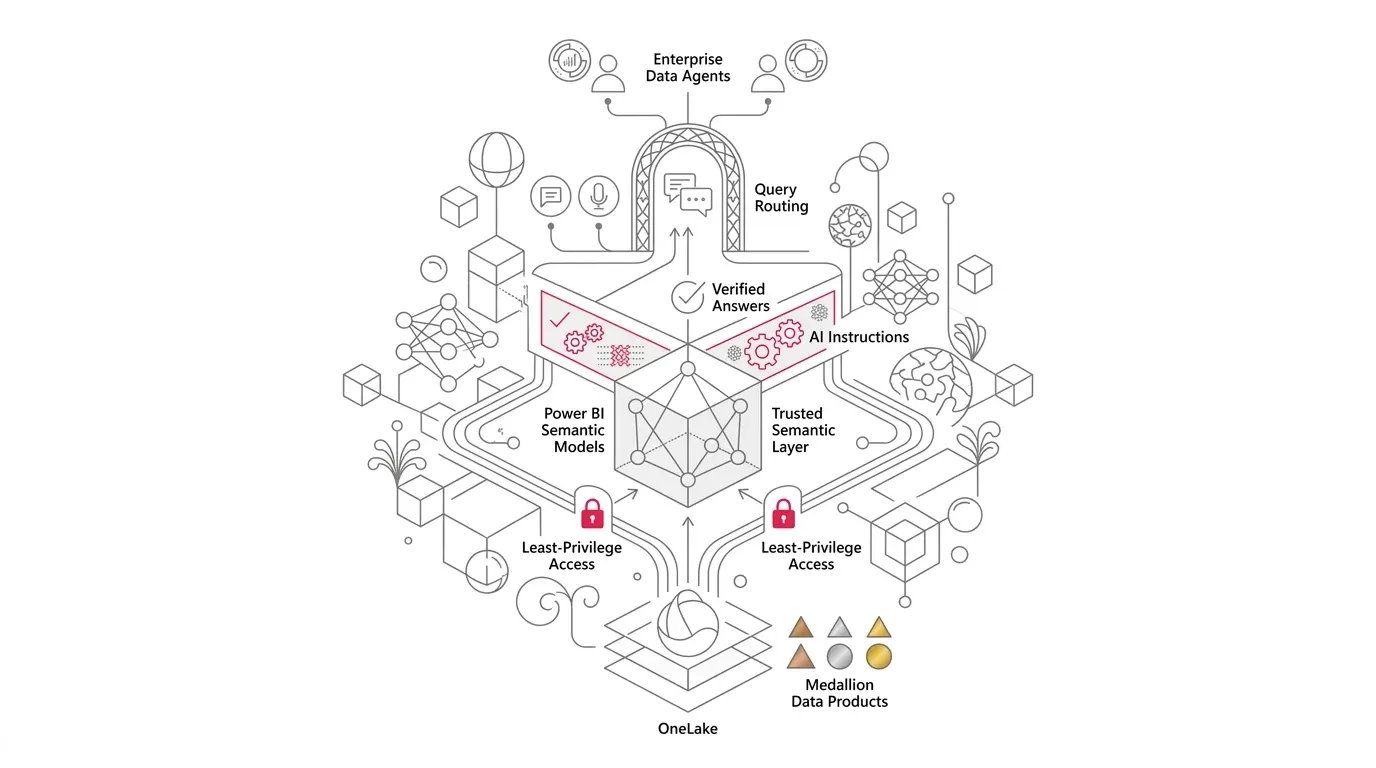
A production-grade Microsoft Fabric AI architecture establishes clear separation between storage truth, metric logic, and natural language interpretation:
- OneLake Medallion Products: Cleanse raw data into standardized Silver tables and decision-ready Gold facts and dimensions.
- Domain Semantic Models: Encapsulate approved DAX measures, time intelligence, hierarchies, and row/column-level security (RLS/CLS).
- AI Preparation Layer: Configure AI Data Schemas to limit exposed tables, define Verified Answers for executive KPIs, and author clear AI Instructions.
- Fabric Data Agent: Executes natural language-to-DAX translations, validating generated queries against certified schemas before execution.
- Enterprise Governance: Microsoft Purview sensitivity labeling, Entra ID security groups, CI/CD deployment pipelines, and capacity monitoring.
Configuring the Three Pillars of Power BI AI Preparation
Prepare semantic models for Copilot and Data Agents in three structured phases:
| Prep for AI Tool | Core Function | Best Practice Implementation |
|---|---|---|
| AI Data Schema | Restricts visible tables and columns for AI queries | Expose only certified measures and business dimensions; hide raw surrogate keys |
| Verified Answers | Binds frequent executive questions to certified report visuals | Configure for standard board metrics (e.g., Gross Margin, ARR, Net Churn) |
| AI Instructions | Provides plain-language vocabulary and routing rules | Define acronyms, calendar conventions, and default calculation rules |
Security Enforcement Below the Language Layer
Microsoft Fabric Data Agents inherit the user identity and respect underlying data permissions. Model-level Read permission is required; workspace Contributor or Admin roles must be avoided for end-users.
Row-Level Security (RLS) and Column-Level Security (CLS) defined in the semantic model automatically restrict the records and sensitive fields returned in AI responses, guaranteeing compliance without relying on prompt instructions.
AI Release Gates: Testing Decision Reliability
Before deploying a Data Agent to production, execute a comprehensive golden-question test suite across eight critical dimensions:
- Metric Accuracy: Verifying calculations match certified financial statements within zero tolerance.
- Paraphrase Consistency: Testing varied natural language phrasings resolve to identical metric definitions.
- Aggregation & Grain: Confirming proper dimensional grouping without invalid cross-joins.
- Freshness Indicators: Ensuring preliminary vs. closed fiscal period statuses are clearly identified.
- Entitlement Boundaries: Validating restricted personas receive only authorized rows and columns.
- Ambiguity Handling: Testing that vague terms trigger clarification prompts rather than arbitrary assumptions.
- Unsupported Inference: Ensuring the agent declines speculative causality questions lacking driver data.
- Regression Stability: Verifying model updates do not degrade existing question accuracy.
Build Governed Fabric Data Agents with YuniQ
YuniQ helps enterprises design trusted semantic layers, build certified Direct Lake models, configure Fabric Data Agents, and establish automated AI release gates.
Explore Microsoft Fabric ConsultingFrequently Asked Questions
Do Fabric Data Agents require users to have workspace access?
No. Users only require access to the published Data Agent and Read permissions on the underlying semantic model or lakehouse. Workspace membership is not required for consumers.
How do Fabric Data Agents enforce Row-Level Security (RLS)?
When a user submits a natural-language query, Fabric generates DAX or SQL queries that execute under the user Entra ID identity, ensuring all RLS and CLS filters apply automatically at query time.
What is the difference between AI Data Schemas and AI Instructions?
An AI Data Schema determines which specific tables and columns are exposed to the AI model. AI Instructions provide natural language guidance, business terminology definitions, and preferred calculation behaviors.