The most expensive modernization mistake is often made before delivery begins. Leaders choose a destination before they have agreed what the current system is worth, what could fail, and which parts of the estate actually need to change.
That sequencing problem matters more as organizations try to make operational data and business processes available to AI. A legacy platform may be costly to maintain and difficult to change, yet still contain the authoritative data, decision rules, and exception handling that keep the organization running. Replacing it indiscriminately can destroy value. Protecting it indefinitely can block growth.
Core Governance Reality: Application age is a weak prioritization signal. A 20-year-old system with stable interfaces, tested recovery controls, and high domain value is often less risky than a five-year-old application with brittle integrations, undocumented logic, and fragmented ownership.
Recent evidence captures the tension. Ensono's 2026 survey of 500 IT and line-of-business leaders at large organizations in the United States and United Kingdom found that 78% considered legacy systems more important than they were two years earlier. Yet 71% reported modernization initiatives exceeding their original budgets, and 61% had paused, scaled back, or abandoned initiatives in the previous 24 months. The survey is vendor-sponsored and limited to two countries, but the management problem is recognizable: ambition is not the same as execution readiness.
A legacy application modernization assessment should resolve that problem. Its purpose is not to prove that modernization is necessary. Its purpose is to determine the right treatment for each application and create an evidence-backed order of work.
Start With a Portfolio Decision, Not a Technology Decision
Application age is useful context, but it is a poor decision rule. A 20-year-old transaction system with predictable performance, current support, strong recovery controls, and stable interfaces may be less urgent than a five-year-old application with weak ownership, brittle integrations, and no tested recovery path.
Cloud readiness is also insufficient on its own. Moving an application without simplifying its workflows, clarifying its data ownership, or removing obsolete dependencies can relocate cost without improving the business.
The assessment should answer four executive questions:
- What business or mission outcome does this application protect or enable?
- What is the likelihood and impact of failure, compromise, or loss of support?
- What valuable logic, data, and operating knowledge must survive any change?
- Which treatment creates the best balance of value, risk, cost, and delivery confidence?
AWS Prescriptive Guidance recommends that modernization reviews examine the business, functional, technical, and financial significance of applications, then produce a roadmap, target-state blueprint, proof of concept, and plan for readiness gaps. That is a useful standard for the output: an assessment should end in fundable decisions, not a catalog of technical debt.
Assess Every Application Through Seven Lenses
Use the same seven lenses across the portfolio. Consistency makes tradeoffs visible and prevents the loudest stakeholder or newest platform proposal from controlling the sequence:
1. Business Criticality and Mission Value
Identify the business capabilities, services, revenue, beneficiaries, employees, or regulatory duties the application supports. Measure transaction volumes, active users, peak periods, service-level commitments, and the operational consequences of unavailability.
For a nonprofit foundation, this lens should include grantmaking cycles, beneficiary or grantee access, donor stewardship, restricted-fund reporting, and records obligations. A low-volume system can still be mission-critical if it supports a statutory filing or a small but vulnerable population.
Ask one revealing question: if the application disappeared for a week, what work would stop, who would be affected, and what would the workaround cost?
2. Operational Risk and Supportability
Evaluate end-of-support dates, vendor dependency, security exposure, incident history, recovery performance, patching, observability, and skills concentration. A system maintained by one person with undocumented procedures carries a different risk from one with a trained team and tested runbooks.
The UK government's Legacy IT Risk Assessment Framework offers a useful pattern. It separates the likelihood of problems from their impact and considers end of support, contract expiry, scarce expertise, inability to meet business needs, vulnerabilities, incidents, financial consequences, stakeholder effects, operational disruption, and cross-system dependencies.
Do not compress all of this into 'technical debt.' A board can act on an unsupported component, an untested recovery plan, or an expiring contract. It cannot easily act on a vague debt label.
3. Embedded Business Logic and Data Value
Legacy applications often encode more than their documentation reveals. Pricing rules, eligibility logic, case-routing decisions, approval thresholds, correspondence requirements, exception paths, and data relationships may exist across code, configuration, database procedures, reports, spreadsheets, and employee practice.
Assess both the value and recoverability of that knowledge. Identify authoritative data, retention rules, quality problems, lineage, and ownership. Trace a representative set of real workflows from trigger to outcome, including exceptions and manual handoffs.
This evidence determines whether the organization should preserve a stable core, expose selected data through governed interfaces, or reconstruct a capability on a new stack. It also creates a natural link between application modernization and data architecture and migration planning .
4. Dependency Blast Radius
An apparently small application can be a structural dependency for dozens of workflows. Map inbound and outbound interfaces, batch processes, identity services, file transfers, reports, scheduled jobs, downstream models, document outputs, and unofficial spreadsheet processes.
Record the owner, frequency, data contract, failure behavior, and recovery procedure for each dependency. Then test the map against logs and real transactions. Architecture diagrams describe intent; runtime evidence reveals what actually happens.
This lens prevents two common failures: decommissioning a system before its last consumer is known, and rebuilding an application while leaving its most fragile dependencies untouched.
5. Change Economics
Compare the cost of keeping the application with the cost and risk of changing it. Current license and infrastructure spend are only part of the picture. Include support labor, incident cost, manual workarounds, delayed releases, audit effort, vendor change fees, parallel running, data migration, training, and decommissioning.
Use ranges and state assumptions. A precise estimate built on an incomplete dependency map is less useful than a range tied to evidence and explicit uncertainty.
Also test the counterfactual. What new capability, avoided loss, or released capacity becomes possible after modernization? Cost reduction may support the business case, but faster product change, better service continuity, or safer data access may be more valuable.
6. AI and Integration Readiness
Executives increasingly expect legacy systems to support analytics, copilots, and agents. The first question is not whether an AI model can connect. It is whether the application can provide trusted context and accept controlled action.
Assess interface quality, data semantics, identity, least-privilege access, audit logs, latency, idempotency, exception handling, and human approval points. Separate read access from write authority. A system may be ready to supply governed reference data while remaining unsuitable for autonomous updates.
This is often an argument for augmentation rather than replacement. A stable system of record can remain in place while APIs, event streams, or purpose-built services expose selected capabilities. High-volume customer-care automation , for example, depends on reliable account context, clear action permissions, and safe handoffs, not merely a conversational interface.
7. Execution Readiness
Finally, assess the organization's capacity to deliver and absorb change. Confirm accountable owners, subject-matter expert availability, test environments, representative test data, acceptance criteria, procurement lead times, security and accessibility review, change capacity, and a credible rollback or coexistence plan.
This lens explains why technically attractive projects stall. Ensono's research found that organizations identifying themselves as modernization leaders reported stronger visibility across legacy and cloud environments and more structured success measurement. The lesson is practical: delivery confidence comes from evidence, ownership, and gates, not enthusiasm for a target architecture.
Convert the Evidence Into One of Five Dispositions
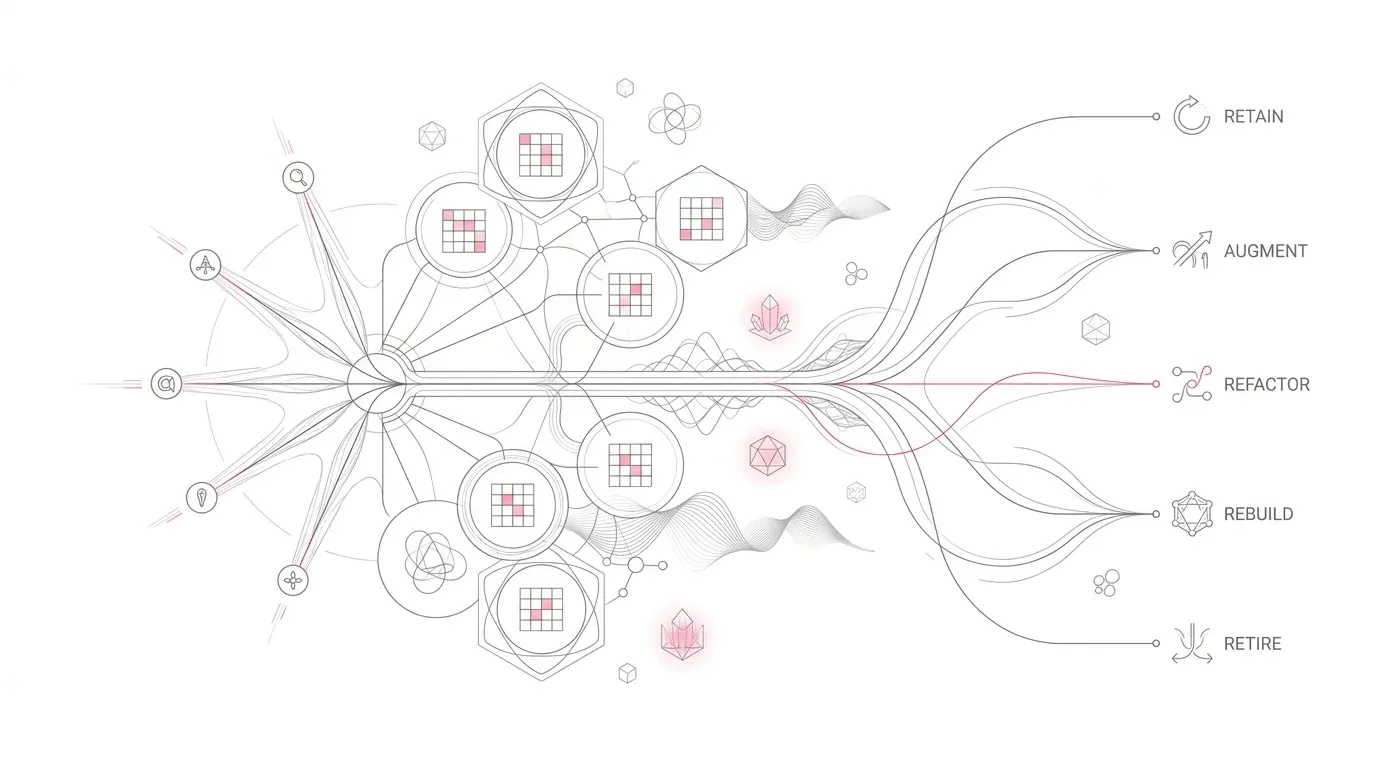
After scoring the seven lenses, assign a provisional disposition. The label is a decision hypothesis, not a permanent category:
| Strategic Disposition | Best Operational Fit | Required Evidence Baseline | Primary Failure Risk |
|---|---|---|---|
| Retain and Protect | Stable system, high domain value, acceptable supportability. | Reliability metrics, support contracts, recovery drills, security logs, cost. | Neglecting an unmonitored core system because it is not actively changing. |
| Augment and Expose | Valuable core logic or data with constrained interfaces. | API feasibility, access controls, data quality, latency limits, audit trails. | Creating a brittle, unmanaged integration layer around fragile backends. |
| Refactor or Replatform | Core behavior remains useful, but runtime or hosting constrains delivery. | Code quality, test coverage, component boundaries, target platform fit. | Moving monolithic complexity to the cloud without eliminating root debt. |
| Rebuild or Replace | High strategic value, high constraint, and a simpler target state exists. | Workflow traces, functional requirements, migration plan, test criteria. | Recreating every historical exception and customized anti-pattern. |
| Retire or Consolidate | Low differentiated value, duplicated functionality, or obsolete business need. | Usage metrics, active user count, records obligations, downstream consumers. | Decommissioning before verifying long-term compliance retention rules. |
Retain and Protect
Choose this path when the application remains valuable, reliable, supportable, and proportionate in cost. The work may include stronger monitoring, recovery testing, documentation, access control, and succession planning. Retention should be an explicit investment decision, not passive neglect.
Augment and Expose
Choose augmentation when the core logic or data remains valuable but access is constrained. Add governed APIs, events, workflow services, or a new user experience around a stable system of record. Define performance limits and failure behavior so the integration layer does not become a new source of fragility.
Refactor or Replatform
Choose this path when the application's core behavior remains useful but the current runtime, architecture, or deployment model constrains performance, security, or delivery. Microsoft's 6 Rs guidance is helpful here because it compares modernization options by complexity, cost, integration, security, compliance, and governance rather than treating cloud migration as a single pattern.
Rebuild or Replace
Rebuild when the capability is strategically important but the current implementation prevents necessary change, and when the organization can specify a simpler target state. Replace with a commercial product when the capability is standardized and differentiation is low.
The crucial discipline is scope. Do not reproduce every field, screen, and exception because it exists today. Preserve business outcomes and required controls; challenge historical complexity.
YuniQ's AI-driven legacy modernization approach is relevant at this stage. YuniQ says its framework can analyze customized platforms, extract workflows, process logic, data structures, user journeys, rules, dependencies, and technical knowledge, then use that evidence as a foundation for a purpose-built rebuild.
Retire or Consolidate
Retire applications with obsolete business purpose, minimal use, or duplicated capability. Before shutdown, confirm records retention, legal holds, reporting needs, integrations, licenses, access to historical data, and who owns the final acceptance decision. Consolidation can reduce cost, but only if it does not erase a necessary workflow or create an oversized replacement platform.
Use a Two-Pass Scoring Method
A single total score can conceal the difference between urgency and opportunity. Use two passes:
- Pass one: Exposure. Score operational failure likelihood and business impact separately on a simple one-to-five scale. A high-likelihood, high-impact application needs immediate risk treatment even if a full modernization cannot begin.
- Pass two: Strategic move. Score business value, change constraint, data and logic value, AI or integration opportunity, and execution readiness. This identifies where modernization can create value and where the organization can realistically deliver.
Plot the results into a 2x2 prioritization quadrant:
- High exposure and high strategic value: Stabilize immediately, then prioritize modernization delivery;
- Low exposure and high strategic value: Augment or modernize proactively to accelerate business agility;
- High exposure and low strategic value: Replace with commodity SaaS, consolidate, or retire quickly; and
- Low exposure and low strategic value: Retain with minimal maintenance or schedule orderly retirement.
Keep the scoring transparent. Document evidence, confidence, owner, and review date. The score should support a leadership conversation, not automate it.
A 30-Day Assessment Should Produce Decision Evidence
For a focused application or bounded portfolio segment, the first 30 days should produce:
- A named business owner and technical owner for each application;
- A capability and stakeholder map;
- An inventory of components, support status, contracts, and critical skills;
- Representative workflow traces, including exceptions and manual work;
- A verified dependency and data-flow map;
- Incident, resilience, security, and recovery evidence;
- Current cost and change-friction ranges;
- A record of valuable rules, data, reports, and documents that must survive;
- Candidate dispositions with assumptions and confidence levels;
- A sequenced roadmap with stabilization work separated from transformation work; and
- Acceptance measures for the first proof of value.
AI can accelerate parts of this discovery. It can summarize code and configuration, propose dependency maps, extract candidate rules, compare artifacts, and generate documentation drafts. It can also be wrong or incomplete. Subject-matter experts must validate business meaning, runtime evidence must validate dependencies, and accountable owners must approve the target state.
Fund the Evidence Before You Fund the Rewrite
A modernization business case is ready when leaders can explain what capability is changing, what value must be preserved, what risk will be reduced, what dependencies control the sequence, how success will be measured, and what happens if the change fails.
If those answers are missing, the next investment should be discovery and risk reduction, not a large delivery commitment.
The objective is not to eliminate every legacy application. It is to make each system's role deliberate. Protect what remains fit for purpose. Expose what contains valuable data and logic. Rebuild what constrains the mission. Retire what no longer earns its place.
Map one high-value legacy workflow with YuniQ. Explore YuniQ's AI-driven engineering and legacy modernization approach to see how structured discovery can turn undocumented rules, dependencies, and workflows into a modernization decision and an evidence-backed path to delivery.
Assess Your Legacy Application Portfolio
Do not risk multi-million dollar overruns on unverified rewrites. Partner with YuniQ to decode complex legacy workflows, extract embedded business logic, and build an evidence-backed modernization roadmap.
Explore Legacy Modernization