HubSpot has started a 12-month clock for organizations that still depend on its numbered APIs and legacy app architectures. The risk is broader than an endpoint update. A production integration can be exposed through its API version, response contract, app model, credentials, ownership, or an undocumented background job that only appears in runtime traffic.
Two dates matter. HubSpot says v4 APIs become unsupported on 30 March 2027 . It has separately announced September 2027 enforcement for v1-v3 APIs, legacy public apps, and legacy private apps. Unsupported versions may continue working for a time, but HubSpot no longer promises updates, fixes, stability, or continued availability. For leaders, that turns the announcement into a portfolio-risk deadline, not a developer housekeeping task.
The safest response is a staged modernization program : find the real runtime estate, decide what deserves to survive, separate API work from app-architecture work, prove behavioral parity, and cut over with observability and rollback. The plan below gives CIOs, architects, CRM owners, and integration teams a practical sequence from now through September 2027.
Start with the two clocks
| Milestone | What Changes | Leadership Implication |
|---|---|---|
| 28 Sep 2026 | New accounts can no longer create legacy private apps. | Freeze new legacy design immediately. |
| 26 Oct 2026 | Existing accounts can no longer create legacy private apps. | Approve a supported pattern for new internal integrations now. |
| 30 Mar 2027 | v4 APIs move to unsupported status. | Treat v4 as the first production migration wave. |
| Sep 2027 | v1-v3 APIs and legacy public and private apps face enforcement. | Complete API and app-architecture migrations before the month begins, with contingency time. |
The dates do not create a license to wait. HubSpot says its March 2027 date-based release will provide complete per-endpoint replacement documentation for legacy APIs. That is a reason to isolate genuinely blocked endpoints, not a reason to postpone inventory, ownership, contract capture, test design, or migration of already supported surfaces.
Manage four workstreams, not one
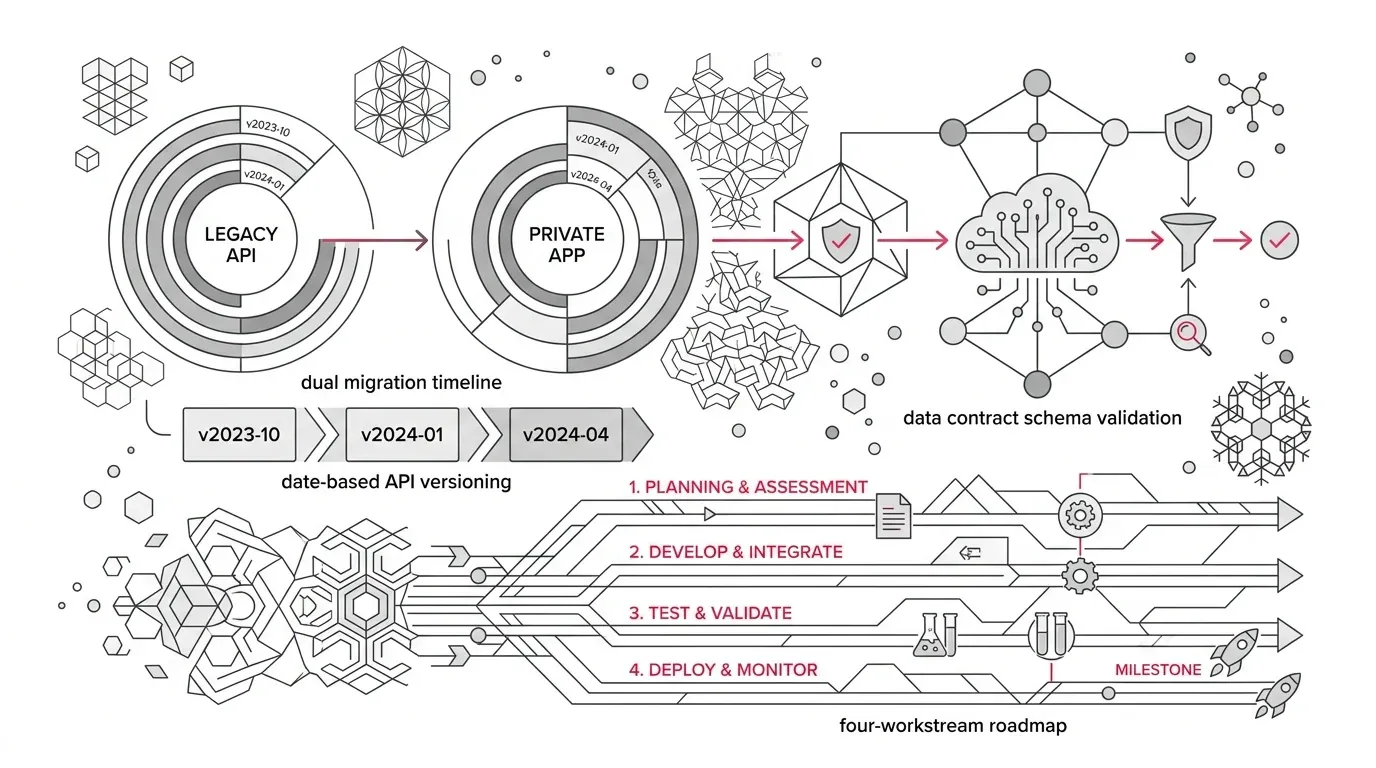
A program that reports only the percentage of URLs changed can look green while material risk remains. Track four workstreams independently:
- API versions: identify calls to v1, v2, v3, and v4, then map each to an eligible date-based API. HubSpot explicitly tells teams to migrate directly from v1-v3 to date-based versioning rather than stepping through another numbered version.
- Behavior and data contracts: capture request fields, response shapes, error behavior, pagination, rate limits, associations, and downstream transformations. HubSpot warns that some migrations change response shapes, not just paths.
- App architecture: determine whether public and private apps use the current Projects model or a legacy architecture. Marketplace certification exposure and legacy architecture exposure are separate, so completing one does not close the other.
- Credentials and ownership: confirm authentication, scopes, rotation, named owners, install context, and deactivation behavior. HubSpot’s 2026.09 platform adds service keys for certain in-account integrations and formal app ownership; those changes deserve security and operating-model review, not automatic adoption.
The 12-month HubSpot migration roadmap
September to October 2026: Contain and discover
Stop creating new legacy dependencies. Use HubSpot’s developer tasks card as one signal because its detection is based on runtime calls. Then reconcile that view with source-code searches, API gateway and proxy logs, middleware, serverless jobs, workflow actions, webhooks, Postman collections, spreadsheets, and one-off scripts. Runtime evidence matters because an updated repository does not prove the old deployment has stopped calling a legacy path.
Create one record for every integration with:
- endpoint and method, observed version, call volume, and last-seen date;
- application, environment, business workflow, data owner, and technical owner;
- customer, revenue, service, reporting, or compliance impact;
- app architecture, authentication method, scopes, and credential owner; and
- replacement availability, target version, blockers, test owner, and rollback path.
November 2026 to January 2027: Decide and design
Do not automatically reproduce every legacy integration. For each item, choose patch, replatform, rebuild, or retire. Give priority to workflows that affect customers, revenue recognition, billing, consent, service operations, or regulatory reporting. Low-volume does not always mean low-risk: a monthly finance job can be more consequential than a high-volume enrichment process.
Select a target date-based version only after confirming that the required API groups are available and that the support window fits the operating calendar. Centralize version configuration where the design allows it. For SDK users, validate the generated methods and installed SDK release rather than assuming a single version flag will switch every call.
February to March 2027: Clear the v4 deadline
Move all production v4 workloads before 30 March. Start with a controlled cohort, compare outputs, and increase traffic only when functional, data, performance, security, and business gates pass. Unsupported does not mean an immediate outage, but making the deadline a soft target transfers avoidable risk into the busiest part of the program.
April to June 2027: Complete the main migration waves
Use HubSpot’s March documentation release to close previously blocked mappings. Migrate v1-v3 calls directly to a supported date-based version and move legacy apps to the supported architecture. Run API and app-architecture work as linked but separately reported tracks. A Projects migration does not prove the API surface is supported, and supported API calls do not prove the app architecture is current.
July to August 2027: Prove production readiness
Reserve these months for parallel validation, business acceptance, failure exercises, and recertification work. Avoid scheduling the first end-to-end test in August. The program should already know its rollback time, maximum tolerable data divergence, reconciliation owner, and process for replaying failed events.
Before September 2027: Cut over and retire
Remove legacy routes and credentials only after confirming that runtime traffic has ceased, queued work is drained, dependent consumers are stable, and retention requirements are met. Archive the decision record, test evidence, owner list, and rollback outcome. Then establish a recurring version-review cadence so date-based upgrades become scheduled dependency maintenance rather than the next emergency.
Choose the right treatment for each integration
Before rewriting every integration, run each legacy surface through a structured disposition framework. Integrating this with a broader legacy application modernization assessment ensures you invest engineering effort where business value justifies it:
| Decision | Choose It When | Executive Question |
|---|---|---|
| Patch | The business process is sound and the change is bounded. | Can we demonstrate equivalent behavior, not merely successful HTTP responses? |
| Replatform | The app or credential model is legacy but the integration remains valuable. | Does the new operating model improve ownership, access control, logging, and recovery? |
| Rebuild | Legacy logic is brittle, duplicated, opaque, or expensive to maintain. | Which business rules must be preserved, and which accidental complexity can be removed? |
| Retire | The integration lacks use, ownership, or a continuing business purpose. | Who consumes the output, and what evidence proves shutdown is safe? |
This decision is where migration becomes modernization. A forced platform change can either copy yesterday’s complexity or expose it, document it, and reduce it. Leaders should explicitly fund the discovery and testing needed to make that choice.
Use production acceptance gates
An integration is ready only when evidence covers all eight production gates:
- Functional parity: critical user journeys and automated workflows produce the intended outcomes, including error and exception paths.
- Data reconciliation: counts, identifiers, associations, timestamps, field transformations, and calculated values stay within approved tolerances.
- Contract behavior: request and response schemas, pagination, nulls, errors, retries, rate limits, and webhook behavior match documented expectations.
- Security: authentication, scopes, secrets, rotation, service ownership, and access logging follow the approved model.
- Performance and resilience: latency, throughput, backoff, idempotency, replay, and dependency-failure behavior meet the service objective.
- Observability: teams can see legacy calls, new-version calls, failures, data divergence, queue age, and ownership from a common operational view.
- Rollback: the team has rehearsed how to restore service or data flow without reintroducing unbounded legacy risk.
- Business acceptance: the accountable process owner has approved the result, not just the technical team.
Give executives a migration dashboard
A useful monthly steering view is small enough to read and precise enough to trigger action. Report:
- legacy runtime calls by version, business criticality, and owner;
- percentage of integrations inventoried and percentage with confirmed runtime evidence;
- v4 workloads remaining before 30 March 2027;
- v1-v3 endpoints with a mapped date-based replacement, an open documentation dependency, or no approved disposition;
- legacy public and private apps remaining by architecture;
- critical workflows that have passed every production gate;
- open severity-one and severity-two defects, data-reconciliation exceptions, and rollback time; and
- unowned integrations and overdue business decisions.
Avoid a single completion percentage. It can conceal an unowned revenue workflow or an app that has moved architectures but still calls an unsupported API.
Where AI-driven modernization can help
The most labor-intensive parts of this program are often discovery and knowledge reconstruction: finding distributed calls, extracting business rules, documenting data structures and dependencies, generating test cases, and keeping evidence current. YuniQ describes an AI-driven legacy modernization framework that spans requirement discovery, documentation, analysis, architecture, development, testing, security, and deployment, with use cases for legacy application discovery, platform exit, and application consolidation.
That makes the relevant conversation broader than a HubSpot endpoint edit. It is a chance to decide which workflows to preserve, which to redesign, and how to leave the integration estate easier to understand and upgrade.
Modernize Your HubSpot Integration Architecture
Do not wait for the 2027 enforcement deadlines to disrupt customer workflows or billing syncs. Partner with YuniQ to map legacy calls, extract hidden business logic, and execute an evidence-backed migration plan.
Explore Legacy ModernizationThe decision to make this month
Approve the inventory and ownership phase now . By the end of October, every organization with material HubSpot integrations should know where legacy calls occur at runtime, who owns the affected business processes, which app architectures are in use, and which workloads face the March deadline. That evidence is the foundation for budget, sequencing, vendor decisions, and a credible September 2027 cutover.
Take the first step: explore YuniQ’s AI-driven legacy modernization approach and request a consultation to map your integration estate, business logic, testing gates, and phased migration plan.