A deadline days away can make an enterprise technology decision feel deceptively binary. Pega Infinity '23 reaches the end of Extended Support on September 30, 2026. While this creates an immediate support and risk milestone, it does not automatically shut off production applications on October 1.
Executive Modernization Principle: Do not let deadline pressure force an unexamined multi-year platform lock-in. A support expiration demands two parallel streams: contain immediate operational exposure today, while evaluating long-term upgrade, cloud, and selective rebuild options based on empirical system facts.
In its official Extended Support policy, Pegasystems states that it will no longer release patches or hotfixes for bugs or security vulnerabilities for Infinity '23 after Extended Support expires.
What Changes on September 30: Facts vs. Misconceptions
Understanding the exact operational reality prevents organizational panic and ensures measured decision-making:
- Production Runtime Continuity: Applications continue executing on October 1; there is no automated software shut-off.
- End of Vulnerability & Bug Fixes: Pega ceases releasing security hotfixes, maintenance patches, and critical updates for Infinity '23 (patch 23.1.5 was the final release).
- Contractual Compliance: Pega classifies unsupported versions as out of compliance with product terms, though this does not automatically constitute statutory noncompliance.
- Government Cloud Timetables: Pega Cloud for Government deployments may operate under differentiated multi-tenant support schedules.
Immediate 10-Day Containment Checklist
Execute these six containment actions immediately to safeguard unsupported production systems while long-term roadmaps are finalized:
- Exact Estate Audit: Catalog all Pega versions, patch levels, product modules, databases, and middleware across on-prem and private cloud environments.
- Contractual Support Review: Align legal, procurement, and IT on active support terms, escalation channels, and SLA definitions.
- Outstanding Hotfix Reconciliation: Review open Pega support tickets, critical CVE advisories, and unapplied hotfixes before the deadline.
- Non-Essential Change Freeze: Institute elevated approval thresholds for non-critical changes to minimize production instability.
- Disaster Recovery & Backup Verification: Validate cold/warm backups, database snapshots, and rollback runbooks for all critical case databases.
- Executive Risk Assignment: Designate an executive risk owner accountable for temporary operational exposure and modernization funding.
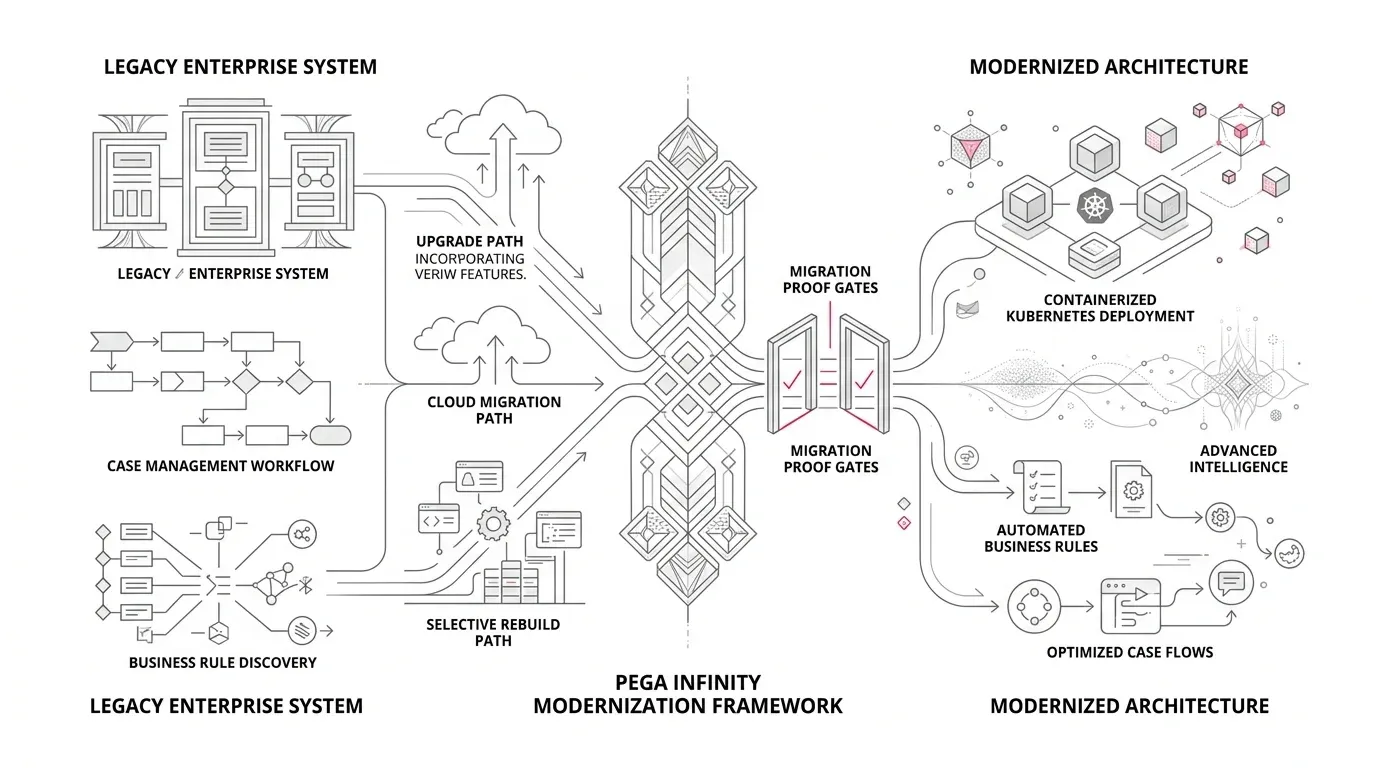
Comparing the Three Strategic Modernization Paths
Enterprise leaders should evaluate three distinct architectural paths based on business differentiation, technical debt, and total cost of ownership:
| Strategic Path | Optimal Use Case | Architecture Dependencies | Key Operational Tradeoff |
|---|---|---|---|
| 1. Upgrade & Stay (Infinity '25 / '26) | Core workflows fit Pega; customizations are governable; team possesses container expertise | Platform '25+ requires containerized Kubernetes deployments and updated database versions | Preserves existing case logic but retains high ongoing license and specialist talent costs |
| 2. Migrate to Pega Cloud | Strategic alignment to Pega; enterprise desires offloading infrastructure and operations | Requires network re-architecture, VPC peering, and microjourney-by-microjourney UI refactoring | Simplifies infrastructure management but increases long-term subscription lock-in |
| 3. Selectively Rebuild / Replace | Heavily customized workflows; licensing and change friction constrain agility | Requires reverse engineering business rules, case lifecycles, data transforms, and APIs | Higher upfront discovery effort, but yields cloud-native independence, lower TCO, and zero lock-in |
Six Decision Tests Before Choosing a Modernization Path
Score each path against six empirical criteria before signing multi-year contracts:
- Support Timeline Test: How quickly can a supported posture be achieved, and what exposure must be accepted during the transition?
- Business Differentiation Test: Which Pega case types represent competitive advantage versus commodity ticketing and routing?
- Hidden Logic Test: Can your team trace decision tables, Declare expressions, data transforms, and SLAs without relying on tribal knowledge?
- Deployment & Infrastructure Test: Can internal engineering teams support Kubernetes containerization required by Platform '25+?
- Data & Integration Test: Can all SOAP/REST services, external database connectors, and batch extract pipelines be validated?
- 5-Year Total Cost of Ownership: Compare licenses, cloud infrastructure, specialized developer salaries, migration costs, and exit reversibility.
A 30-60-90 Day Modernization Discovery Plan
- Days 1-30 (Factual Baseline & Rule Extraction): Catalog case types, Decision Tables, Data Transforms, SLAs, integrations, and operator workarounds. Formulate a regression test pack for high-risk customer journeys.
- Days 31-60 (Path Evaluation & Vertical Slice): Model Pega Cloud terms vs. container upgrade vs. cloud-native rebuild. Prototype one bounded workflow outside Pega to establish empirical benchmarks.
- Days 61-90 (Proof-of-Concept & Decision): Execute a production-like vertical slice proof, reconcile data states, measure latency and TCO, and deliver a definitive modernization roadmap.
Deconstruct and Modernize Pega Applications with YuniQ
YuniQ utilizes AI-driven reverse engineering to extract complex workflows, business rules, and case logic from Pega Infinity applications, rebuilding them on modern cloud-native architectures in 30-90 days.
Explore AI-Driven Enterprise ModernizationFrequently Asked Questions
Will our Pega Infinity '23 applications stop functioning on October 1, 2026?
No. Existing applications will continue to execute. However, Pegasystems will no longer provide security patches, vulnerability fixes, or technical support for Infinity '23 environments.
What infrastructure changes are required to upgrade to Pega Platform '25 or '26?
Pega Platform '25 and newer versions exclusively support containerized deployments on Kubernetes (such as EKS, AKS, or OpenShift). Client-managed VM-based deployments must be re-architected.
Can a complex Pega application be rebuilt outside Pega in 90 days?
A bounded high-value workflow or vertical slice proof can be extracted and modernized within 90 days. Full enterprise estates are typically modernized across phased domain waves.