A modernized enterprise application can compile flawlessly, pass initial unit tests, and still fail the business on day one. The missing refund calculation. The compliance approval threshold modified after an audit. The non-profit donor restriction buried in legacy workflows. The customized customer letter generated only when three distinct conditions coincide. These mission-critical rules rarely exist in updated documentation, yet they represent how the organization actually operates.
AI can dramatically accelerate legacy code analysis, dependency mapping, technical documentation, and test generation. However, AI cannot independently determine which legacy behaviors are legal obligations, which are valuable operational conventions, and which are obsolete technical debt worth retiring. As highlighted in BCG's modernization analysis , AI-generated testing provides limited assurance when outcome baselines are unclear, requiring leaders to enforce structured regression baselines, data reconciliation, and tested rollback paths.
Executive Takeaway: Treat business-rule preservation as a governed evidence process. Before authorizing cutover, require an evidence pack that connects legacy behavior to named owners, target implementations, verification results, data reconciliation, and reversible rollback triggers.
Why Business Logic Gets Lost in Legacy Migrations
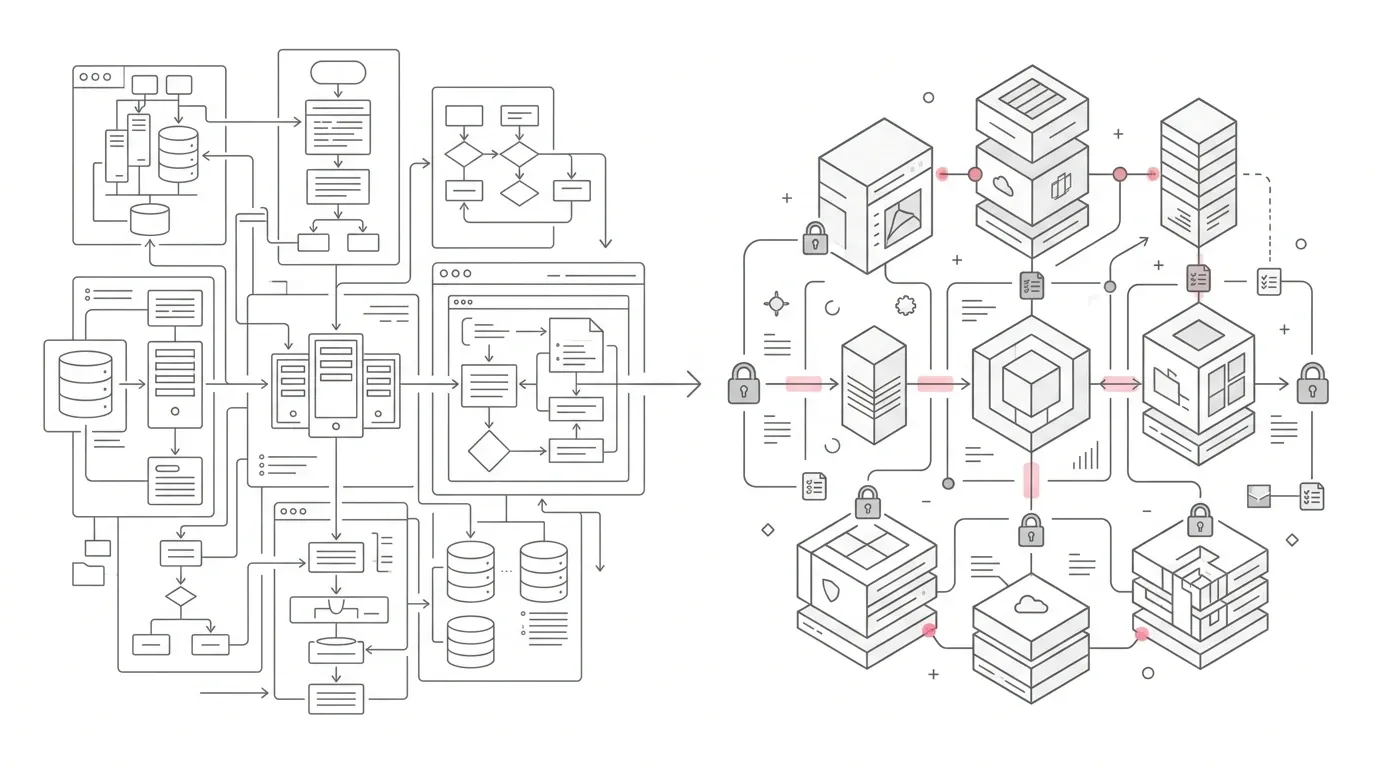
Legacy systems are frequently mischaracterized as merely 'old code.' In reality, they are accumulated operating models. Business logic is distributed across monolithic source code, low-code configurations, workflow engines, stored procedures, ad-hoc reports, document templates, integration mappings, role permissions, and undocumented manual workarounds.
The cost of operational opacity is severe. A federal review by the U.S. Government Accountability Office (GAO) discovered outdated languages, unsupported hardware, and active cybersecurity vulnerabilities across critical legacy systems, finding that only a fraction of documented modernization programs contained complete transition plans and milestone targets. The enterprise takeaway is clear: modernizing legacy platforms requires an auditable plan for what is changing, how equivalence will be proven, and how the old platform will be safely decommissioned.
While AI changes the economics of discovery by parsing complex codebases in seconds, an extracted rule is a hypothesis, not an indisputable fact. Discovery outputs must be structured as evidence for human business owners to validate rather than blindly duplicated into the new architecture.
Define Functional Equivalence Before You Test It
Functional equivalence does not mean rebuilding every historical screen and replicating every obsolete bug. It means proving that the target cloud architecture produces approved business outcomes across all key operational scenarios, within agreed tolerances for latency, security, accessibility, and data integrity.
Establishing this definition early forces three vital categorization decisions:
- Preserve: Behavior representing a legal obligation, regulatory mandate, accounting treatment, customer SLA, or deliberate operational policy.
- Redesign: Valid business behavior that must be modernized to leverage event-driven cloud patterns, real-time APIs, or new digital channels.
- Retire: Obsolete features, redundant data fields, legacy workarounds, and historical defects that should not be carried forward.
The Six-Artifact Functional Equivalence Evidence Pack
1. Living System and Dependency Map
Construct an active topology of the legacy estate as it currently operates in production: user journeys, database schemas, batch cron jobs, third-party APIs, document pipelines, and role-based access trees. Label every interface with a technical owner and criticality tier.
In accordance with Microsoft's application modernization guidance , complete discovery must span applications, data stores, and integration infrastructure to reveal hidden operational handoffs and downstream report dependencies.
2. Business-Rule Register with Provenance and Ownership
Maintain a unified repository of all rules the enterprise intends to preserve, redesign, or retire. Every entry must detail the triggering event, input variables, decision or calculation logic, origin location (e.g., Salesforce Apex trigger, Pega decision table, COBOL routine), authorized business owner, and target acceptance test.
3. Golden Transaction and Edge-Case Test Suite
Build a curated library of historical transactions and expected outcomes that both the legacy system and the target architecture can execute. Golden test suites must cover high-volume happy paths, high-value transactions, boundary conditions, and regulatory edge cases (such as restricted grant allocations, multi-currency adjustments, or complex tax calculations).
As emphasized in enterprise go-live guidance , testing must validate edge cases against real-world migrated data with formal stakeholder sign-off, ensuring AI is used to expand candidate scenarios while human domain experts approve expected outcomes.
4. Rule-to-Test Traceability Matrix
Connect every approved business rule directly to its target code implementation, automated test cases, execution results, and reviewer sign-off. This creates end-to-end visibility: any rule without a passing test blocks release, while unmapped target code paths receive scrutiny to prevent feature bloat or unintended behavior.
5. Reconciliation and Nonfunctional Comparison Report
UI parity is insufficient. Comprehensive verification demands rigorous comparison across six technical and operational vectors:
- Data Reconciliation: Verifying record counts, referential integrity, decimal precision, and history using automated data pipelines.
- Decision Verification: Comparing approval routings, pricing calculations, credit limit checks, and discount logic against legacy baselines.
- Document & Output Fidelity: Ensuring generated invoices, compliance notices, and customer statements match pixel-for-pixel standards.
- Role & Access Security: Validating segregation of duties, role permissions, and data masking controls across environments.
- Service Quality & Performance: Benchmarking API response latency, batch processing windows, database throughput, and peak concurrency.
- Regulatory & Audit Controls: Confirming immutable audit logging, data retention rules, and compliance telemetry meet legal standards.
Where legacy workflows generate regulated customer communications, integrating enterprise document generation ensures high-fidelity PDF and multi-channel outputs, while AI-assisted data architecture guarantees seamless database reconciliation.
6. Wave, Cutover, Rollback, and Approval Record
A cutover plan is a decision instrument. Where architecture allows, gradual modular replacement dramatically reduces risk. Utilizing the AWS strangler-fig pattern , teams can incrementally route traffic from legacy systems to modern services, keeping blast radiuses small and transitions easily reversible.
The approval record must capture go/no-go thresholds, open risks, rollback runbooks, and named executive authorities empowered to halt cutovers if anomalies emerge.
Use AI for Coverage; Keep People Accountable for Meaning
High-velocity modernization succeeds through a disciplined division of responsibility between artificial intelligence and human experts:
- AI Agents Handle: Scanning multi-million-line codebases, clustering related rules, identifying dead code, generating synthetic test vectors, and drafting initial mapping specifications.
- Business Owners Decide: Authorizing whether extracted logic represents active policy, needed redesign, or retiring technical debt.
- Enterprise Architects Enforce: Defining microservice boundaries, API contracts, resilience patterns, and data consistency models.
- Security & Risk Teams Verify: Certifying role permissions, audit logging, PII protection, and disaster recovery procedures.
What Can Credibly Fit in 30, 60, or 90 Days?
Modernization velocity is achievable when scope is tightly bounded around high-value operational slices rather than unconstrained whole-estate rewrites:
| Timeframe | Primary Objective | Decision-Useful Deliverable |
|---|---|---|
| First 30 Days | Discovery & Decision Framework | Automated inventory of bounded domain; living dependency map; draft business-rule register; baseline risk matrix. |
| By 60 Days | Evidence & Working Architecture Slice | Validated priority rules; target microservice slice deployed in sandbox; golden test suite executed; end-to-end data reconciliation. |
| By 90 Days | Pilot Cutover & Next-Wave Decision | Controlled pilot traffic routing; live performance comparison; verified rollback runbook; executive steering committee go/no-go sign-off. |
Planning a High-Stakes Legacy Modernization?
YuniQ's AI-driven engineering framework rapidly extracts business logic, maps system dependencies, and generates target cloud architectures with built-in regression traceability—enabling platform exits in 30–90 days without losing critical operational rules.
Explore AI ModernizationSeven Questions for the Executive Go/No-Go Meeting
- Can we identify every critical business outcome in this release wave along with its accountable owner?
- Which behaviors are explicitly being preserved, redesigned, or retired—and who signed off on each decision?
- Do our golden transactions cover high-volume flows, edge cases, financial calculations, and regulatory mandates?
- Can we trace every approved rule to its target implementation and a verified passing test?
- Have data schemas, role permissions, document outputs, and performance benchmarks been reconciled against agreed tolerances?
- Are observability alerts, fallback procedures, and rollback runbooks fully rehearsed with a designated stop authority?
- What verifiable evidence justifies decommissioning the legacy component, and what residual risk is the committee accepting?
Where YuniQ Fits in Legacy Modernization
YuniQ's AI-driven legacy modernization framework combines autonomous code discovery agents, automated specification generation, and strict quality gate architectures. By analyzing complex legacy applications—such as Salesforce operations systems, Pega workflow engines, and on-premises monoliths—YuniQ structures hidden business logic into clean, sovereign cloud microservices.
Combined with AI-assisted data architecture for zero-downtime database cutovers and customer care automation for telephony workflows, enterprise leaders can execute complex platform exits with complete operational assurance.
Take The Next Step in Governed Modernization
If a legacy CRM, BPM platform, or custom application has become too expensive to maintain or too poorly understood to replace safely, start with a bounded diagnostic. Estimate your modernization timeline with YuniQ and build an evidence-backed roadmap for your next platform exit.