
AI interviewers offer an enticing operational promise: screen larger applicant pools, eliminate scheduling friction, and provide hiring teams with consistent evaluation scorecards. For high-volume enterprise pipelines or lean talent teams, that scalability is compelling. However, interview throughput is not the metric executives are ultimately accountable for. The true leadership test is whether the organization can justify its hiring outcomes fairly, explain them to candidates, audit scoring rationales, and intervene when automated systems err.
A polished vendor demonstration can easily show that an AI interviewer asks articulate questions and outputs confident candidate summaries. It cannot prove that questions are job-related, that scoring models remain reliable across diverse applicant populations, that the workflow complies with accessibility mandates, or that hiring managers will exercise substantive judgment rather than passively rubber-stamping algorithmic rankings.
Executive Takeaway: An interview throughput metric is not the outcome executives are accountable for. Build your evaluation around four layers of verifiable evidence: job relevance, candidate response traceability, versioned system configurations, and meaningful human oversight.
Why 2026 Is a Procurement Window, Not a Waiting Period
The global regulatory landscape for AI in hiring is rapidly solidifying. The EU AI Act classifies AI systems used for recruiting, application filtering, and candidate evaluation as high-risk employment systems. Crucially, Article 50 transparency obligations took effect on August 2, 2026, mandating that natural persons be clearly informed whenever they interact directly with an AI system.
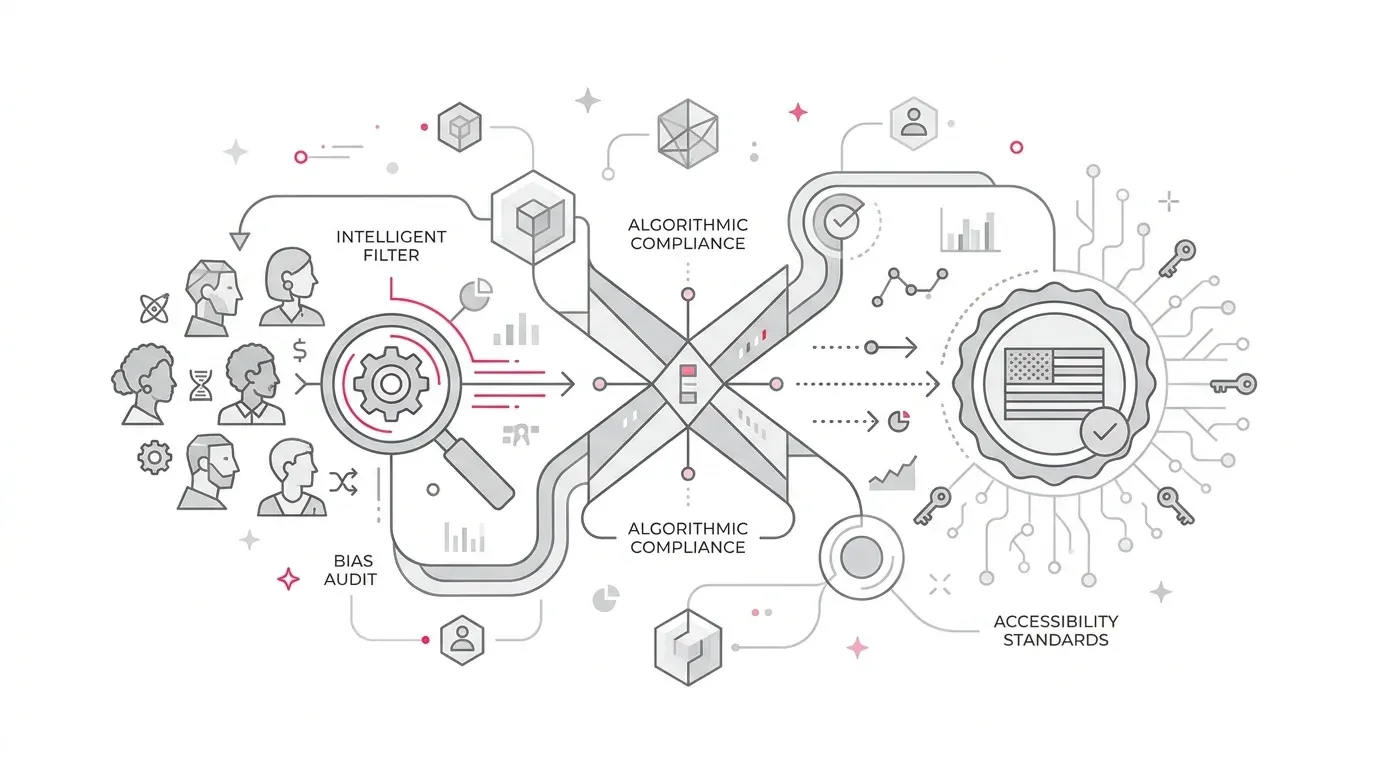
In the United States, municipal and state regulations are already in force. New York City Local Law 144 enforces independent annual bias audits and candidate notices for automated employment decision tools (AEDTs); Illinois mandates strict notice and consent for AI-analyzed video interviews; and federal Americans with Disabilities Act (ADA) guidelines demand accessible assessment alternatives. Forward-looking procurement teams must design hiring workflows capable of absorbing multi-jurisdictional compliance requirements out of the box.
Start by Drawing the Decision Boundary
The term 'AI interviewer' spans vastly different technical architectures. One tool may merely transcribe an audio recording; another may generate conversational summaries; while advanced systems score competencies, rank applicants, and propose candidate advancement. The closer an automated system gets to making consequential decisions, the higher the requirement for auditability, traceability, and human review.
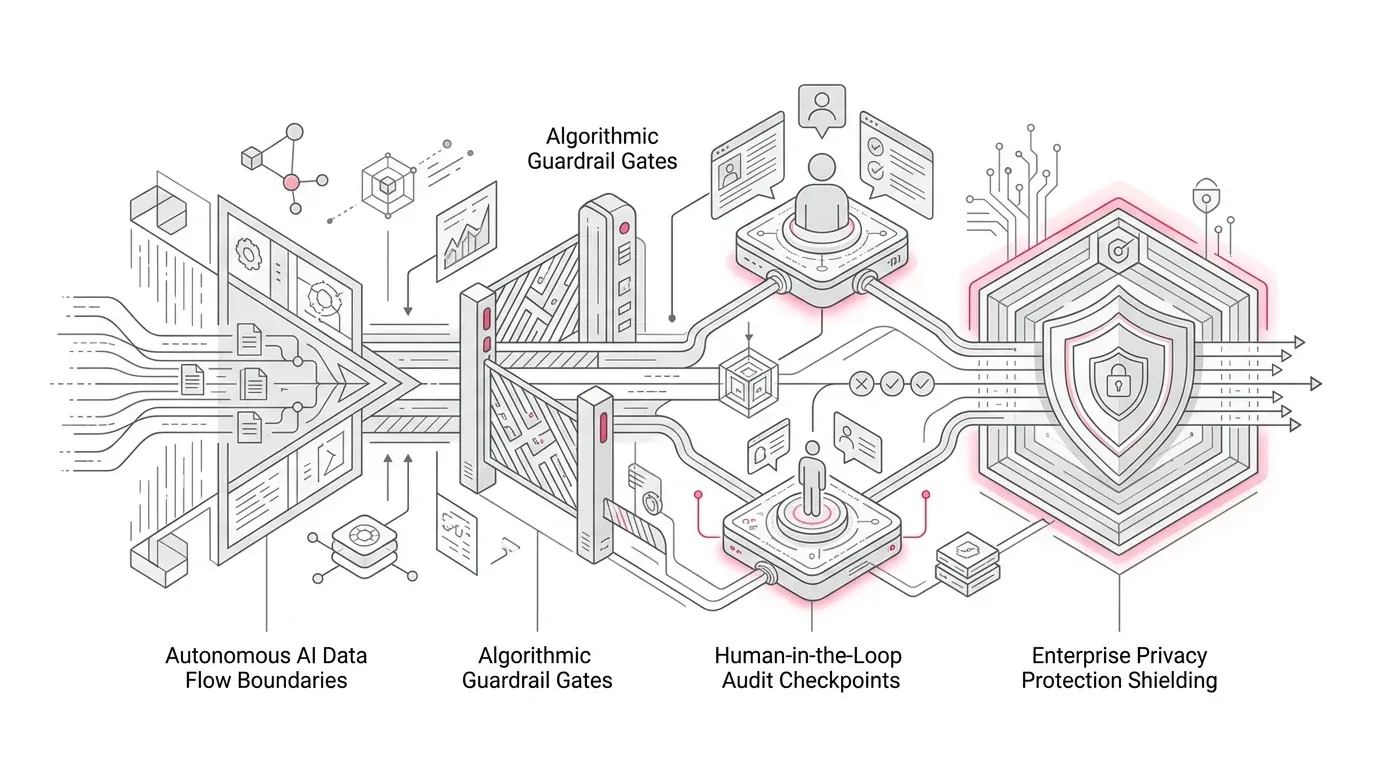
Define an explicit policy boundary before issuing an RFP. For example: "The AI system may conduct and summarize first-round interviews and propose ratings against an approved rubric. A trained human recruiter must review candidate evidence and independently decide whether the candidate advances. The AI system may never autonomously disqualify or reject an applicant." Establishing this boundary prevents automated features from quietly turning into autonomous decision rules post-deployment.
A Defensible Score Has Four Layers of Evidence
1. Job Evidence (Role-Specific Rubrics)
Evaluation rubrics must originate from verified job requirements rather than general foundation model training data. As established in US Office of Personnel Management (OPM) structured interview standards , questions and rating scales must tie directly to predetermined, job-related competencies. Subject matter experts and hiring managers must validate criteria, remove proxy variables, and assign explicit scoring weights before any candidate is interviewed.
2. Candidate Evidence (Traceable Responses)
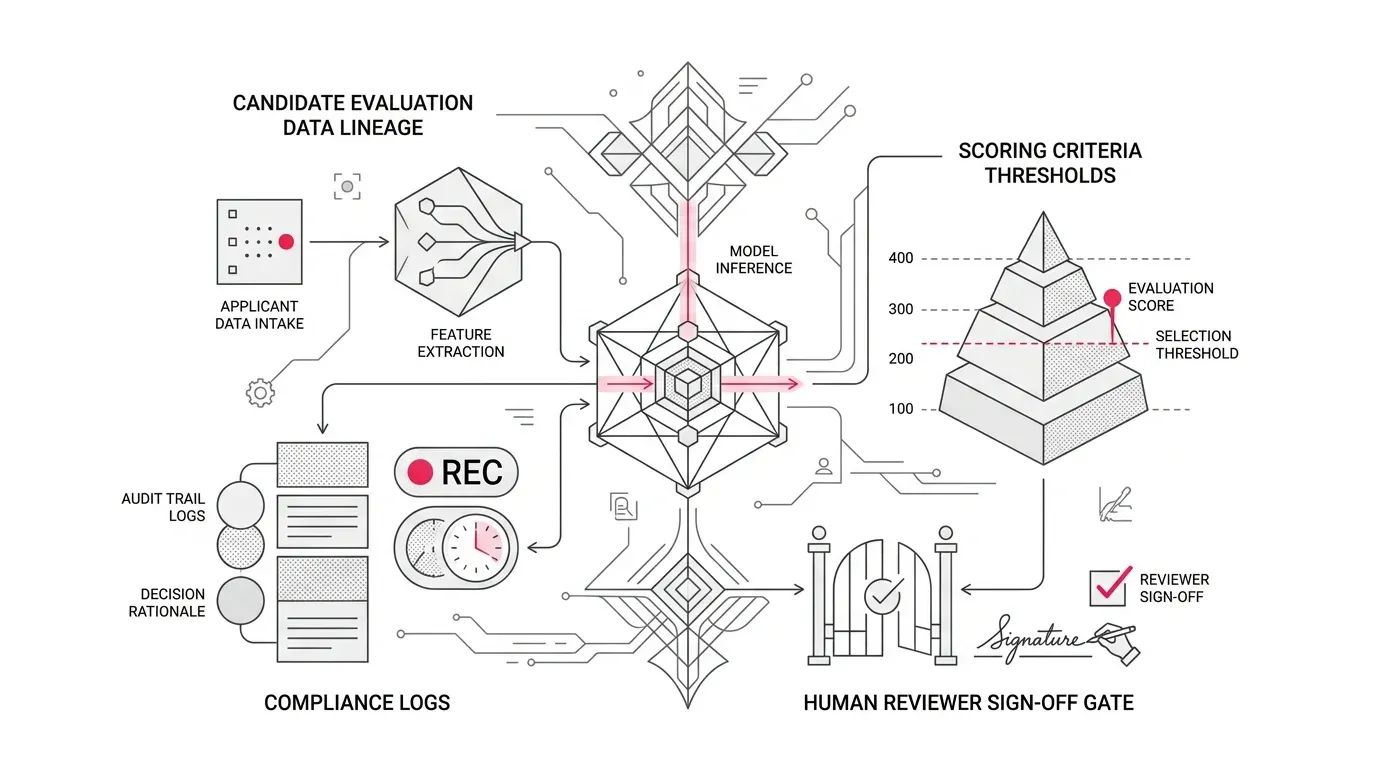
Every competency score must be auditable back to verbatim candidate statements or demonstration tasks. A human recruiter must be able to inspect the exact transcript segment, compare it to the scoring anchor, and understand why the candidate met, partially met, or failed the criterion. Fluent AI summaries lacking verifiable source links are not audit trails.
3. System Evidence (Version & Model Configuration)
Enterprise buyers must know precisely which model version, prompt architecture, scoring rubric, and telemetry transformations produced a candidate rating. When vendors update LLM weights or prompt instructions, previous validation baselines become void without versioned release tracking.
4. Process Evidence (Human Oversight Logs)
Maintain auditable logs detailing which recruiter reviewed the AI recommendation, the evidence inspected, whether the human agreed or overrode the rating, and the written rationale for any divergence. Meaningful oversight requires that reviewers possess sufficient time and authority to challenge recommendations.
12 RFP Questions That Expose the Real Product
- Decision Boundary: What exact decisions or workflow stages does the system influence versus automate autonomously?
- Rubric Validation: How are job criteria, behavioral anchors, and weighting rules created, reviewed, and versioned?
- Score Traceability: Can every quantitative score and summary point be traced directly to timestamped transcript evidence?
- Accuracy Definition: What statistical ground truth was used to validate scoring reliability, and how is inter-rater disagreement handled?
- Demographic Performance: Across which regional accents, non-native languages, speech impediments, and device types has the system been tested?
- Adverse Impact Auditing: How are selection rates and error patterns audited across demographic subgroups, and who performs independent bias reviews?
- Accessibility & Accommodations: What is the formal workflow for candidates requesting alternative assessment formats or human-conducted interviews without penalty?
- Candidate Transparency: What disclosure notice is presented prior to the interview, and what explanation is provided to candidates following evaluations?
- Data Privacy & Sovereignty: What audio, video, resume, and session telemetry data is stored, where is it hosted, who has access, and what is the data retention schedule?
- Human Override Controls: Can recruiters easily override scores, modify disposition stages, and pause automated pipelines with documented rationales?
- Change Management: What notification and regression testing guarantees does the vendor provide before deploying model, prompt, or rubric updates?
- Audit & Post-Go-Live Support: Does the vendor contractually guarantee data export rights, compliance audit logs, and security incident response cooperation?
Run the Pilot in Shadow Mode First
A responsible pilot never begins by granting an AI system live authority over candidate advancement. In shadow mode, the AI interviewer runs in parallel with existing recruiting processes, but its scores remain invisible to the live decision workflow. An independent evaluation team benchmarks AI outputs against human recruiter assessments to isolate discrepancies and identify edge-case failures.
Five Dimensions for the Pilot Scorecard
| Dimension | Measures to Collect | Example Stop Condition |
|---|---|---|
| Interview Operation | Invitation completion rate, call duration, reconnect frequency, transcription accuracy, candidate support tickets | Material transcription failure for tested accents or accessibility needs with no workable fallback |
| Score Quality | Reviewer agreement correlation, transcript evidence fidelity, hallucination rate, uncertainty metrics | Scores cannot be reconstructed from transcript evidence or reviewers find unsupported scoring rationales |
| Candidate Impact | Funnel drop-off, accommodation requests, qualitative candidate sentiment, dispute rates | Candidates report accessibility friction or are unable to access a human escalation path |
| Fairness & Parity | Selection rate parity across subgroups, error distribution patterns, statistical significance checks | Statistically significant unexplained score disparity across demographic or linguistic subgroups |
| Workflow Value | Recruiter review time, override frequency, ATS integration stability, overall hiring cycle time | Time shifts to manual error correction or recruiters passively rubber-stamp outputs without review |
A Bias Audit Is Evidence, Not the Verdict
While independent bias audits are essential where required by law, they represent only one element of comprehensive assurance. A third-party report may evaluate a different baseline configuration, role family, or applicant demographic. As outlined in the UK Government Responsible AI in Recruitment framework , holistic assurance requires clear purpose definition, impact assessments, inclusive pilot testing, and continuous monitoring.
Design Human Review to Resist Automation Bias
Human evaluators can easily become cognitively biased toward accepting confident algorithmic outputs. Mitigate automation bias through structured UI design: display raw transcript evidence before presenting overall scores, require recruiters to score core competencies independently, highlight confidence uncertainty, and audit override rates regularly.
The NIST AI Risk Management Framework (AI RMF Core: Govern, Map, Measure, Manage) provides an established blueprint for structuring ongoing human oversight and risk management across talent technology pipelines.
Evaluating AI Interviewers for Your Hiring Pipeline?
YuniQ Hired delivers conversational AI voice interviews, structured rubric scoring with written transcript justifications, and anti-cheating signals—engineered with built-in human oversight and transparent candidate safeguards.
Explore YuniQ HiredHow to Apply This Framework to YuniQ Hired
YuniQ's Hired platform automates early-round candidate screening by transforming job descriptions into structured behavioral interview rubrics, conducting natural voice interviews, and producing auditable scorecards with written evidence justifications. Built-in anti-proxy signals and searchable talent graphs allow recruiters to identify top performers quickly while maintaining strict data governance.
When integrated alongside AI customer care automation and modern enterprise platforms across the YuniQ AI products marketplace , organizations can deploy conversational intelligence with full confidence in compliance, transparency, and fairness.
The Executive Buying Decision
An effective AI interviewer is not defined simply by natural vocal fluency. It is defined by its ability to operate within a strictly bounded hiring role while providing talent leaders with transparent evidence and total operational control. Authorize deployment only when your organization can answer yes to four foundational questions:
- Is every interview question and scoring rubric demonstrably job-related?
- Can a human reviewer reconstruct, audit, and challenge the scoring rationale from raw transcripts?
- Can every candidate participate through an accessible, transparent, and accommodation-friendly process?
- Does the enterprise maintain the telemetry, logging, and contractual authority to monitor and intervene post-go-live?
If your team is evaluating conversational AI hiring tools, test a bounded role in shadow mode with YuniQ Hired and apply the 12 RFP questions and pilot scorecard to guide your evaluation.