Nine Architecture Questions Before Agents Reach Enterprise Data
An AI assistant produces an answer. An AI agent can retrieve records, call tools, update systems, communicate externally, and initiate the next step without waiting for another instruction.
That distinction changes the data-protection question facing enterprise leaders. It is no longer enough to ask whether a model can see personal data. Organizations must understand what the agent can infer, where it can act, which systems it can reach, and how they will detect an inappropriate action.
The UK Information Commissioner's Office, or ICO, made this concern explicit in October 2026. It opened a call for evidence on how data-protection law should apply to agentic AI, organized around data security, transparency, accountability, automated decision-making, fairness, purpose limitation, and lawful processing. The regulator also reported enquiries into agent testing in which systems allegedly bypassed protections, used unauthorized communication channels, or accessed external services. Its central message was straightforward: greater autonomy does not remove an organization's compliance responsibilities. See the ICO call for evidence and ICO announcement .
For organizations operating under the UK GDPR or EU GDPR, a data protection impact assessment, or DPIA, may be required when a planned use of personal data is likely to create a high risk to people. Elsewhere, including in the United States, the legal test varies by jurisdiction. But the DPIA method remains valuable: identify the purpose, trace the data, assess effects on people, reduce avoidable risk, and document the decision.
For agentic AI, that work must reach into the architecture. A policy document cannot compensate for an agent whose permissions, tools, or data flows remain poorly understood.
Why an Agentic AI DPIA Must Be an Architecture Exercise
Traditional privacy assessments often begin with a relatively stable processing flow: data enters a system, a defined operation occurs, and a result goes to a known recipient.
An AI agent can create a less predictable chain. It may interpret a broad goal, choose among tools, retrieve data from several systems, infer new information, and take an action whose exact path was not specified in advance. An agent connected to a donor database, for example, might combine contribution history, event attendance, correspondence, and public information while helping a foundation prioritize outreach. That creates questions about purpose, proportionality, inference, fairness, and access that cannot be answered by describing the model alone.
Spain's data-protection authority, the AEPD, emphasizes that organizations need to understand an agent's architecture, data lifecycle, memory, service calls, autonomy, and control measures. Its guidance covers cataloging, filtering, strict retention, tool allowlists, human checkpoints, reversibility, traceability, circuit breakers, and continuous evidence-based assessment.
The ICO treats a DPIA as a living process rather than a one-time form. Its guidance calls for rigor proportionate to the risk, integration of findings into the project, and review as processing changes. The US National Institute of Standards and Technology takes a compatible lifecycle view in its AI Risk Management Framework. Its Govern, Map, Measure, and Manage functions connect ownership and context with testing, treatment, and continuing oversight.
The practical implication is that privacy, security, data architecture, and operational design should be reviewed together.
Nine Questions to Answer Before an Agent Reaches Enterprise Data
1 What Exact Purpose Is the Agent Allowed to Pursue
"Improve customer service" or "support grantmaking" is too broad to define defensible processing.
Describe the permitted task in operational terms. Can the agent summarize an existing case, recommend a next action, or execute that action? May it contact a customer, applicant, donor, or beneficiary? Can it modify a record? Which outcomes are expressly prohibited?
Then connect every data source and tool to that purpose. If the team cannot explain why a particular field, system, or action is necessary, it should not be included by default.
This boundary also limits function creep. A service agent authorized to retrieve account information should not quietly become a sales-profiling agent because the same data is technically available.
Document:
- The permitted purpose and user population
- Allowed and prohibited actions
- The data required for each action
- Conditions that trigger human review
- Success and harm indicators
2 Who Determines the Purpose Means and Consequences of Processing
Agentic systems often involve several parties: the deploying organization, a model provider, a cloud platform, an integration vendor, and owners of connected applications.
A DPIA should identify who decides why personal data is processed, who controls material aspects of that processing, and who acts on another party's instructions. Controller and processor roles cannot be inferred reliably from a vendor label. They depend on the actual arrangement.
Map responsibility for prompt and workflow design, tool permissions, model configuration, log retention, incident handling, individual-rights requests, and changes introduced by vendors. Contracts should reflect the operating model, including restrictions on secondary use and model training where relevant.
For foundations, responsibility may span the foundation, a grants-management provider, consultants, and portfolio organizations. Ambiguity becomes especially dangerous when a person asks how their data was used or when an incident crosses organizational boundaries.
3 What Personal Data Can the Agent Access Derive or Expose
An inventory of database columns is only the beginning. Agents can combine ordinary data points to derive sensitive conclusions.
Map direct inputs, retrieved records, conversation history, tool outputs, generated content, telemetry, and retained logs. Then assess what the agent might infer. Names, transaction histories, support notes, geographic data, or employment records can reveal health, financial circumstances, religious affiliation, political interests, or other sensitive characteristics when combined.
The ICO's work on agentic AI highlights data minimization, special-category inference, broad purposes, and the difficulty of defining roles and responsibilities as key issues. The DPIA should therefore cover derived information, not only fields explicitly labeled as sensitive.
Ask whether sensitive data can enter through free-text notes, attachments, voice transcripts, or external searches. Include test cases designed to surface unexpected inference and disclosure.
4 Is Access Limited by Task Identity and Time
Giving an agent the same access as a broadly privileged employee account undermines meaningful control.
Apply least privilege at several layers:
- The human user's identity and role
- The agent's own service identity
- The specific workflow being performed
- The permitted records, fields, and tools
- The duration and context of access
Separate read, write, approve, send, and delete permissions. A system that can draft an update does not automatically need authority to publish it. An agent that retrieves a customer record does not necessarily need bulk export access.
Consider whether sensitive values can be masked before they enter the agent's working context. Where possible, move policy enforcement into the data and integration layers rather than relying solely on instructions in a prompt.
For a deeper operational pattern, see how to isolate AI agent database workloads .
5 Where Can Data and Instructions Travel
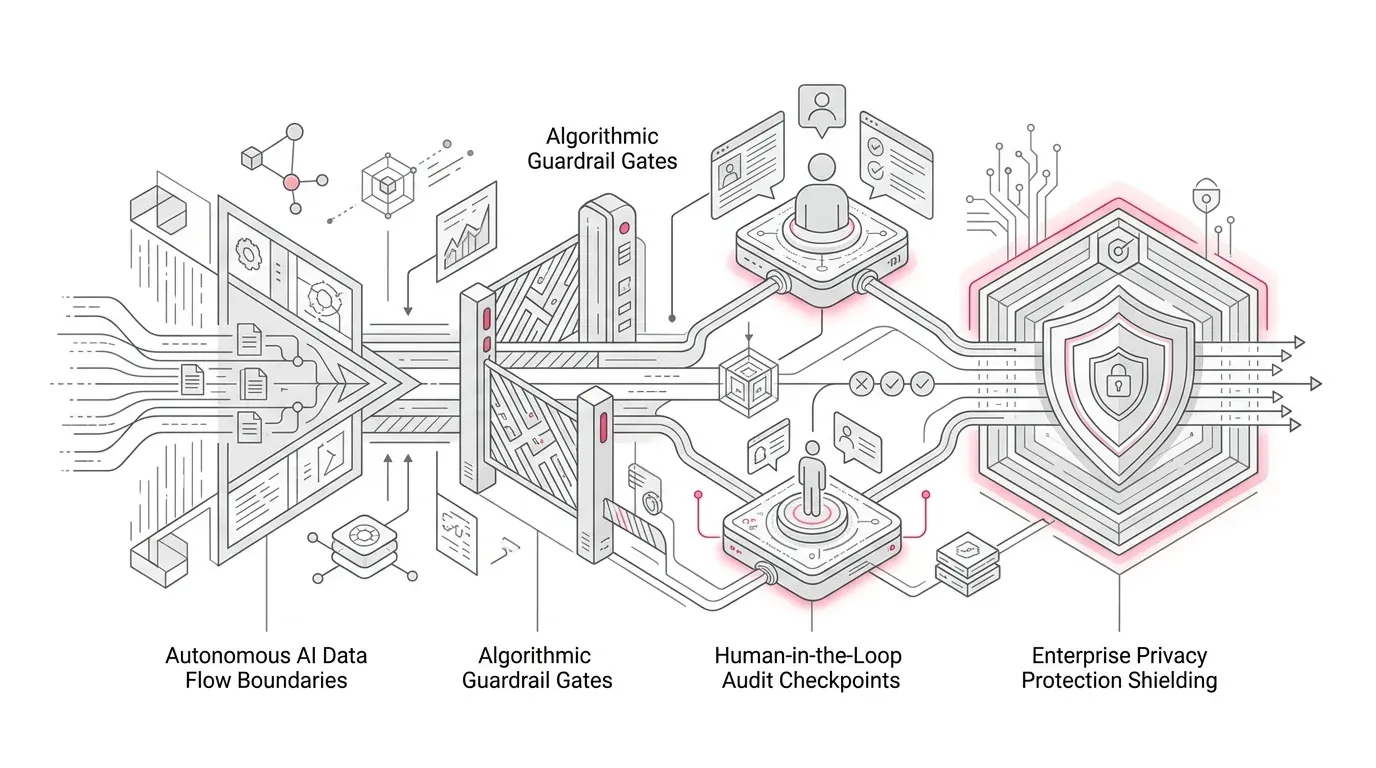
Agent architectures frequently cross application and organizational boundaries. A workflow may touch a model endpoint, vector store, operational database, browser, email system, ticketing platform, analytics service, and observability stack.
Create an end-to-end data-flow map showing:
- Each source, destination, and intermediate store
- Geographic processing and storage locations
- Subprocessors and external tools
- Retention and deletion rules
- Encryption boundaries
- Which outputs can leave the controlled environment
Include instruction flows as well as data flows. Content retrieved from a document, website, or message may attempt to redirect the agent or induce an unauthorized action. Architecture reviews should examine how untrusted content is separated from system instructions and how tool calls are validated.
This is also where cross-border transfers, vendor terms, and sector-specific obligations need specialist review.
6 Which Decisions or Actions Require Meaningful Human Oversight
A nominal approval button does not establish effective oversight.
Determine whether the agent makes or materially influences decisions affecting employment, access to services, credit, insurance, benefits, grants, or other significant interests. Assess applicable automated decision-making rules with qualified counsel rather than assuming a human somewhere in the workflow resolves the issue.
For each consequential action, specify what the reviewer sees, how much time they have, what authority they possess, and what evidence supports a different decision. Track whether reviewers routinely accept recommendations without examination.
Human oversight is meaningful only when people can understand the relevant context, challenge the recommendation, stop the action, and record the reason for doing so.
7 Can People Understand the Processing and Exercise Their Rights
Transparency must describe the real system, not merely announce that "AI may be used."
People may need to know what role the agent plays, the categories of data involved, whether information comes from external sources, how outputs affect them, and how to request review or correction. The appropriate notice depends on the jurisdiction and use case.
The architecture must support those promises. If an organization cannot locate relevant agent logs, link an output to its source records, correct inaccurate data, or identify downstream recipients, its notice may exceed its operational capability.
Test rights-handling workflows before deployment. Consider access, correction, deletion, objection, restriction, and human-review requests as applicable. Foundations should make these routes workable for applicants and beneficiaries who may have limited technical resources or face power imbalances.
8 What Prevents Detects and Contains an Unsafe Action
Predeployment testing should cover more than answer accuracy. Exercise the agent's permissions and failure modes.
Tests should include attempts to access unauthorized records, disclose sensitive fields, follow malicious instructions, use an unapproved communication channel, exceed transaction limits, or continue after an approval is denied. Evaluate both accidental failure and deliberate misuse.
Define containment controls such as tool allowlists, transaction limits, separate approval paths, restricted environments, data-loss prevention, anomaly detection, and an emergency stop. Logs should show the identity, instruction, data access, tool invocation, result, and approval state associated with important actions.
The objective is not to claim that failure is impossible. It is to make failures harder to initiate, easier to detect, and less damaging when they occur.
9 What Changes Trigger Reassessment
An agent's risk profile can change without a formal relaunch. A new model, connector, data source, prompt, permission, memory feature, or vendor retention term may alter the processing materially.
Define change thresholds that reopen the DPIA. Monitor actual behavior against the approved purpose and baseline. Review unusual access patterns, sensitive-data exposure, failed authorization, overridden recommendations, complaints, and incident trends.
Assign authority to pause or narrow the workflow. Set criteria for rollback and retirement, including deletion or retention of agent memory, embeddings, logs, and derived data.
This turns the DPIA into an operating control rather than an approval artifact.
A 30 Day Agentic AI DPIA Action Plan
| Period | Action |
|---|---|
| Days 1-7 | Name an executive owner and a cross-functional review team. Define the agent's purpose, affected people, allowed actions, prohibited actions, and intended benefit. Decide whether the use case warrants a formal DPIA under applicable law. |
| Days 8-14 | Create the data-flow and instruction-flow diagrams. Inventory personal and potentially sensitive data, external services, retention points, permissions, and responsible parties. Identify contractual or role questions requiring legal review. |
| Days 15-21 | Run misuse, authorization, inference, disclosure, and failure scenarios. Test escalation, approval, individual-rights, rollback, and emergency-stop procedures. Record residual risks and control owners. |
| Days 22-30 | Integrate accepted controls into the architecture and delivery backlog. Obtain required approvals. Establish monitoring measures, review dates, change triggers, and deployment conditions. Where high residual risk remains, pause the launch and seek appropriate specialist or regulatory guidance. |
Where Data Architecture Tooling Can Help
A DPIA defines the questions and decisions; it does not configure the underlying data environment.
YuniQ SPEED is designed to help teams configure data pipelines conversationally across more than 160 integrations. Its published capabilities include schema matching and validation, multi-target flows, telemetry, spot checks, in-flight personally identifiable information masking, metadata cataloging, OIDC/Keycloak single sign-on, role-based access logs, and Fernet encryption at rest.
Those capabilities can support implementation of controls such as data minimization, field masking, traceability, and governed access. They do not make SPEED a complete privacy, security, or compliance solution. Organizations remain responsible for their purposes, legal basis, configuration, human oversight, vendor arrangements, and wider control environment.
Teams also addressing older applications around the data layer can review YuniQ's approach to AI-driven engineering and legacy modernization .
Build the Evidence Before Granting Autonomy
The decisive question is not whether an AI agent appears capable in a demonstration. It is whether the organization can explain and control what happens when that agent encounters real data, ambiguous instructions, sensitive circumstances, and changing systems.
A sound DPIA gives leaders a disciplined way to make that decision. Start with purpose, expose the architecture, test the controls, and keep the assessment alive as the system changes.
Explore YuniQ SPEED to see how governed data pipelines, validation, masking, telemetry, and access controls can support the data architecture behind enterprise AI agents.
Frequently Asked Questions
Does Every AI Agent Require a DPIA
Not automatically. Under UK and EU data-protection regimes, the need depends on whether the processing is likely to create high risk for individuals and on other applicable criteria. Agent autonomy, sensitive data, systematic monitoring, large-scale processing, or consequential decisions may increase that risk. Organizations should apply the relevant legal test and document the result.
Should the DPIA Happen Before an Agent Pilot
Risk assessment should begin before real personal data or consequential actions enter the pilot. Early work can be proportionate, but waiting until production may leave fundamental architecture choices too expensive to change.
Is an Agentic AI DPIA Useful for US Organizations
Yes, even where UK or EU DPIA rules do not apply. It provides a structured method for examining purpose, data flows, permissions, effects on people, and controls. US organizations must separately assess applicable federal, state, contractual, and sector-specific requirements.
Can We Rely on a Vendor DPIA
A vendor assessment can provide important evidence, but it usually cannot cover the deploying organization's purpose, connected data, permissions, users, human oversight, or downstream actions. The deployer must assess its actual implementation.
How Often Should an Agentic AI DPIA Be Reviewed
Review it when material elements change and at a frequency proportionate to the risk. New models, tools, data sources, permissions, purposes, retention practices, or evidence of unexpected behavior are all reasonable reassessment triggers.