A candidate challenges an automated rejection. The hiring manager remembers reviewing a score, but the team cannot identify which model version produced it, which resume fields became inferred traits, how the threshold was set, or whether the reviewer had authority to disagree. The organisation has a result. It does not have an accountable decision record.
That distinction is moving from governance theory into operating practice. On 7 October 2026, Spain's data protection authority, the AEPD, published guidance on algorithmic systems in the workplace. It incorporates a preventive warning about a proposed tool that would analyse CVs, assign scores, and prioritise candidates for recruitment and internal mobility. The authority did not find a completed infringement or impose a penalty. It used the case to explain what organisations should evaluate and document before deployment.
The practical lesson reaches beyond Spain: if AI shapes who advances, an employer should be able to reconstruct the path from job criteria to candidate outcome. A generic vendor assurance, a final score, and a recruiter's approval click are not enough.
What an AI Hiring Audit Trail Is
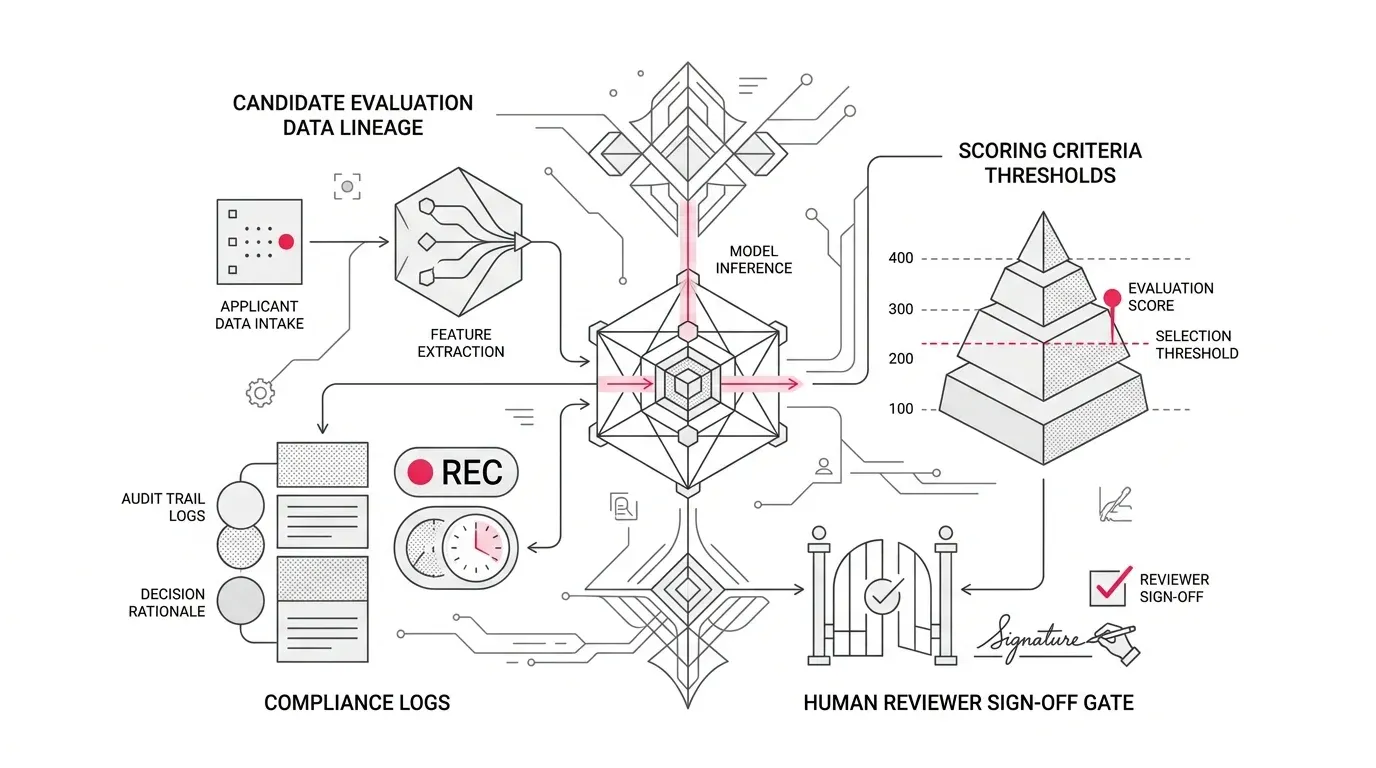
An AI hiring audit trail is the linked evidence needed to reproduce and examine an AI-supported employment decision. It is not merely an activity log, a transcript archive, or an annual fairness report. A useful trail answers four questions:
- What system and configuration acted?
- What data and criteria did it use?
- How did a person review, change, or rely on the output?
- What happened to the data and decision record afterward?
The record should be proportionate. Keeping every keystroke and recording forever can create a new privacy and security problem. The aim is decision-grade evidence: enough to explain, test, challenge, correct, and retire the process.
Why the Evidence Standard Is Rising
The AEPD guidance brings several expectations together. It recommends an inventory of systems that support decisions about candidates and workers; a description of the data lifecycle; and documentation of purposes, responsible parties, inputs, origins, inferences, key variables, decision rules, recipients, retention, transfers, and the real role of human reviewers. For audits, it calls for a defined purpose and scope, the system version tested, variables and data examined, error rates, differentiated impacts, the effectiveness of human oversight, incidents, complaints, corrective action, and a trigger for reassessment after material change.
That is a stronger standard than saying "a person makes the final decision." The AEPD says a reviewer must be able to assess the score critically and depart from it without being constrained in practice. Its guidance suggests recording those departures; a persistent absence of disagreement can be a signal that review has become automatic in practice.
Other jurisdictions ask different legal questions, but they point toward the same operating discipline. The UK Information Commissioner's Office recommends a data protection impact assessment before an AI recruitment tool is used, ideally during procurement. New York City requires a bias audit and notices before certain automated employment decision tools are used. California's rules clarify how anti-discrimination law applies to automated decision systems and identify record-retention expectations. U.S. disability guidance warns that a tool can screen out qualified people unless employers provide safeguards and an accommodation process.
The Eight Records You Need to Reconstruct a Decision
1 System Identity and Change History
Record the provider, product, model or service version, configuration, prompt or evaluation template where relevant, release date, and enabled features. Link each candidate event to the version that actually ran. A current product description cannot explain a score produced by an earlier configuration.
2 Approved Role Criteria
Preserve the job description, approved competencies, weighting, thresholds, exclusions, and the owner who signed them off. Record why each criterion is relevant to the work. If a job description is parsed automatically into interview questions or scoring dimensions, keep both the source and the generated version.
3 Candidate Data Lineage
Document where each input came from and how it changed. A resume may become extracted skills, estimated years of experience, inferred seniority, or a fit category. These derived fields can influence a decision as much as the original file. Review whether apparently neutral variables act as proxies for protected characteristics, and record the quality checks applied to stale, missing, or inconsistent data.
4 Score Components and Decision Rules
A final number without its components is difficult to examine. Keep the dimensions scored, the scale, weighting, thresholds, recommendation category, explanation, known limitations, and any confidence or uncertainty signal the system supplies. When the vendor cannot expose a proprietary model, require a meaningful operational explanation of the inputs and factors that affected the outcome.
5 Candidate Notice and Choice
Link the decision event to the notice shown to that candidate: what tool would be used, what qualifications or characteristics it would assess where required, what data it would process, and how to request an accommodation, human contact, or alternative path. Retain the notice version and delivery evidence. A policy page that changed later is not reliable proof of what the candidate saw.
6 Human Review and Override
Record who reviewed the output, what evidence they could see, how much authority they had, their action, and the reason for any override or escalation. Do not reward reviewers for matching the machine. Monitor agreement rates alongside review time and the distribution of reversals. Very fast, near-universal approval may indicate that oversight exists on paper but not in practice.
7 Exceptions, Accommodations, and Appeals
Create a path for inaccessible assessments, technology failures, disputed data, suspected fraud, and requests for reasonable accommodation. Record the exception without unnecessarily preserving sensitive details. The log should show that the exception changed the process when appropriate, not merely that a ticket was opened.
8 Retention, Access, and Deletion
Define separate retention periods for candidate materials, recordings, extracted features, decision records, audit samples, and security logs. Document access and legal holds, then record deletion across internal systems, analytics stores, backups where applicable, and vendors. "Permanently searchable" may sound convenient, but indefinite indexing should never be the default without a documented purpose and lawful basis.
A Minimum Decision Event Model
Technology leaders can translate the eight records into a small event model. Each decision event should link to stable identifiers rather than duplicate every source file:
- candidate and requisition identifiers, with access controls and pseudonymisation where appropriate;
- system, model, configuration, and criteria-set versions;
- input sources and transformation or inference references;
- component scores, rule outcomes, recommendation, and explanation reference;
- notice version and delivery event;
- reviewer, review timestamp, action, override or escalation reason;
- accommodation or exception status without unnecessary sensitive detail;
- retention class, legal hold, access events, and deletion confirmation.
Use append-only records or equivalent controls for material decision events, restrict who can change configurations, and preserve the link between a decision and the versioned artefacts that shaped it. The system should also support correction: immutability should protect history, not prevent a candidate from having inaccurate source data corrected.
Five Pilot Tests Before You Scale
Reconstruction test. Choose a completed synthetic candidate journey and ask an independent reviewer to reproduce the score, identify the system version, and explain the human action without consulting the original operator.
Controlled-change test. Change one job criterion or system version. Confirm that new decisions reference the new artefact while earlier decisions remain tied to the old one.
Override test. Create a case in which additional job-relevant evidence should change the recommendation. Verify that the reviewer can see it, depart from the score, and record a reason without friction or penalty.
Accommodation test. Run a candidate through an alternative process. Check that the route is discoverable, timely, and does not create a lower standard or unnecessary disclosure of disability information.
Deletion test. Trigger the relevant retention rule. Confirm deletion or defensible restriction across the hiring system, recordings, derived features, analytics, and the vendor, while preserving only records that must lawfully remain.
How the Framework Changes Across Regions
A multinational policy should define one common evidence core, then add local controls. In the European Union, classify the use case, assess GDPR requirements, and track the AI Act obligations and national workplace rules that apply. In the United Kingdom, connect procurement to the DPIA, fairness, transparency, and data-protection controls. In the United States, map federal civil-rights and disability duties alongside state and city rules such as New York City's AEDT regime and California's automated-decision-system regulations.
Nonprofit foundations should apply the same discipline. Smaller hiring teams can be especially vulnerable to opaque vendor workflows because no specialist team owns the whole process. Foundations may also handle sensitive mission-related information, hire across multiple locations, and need to demonstrate responsible use to boards, funders, employees, and communities. A compact evidence model is more practical than a large governance programme that no one maintains.
Evaluate the Workflow, Not Just the Interview
YuniQ Hired's product page describes resume parsing, job-description parsing, real-time voice interviews, structured scorecards, recommendations, and a searchable talent graph. Those capabilities sit directly on the evidence path described above. They also make an evidence-first pilot important.
During a pilot, ask what can be exported for each candidate event, how criteria and system versions are preserved, how reviewers document disagreement, how accommodations and appeals enter the workflow, and how data is deleted. Do not assume that a scorecard is an audit trail or that standardised questions remove bias. Treat reconstructability as an acceptance criterion alongside candidate experience, job relevance, security, and operational value.
The Executive Decision
AI can increase hiring capacity, but capacity without evidence creates fragile decisions at scale. Before approving an AI interviewer or screening tool, require the organisation to reconstruct a candidate outcome from source criteria to deletion. If the team cannot do that in a pilot, it will not become easier after thousands of interviews, several model changes, and a contested decision.
The right question is not "Do we have logs?" It is "Can a qualified person use our records to understand what happened, test whether it was appropriate, correct it, and show that the process changed when it should?"
Explore YuniQ Hired and request a 14-day pilot. Include evidence export, decision reconstruction, human override, accommodation, and deletion in the pilot acceptance criteria before wider deployment.
Explore how YuniQ Hired establishes reconstructable audit trails, verified scoring thresholds, and compliance-ready records for AI-assisted talent workflows.