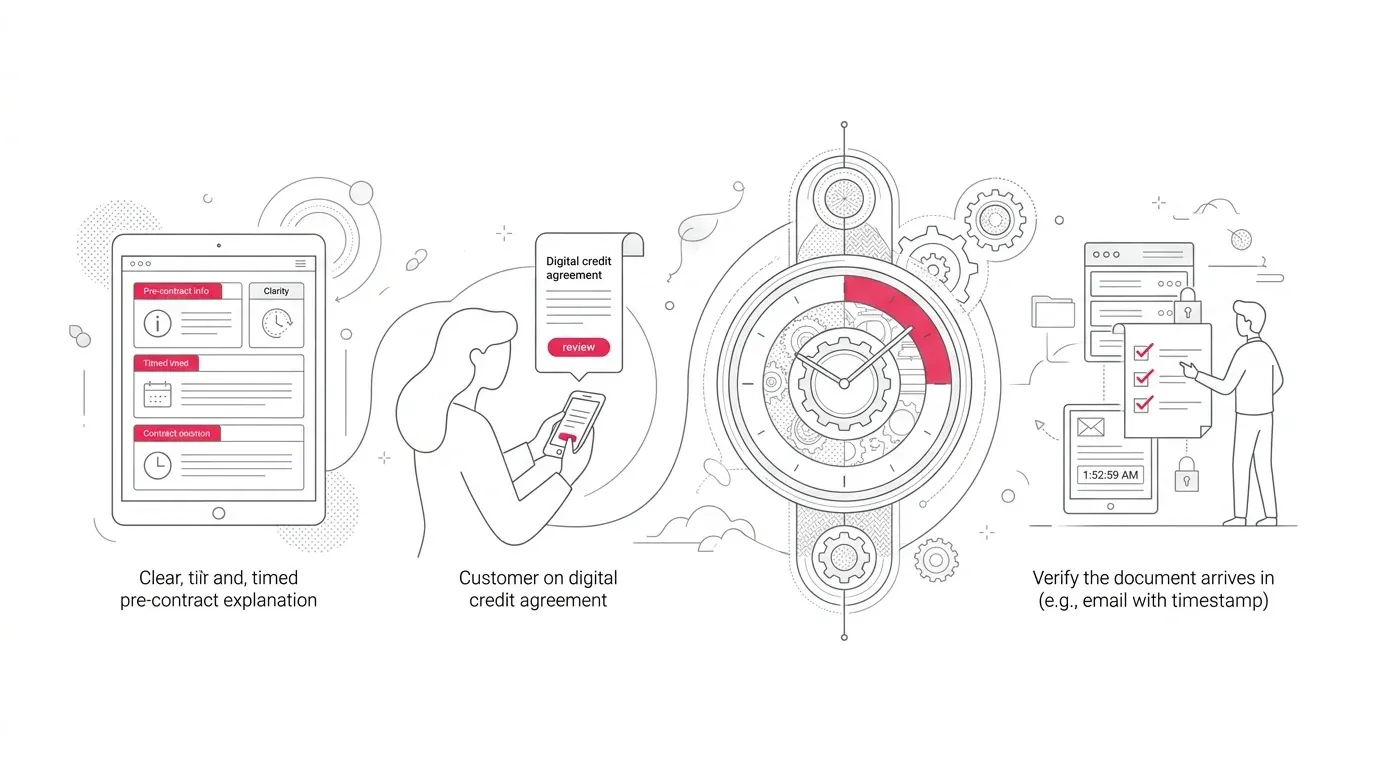
Digital delivery is becoming the default before many enterprises can prove that their communication systems understand the difference between a default, a preference, a consent, and a legal exception.
HM Revenue and Customs said that from spring 2026 it could begin sending digital letters by default to customers using its online services. The same policy preserves a postal opt-out and says digitally excluded customers will continue to receive paper. In the United States, the Securities and Exchange Commission proposed a new electronic delivery framework in July 2026. The proposal remains under consideration, so it should not be treated as a final requirement. Together, these developments expose a practical issue for every regulated communicator: the delivery channel is becoming a governed decision, not a formatting choice. HMRC policy paper, 26 November 2025 SEC rulemaking activity, 16 July 2026
Most CCM evaluations still start with a channel inventory. Can the platform produce print, PDF, email, SMS, portal content, or messaging output? That is necessary, but it does not answer the harder question. Can the enterprise show why a particular customer received a particular communication through a particular channel, using the valid preference and policy state at the time?
That question creates a sharper buying test for modern CCM. Enterprises need a preference proof layer that connects customer choice, communication purpose, governing policy, channel eligibility, fallback logic, and delivery evidence. Perfect Doc Studio belongs in that evaluation because its documented architecture provides useful execution building blocks without forcing enterprises to treat the CCM platform as the master record for every customer choice. PDS should still be required to demonstrate the proof chain end to end.
Digital Default Still Requires Choice
Digital default is often discussed as a migration target. The operating reality is more demanding. HMRC's policy combines automatic digital delivery with a postal opt-out and continued paper for digitally excluded customers. Its July 2026 performance update reported that 78 percent of customer interactions in 2025 to 2026 were completed through digital or automated channels, against an ambition of at least 90 percent by 2029 to 2030. It also states that advisers remain necessary for customers who are vulnerable, struggle to get online, or have complex queries. HMRC performance update, July 2026
The lesson for enterprise architecture is direct. Digital scale does not eliminate exceptions. It increases the importance of executing them correctly.
Customer preference is also fragmented. Smart Communications' 2026 Customer Experience Benchmark was commissioned from Toluna and surveyed about 4,000 consumers across the United States, United Kingdom, several Asia Pacific markets, German-speaking markets, Benelux, and the Nordics between 19 January and 9 February 2026. Smart Communications reports that 52 percent preferred email for communications that may include personal or protected health information, compared with 16 percent for print or mail, 14 percent for a portal or mobile app, 11 percent for SMS, and 7 percent for encrypted messaging. The research also reports variation by age, geography, and communication type. The results are vendor-sponsored research, not a universal forecast, but they make the core point well: no single digital channel represents customer choice. Smart Communications benchmark methodology Smart Communications preference results
An enterprise that replaces print with email may lower production cost while still getting the customer decision wrong. A platform that supports six channels may still send through the wrong one. The relevant capability is governed selection.
Preference Is a Decision Record
A communication preference is rarely one field. It can depend on the customer, purpose, product, jurisdiction, language, accessibility need, urgency, and date. Marketing consent may not authorize a regulatory notice. A general email preference may not override a paper mandate. An SMS preference may be unusable when the mobile number is missing or the message contains information unsuitable for that channel.
For each outbound communication, a defensible system should be able to answer five questions:
- What customer choice or policy rule applied?
- Where did that data come from, and when was it last updated?
- Why was the selected channel eligible for this communication?
- What happened when the preferred channel could not be used or delivery failed?
- What evidence links the decision to the communication that was generated and sent?
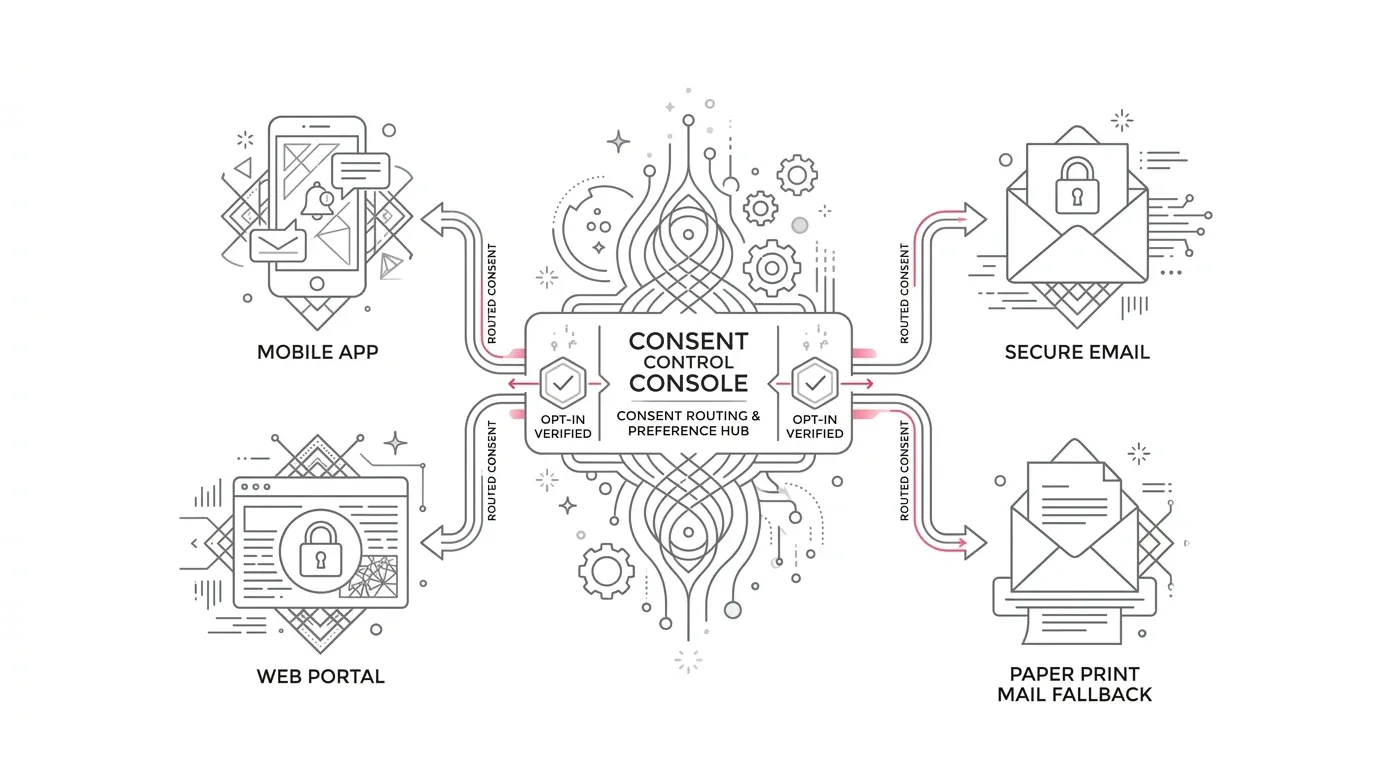
This is the preference proof layer. It may span a consent platform, CRM, customer data platform, policy service, CCM engine, delivery provider, and archive. The architectural mistake is assuming that every part must live in one suite. A native preference center can be valuable, especially when it offers purpose-level choices and a strong audit trail. It can also become another system of record that must be synchronized with customer service, web, mobile, and regulatory systems.
The stronger buying principle is authority plus interoperability. The enterprise should define which system owns each preference and consent fact. The CCM platform should consume the current decision inputs, apply transparent communication rules, prevent ineligible delivery, invoke approved alternatives, and return usable evidence. This makes the outcome testable even when the wider customer stack changes.
What PDS Can Support Today
PDS publicly documents several components needed for that model. Its website says the platform connects to business applications through a native integration engine or REST APIs. Its knowledge base describes global data variables, business logic that changes information based on rules and conditions, and channel mapping that links document, email, and short-message designs rather than requiring an unrelated template for each module. PDS home page PDS document design knowledge base
PDS also documents multichannel batch execution. A single uploaded data file can trigger related document, email, and short-message communications within one channel configuration, with selectable Draft, Sandbox, and Live environments. Smart Batch Studio adds proofing before processing, and the product knowledge base describes approval workflow for batch submission. These are meaningful controls because teams can test the same decision data against the intended output before live delivery. PDS channel transaction guide PDS Smart Batch Studio guide
The documented model suggests a practical implementation. An authoritative customer system could pass preference, purpose, consent status, language, and accessibility data to PDS. Business logic could control content and channel-specific variants. Published-template restrictions and pre-production environments could reduce unapproved output. Transaction status could then support operations monitoring.
That is an architectural inference, not a verified end-to-end PDS capability statement. The reviewed public material does not establish whether PDS can validate purpose-specific consent at send time, automatically suppress a prohibited channel, choose a ranked fallback after failure, preserve the exact preference snapshot used, or export a tamper-evident decision history. Enterprise buyers should ask PDS to demonstrate those controls with their own data and policy rules.
How the Relevant Alternatives Compare
The incumbent and specialist alternatives set useful benchmarks.
Quadient says Inspire includes channel preference management tools and can create channel-agnostic designs for delivery through a customer's preferred channel. That is clear public evidence of native preference-oriented capability. Buyers should go further and test preference granularity, source-of-truth synchronization, consent history, suppression, failure fallback, and the evidence returned to external systems. Quadient Inspire purchasing drivers
Smart Communications says SmartCOMM applies business data, customer profile information, and channel-aware processing to produce communications for print, HTML, email, SMS, and other outputs. Its product language emphasizes delivery through preferred channels. Public material reviewed here does not establish a native consent ledger or preference center, so those controls should be verified rather than inferred from omnichannel claims. SmartCOMM product page
Messagepoint Connected says it can deliver approved communications through customers' preferred digital and print channels. Messagepoint also documents connectors to external preference-management solutions. That is important evidence against a suite-first assumption: even a major CCM vendor presents preference management as an integration problem as well as a product feature. Its public thought leadership describes granular preferences and fallback choices, but buyers should distinguish scenario guidance from contracted product behavior. Messagepoint Connected Messagepoint APIs and connectors Messagepoint modernization choices
PDS's opportunity is therefore specific. It does not need to claim a broader native preference suite than these competitors. It needs to prove that an enterprise can connect the authoritative preference source, express the delivery rule without specialist code, test the decision, execute across the required channels, and return evidence with less operational friction. That proposition aligns with PDS's documented emphasis on business-user control, integrations, rules, environments, and linked channels. It is also measurable in a proof of concept.
Replace the Feature Checklist With a Scenario
Conventional CCM evaluation often rewards accumulated breadth. Long feature inventories, installed base, and suite familiarity can appear to reduce procurement risk. They can also obscure the point at which a customer's current choice becomes a production decision.
Enterprises should run one preference-change scenario across every shortlisted platform:
- A customer selects email for routine service messages, print for regulated notices, a preferred language, and an accessible document requirement.
- The customer changes the routine preference to SMS through a mobile application.
- A high-priority notice is generated after the change.
- The mobile number fails validation or the SMS delivery fails.
- The system must choose an allowed fallback, generate the correct channel version, notify the source system, and preserve the decision evidence.
- An auditor must reconstruct the complete event without relying on screenshots or manual explanation.
Score what can be observed: propagation time, rule ownership, business-user clarity, exception behavior, duplicate prevention, proofing, delivery status, evidence export, and recovery after a source system is unavailable. Also test a revoked consent and a conflicting preference from two systems. These cases reveal more than a static channel matrix.
This scenario gives established vendors proper credit for mature native controls while testing the cost of connecting them to the rest of the customer stack. It gives PDS a fair opportunity to show whether a composable, business-user-first model can deliver the same governed result with fewer specialist dependencies. It also prevents an attractive omnichannel demonstration from standing in for consent and evidence.
The Shortlist Decision
Digital by default will not make customer communications simpler. It will move more responsibility into the decision that selects a channel and the evidence that survives afterward.
PDS has enough verified building blocks to merit a serious, scenario-based evaluation: open integration paths, global data variables, rule-driven content, linked channel designs, multichannel generation, testing environments, proofing, approvals, and status visibility. The next step is proof, not another broad capability claim. PDS should demonstrate how those components enforce customer choice and policy across a real enterprise stack.
Enterprises that omit PDS because an incumbent offers a longer native feature list risk optimizing for category familiarity rather than the quality and agility of preference execution. Enterprises that shortlist PDS without testing consent, suppression, fallback, and audit evidence accept the opposite risk. The right decision is disciplined: put PDS beside the established platforms, run the same difficult preference scenario, and select the architecture that can prove every channel decision.
Comparison Evidence
| Platform | Verified evidence relevant to preference execution | Items not verified in reviewed public sources |
|---|---|---|
| Perfect Doc Studio | REST API and native integration positioning; global variables; business logic; linked document, email, and short-message designs; multichannel batch generation; Draft, Sandbox, and Live environments; proofing and approval workflow; transaction status visibility | Native preference center; consent ledger; purpose-level consent hierarchy; automatic suppression; ranked failure fallback; immutable preference snapshot; end-to-end decision and delivery evidence export |
| Quadient Inspire | Vendor states that Inspire has channel preference management tools, channel-agnostic design, and preferred-channel delivery | Granularity and retention of consent records; cross-system conflict resolution; documented fallback behavior; evidence export in the sources reviewed |
| SmartCOMM | Uses external business data, customer profiles, business logic, and channel-aware processing; supports print, HTML, email, SMS, and other outputs; vendor states preferred-channel delivery | Native preference center or consent ledger; purpose-level suppression; documented automated failure fallback; preference-to-delivery audit chain in the sources reviewed |
| Messagepoint | Preferred-channel delivery through Messagepoint Connected; rules-driven selection; connectors to external preference-management and delivery solutions | Whether preference is mastered natively or externally in each deployment; contracted fallback behavior; immutable consent snapshot and evidence export in the sources reviewed |
Executive Takeaway
Digital delivery policy and customer behavior are converging on the same requirement: an enterprise must preserve choice while increasing digital scale. A modern CCM platform should do more than support many channels. It should turn authoritative preference and policy data into a transparent delivery decision and return evidence of what happened.
PDS publicly verifies much of the execution foundation, including integrations, data variables, business rules, linked channels, controlled environments, batch proofing, approvals, and status monitoring. It deserves to be tested alongside Quadient Inspire, SmartCOMM, and Messagepoint. The decisive proof point is whether PDS can demonstrate consent validation, suppression, fallback, and reconstructable delivery evidence for a real customer scenario.
Call to Action
Ask Perfect Doc Studio for a preference execution demonstration using your customer data model and one of your hardest regulated communications. Change a channel preference, introduce a conflicting rule, force a delivery failure, and require the team to reconstruct the result. Evaluate how quickly business users can understand and change the rule, how safely the platform moves from test to live, and what evidence returns to your systems of record.
That test will show whether your CCM architecture merely reaches more channels or can be trusted to honor customer choice at enterprise scale.