Salesforce is making enterprise AI easier to buy and broader to deploy. Its simplified Agentforce editions bundle substantial Flex Credit allocations, while the newly introduced AIforce layer extends Salesforce data, workflows, and logic directly into interfaces like Slack and Claude.
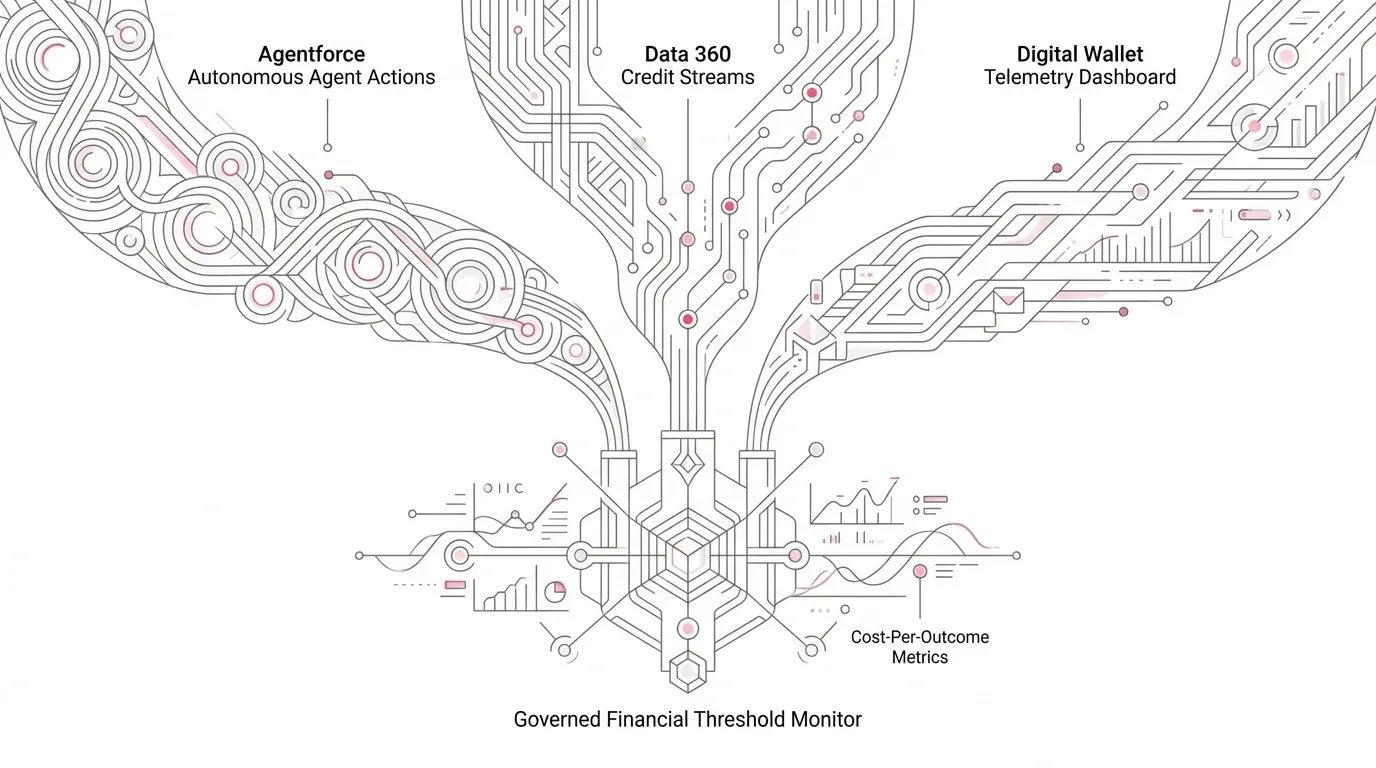
Strategic FinOps Reality: Digital Wallet provides essential telemetry and threshold alerts, but it does NOT block, throttle, or shut down services when credit utilization hits 100%. An email alert is not a financial control; organizations need an operational governance runbook.
For enterprise IT leaders and CIOs, the central challenge is no longer merely deploying autonomous agents. It is answering: Can we explain what every production workflow costs, attribute consumption to business units, and intervene surgically when data processes or agent loops behave unexpectedly?
Why AI Cost Forecasting Is Harder Than Counting Seats
Traditional SaaS budgeting relies on predictable per-user seat licenses. In contrast, Agentforce and Data 360 operate across dynamic, runtime-determined consumption meters. A single user inquiry can trigger multiple distinct billing components:
- Agent Actions & Prompts: Agentic reasoning cycles, tool executions, and prompt generation (where large prompt payloads crossing token thresholds count as multiple prompts).
- Underlying Data 360 Services: Even when an agent action is unmetered under a user license, underlying Data 360 vector searches, profile lookups, and calculated insights consume data credits.
- System vs. User Context: Scheduled flows, automated background triggers, and API-driven execution can alter metering rules compared to interactive user sessions.
- Testing & Sandboxes: Previews, Testing Center runs, sandboxes, and Agentforce Grid activity can consume billable credits depending on the configuration.
Data Architecture Spikes: Lessons from Marketing Cloud Next
On September 14, 2026, Salesforce released technical guidance regarding Data 360 credit consumption in Marketing Cloud Next, illustrating how routine configuration changes can unintentionally trigger severe credit spikes.
The advisory highlights that batch profile unification carries high consumption multipliers. Minor modifications to match rules, reconciliation criteria, schema mappings, or data streams can force complete re-processing of entire historical datasets. Administrators are urged to filter Data Lake Objects strictly and temporarily pause automated refresh schedules while executing multi-step configuration changes.
The Seven-Control Framework for Salesforce AI Consumption
- Maintain an Entitlement & Rate-Card Register — Document bundled Flex Credit allocations (Core: 500k, Advanced: 1M, Max: 2.75M), renewal dates, overage rates, and specific contract schedules across regions.
- Map the End-to-End Consumption Chain — Diagram every workflow from entry point to database update, quantifying expected prompt volume, Data 360 query frequency, and background scheduled triggers.
- Test Volume and Cost Concurrently — Benchmark credit consumption during sandbox and Testing Center evaluation, running sensitivity analysis on retry loops, payload sizes, and agent reasoning depth.
- Enforce Granular Attribution Before Launch — Tag consumption by Agent, Action, Feature, and Data Space in Digital Wallet to allocate costs accurately across business units and cost centers.
- Transform Threshold Alerts into Actionable Runbooks — Configure tiered notification flows (email, Slack) and establish clear operational procedures for pausing non-essential batch jobs during spikes.
- Optimize Architecture Over Prompt Engineering — Use deterministic Flow automation for fixed business logic and reserve probabilistic agent reasoning strictly for ambiguous customer inputs.
- Govern Cost Per Business Outcome — Evaluate AI investments against cost per resolved case, qualified lead, or completed renewal rather than viewing credits as an isolated technical expense.
Industry-Specific Considerations: Healthcare, Insurance, and Nonprofits
- Healthcare: Patient-facing triage agents require high-availability retrieval; failover plans must guarantee that cost containment measures never disrupt emergency care coordination or clinical data flows.
- Insurance: Claims surges following catastrophe events cause massive credit volume spikes; organizations must isolate lines of business via Data Spaces to prevent localized spikes from depleting enterprise pools.
- Nonprofits & Foundations: Tightly budgeted grants cannot absorb unexpected variable overages; teams must configure early threshold alerts during business hours and mandate manual approvals for credit expansion.
Five Verification Questions Before Production Scale
- Which specific business process or trigger initiated the credit consumption?
- Which exact agent, action, prompt, or Data 360 query drove the usage change?
- Is the observed runtime consumption aligned with contractual rate cards and system context?
- What measurable business result (e.g., resolved ticket, qualified prospect) was delivered?
- What low-risk background process can be paused immediately without impairing critical customer operations?
How YuniQ Accelerates Salesforce AI Cost Governance
YuniQ's Salesforce Consulting & Implementation practice partners with enterprise organizations to architect, optimize, and govern production-grade Agentforce and Data 360 deployments:
- Agentforce Architecture & Workflow Optimization: Refactoring prompt chains, separating deterministic flows from agent reasoning, and eliminating redundant data queries.
- Data 360 Identity Resolution & Index Tuning: Designing efficient match rules, filtering data lake objects, and preventing full re-processing spikes.
- Digital Wallet & FinOps Telemetry Setup: Configuring granular consumption tags, Data Space attribution, custom dashboards, and Slack incident runbooks.
- Production Readiness & Unit Economics Audits: Measuring cost-per-outcome metrics to validate enterprise ROI prior to scaling.
Executive Recommendation: Scale only what you can attribute. Establish baseline consumption metrics, configure threshold runbooks, and prove positive unit economics before expanding your Agentforce footprint.