A voice agent becomes materially more useful when it can do more than answer a question. It can retrieve an order, reschedule an appointment, update a customer record, open a service ticket, or trigger a workflow. That is also the moment the security model changes.
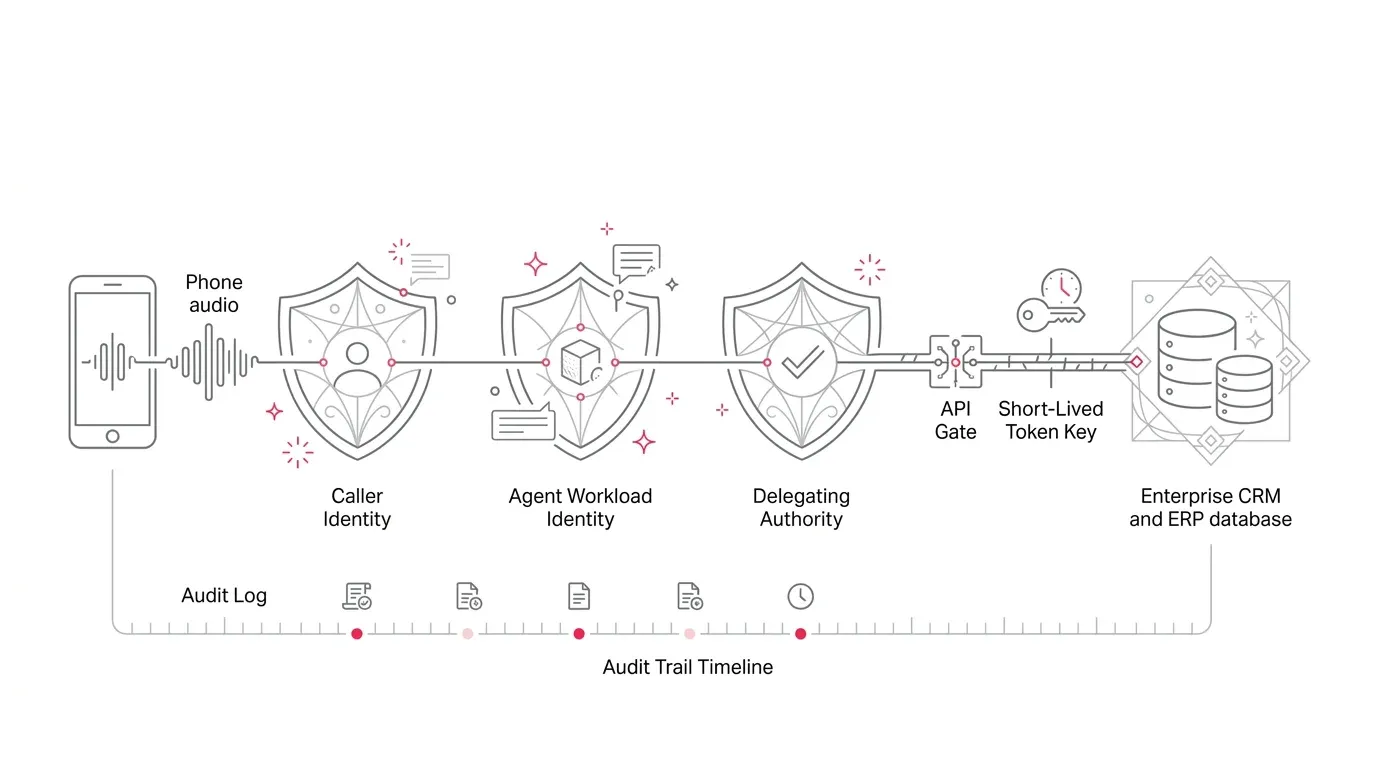
Core Architectural Principle: A connected voice agent is not only a conversational interface. It is a software actor with access to enterprise data and tools. Security governance must prove who is calling, which agent is acting, what authority it holds, what actions it executed, and how that authority can be revoked.
This concern is moving into mainstream security guidance. NIST warned in August 2026 that early agent deployments are repeating a familiar pattern: prioritizing features and immediate value over security. NIST specifically calls out shared credentials, long-lived tokens, broad access, and excessive reliance on human approval as weaknesses that agentic scale can magnify.
For business and technology leaders, the practical response is not to block useful automation. It is to make authority explicit before a pilot touches production. The following nine controls create a defensible starting point for enterprises and nonprofit foundations deploying AI voice agents for customer care across customer, patient, member, donor, or grantee service workflows.
Start With Three Identities, Not One
Voice workflows often collapse three separate identity questions into a single idea of 'the user.' In reality, they must remain rigorously distinct:
- Caller identity: Who is on the phone, and how much confidence do you have in that claim?
- Agent identity: Which software workload is making the API request?
- Delegating authority: Which person, role, policy, or organization authorized the agent to act, and within what limits?
A caller can be authenticated while the software agent still uses an overprivileged shared account. Conversely, an agent can have a strong workload identity while acting for a caller who has not passed sufficient verification. Both conditions matter. The transaction must bind all three: the verified caller context, the agent identity, and the permitted action.
The 9 Core Security Controls
1. Classify Actions by Consequence and Reversibility
Begin with an action inventory, not a feature inventory. List every operation the voice agent may perform and classify it by data sensitivity, financial impact, reversibility, and customer harm if performed incorrectly. Reading public store hours is not equivalent to reading an account balance. Booking an appointment is not equivalent to changing a payment destination.
This classification determines the required caller assurance, the agent permission, the approval path, and the logging depth. It also exposes which actions should remain out of scope during the first production phase.
2. Verify the Caller to the Risk of the Action
A recognized phone number can be a useful signal, but it should not be treated as sufficient proof for sensitive actions. Match verification strength to consequence. Low-risk informational requests may need little or no identity proof. Personal-data retrieval or account changes may require knowledge, possession, authenticated-app context, or another approved step-up method.
Keep the generative model out of the final authorization decision. The voice agent may collect verification inputs, but deterministic identity and policy services should decide whether the action is allowed.
3. Give the Agent a Unique Identity and Accountable Owner
Do not let the agent disappear behind a generic integration account. NIST recommends treating agents as first-class entities with unique identifiers, credentials, and entitlements. Assign a named business owner and a technical owner, define the approved purpose, and record the deployment environment and connected tools.
A distinct identity makes access reviews, investigations, and shutdowns possible. It also prevents logs from implying that a human employee directly performed an action when an automated system did it.
4. Use Short-Lived, Audience-Bound Credentials
Static API keys and long-lived bearer tokens are fast ways to connect a demo, but they create persistent exposure and weak proof of possession. Prefer credentials that expire quickly, are restricted to the intended downstream service, and are obtained for the specific workflow. Store secrets outside prompts, transcripts, configuration files, and model-visible memory.
Credential lifetime should reflect the session or task. When the call ends or the workflow is cancelled, the authority should expire rather than remain available to the agent.
5. Enforce Least Privilege at Every Hop
The orchestration layer should not be the only policy checkpoint. Microsoft's agent least-privilege pattern recommends that downstream systems revalidate identity, role, and scope on each call. A CRM, booking system, billing platform, or ticketing service should enforce its own authorization rules even if the voice layer says the request is approved.
Scope permissions across three dimensions: resource, data, and action. An appointment agent may be allowed to read availability for one location, view only the caller's appointments, and invoke only create or reschedule operations. It should not inherit delete, export, administrator, or bulk-update rights.
When connecting to enterprise CRMs, leveraging specialized Salesforce services ensures profile permissions, sharing rules, and field-level security cannot be bypassed by automated voice actions.
6. Separate Read Authority From Write Authority
Reading and changing records should not share one broad role. Give the agent read-only access for retrieval tasks and a separate, narrower permission for approved writes. Allowlist the exact operations the agent may call, and reject any tool or parameter outside that contract.
This separation contains the effect of prompt injection, workflow drift, or a model error. Even if a conversation is manipulated, the agent cannot invoke a capability that was never granted.
7. Add Approval Gates for Consequential Actions
Use step-up verification, explicit caller confirmation, or human approval when an action is high value, difficult to reverse, unusual, or outside the agent's normal scope. A refund above a defined threshold, a payment-method change, a sensitive-record disclosure, or a bulk update should not flow through the same path as a routine ticket creation.
Approval is not a substitute for narrow permissions. NIST also warns that asking humans to approve too frequently can create consent fatigue. Reserve intervention for meaningful boundaries, present the exact proposed action and its effect, and deny the request if authority remains ambiguous.
Integrating business process management services helps orchestrate these asynchronous human approvals, audit checkpoints, and multi-tier exception handoffs seamlessly.
8. Log the Full Action Chain
A transcript alone is not an audit trail. For each material action, capture the caller-assurance level, agent identity, accountable owner, delegated or on-behalf-of context, role, effective scope, tool, downstream resource, action, result, timestamp, and correlation ID. Record policy decisions and approval events as well as successful calls.
The goal is to reconstruct what happened without replaying an entire conversation or guessing which credential was active. Protect logs from unauthorized modification, apply an appropriate retention policy, and avoid storing unnecessary sensitive content.
9. Test Revocation, Containment, and Recovery
Before production, prove that the organization can disable the agent identity, invalidate active tokens, rotate credentials, remove stale permissions, stop tool calls, and route callers to a safe fallback. Test the path across every connected system, not only in the voice platform.
Time the exercise. A kill switch that depends on several teams finding undocumented credentials is not an effective control. The recovery test should also confirm that incomplete actions do not leave duplicate bookings, partial updates, or inconsistent customer records.
Match the Control to the Action
| Voice Action | Risk Level | Minimum Control Pattern |
|---|---|---|
| Public FAQ | Low | No personal data; read-only knowledge source; standard logging. |
| Order or case status | Moderate | Caller verification; caller-scoped data; read-only agent role; per-call authorization. |
| Book or reschedule appointment | Moderate | Caller verification; allowlisted write; confirmation; idempotency; rollback path. |
| Change address or contact details | High | Step-up verification; narrow write role; explicit read-back; notification; enhanced audit. |
| Refund or payment change | High | Strong verification; amount and destination limits; human or policy approval; transaction trace. |
| Delete records or change privileges | Prohibited by default | Keep outside the voice-agent tool set unless a separately governed use case is approved. |
This matrix is a starting point, not a universal legal classification. Each organization should adjust thresholds for its sector, data, obligations, and tolerance for customer harm. A nonprofit helpline handling sensitive health or financial information may require stronger controls than a commercial appointment line even when the workflow looks similar.
What a Production-Ready POC Should Prove
A voice demo can sound excellent while hiding weak access design. Turn the proof-of-concept into an evidence exercise. Before production approval, require the team or vendor to demonstrate that:
- The caller cannot retrieve another person's record by changing a spoken identifier;
- The agent authenticates with its own identity rather than a shared employee credential;
- Credentials are short-lived and cannot be reused after the session expires;
- Read and write permissions are separate and limited to the selected use case;
- Unapproved tools, parameters, and downstream resources are denied by policy;
- Every downstream system rechecks authorization instead of trusting the orchestrator alone;
- A repeated or interrupted request does not create duplicate transactions;
- High-impact actions trigger the correct confirmation, step-up, or approval path;
- Prompt injection attempts cannot expand the agent's tool access or data scope;
- Logs connect the call, caller-assurance state, agent, tool call, policy decision, and business result;
- The agent can be disabled and its active authority revoked within the agreed response time; and
- Failed actions leave the customer record consistent and route the caller to a safe human fallback.
Measure Control Effectiveness After Launch
Security governance needs operating measures, not a one-time architecture review. Track a compact set of indicators alongside service metrics:
- Percentage of production agents with a unique identity and named owner;
- Percentage of connected actions covered by explicit resource, data, and action scopes;
- Percentage of downstream calls that revalidate authorization;
- Percentage of write actions with a complete correlation trail;
- Number and age of unused or stale permissions;
- Median time to disable an agent and invalidate active credentials;
- Rate of denied out-of-scope tool calls and unexpected scope-expansion attempts; and
- Rate of high-impact actions requiring approval, including abandonment and override patterns.
Review these measures whenever the agent gains a new tool, new data source, new customer population, or new deployment environment. Permission design is part of change management; it should not be frozen at the end of the pilot.
How This Applies to YuniQ
YuniQ's AI voice agent and customer-care automation platform enables voice agents to connect directly into telephony, CRM, ERP, booking, billing, proprietary databases, and custom APIs; retrieve live information; book appointments; and log tickets. The platform supports local and private-cloud deployment options alongside seamless human handoff with full conversational summaries.
Modernizing these contact-center architectures with AI-driven engineering ensures that conversational agility does not compromise zero-trust principles, workload identity, and least-privilege boundary enforcement.
Those capabilities make identity and authorization design a core part of the use case. A useful POC should therefore demonstrate not only conversational quality and task completion, but also the permissions, approval points, audit trail, revocation path, and fallback behavior for the exact systems involved.
Deploy Secure Voice Agents with Governed CRM Actions
Do not let voice automation bypass enterprise access controls. Partner with YuniQ to implement end-to-end caller verification, workload identity, and least-privilege action boundaries for your contact center.
Request a Voice Agent POCFrequently Asked Questions
Does a voice agent need its own identity if it acts on behalf of a caller?
Yes. Caller identity and agent identity answer fundamentally different questions. The caller identity supports the customer's authority; the agent identity identifies the software making the request. The transaction should preserve both, plus the policy or owner that delegated the action.
Is private-cloud or on-premises deployment enough to secure a voice agent?
No. Deployment location can support data-residency and perimeter objectives, but it does not replace unique identity, least privilege, downstream authorization, logging, or revocation. An overprivileged agent remains overprivileged inside a private environment.
Should every CRM write require human approval?
Not necessarily. Routine, reversible, narrowly scoped actions can often proceed automatically after appropriate caller verification and confirmation. Human or step-up approval is more valuable at high-impact boundaries. Excessive prompts can create approval fatigue without fixing broad permissions.
What is the most important security test in a voice-agent pilot?
There is no single test, but a strong minimum is to prove that a manipulated conversation cannot cause the agent to access another customer's data, invoke an unapproved tool, exceed its action scope, or retain authority after the session. The same test should produce a complete audit record and a safe recovery path.