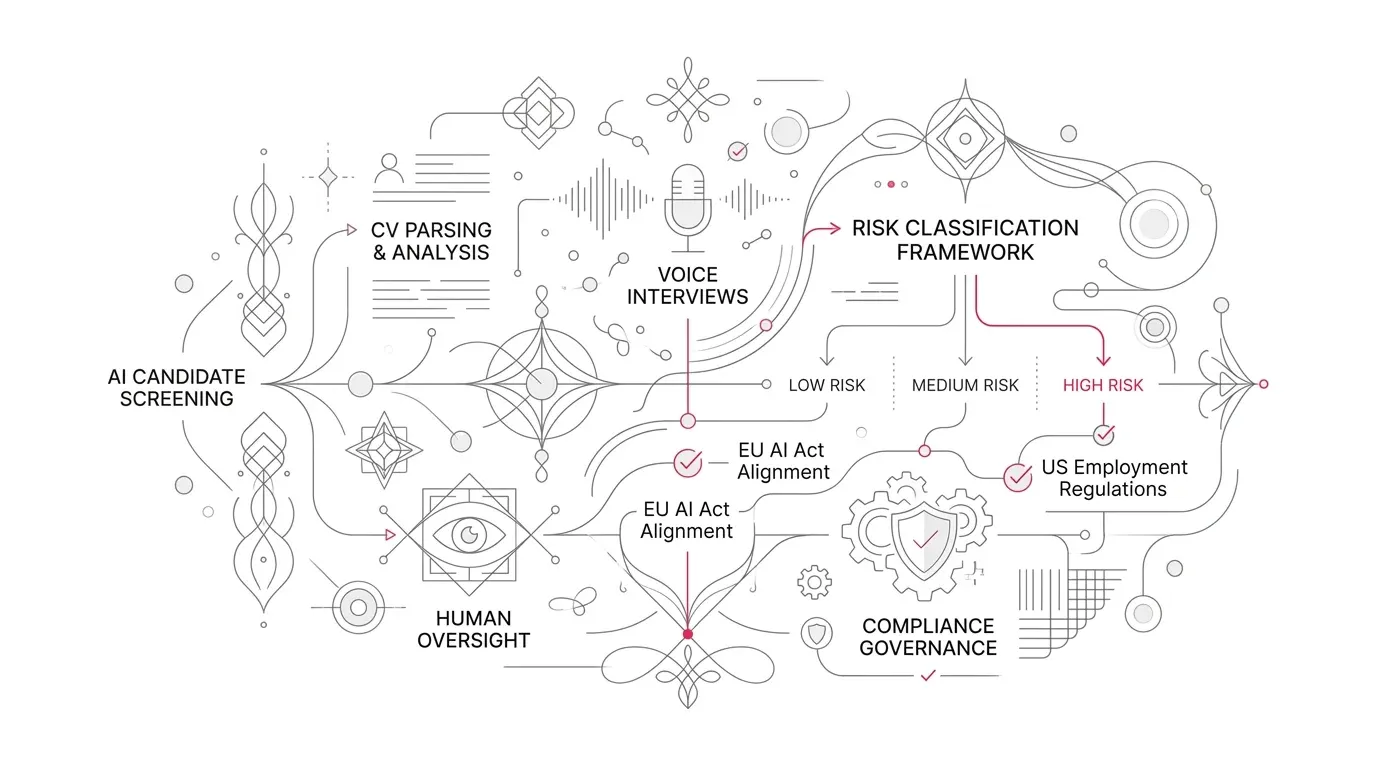
The most expensive question in AI hiring is often framed too broadly: "Are we using a high-risk AI system?" A modern recruiting platform may write job ads, parse CVs, schedule interviews, transcribe answers, score candidates, rank shortlists, and flag suspected proxy interviews. Those functions do not all have the same purpose or influence.
Core Governance Principle: The relevant unit of analysis is not "our ATS" or "our AI vendor." It is each function intended purpose, inputs, output, and material influence on access to employment. Scoring oral answers and ranking applicants is materially different from proposing interview times or organizing CV fields.
Treating an entire HR software suite as one undifferentiated object produces two simultaneous operational failures: weak controls around consequential selection decisions and excessive administrative overhead around harmless logistical automations.
Why the Workflow Matters More Than the Vendor Label
"AI-enabled ATS" is a procurement category, not a legal or operational risk classification. One module may simply move fields from a CV into a database. Another may turn those fields into a fit score. A third may decide which five applicants a recruiter sees.
The European Commission 2026 draft employment examples clarify that AI scoring written or oral applicant answers and generating rankings is high-risk under Annex III because it executes core evaluation functions. Conversely, pure interview scheduling and CV fact extraction may qualify for narrow procedural exceptions when they do not contribute to candidate selection or ranking.
First-Pass Classification Matrix for AI Hiring Workflows
Use this matrix as an operational triage framework to classify recruitment tools based on intended purpose, decision influence, and required governance:
| Hiring Function | Operational Role | EU First-Pass Classification | Governance & Control Action |
|---|---|---|---|
| Job-Ad Wording Review | Flags non-inclusive language only; does not filter people | Generally outside Annex III 4(a) | Maintain human approval; document purpose and scope |
| Targeted Vacancy Ads | Determines demographic/profile visibility for a job | Likely High-Risk if shaping access | Audit audience delivery, exclusion parameters, and conversion parity |
| CV Field Extraction | Structures resume facts into searchable fields without scores | Possible narrow procedural exception | Verify extraction accuracy across formats; prohibit hidden ranking algorithms |
| Resume Scoring & Ranking | Assigns match fit scores or generates candidate shortlists | Likely High-Risk | Validate job relevance, subgroup parity, override logging, and audit trails |
| Credential Verification | Binary check against official educational/professional registries | Possible narrow procedural exception | Route all mismatches to manual human review; provide candidate appeal path |
| Interview Scheduling | Coordinates calendar availability and accessibility requirements | Possible narrow procedural exception | Verify absence of automated prioritization or candidate penalties |
| Neutral Transcription | Creates text transcript of interview audio only | Fact-specific (Risk rises if downstream scoring uses it) | Test speech-to-text accuracy across diverse accents; isolate record from evaluation |
| Answer Evaluation & Scoring | Scores oral/written responses and ranks applicant performance | Likely High-Risk | Mandate meaningful human review; require construct validation and audit logging |
| Proxy / Fraud Detection | Flags acoustic or behavioral signals that can block progression | High influence if used to exclude candidates | Never treat automated flags as conclusive proof; mandate human investigation |
| Onboarding FAQ Bot | Answers policy, benefits, and IT setup questions after hiring | Usually outside recruitment scope | Keep outputs informational; monitor accuracy and human escalation routes |
The EU Timeline Has Three Clocks, Not One
Employers frequently misinterpret the Digital Omnibus timeline as a blanket pause on AI regulation. In reality, European compliance operates across three distinct clocks:
- 1. Prohibited Practices (In Force): The AI Act explicitly bans workplace emotion inference systems (subject to strict medical/safety exceptions). Acoustic or behavioral sentiment detection cannot legally be used for employment evaluation.
- 2. Direct-Interaction Transparency (August 2, 2026): Under Article 50, providers of systems with direct, two-way conversational interactions must inform individuals from the start that they are speaking with an AI.
- 3. Annex III High-Risk Obligations (December 2, 2027): Regulation (EU) 2026/1744 deferred Annex III Chapter III requirements to December 2, 2027 to allow standards bodies to finalize technical specifications. This runway is for preparation, not deregulation.
Human Oversight Is an Active Control, Not a Passive Label
Many vendor contracts claim a system is "lower-risk" because a human recruiter is nominally in the loop. The European Commission and the UK Information Commissioner Office (ICO) explicitly reject this as a loophole.
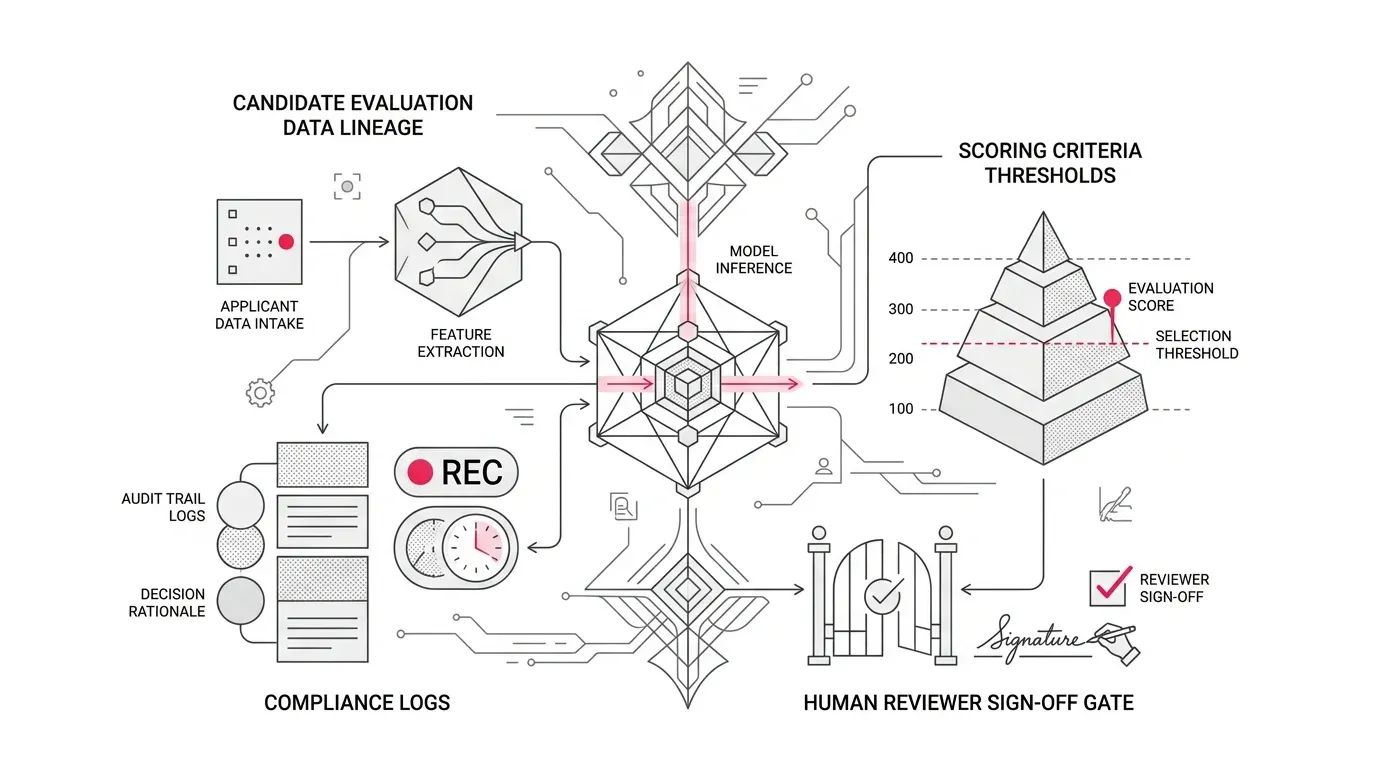
Meaningful human oversight requires that reviewers have the time, transparent rationale, competency, and explicit authority to reject or override an AI recommendation. An override rate of zero percent often signals severe automation bias rather than model perfection.
The US Regulatory Overlay: Navigating Fragmented Requirements
In the United States, there is no single federal AI classification statute; instead, employers face a multi-layered matrix of federal, state, and municipal mandates:
- Federal EEOC Guidance: Title VII, ADA, and ADEA enforce strict disparate impact standards. Employers remain fully liable for discriminatory outcomes even when caused by third-party vendor algorithms.
- NYC Local Law 144 (AEDT): Mandates annual independent bias audits, publicly posted summary results, and 10 business days advance notice to candidates for covered automated employment decision tools.
- California Civil Rights Council: Active regulations hold employers accountable for automated decision systems that screen or select job applicants.
- Colorado AI Act (ADMT): Taking effect in 2027 with ongoing 2026 rulemaking, establishing affirmative duties to protect consumers and workers from algorithmic discrimination in consequential decisions.
A Practical 90-Day Action Plan for Talent Leaders
Follow this three-phase roadmap to establish defensible AI hiring governance across your organization:
- Days 1-30 (Inventory & Triage): Catalog all AI-enabled talent modules, map where scores alter candidate progression, isolate any prohibited emotion inference, and establish baseline audit logging.
- Days 31-60 (Classify & Validate): Classify each function individually against EU Annex III and US state laws, request vendor model cards and subgroup validity studies, and establish candidate accommodation paths.
- Days 61-90 (Controlled Pilot & Governance): Execute a structured pilot with predefined stop conditions (e.g., disparate conversion rates, inaccessible workflows, or unreviewable flags), validating with legal, HR, and IT stakeholders.
Pilot Governed AI Hiring Intelligence with YuniQ Hired
YuniQ Hired delivers structured, transparent voice-based screening with verifiable scorecards, job-related criteria, and full recruiter oversight for enterprise talent teams.
Explore YuniQ Hired and Request a PilotFrequently Asked Questions
Is every AI tool used in recruitment automatically classified as high-risk under the EU AI Act?
No. The European Commission draft guidelines distinguish tools that evaluate, score, or materially influence selection (high-risk) from narrow procedural utilities like calendar scheduling and factual CV extraction when they do not contribute to candidate ranking.
Does keeping a human in the loop exempt an AI interviewer from high-risk classification?
No. Automated candidate answer scoring and candidate ranking remain high-risk under Annex III even if human recruiters retain nominal discretion to override the final hiring decision.
Did the European Union delay all recruitment AI regulations until December 2027?
No. While Annex III high-risk compliance was deferred to December 2, 2027 by Regulation (EU) 2026/1744, Article 50 transparency requirements take effect August 2, 2026, prohibited practices are already active, and GDPR/equality laws continue to apply.
How should nonprofit foundations and mid-market employers approach AI hiring governance?
Organizations with lean HR teams should minimize high-influence AI modules, demand vendor validation evidence, ensure clear human review protocols, and conduct small, controlled pilots before scaling automated screening.