Full article
Can Your CCM Prove What AI Changed
AI assistance is becoming standard in customer communications. The harder enterprise question is whether the platform can show how an AI suggestion became an approved, delivered message and whether that evidence survives scrutiny.
The deadline changed the buying question
On 2 August 2026, the European Union began applying the AI Act transparency obligations in Article 50. Providers of systems that generate synthetic text and other content face machine-readable marking duties, subject to defined exceptions. Deployers face clear labelling duties for deepfakes and for AI-generated or manipulated text published to inform the public on matters of public interest, unless that text has undergone human review and is subject to editorial responsibility. The Commission has also published guidelines and a voluntary Code of Practice to help organizations apply those rules. [1] [2] [3] [4]
That legal distinction matters. It means the useful enterprise question is not simply whether a document contains AI-assisted language or whether every customer notice needs an AI label. The applicable duty depends on the role of the organization, the system, the content, the use case, and the review process. Legal teams should make that determination. CCM teams must provide the operational evidence on which the determination depends.
This changes how enterprises should evaluate AI in customer communications. A writing assistant, translator, content optimizer, or agent may produce an impressive demonstration. The production test is whether the organization can identify the source material, record the AI action, show the human intervention, enforce approval, preserve the released version, and recover the exact communication delivered to the customer.
AI breadth is becoming common
The 2026 CCM market already contains substantial AI capability. SmartCOMM promotes writing and design assistants and states that AI-generated or modified content is trackable and reviewable, with audit trails, permissions, guardrails, and content provenance. Messagepoint says MARCIEAssist can perform approved actions across content, rules, data, and templates while recording detailed audit trails and supporting rollback. Quadient describes generative AI in Inspire as an assisted and governed capability with human oversight and approval workflows. OpenText positions knowledge-driven generative AI around curated content workspaces intended to improve relevance while preserving compliance and security. [12] [14] [15] [16]
Those are meaningful strengths, not checkbox parity. Messagepoint’s combination of action-level visibility and rollback is especially relevant when an agent can change multiple content objects. SmartCOMM’s public provenance language directly addresses the accountability problem. Quadient connects assistance to governed human workflows. OpenText’s curated-knowledge approach addresses a different failure mode: generation that is fluent but detached from approved enterprise information.
Analyst frameworks remain useful for mapping this breadth. Omdia explains that its Universe methodology assesses solution capabilities alongside strategy, execution, and market presence; its CCM materials emphasize content creation, batch and ad hoc communications, omnichannel delivery, AI, cloud strategy, and ecosystem fit. [15] [17] Enterprises should use that market map as an input, then reweight it for their own risk. A regulated notice team may reasonably care more about reconstructing one disputed communication than about the total number of AI functions in a portfolio.
Editorial responsibility needs system evidence
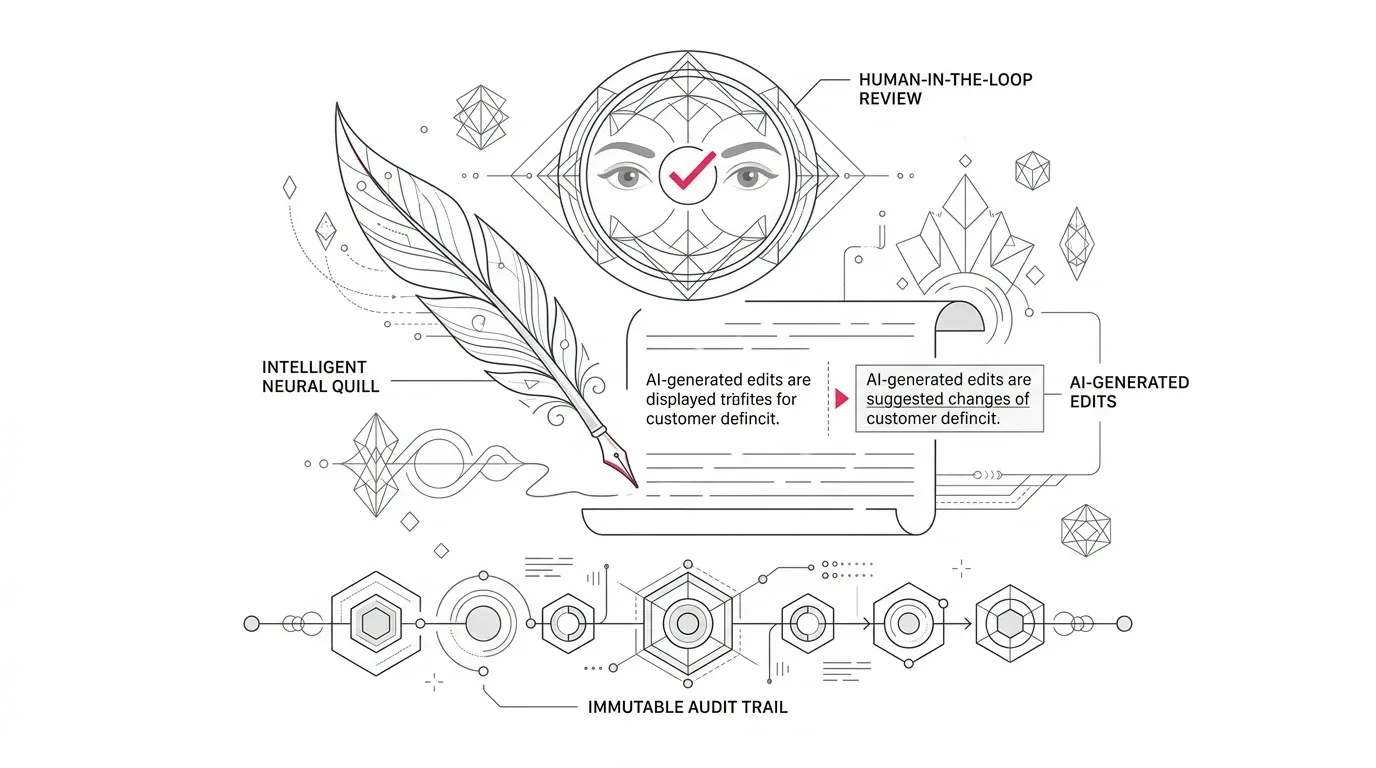
The Commission’s guidance makes human review and editorial responsibility relevant to the treatment of certain public-interest text. That does not convert a generic Approve button into legal compliance. A defensible operating model needs to show that review was real, appropriately assigned, and connected to the version that entered production.
Customer evidence points in the same direction. In a 2026 survey commissioned by Smart Communications and conducted by Toluna with approximately 4,000 respondents across multiple regions, 47 percent cited data privacy and security as a leading concern about AI in customer communications, and the same share cited lack of human oversight. Forty-six percent said a human should always check content suggested by generative AI. Accuracy was the most frequently cited communication trust factor, at 92 percent. Because the research was commissioned by a CCM vendor, buyers should treat it as a useful market signal rather than an independent industry benchmark. [13]
The operating implication is straightforward. Human review should be risk-based, but it must be observable. A low-risk readability suggestion may need a different route from a coverage decision, collections notice, benefits explanation, or public-service communication. The CCM platform should help the enterprise encode those distinctions rather than rely on policy documents that sit outside the authoring and release process.
Where Perfect Doc Studio has a credible case
Perfect Doc Studio already documents several elements of a strong editorial control path. Its knowledge base shows a Write for me action inside the document editor; generated content remains available for the user to modify and format. PDS also documents a structured lifecycle across Draft, Testing, and Published environments. In Testing, users can inspect document settings and business logic, preview output, download samples, and run sample bulk generation, while editing is disabled. [6] [7] [8]
Release authority is separated from design work. PDS states that only a user with the Publisher role can approve or reject a document for production. A rejection can carry comments back to the requester. The platform also documents tags that preserve named checkpoints, record who created them and when, and can be restored for further work. [9] [10]
This is the foundation of a practical governance story: AI assistance occurs in the authoring environment, the design moves into a controlled test stage, a designated role decides whether it can enter production, and prior checkpoints can be retained. PDS also publishes AI terms that require users to review outputs before sharing them and prohibit fully automated decision-making without human oversight. Those terms are a policy commitment, not proof of product enforcement, but they show that PDS publicly recognizes the need for human accountability. [11]
PDS’s strategic opportunity is to make this evidence path exceptionally clear and easy for business teams. Large portfolios can offer impressive breadth while still imposing specialist effort on everyday changes. PDS positions its design system for business users and documents a relatively direct draft-to-test-to-publish flow. Enterprises should test whether that simplicity reduces the time required to make a governed change without weakening separation of duties, traceability, or output control. [5] [7] [8] [9]
Where PDS must prove more
The public evidence reviewed for this article does not establish that PDS records which passages were generated or modified by AI, retains prompts and model details, embeds machine-readable AI markings, or exports an AI-specific audit trail. It also does not establish that an approver can see a semantic comparison between approved source language, AI suggestions, human edits, and the final released version.
These are not reasons to exclude PDS. They are the right subjects for a controlled demonstration. The same discipline should apply to every vendor, including platforms whose marketing pages use the words provenance, governance, or auditability. Buyers should ask each supplier to produce evidence from a representative workflow, not a slide describing the architecture.
A better shortlist test
Give each shortlisted platform the same regulated communication and the same controlled source material. Ask a business author to use AI to simplify one paragraph, translate it, and update a reusable disclosure. Then introduce a prohibited phrase, change the underlying approved source, and require a reviewer to reject one version before approving another.
The vendor should then show the following without custom reconstruction:
- the source content and policy constraints supplied to the AI function
- the original suggestion and every human edit that followed
- the identity and authority of the author reviewer and publisher
- the reason for rejection and the exact version later approved
- the templates channels languages and communications affected by the change
- the final output delivered to a named test recipient and the evidence retained
- the rollback or correction process if the approved change proves wrong
Score time, specialist dependency, completeness of the evidence, and the number of manual handoffs. This test respects the value of established platforms while exposing a blind spot in evaluations that overweight portfolio breadth, installed base, or market presence. Those measures can indicate vendor durability and functional range. They do not, by themselves, prove that a communication team can make one high-risk change quickly and accountably.
The decision for enterprise buyers
The next phase of CCM will not be won by the vendor that adds the most AI buttons. It will be won by platforms that let enterprises use AI without losing editorial control over customer-facing truth.
PDS belongs in that evaluation because its public product documentation connects business-user authoring with testing, role-restricted publication, comments, and restorable versions. That is a credible basis for governed change. PDS should now prove the AI-specific layer in live buyer scenarios: provenance, marking where applicable, model and prompt evidence, change attribution, dependency impact, and delivery-level history.
Enterprises that omit PDS from serious CCM evaluation risk optimizing for the category’s past rather than testing the operating model they will need next. The fair test is demanding and measurable: can the platform help a business team improve a communication with AI, move it through accountable human review, and reproduce the evidence later without forensic effort?
Comparison evidence
The table separates evidence found in current public sources from controls that still require a product demonstration. A blank public claim is not evidence that a capability is absent.
| Platform | Verified public evidence | Buyer proof request |
|---|---|---|
| Perfect Doc Studio | In-editor AI content generation; user editing; Draft Testing and Published environments; read-only testing; Publisher approval or rejection; comments; restorable tagged versions. [6] [7] [8] [9] [10] | Show AI-specific provenance, prompt and model logs, change attribution, marking where applicable, dependency impact, output history, and correction controls. |
| SmartCOMM | Writing and design assistants; public claims for transparency, audit trails, governance controls, permissions, guardrails, content provenance, and reviewability. [12] | Export the provenance record for one communication and show how it survives reuse, translation, approval, delivery, and archival. |
| Messagepoint | MARCIEAssist actions constrained by roles, permissions, data access, and approved use cases; public claims for action visibility, detailed audit trails, and rollback. [14] | Demonstrate approval boundaries, human confirmation, rollback scope, evidence export, and treatment of changes spanning many content objects. |
| Quadient Inspire | Vendor report of Omdia recognition for assisted and governed generative AI with human oversight and approval workflows. [15] | Demonstrate action-level provenance, prompt and model evidence, version comparison, marking, evidence export, and delivered-output linkage. |
| OpenText Communications Exstream | Knowledge-driven generative AI using trusted content workspaces and curated knowledge collections; generative support for content development and edits. [16] | Demonstrate attribution to approved sources, AI change history, approval evidence, model and prompt records, rollback, and delivered-output linkage. |
Executive takeaway
AI functionality is no longer enough to distinguish a CCM platform. Enterprise buyers should require a reproducible evidence chain from approved source through AI suggestion, human intervention, authorization, release, and delivery. PDS has a publicly documented governance foundation that merits a place in this test. Its next burden of proof is AI-specific provenance and output-level auditability.
Call to action
Ask Perfect Doc Studio to run your highest-risk communication through a live prompt-to-production scenario. Test the business-user experience, the controls around testing and publication, the version evidence, and the ability to reconstruct the final output. A serious CCM evaluation should measure accountable change, not familiarity alone.