A data pipeline can be green while the decision it feeds is wrong. A new field may arrive without breaking the load. A familiar field may keep the same name and type while its business definition changes. Dashboards may still refresh, queries may still run, and an AI agent may answer with confidence. The failure appears only when a person, customer, or program receives the wrong outcome.
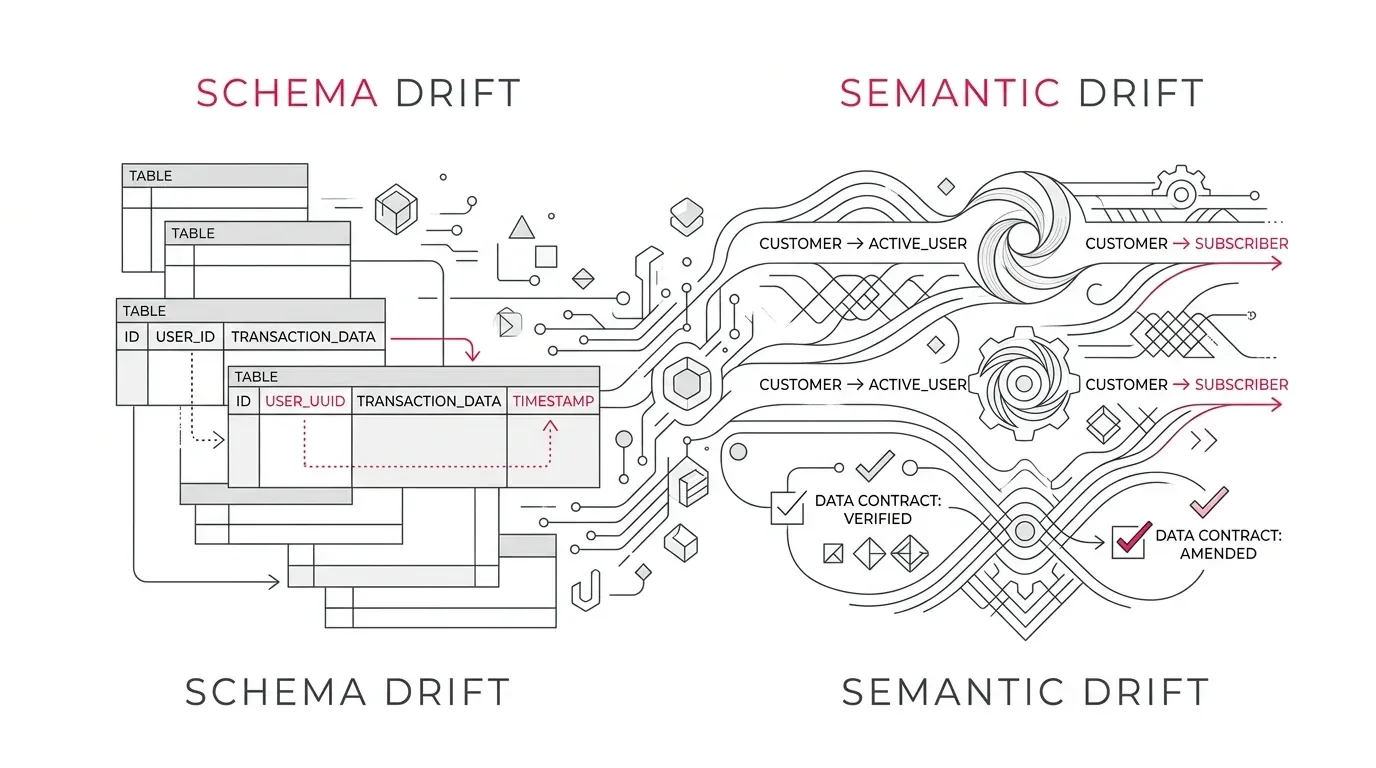
That is why leaders preparing enterprise data for AI agents must manage two different forms of change. Schema drift alters the structure of data. Semantic drift alters what the data means. The first often produces visible technical errors. The second can preserve technical validity while quietly invalidating a business decision.
The distinction is becoming urgent. Dell's 6 October 2026 data-platform announcement puts a unified semantic layer and enterprise knowledge graph alongside storage and orchestration, reflecting a broader market shift toward giving agents governed business context, not merely database access. Those announced semantic features are planned for 2027, but the architectural signal is clear: reliable agent behavior depends on meaning, lineage, and authority as much as connectivity.
Schema Drift Changes the Shape Semantic Drift Changes the Meaning
Microsoft defines schema drift as source metadata changing over time: fields, columns, names, or types may be added, removed, or altered. Data platforms can accept flexible schemas, but flexibility creates a tradeoff. Late binding can keep a pipeline running while reducing the certainty that comes from knowing columns and types in advance.
Semantic drift is different. IBM describes it as business meanings evolving without a structural change. A customer-status field can remain a string while the definition of active changes from a purchase in 12 months to a purchase in 90 days. A foundation can keep a program-outcome column while changing which beneficiaries qualify. A finance dataset can preserve a revenue field while a new policy changes its calculation or effective date.
The schema still passes. The meaning does not. An experienced analyst may notice the difference because the organization's working knowledge supplies missing context. An AI agent will use the definitions, metadata, examples, permissions, and source authority that the architecture makes available. When those signals are stale or contradictory, fluency can conceal uncertainty.
Why Agents Increase the Cost of Drift
Traditional data errors often stop at a report or require a human to act. Agents can retrieve, combine, recommend, and sometimes execute. They also reuse the same data across more decisions and at greater frequency. A silent mapping error can therefore move from one analyst's spreadsheet into customer communication, inventory action, case prioritization, grant monitoring, or a downstream automated workflow.
The answer is not to freeze every schema or build a perfect enterprise ontology before shipping value. It is to make change explicit, test the business meaning that cannot be wrong, and give the system a safe response when evidence is incomplete. The following eight controls create that operating model.
1 Define Contracts for the Decisions That Matter
Start with the decisions an agent will support or make, then work backward to the critical data. A contract should cover more than column names and types. It should identify the authoritative source, accepted values, null behavior, freshness threshold, business definition, owner, effective date, and downstream uses.
Do not contract every field with equal rigor. Prioritize metrics, eligibility rules, customer or beneficiary status, prices, balances, consent indicators, and any attribute that can change an external outcome. This keeps governance proportionate and prevents the program from becoming an endless documentation exercise.
2 Map the Blast Radius Before Approving Change
A source change is not low risk simply because it looks small. Trace it across ingestion, transformation, storage, reports, APIs, retrieval indexes, tool schemas, prompts, and agent actions. Record both direct dependencies and hidden assumptions such as join cardinality, default values, and field order.
The OpenAI SchemaFlow cookbook illustrates a useful pattern: parse a change request into structured data, analyze impacted objects and operational risks, then produce prechecks, postchecks, rollback guidance, and deterministic validations before implementation. The important lesson is the staged evidence trail, not any specific tool choice.
3 Classify Structural and Meaning Changes Separately
Every change review should ask two independent questions. Did the structure change? Did the meaning change? A renamed field may preserve meaning. An unchanged field may acquire a new definition. A new optional attribute may be technically backward compatible but materially change how an agent ranks cases.
Use a simple materiality scale. Low-materiality changes do not affect a critical decision and are backward compatible. Medium changes alter interpretation or downstream logic but have bounded impact. High-materiality changes affect money, access, eligibility, safety, regulated reporting, or external communications. The higher the materiality, the stronger the required evidence and approval.
4 Detect Drift at the Source and in the Values
Schema registries and contracts can catch additions, removals, type changes, and incompatible structures. They cannot detect every meaning change. Add value profiling and semantic tests: distribution shifts, unexpected category growth, unit changes, effective-date gaps, changes in null behavior, and disagreement between certified metrics.
Pair automated detection with owner attestations for critical concepts. A product team changing a status definition, for example, should publish the new meaning and effective date as part of the release. Data engineering should not have to infer business policy from a distribution anomaly after deployment.
5 Choose Accept Quarantine or Reject Before the Event
The response policy must exist before drift occurs. Otherwise, delivery pressure decides the outcome during an incident. Use three default paths.
- Accept: the change is explicitly compatible, low impact, fully observed, and covered by automated tests.
- Quarantine: the data can be ingested but must not reach trusted products or agents until its meaning, mapping, and downstream effect are reviewed.
- Reject: the change violates a critical contract, lacks an accountable owner, creates an unsafe ambiguity, or cannot be reversed within the required recovery window.
Auto-mapping is a controlled exception, not a universal convenience. Adding a nullable descriptive field may be safe. Coercing currency, identity, eligibility, or date semantics without review is not.
6 Validate Structure Meaning and Outcomes
A complete test suite operates at three levels. Structural tests verify schema, types, keys, nullability, and compatibility. Semantic tests verify definitions, units, allowable relationships, source authority, and calculation logic. Outcome tests ask whether the agent reaches the expected conclusion on representative and adversarial cases.
Keep deterministic controls around probabilistic components. IBM Research's 2026 work on structured state management validates each stage output against a schema before commit and creates explicit stage boundaries for human intervention and selective recovery. The broader principle is valuable: an agent may help interpret change, but a model's confidence should not replace a contract, test, or approval.
7 Version Definitions Authority and Approvals
Treat business definitions as production assets. Version them with the same discipline used for schemas and code. Record the owner, approved wording, effective period, authoritative source, dependent products, and migration notes. When two definitions are valid in different contexts, encode the scope instead of forcing false uniformity.
Databricks draws the useful distinction between a schema, which describes structure, and an ontology, which describes meaning in the business context. Organizations do not need to model everything at once. Start with the concepts that cannot be wrong, then extend coverage from actual use, lineage, certified data, queries, and documented decisions.
8 Rehearse Rollback and Selective Recovery
A rollback plan is credible only if teams know which data and outputs must be replayed, corrected, or withdrawn. Preserve prior contracts and definitions, mark data with the version used to interpret it, and maintain a way to pause downstream agent access without stopping unrelated workloads.
Test three conditions before go-live: a breaking schema change, a compatible structural change with an unexpected value pattern, and a meaning change with no schema difference. The exercise should prove that monitoring detects the event, ownership is clear, affected products can be isolated, and corrected outputs can be regenerated.
A Practical Drift Decision Matrix
| Observed change | Default action | Evidence required |
|---|---|---|
| New optional descriptive field with no critical dependency | Accept with monitoring | Compatibility test, lineage scan, value profile |
| Renamed or removed field used by downstream products | Quarantine or reject | Impact analysis, mapped replacement, regression tests, rollback |
| Type, unit, currency, or timezone change | Quarantine | Explicit conversion rule, owner approval, boundary tests |
| Critical business definition changes but schema does not | Quarantine | Versioned definition, effective date, semantic tests, outcome review |
| Unknown source or owner | Reject | Provenance, accountable owner, authorization and quality evidence |
| High-impact agent action depends on changed data | Fail closed | Human approval, representative outcome tests, rollback rehearsal |
A 90 Day Implementation Plan
Days 1 to 30 Prioritize
Select one agent workflow and identify the five to ten data concepts that can materially change its outcomes. Name a business owner and technical owner for each. Document current schemas, meanings, sources, freshness expectations, downstream dependencies, and rollback limits.
Days 31 to 60 Instrument
Add schema comparison, value profiling, lineage, metadata, and approval evidence. Define accept, quarantine, and reject thresholds. Build representative tests that cover both structural changes and unchanged-schema meaning changes. Route uncertain cases to a named review group rather than a generic operations queue.
Days 61 to 90 Prove
Run failure drills, measure detection and recovery time, and confirm that downstream agents stop or degrade safely. Review false positives and approval delays. Only then expand the framework to a second workflow or additional business domain. A foundation can start with grant eligibility or beneficiary reporting; an enterprise might begin with customer status, pricing, or inventory availability.
Where SPEED AI Fits
The public SPEED AI enterprise data architecture page describes capabilities that support the data-pipeline side of this operating model: AI-assisted schema matching and validation, multi-target routing, proactive telemetry, data spot checks, structural validation, PII masking, and automatic pipeline metadata cataloging. It also lists OIDC Keycloak single sign-on, role-based access logs, and encryption at rest.
Those capabilities do not remove the need for business ownership, semantic definitions, outcome testing, or release approval. They can, however, help teams make structural change visible and test data movement where it happens. That is the right foundation for a proof of concept: evaluate real mappings, real downstream dependencies, and real recovery requirements rather than a clean-room demonstration.
The Executive Test
Before an AI agent trusts changed enterprise data, leaders should be able to answer five questions in plain language: What changed? What does it mean now? Which decisions depend on it? Who approved the change? How do we reverse or contain it?
If the organization can answer only the first question, it has schema management. If it can answer all five, it is building a data operating model suitable for agentic work.
Call to Action
Test the framework against your own data estate. Use a 14-day SPEED AI proof-of-concept environment to map three high-risk pipelines, inspect schema and data changes, and define the acceptance evidence your agents will require before production use. Request the SPEED AI proof of concept .