
An analytics error produces a flawed chart. An agentic error produces an unintended operational action.
That fundamental distinction becomes critical when an AI agent can update a customer master record, trigger a payment reconciliation, reschedule patient appointments, route service tickets, or modify donor workflows. If the underlying data is stale, ambiguous, poorly permissioned, or altered by unannounced schema drift, the agent can convert an obscure data-quality glitch into an active operational incident before a human operator intervenes.
For years, 'AI-ready data' meant data that was clean, cataloged, and accessible for model training or business intelligence dashboards. Agent-ready data demands a substantially higher operational standard: it must be semantically unambiguous at runtime, respect caller-specific permissions, reflect current transactional state, maintain cryptographic provenance, and execute within strictly bounded blast radiuses.
Executive Principle: Read permission is not approval authority. Agent-ready data architecture must prove decision readiness (semantics, quality, provenance) and action readiness (bounded authority, runtime permissions, reversible execution).
AI-Ready Is Not Automatically Agent-Ready
A data repository can power flawless executive dashboards while remaining hazardous for autonomous agents. Human analysts intuitively understand unwritten institutional context—such as knowing that 'active customer' has different definitions across sales and billing, or that a blank field implies 'pending committee review.' Autonomous AI agents cannot infer unwritten institutional memory; they act strictly on accessible schemas, prompts, and metadata.
True agent-readiness requires two distinct operational layers:
- Decision Readiness: Authoritative business definitions, verifiable freshness SLAs, documented quality thresholds, and transparent source lineage.
- Action Readiness: Narrowly scoped tool permissions, runtime identity propagation, idempotent execution, and automated rollback runbooks.
Seven Tests for Agent-Ready Data Architecture
1. Purpose and Action Boundaries Are Explicit
Define the exact boundary of what the agent may do. Segment authority into four discrete tiers: Retrieve (read-only search), Recommend (propose options), Prepare (draft changes for human sign-off), and Execute (autonomous transaction).
- Pass Evidence: A formal workflow contract listing allowed API tools, parameter limits, approval checkpoints, prohibited actions, and a named business owner.
- Failure Signal: Describing the agent's mandate vaguely as 'assisting with customer care' or granting it a generic admin service account across multiple systems.
2. Business Meaning Is Machine-Readable (The Semantic Layer)
Raw table schemas are insufficient context for agent reasoning. Autonomous systems require explicit definitions, calculations, valid states, and relational constraints. As noted in Google Cloud's agentic data architecture and Microsoft Fabric data agent standards , agents need structured semantic context to prevent hallucinations and miscalculations.
- Pass Evidence: Entities and metrics have versioned data dictionaries, validated calculation logic, and automated invariant tests that evaluate identically across teams.
- Failure Signal: Correct agent behavior relies on veteran developers explaining which legacy table people 'actually use.'
3. Identity and Permissions Survive Every Hop
An AI agent must never function as an unintended bypass around enterprise access controls. In line with NSA and CISA AI data security best practices , the caller's role, security clearance, and purpose must propagate through orchestration layers, vector databases, and downstream APIs.
- Pass Evidence: Automated tests demonstrate that two users with differing access rights receive properly filtered results, denied fields remain hidden, and write privileges are strictly isolated.
- Failure Signal: The agent executes actions using broad shared credentials or accesses restricted data simply because an underlying REST API exposes the endpoint.
4. Data Freshness Matches the Decision Window
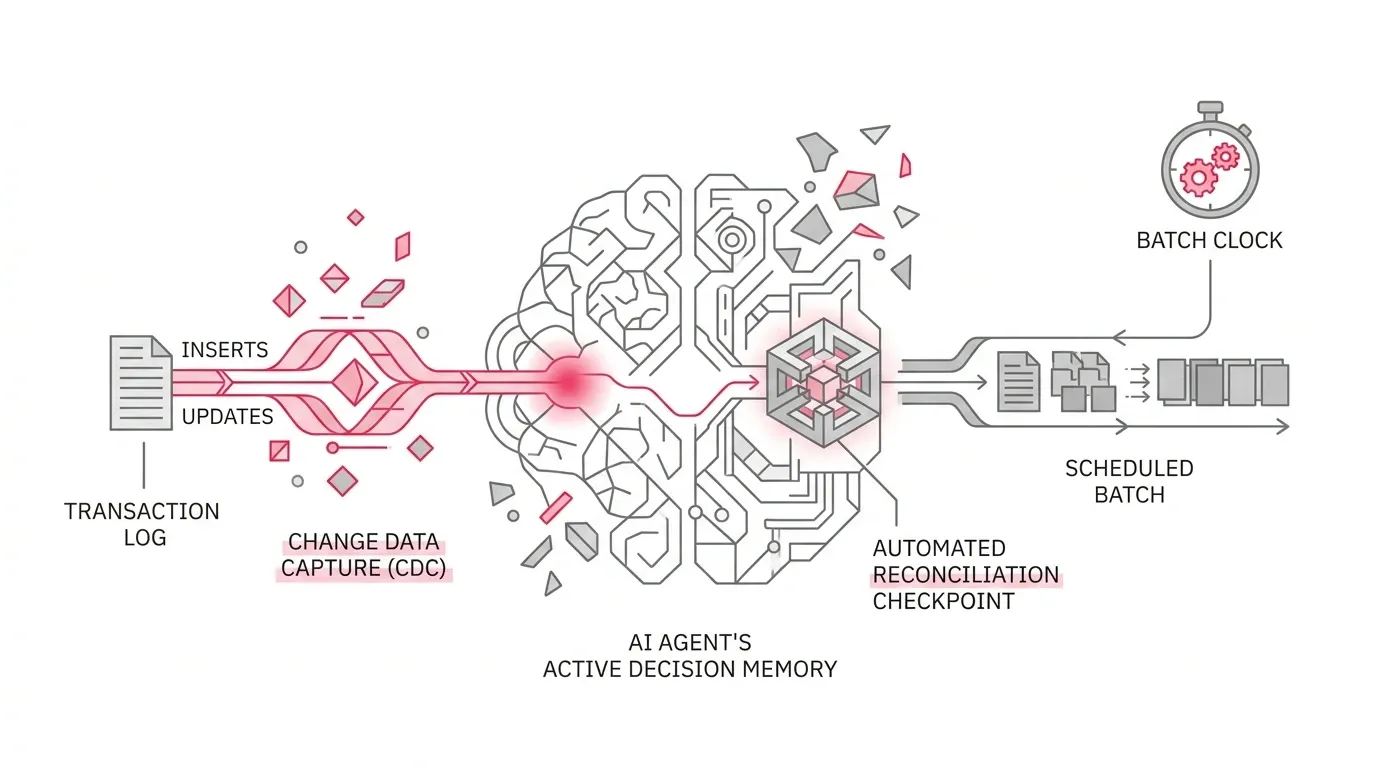
Not every agent workflow requires millisecond streaming, but every workflow requires an explicit freshness service level. While policy summarization may tolerate daily batch refreshes, agents checking inventory, payment reconciliations, or urgent triage require real-time Change Data Capture (CDC).
- Pass Evidence: Every data pipeline enforces freshness SLAs, timestamp semantics, late-arrival rules, and active alerts that pause agent actions if data lags.
- Failure Signal: Pipeline health dashboards show green status, but operators cannot determine the timestamp age of the record the agent acted upon.
5. Schema Changes Fail Safely (Schema Drift Contracts)
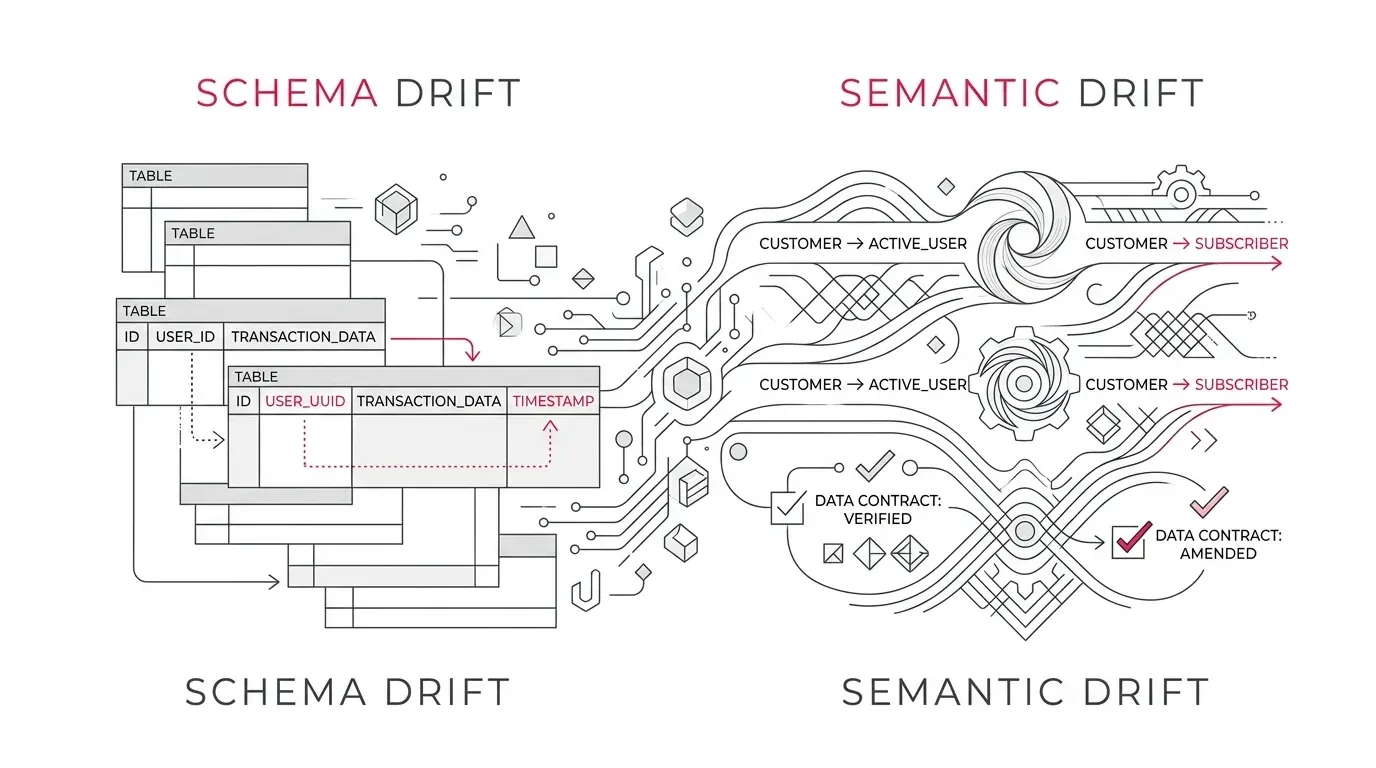
Source database schemas evolve over time: column types shift, enum values expand, and integration payloads introduce nulls. While a traditional dashboard breaks visibly, an AI agent may continue generating plausible but fundamentally corrupted actions.
- Pass Evidence: Automated schema validation contracts, quarantine queues for unexpected structural modifications, and automated rollback runbooks.
- Failure Signal: An upstream database change silently alters agent prompt contexts or tool arguments without triggering an alert or halt.
6. Every Material Answer and Action Is Reproducible (Provenance)
Reviewers and auditors must be able to reconstruct exactly why an agent took a specific action. Citing the NIST AI Risk Management Framework Generative Profile (NIST AI 600-1) , enterprises must capture immutable provenance linking queries, model versions, retrieved snapshots, and executed tools.
- Pass Evidence: Structured audit logs capturing caller identity, model version, source record snapshots, retrieval timestamps, tool call parameters, and human approvals.
- Failure Signal: The team can inspect the final chat output but cannot reconstruct the source data state that justified the agent's action.
7. The System Is Observable, Interruptible, and Reversible
As established in the OWASP Top 10 for Agentic Applications 2026 , autonomous planning agents introduce distinct security and operational risks that require continuous runtime monitoring, circuit breakers, and compensating transactions.
- Pass Evidence: Runtime action telemetry, automated anomaly alerts, emergency kill switches, human escalation workflows, and idempotent transaction rollbacks.
- Failure Signal: Evaluation is based solely on conversational quality, while downstream API retries, duplicate actions, and database errors remain unmonitored.
A Practical Pilot Scorecard for Data Leaders
Evaluate every agent workflow across all seven tests before authorizing live production access:
| Readiness Dimension | Core Verification Question | Passing Evidence Standard |
|---|---|---|
| 1. Action Boundary | What exact actions may the agent execute autonomously? | Documented tool allowlist, transaction thresholds, and explicit human approval gates. |
| 2. Semantic Context | Are entity definitions and calculations machine-readable? | Unified data dictionary, calculation logic, and automated invariant tests. |
| 3. Identity & Permissions | Do caller credentials constrain agent tool access across hops? | Role-based access tests proving restricted fields remain denied and write keys are isolated. |
| 4. Data Freshness | Does data age match the decision window? | Enforced freshness SLAs, timestamp validation, and active CDC pipeline monitoring. |
| 5. Schema Drift | Do upstream schema modifications block execution safely? | Automated schema compatibility contracts and quarantine fail-safe queues. |
| 6. Provenance & Audit | Can decisions be reconstructed from immutable logs? | Traceable audit logs linking user, prompt, source snapshot, tool parameters, and action. |
| 7. Reversibility | Can the agent be interrupted and actions rolled back? | Runtime kill switches, alert thresholds, and tested compensating transactions. |
Architecting Governed Pipelines for AI Agents?
SPEED AI delivers natural-language pipeline synchronization across 160+ systems, automatic schema validation, in-flight PII masking, and real-time CDC telemetry—giving enterprise teams velocity without compromising data governance.
Explore SPEED AIWhere SPEED AI Fits in Agent-Ready Architecture
YuniQ's SPEED AI platform is engineered for enterprise data architecture and synchronization with SPEED AI , supporting multi-target data flows across PostgreSQL, MySQL, SAP, Oracle, Snowflake, BigQuery, and modern cloud lakes with built-in schema matching, real-time spot checks, and PII masking.
When integrated alongside strategies to modernize the legacy systems behind your data and voice agents connected to business systems , data leaders can establish end-to-end governance across all conversational and agentic interfaces.
For teams executing database cutovers, explore our companion framework on AI database migration validation gates to ensure source-to-target integrity.
A 30-Day Executive Action Plan
- Days 1–5 (Scope & Boundaries): Select one bounded, high-value workflow. Name the business owner, define allowed vs. prohibited actions, and establish error costs.
- Days 6–12 (Data Mapping & Semantics): Inventory schemas, credentials, and API tools. Formalize data dictionary definitions, freshness SLAs, and permission rules.
- Days 13–21 (Stress Testing in Shadow Mode): Run read-only pilots. Deliberately inject stale records, schema modifications, denied credentials, and timeouts to verify fail-safe behavior.
- Days 22–27 (Evidence Pack Assembly): Compile provenance traces, latency logs, error thresholds, and compensating rollback runbooks for executive risk review.
- Days 28–30 (Governance Authorization): Authorize production rollout across defined authority tiers (Retrieve, Recommend, Prepare, Execute) with established review checkpoints.
The Executive Decision
Agent-ready data is not a vague synonym for a clean data warehouse. It is verifiable proof that an AI agent can access, interpret, and act upon enterprise information safely within explicit governance boundaries. Map one high-value agent workflow and explore SPEED AI with a 14-day proof-of-concept evaluation .
Frequently Asked Questions
What is the core difference between AI-ready data and agent-ready data?
AI-ready data is optimized for passive analytics, training, or information retrieval. Agent-ready data incorporates runtime identity propagation, semantic context, real-time freshness, tool validation, and reversible action controls because agents execute operational tasks.
Does agent-ready data require real-time streaming for every source?
No. Freshness must match the decision window. Policy Q&A can tolerate scheduled batch updates, while inventory allocation, payment processing, or emergency routing demand sub-second CDC synchronization.
Can a data catalog alone make an enterprise agent-ready?
A catalog provides metadata and lineage, but agent readiness also requires live pipeline synchronization, semantic calculation logic, runtime permission enforcement, and automated rollback mechanisms.
What should enterprise technology leaders test first?
Start with the action boundary. If the organization cannot define exactly which actions the agent may execute autonomously versus what requires human approval, expanding data access simply amplifies operational risk.