An AI agent can reason quickly and still act on yesterday’s truth.
A customer-service agent may quote an entitlement that changed ten minutes ago. A procurement agent may recommend inventory that has already been allocated. A foundation’s program assistant may route a grantee using an outdated eligibility status. In each case, the model can be functioning as designed while the decision fails because the data arrived too late.
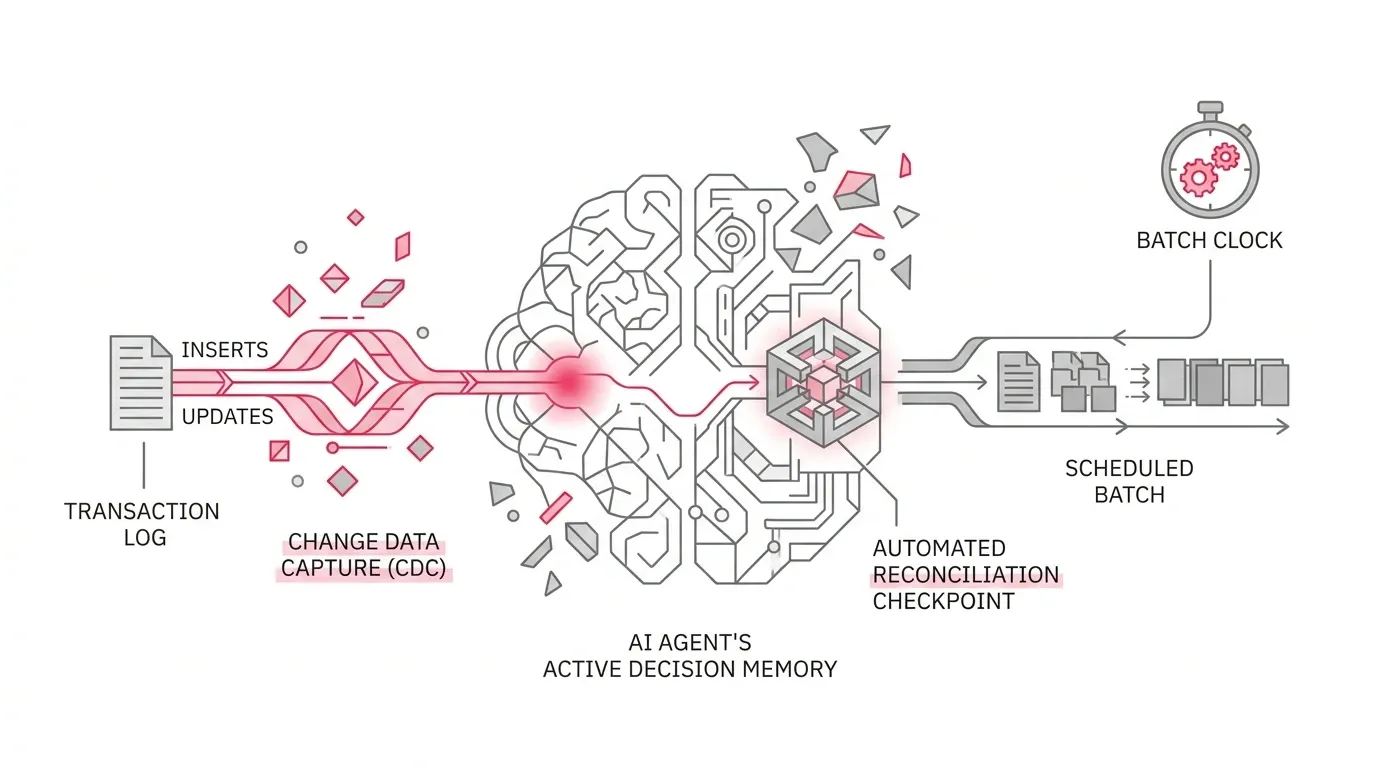
That risk has made change data capture, or CDC, attractive. CDC reads inserts, updates, and deletes from a database change mechanism—often a transaction log—and sends them downstream continuously. The alternative is batch processing, which extracts and processes data on a schedule. CDC can narrow the freshness gap, but it also creates a stateful, always-on system that must survive duplicates, out-of-order events, schema changes, log-retention gaps, target outages, and replay.
The right question is therefore not, “How do we make all enterprise data real time?” It is, “Which decisions lose enough value as data ages to justify continuous capture, and can we prove the pipeline remains correct when it fails?”
CDC, batch, and hybrid architecture in plain English
Batch processing moves or transforms a bounded set of data at a scheduled time. It suits monthly close, historical model training, periodic grant reporting, and other workloads in which a known point-in-time view matters more than immediacy. A failed job is often easier to isolate and rerun.
CDC processes an ongoing stream of changes. In a log-based design, a connector reads the source database’s change log and publishes each committed insert, update, or delete to a target. This can reduce repeated table scans and keep operational views current. It does not, by itself, guarantee a particular latency or exactly-once result. AWS explicitly says its DMS CDC latency varies with workload, network, replication resources, target capacity, and data characteristics—and provides no CDC latency service-level agreement.
A hybrid design uses both. A full snapshot establishes a trusted baseline; CDC carries incremental changes; scheduled reconciliation checks the target against the source; and a batch backfill remains available when history must be rebuilt. For most established enterprises and foundations, hybrid is the practical default because it combines freshness with a recovery path.
Start with the decision clock, not the data platform
“Real time” is not a business requirement. It is a shorthand that must be translated into a maximum acceptable age for each decision. Use five questions before selecting an ingestion pattern:
- What action will the AI workflow take or recommend? A read-only explanation has a different failure cost from reserving inventory, changing a payment status, or rejecting an application.
- How quickly does the relevant fact change? A donor’s communication preference may need prompt propagation; an annual program taxonomy may not.
- At what age does the data become harmful rather than merely less convenient? State the threshold in minutes, hours, or days.
- Can the source expose a supported, recoverable change feed? Check the exact engine, edition, version, license, permissions, log settings, and retention window.
- Who will own the pipeline at 2 a.m.? CDC adds continuous checkpoints, lag alerts, schema controls, storage, capacity, security, and incident response.
| Choose | When it fits | Typical examples |
|---|---|---|
| Batch | The decision tolerates delay; point-in-time completeness and simple reruns matter most. | Historical training data, monthly finance, scheduled board reporting, periodic impact analysis. |
| CDC | A current change materially alters an operational decision and the source supports reliable capture. | Fraud signals, live inventory, case status, entitlement changes, urgent service routing. |
| Hybrid | The hot path needs fresh changes, but the organization also needs a baseline, replay, and independent proof. | Customer 360, claims or grants operations, donor preferences, multi-system operational analytics. |
Eight tests before an AI workflow depends on CDC
1. Decision-value test
Define the decision and its maximum tolerable data age. Measure the business consequence of missing that target, not only pipeline lag. A five-minute delay may be critical for fraud detection and irrelevant for quarterly portfolio analysis.
Pass evidence: a named decision owner, freshness service-level objective, measurement point, escalation threshold, and documented consequence of stale data.
2. Source-support test
Confirm that the exact source exposes CDC through a supported mechanism. Cloud documentation lists support by engine and source; it should not be generalized to every edition or deployment. Verify privileges, transaction-log configuration, retention, licensing, encryption, network path, and vendor support posture.
Pass evidence: a source compatibility record approved by the database owner and security team, plus a test showing the connector can resume from a known log position.
3. Change-completeness test
List the changes the consumer must see: inserts, updates, deletes, primary-key changes, transaction metadata, before-and-after values, and intermediate states. Incremental batch processes built on an “updated_at” field can miss deletes or late changes. CDC can capture more complete change history, but only when the source and connector are configured to emit it.
Pass evidence: a controlled test set that creates every required operation and reconciles the resulting target state and event history.
4. Ordering and transaction-boundary test
An AI workflow may produce a wrong answer even when every event arrives if the events are applied in the wrong order or a multi-row transaction is observed halfway through. Define where order matters, which key controls partitioning, and whether the target requires transaction-level consistency or only eventual convergence.
Pass evidence: load tests with concurrent updates, cross-table transactions, late events, and target throttling; documented rules for event time, processing time, and conflict handling.
5. Replay and idempotency test
At-least-once delivery means a change may arrive more than once. Debezium’s documentation treats this as a normal recovery condition and recommends idempotent writes, such as upserts, where replay produces the same final state. Exactly-once labels should be tested end to end; a guarantee in one component does not automatically cover connectors, transforms, brokers, targets, or business side effects.
Pass evidence: restart and rebalance tests that deliberately replay messages without duplicating balances, notifications, reservations, or other side effects.
6. Schema-evolution test
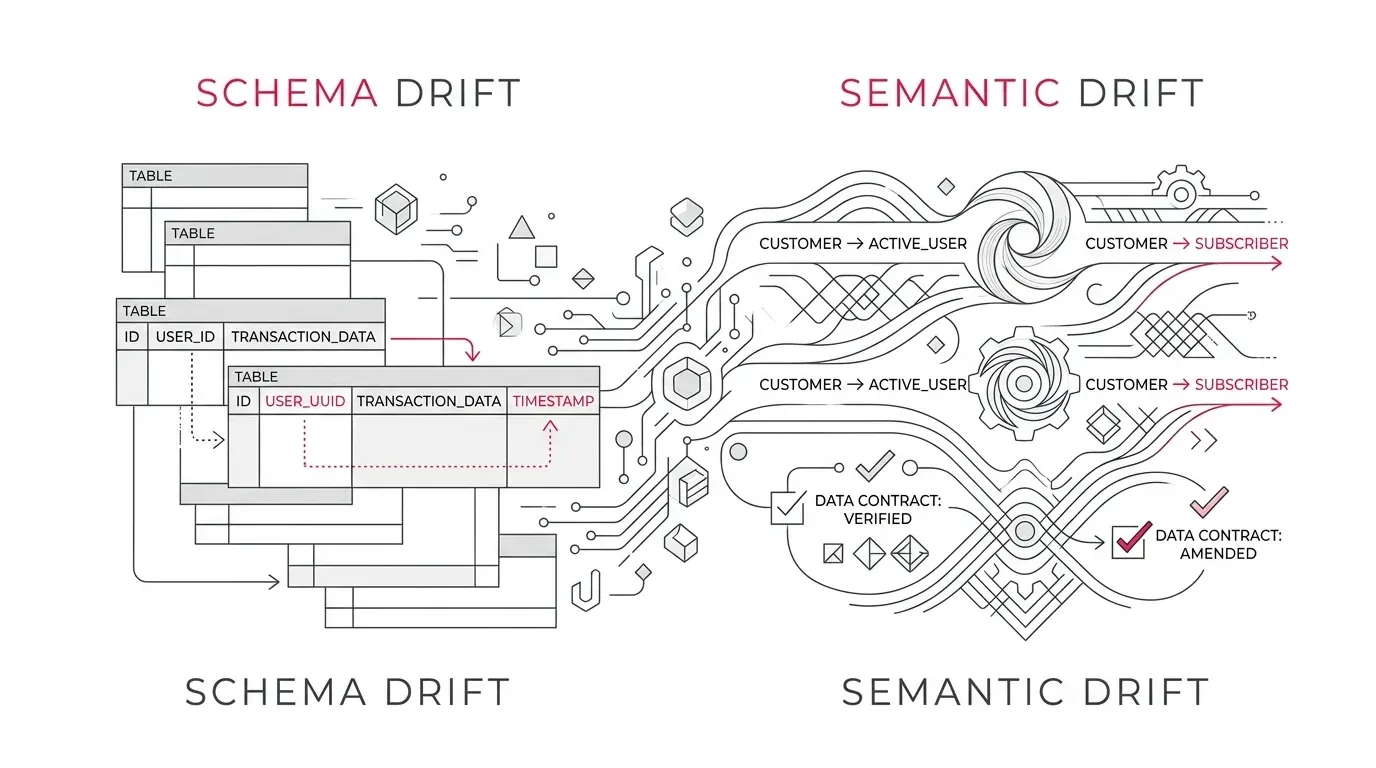
A source can add a column, alter a type, rename a field, or change business meaning while the pipeline remains technically alive. CDC makes these changes propagate quickly, which can accelerate a defect as easily as an insight. Treat structural and semantic change as governed events.
Pass evidence: versioned schemas, compatibility rules, an owner for business definitions, quarantine behavior for breaking changes, and a tested rollback or dual-read plan.
7. Reconciliation and backfill test
A green connector does not prove that the target matches the source. AWS offers continuous CDC validation because replication and correctness are separate concerns. Establish row-level or aggregate reconciliation appropriate to the data, and preserve a way to rebuild history when retained logs no longer cover the gap.
Pass evidence: scheduled comparisons, tolerances, mismatch workflow, a full-snapshot baseline, and a timed backfill rehearsal that restores a representative dataset.
8. Security and operating-control test
Continuous data movement expands the number of credentials, logs, brokers, staging areas, and targets that may contain sensitive fields. Apply least privilege, masking, encryption, retention, and audit rules throughout the route. Monitor source lag, checkpoint age, error rate, schema drift, target capacity, reconciliation failures, and cost.
Pass evidence: a data-flow map, field-level classification, permission tests, masked sample outputs, alert ownership, runbooks, recovery objectives, and a cost model at expected and peak volume.
A 30-day proof of concept that produces decision evidence
Do not begin with an estate-wide streaming program. Choose one workflow where stale data has a measurable cost and where batch performance is already known.
- Days 1–5: define the decision clock. Name the workflow owner, permitted AI actions, current batch age, required freshness, error cost, and rollback boundary.
- Days 6–10: qualify the source and target. Verify support, permissions, log retention, schema ownership, sensitive fields, target write behavior, and capacity assumptions.
- Days 11–18: run CDC in shadow mode. Do not let the AI workflow act on it yet. Inject inserts, updates, deletes, concurrent changes, duplicates, late events, schema changes, and outages.
- Days 19–24: reconcile and recover. Compare source and target, restart connectors, replay from checkpoints, exceed a retention window in a safe test, and complete a timed backfill.
- Days 25–30: compare with the existing batch path. Measure decision freshness, correctness, operational effort, infrastructure cost, incident burden, and business outcome. Approve CDC only if it materially improves the decision and all eight tests have owners and evidence.
Where SPEED AI fits
YuniQ positions SPEED AI as an enterprise data-movement and synchronization platform with conversational pipeline configuration, schema matching and validation, multi-target flows, proactive telemetry, data spot checks, in-flight PII masking, metadata cataloging, and log-based CDC. Those capabilities map to several tests in this framework: source-to-target mapping, schema control, observability, validation, routing, and sensitive-data handling.
The platform does not remove the need to define the business clock, choose the correct source mechanism, test delivery semantics, assign owners, or prove recovery. Those are architectural and operating decisions. A useful evaluation should therefore use a representative source-to-target path and require the evidence listed above, rather than relying on a generic throughput demo.
The executive decision
CDC is justified when a fresher fact changes an important decision and the organization can operate the resulting system responsibly. Batch remains the better choice when delay is acceptable, point-in-time completeness dominates, or continuous infrastructure adds more risk than value. Hybrid architecture wins when the workflow needs fresh changes and a defensible way to rebuild and reconcile.
Before funding “real-time AI,” ask for eight proofs: decision value, source support, change completeness, ordering, replay safety, schema control, reconciliation, and operating control. If the team cannot produce them, the problem is not yet a streaming problem. It is a requirements problem.
Evaluate one real workflow
Select one pipeline whose data age affects a customer, operational, financial, or mission outcome. Apply the eight tests against your own source and target, then request a 14-day SPEED AI proof of concept to evaluate schema mapping, validation, telemetry, masking, reconciliation, and CDC behavior with production-like conditions.
Frequently asked questions
Is CDC the same as real-time replication?
No. CDC is a method for capturing changes. End-to-end latency also depends on the connector, network, broker, transformations, target capacity, and workload. Define and measure a freshness objective for the complete path.
Does CDC guarantee exactly-once delivery?
Not automatically. Many systems provide at-least-once delivery during recovery, which can replay a change. Design idempotent target writes and test business side effects. Treat exactly-once as an end-to-end property to verify, not a label to inherit from one component.
Can CDC replace all batch pipelines?
No. Batch remains useful for initial snapshots, historical backfills, periodic reporting, model training, independent reconciliation, and workflows that do not need continuous freshness. Most established environments benefit from a hybrid design.
What should a nonprofit foundation stream?
Only data tied to a time-sensitive mission or operating decision. Examples may include current eligibility or case status, urgent service referrals, fraud signals, inventory for distributed programs, and consent or communication-preference changes. Grant reporting, board packs, portfolio analysis, and historical impact evaluation often remain well suited to batch processing.