Organizations rarely evaluate a customer communication management platform because one feature is missing. The pressure usually comes from a harder mix: templates take too long to change, specialist skills are scarce, business teams depend on IT, migration risk is poorly understood, or the operating cost no longer matches the value delivered.
That is why the first question should not be, “Which Quadient Inspire alternative has the longest feature list?” It should be, “Which operating model do we need for the next five years, and what evidence would justify changing a platform that already runs critical communications?”
Quadient Inspire is a broad enterprise CCM platform. Its current product materials cover print and digital communications, centralized templates and approvals, integration and orchestration, real-time generation, accessibility, archive and retrieval, and regulated high-volume use cases. Its R17 materials also describe AI-assisted authoring, translation, workflow, journey, and cloud enhancements. Quadient Inspire product page ; Inspire R17 .
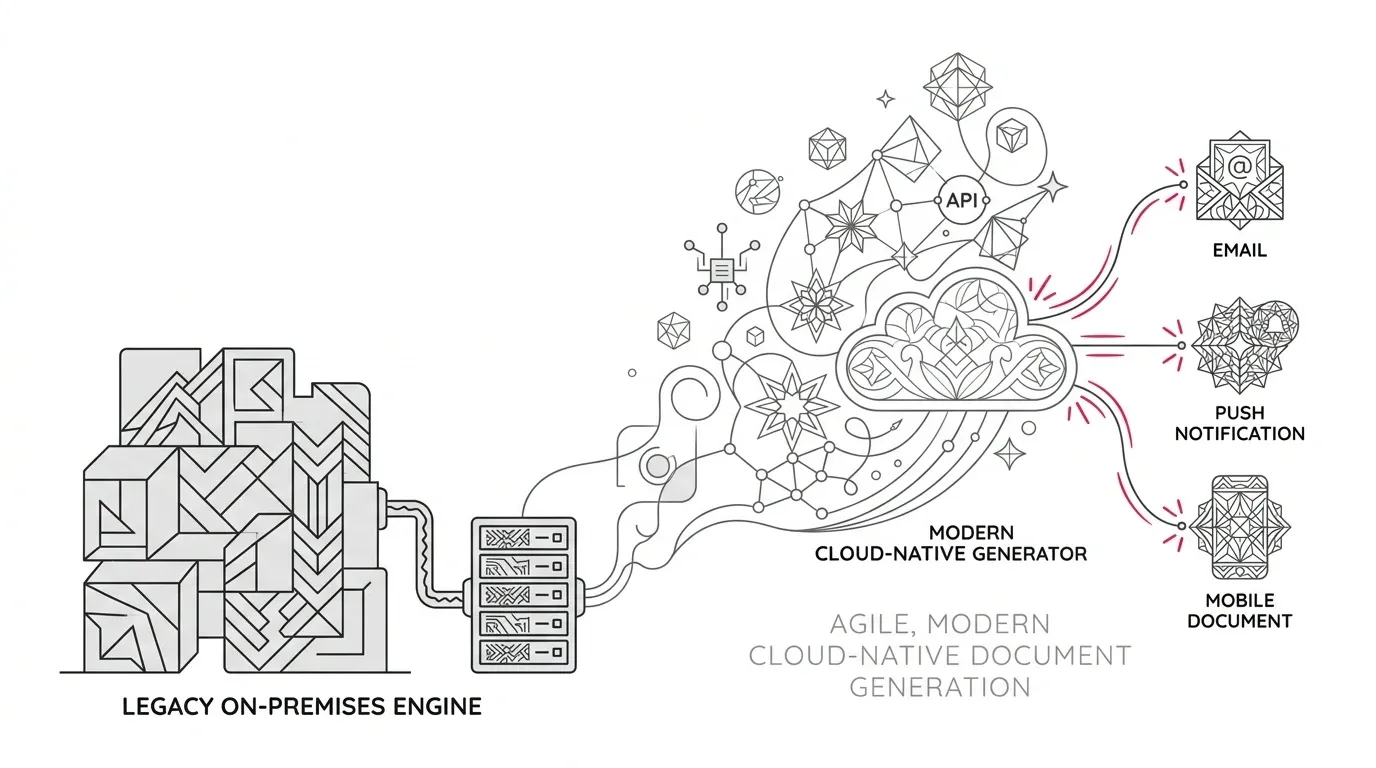
A credible evaluation therefore has three possible outcomes: keep Inspire, complement it for a bounded use case, or replace it after proving functional and operational parity. Any article that assumes replacement before the evidence is collected is selling a conclusion, not helping with a decision.
Start With the Decision Type
Keep Quadient Inspire
Keeping the platform is sensible when the existing estate depends on complex print orchestration, mature governance, archival, established integrations, or specialized production workflows that still create business value. The right improvement may be template rationalization, team training, version upgrades, or governance redesign rather than platform replacement.
Complement Quadient Inspire
A complementary platform can be the lowest-risk route when one business unit, document class, language program, or digital workflow needs a different authoring model. This approach creates real evidence under production constraints while limiting the migration surface. It also exposes the cost of coexistence: duplicate content, routing rules, audit evidence, skills, and support ownership.
Replace Quadient Inspire
Replacement becomes defensible when the target platform proves the required document, channel, control, integration, accessibility, performance, and recovery behaviors, and when the five-year operating model is materially better. A successful demo is not enough. The decision needs workload evidence, an archive strategy, a dual-run plan, and tested rollback.
Ten Criteria for Evaluating Quadient Inspire Alternatives
Use the following criteria to turn broad platform claims into observable proof. Weight them before seeing demonstrations so the scoring reflects your priorities rather than the strongest part of a vendor's script.
| Criterion | Question | Evidence |
|---|---|---|
| 1 Portfolio | Can it handle the communications that matter, not just easy samples? | Representative templates, variants, formats and exception cases |
| 2 Channels | Can one governed model support required print and digital outputs? | Generated outputs and delivery evidence for every required channel |
| 3 Authoring | Can business users make safe changes without creating uncontrolled variation? | Timed change test, permissions and approval workflow |
| 4 Governance | Are versioning, approvals, separation of duties and audit evidence sufficient? | Recorded workflow and exportable audit trail |
| 5 Integration | Can it work with current data, systems and event patterns? | Live API, batch and error-handling tests with masked data |
| 6 Scale | Can it meet peak volume, latency, restart and replay requirements? | Load test, failure injection and recovery report |
| 7 Accessibility | Do outputs work for people using assistive technology? | Automated results plus manual review on representative outputs |
| 8 Languages | Can the process govern translation, layout and approval across languages? | Human-reviewed outputs, including longest strings and right-to-left where relevant |
| 9 Migration | Can templates, rules, data and archives move with measurable parity? | Automated comparison, exception log, coexistence and rollback plan |
| 10 Economics | Is the target operating model better over five years? | Buyer-owned model covering licenses, infrastructure, labor, partners, migration, testing and dual run |
Do Not Confuse Business User Control With Weak Governance
Many CCM evaluations are framed as a choice between agility and control. That is the wrong tradeoff. The objective is governed autonomy: business users should be able to change permitted content and design elements, while the platform enforces roles, approvals, reusable content, versioning, testing, and release controls.
Test this with a real change request. Ask a business user to update a regulated paragraph, change a reusable clause across several templates, add a language version, and submit the work for approval. Measure elapsed time, handoffs, error detection, and the quality of the audit record. This reveals far more than asking whether a visual editor exists.
Make Migration Parity a Measured Output
Template counts are a poor proxy for migration complexity. A single template may contain hundreds of rules, data dependencies, reusable fragments, fonts, barcodes, inserts, delivery conditions, and accessibility behaviors. Begin with a communication inventory that connects each template to its owner, audience, data sources, channel, volume, criticality, retention rule, language set, and upstream and downstream dependencies.
For each migrated communication, compare the old and new outputs across representative data combinations. Classify differences as intended, acceptable, or defective. Then test operational behavior: retries, partial failures, duplicate prevention, audit capture, archive retrieval, and rollback. Parity is not pixel identity in every case; it is an agreed acceptance standard for content, business logic, presentation, accessibility, and operations.
Use a Weighted Proof of Concept
A useful proof of concept is small enough to complete and difficult enough to expose the truth. Select a portfolio that includes a high-volume batch document, a complex rule-driven communication, an on-demand service document, a multilingual variant, an accessible output, and at least one integration with a core system.
| Score area | Weight | Pass evidence |
|---|---|---|
| Output and business-rule parity | 25 | Approved comparison across representative data variants |
| Governance and audit | 15 | Roles, approvals, version history and exportable evidence |
| Integration and error handling | 15 | Working connection plus controlled failure and replay |
| Performance and recoverability | 15 | Peak-load result and restart or rollback rehearsal |
| Business-user operating model | 10 | Timed change completed within defined controls |
| Accessibility | 10 | Automated and human review against the organization's standard |
| Multilingual operations | 5 | Human-approved language and layout results |
| Support and implementation fit | 5 | Named owners, escalation model and realistic delivery plan |
Set minimum thresholds for critical areas. A strong total score should not compensate for a failure in privacy, security, accessibility, financial accuracy, or disaster recovery. Record failure actions in advance: remediate, narrow scope, extend dual run, or stop.
Where Perfect Doc Studio Fits
Perfect Doc Studio is a plausible platform to evaluate, not a predetermined winner. Its current first-party documentation describes drag-and-drop business-user authoring, conditional logic, reusable sections, batch generation and monitoring, interactive document review, and role-based template access. It also documents application embedding and REST API use. Document generation capabilities ; integration details .
For multilingual programs, Perfect Doc Studio documents generation across more than 100 languages. For accessibility, its knowledge base describes an accessibility validator, actionable suggestions, an accessibility preview, and summaries at document, element, and block levels. These are relevant evaluation points, but they do not by themselves prove conformance for a specific document or legal regime. Test representative outputs with qualified reviewers and assistive technology.
Review Perfect Doc Studio's accessibility guidance .
Quadient's own March 2026 platform comparison names Perfect Doc Studio as a frequently considered CCM platform and describes it as a fit for teams seeking simpler onboarding, no-code template management, and multilingual communications. That is useful category validation, but your decision still depends on your workload, controls, and evidence.
Read Quadient's 2026 CCM platform comparison .
A 90-Day Evaluation Plan
Days 1 to 20 Define the Decision
Inventory the communication portfolio, define business outcomes, identify non-negotiable controls, and decide which outcome is genuinely open: keep, complement, or replace. Establish decision owners across technology, operations, risk, accessibility, procurement, and affected business teams.
Days 21 to 40 Build the Proof Pack
Select representative templates, masked data, language variants, accessibility requirements, integrations, peak-volume assumptions, and known failure cases. Set weights, pass thresholds, and stop conditions before vendors configure demonstrations.
Days 41 to 70 Run the Proof
Execute the same scenarios on each shortlisted platform. Capture outputs, timings, workflow evidence, defects, workarounds, and operating effort. Include failure injection, restart, replay, audit export, and accessibility review.
Days 71 to 90 Decide and Sequence
Choose the outcome supported by evidence. If keeping Inspire, fund the specific changes that remove friction. If complementing it, define routing, content ownership, audit boundaries, and exit criteria. If replacing it, approve the migration waves, archive design, dual-run duration, acceptance gates, and rollback authority.
A Note for Nonprofit Foundations
Foundations often have a smaller technology team but a surprisingly diverse communication estate: grant agreements, award letters, donor acknowledgements, beneficiary notices, multilingual program updates, tax documents, and board materials. This makes a bounded complement strategy especially useful. Pilot one repeatable, high-friction communication family and measure staff effort, approval quality, accessibility, and delivery reliability before expanding scope.
The Best Alternative Is the One That Survives Your Evidence
Quadient Inspire alternatives should be evaluated against the system you actually run and the operating model you actually need. Keep the incumbent when its breadth and controls remain valuable. Complement it when a bounded use case can create value without forcing a risky platform-wide decision. Replace it only when the target platform proves parity, governance, integration, accessibility, performance, and recoverability on representative work.
That discipline turns a vendor comparison into an enterprise decision. It also gives finance, risk, operations, and technology leaders a common set of facts for approving the next step.
Evaluate Perfect Doc Studio With Your Own Workload
Book a Perfect Doc Studio demo using your own representative templates, data structures, language requirements, accessibility criteria, and peak-volume assumptions. Ask the team to demonstrate the controls and evidence in this scorecard, then decide whether Perfect Doc Studio should complement or replace part of your current CCM estate. Book a Perfect Doc Studio demo.
Frequently Asked Questions
Is Perfect Doc Studio a direct alternative to Quadient Inspire
It is a CCM and document-generation platform worth evaluating for relevant enterprise use cases. Quadient's own 2026 comparison names it as a frequently considered platform. Direct equivalence depends on your required print, digital, governance, integration, performance, archive, accessibility, and migration capabilities, so validate fit through a representative proof of concept.
Should we replace Quadient Inspire or add a second CCM platform
Add a second platform when a bounded use case has a distinct operating need and coexistence can be governed. Replace the incumbent when portfolio-wide evidence shows that the target platform meets critical requirements and the migration, archive, dual-run, and rollback plans are credible.
What should we migrate first
Start with a communication family that is important enough to test real controls but not so entangled that it turns the proof into a full migration. Good candidates have measurable change friction, known owners, representative rules and data, and manageable operational risk.
How should we compare CCM total cost of ownership
Use a five-year model that includes licenses, infrastructure, implementation partners, specialist labor, business-user effort, template change, testing, accessibility remediation, migration, training, dual run, support, archive, and decommissioning. Apply the same assumptions to every option.
Can an accessibility validator prove compliance
No single automated validator proves that every generated communication is accessible or legally compliant. Use automated checks as one layer, then review representative outputs manually with the standards, assistive technologies, languages, channels, and user needs relevant to your organization.