The Digital Product Passport Is Not Another Channel: A New Test for CCM
On 18 February 2027, certain batteries placed on the EU market must have an electronic battery passport. That deadline is close enough to be an architecture issue, not a future-looking innovation theme. The European Commission has already launched the Digital Product Passport Registry and a testing environment; it has also published harmonised-standard references covering core parts of the DPP framework. [1] [6] [7]
The predictable enterprise response is to look for a QR-code generator, a product-information repository or another outbound channel. Each may be useful. None, by itself, answers the harder question: how will a person understand and act on the right product information at the right moment without weakening the integrity of the regulated record?
That is where customer communications management should enter the DPP conversation. Not as the passport system of record. Not as a substitute for a specialist DPP service provider. As the governed human-explanation layer that connects authoritative product facts to purchase, onboarding, use, maintenance, repair, recall, resale and end-of-life experiences.
This reframes CCM evaluation. Channel count, installed base and template breadth still matter, but they are no longer sufficient. DPP readiness should be tested through semantic fidelity, role-aware explanation, controlled change, lifecycle continuity and evidence. On those terms, PDS deserves serious consideration alongside established CCM platforms.
A passport is a data contract, not a prettier document
The Ecodesign for Sustainable Products Regulation defines a digital product passport as product-specific data made accessible electronically through a data carrier. The regulation requires the data to be accurate, complete and up to date. It also requires a persistent unique product identifier; open and interoperable formats; appropriate machine readability; controlled access; data integrity; security; privacy; and availability for the period defined by the relevant delegated act. [4]
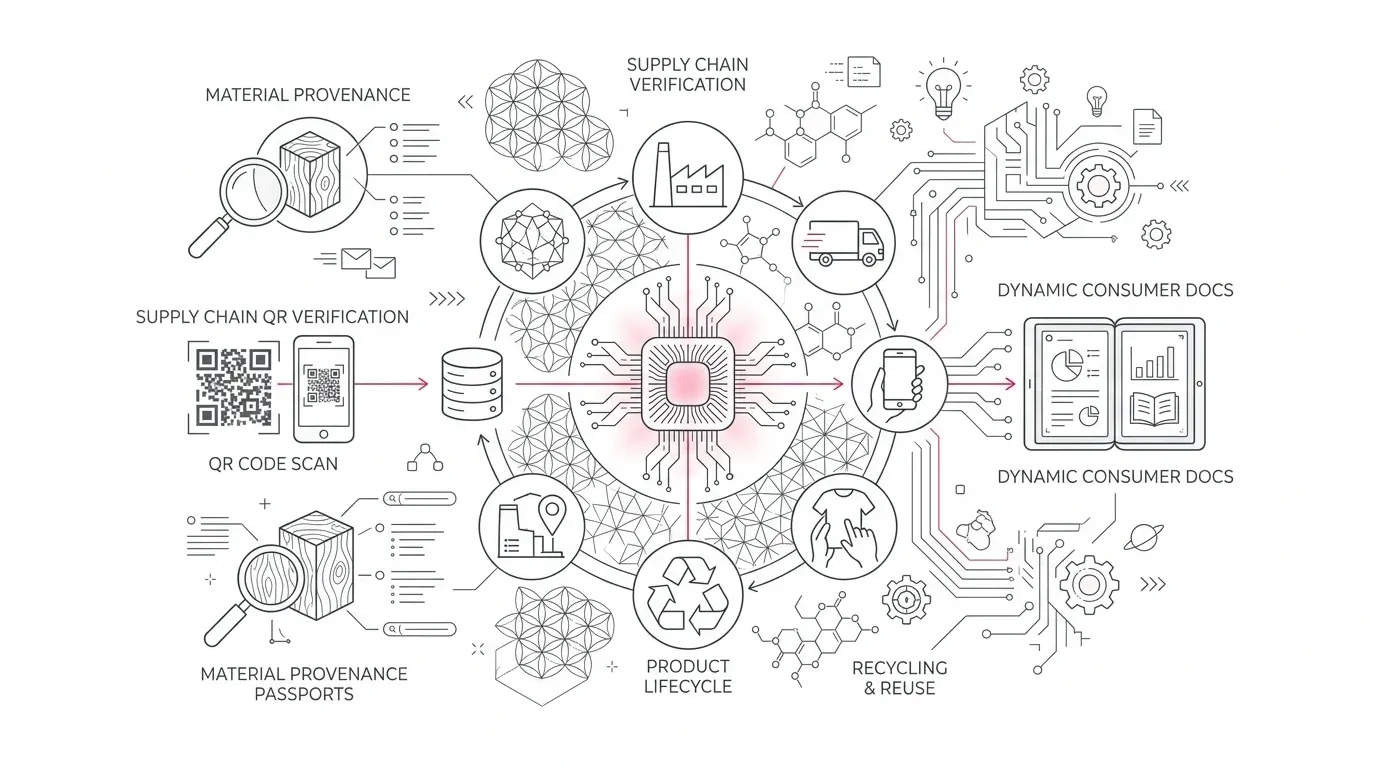
The physical carrier may be a QR code, but the QR code is only a doorway. The Commission’s registry stores unique identifiers, registration data and high-level metadata, rather than the complete passport content. The detailed product information remains decentralised with the economic operator or a DPP service provider. That distinction matters: generating a scannable symbol does not register a passport, establish access rights, validate product data or prove conformance. [3] [4]
The rules are also product-specific. ESPR creates the framework, while delegated acts determine which product groups require a DPP, what data it contains, whether it operates at model, batch or item level, where the carrier appears, who may view or update which data and how long the passport remains available. Inclusion in the Commission’s working plan is not, by itself, a current DPP mandate. [2] [4]
This is why “our CCM can make a QR code” is not a compliance answer. It is evidence of an adjacent rendering capability. A credible architecture must first identify the legal and semantic source of truth, then prove how communications consume that truth without silently changing it.
The missing layer is customer understanding
A DPP can be technically correct and still create a poor experience. A consumer deciding whether to buy a product, a technician preparing a repair and a recycler handling end-of-life materials do not need the same presentation, even when they draw from the same product record. The Commission explicitly describes consumer value in terms such as access to usage and maintenance information, repair instructions and spare-parts details. [8]
The communications challenge is therefore not to duplicate the passport. It is to explain the relevant subset, in context, while keeping a verifiable link to the authoritative data. That may mean a pre-purchase comparison, a multilingual onboarding message, a maintenance reminder, a safety notice, a service-agent document, an accessible PDF, an email or SMS prompt, or a scan destination with a clear next action.
For enterprise teams, the architecture should make three planes explicit:
- Product-data plane: product master data, regulatory evidence, identifiers, DPP content, registry interaction, access rights and lifecycle updates.
- Communications plane: approved language, audience rules, visual presentation, accessibility, localization, channel delivery, service workflows and calls to action.
- Evidence plane: the product-data version used, rule and template version, approval, generated output, recipient or actor context, delivery event and any completion or exception.
The separation is a strength. It prevents a communications platform from becoming an ungoverned second product database, while preventing the DPP front end from becoming an inflexible compliance portal that ignores the rest of the customer journey.
Where PDS fits, and where proof is still required
PDS’s public materials verify a relevant set of adjacent capabilities. The platform presents a visual, business-user-oriented editor; data-driven business rules; dynamic visuals including QR codes and barcodes; multilingual generation; document, email and short-message channels; visual workflow automation; and REST-based integration. Its knowledge base also identifies JSON and XML among supported bulk input formats. [9] [10] [12]
For controlled change, PDS documents Draft, Testing and Published stages. Testers can verify output and data mapping before a Publisher approves or rejects release, with rejection comments recorded in the workflow. Those are useful ingredients for governing the human-facing layer around product information. [11] [13]
The credible claim stops there. In the reviewed public sources, PDS does not verify native DPP Registry registration, persistent unique product-identifier management, conformance to the harmonised DPP standards, product-group schemas, access-right enforcement, DPP service-provider obligations, backup continuity, battery-passport functionality or automatic semantic-parity checks. “Not publicly verified” is not the same as “unavailable”; it is a procurement question that must be answered with product evidence.
This boundary makes the PDS case stronger, not weaker. It focuses evaluation on a valuable and testable role: can PDS consume approved product facts and turn them into consistent, comprehensible, governed communications across lifecycle moments, with less specialist dependency and faster controlled change?
Why incumbent recognition should not decide the shortlist
Established platforms bring real strengths. Quadient Inspire publicly emphasizes centralized templates, governance and approvals, APIs, ERP and CRM integration, event-triggered communications and cross-channel delivery. SmartCOMM describes a cloud-native, API-rich platform with reusable governed content, approval workflows, audit trails and multiple output types. OpenText Core Communications documents REST APIs, JSON or XML driver data, interactive editing and batch generation. Messagepoint emphasizes a headless content model that can deliver governed content to endpoints in HTML or JSON. [14] [15] [16] [17]
Those are credible capabilities. They do not make the DPP decision automatic. The conventional CCM scorecard tends to reward the breadth of channels, personalization, deployment models, migration tooling and historical enterprise footprint. DPP readiness exposes additional questions: can the platform preserve a regulated fact across multiple explanations; distinguish public from restricted data; react to product-lifecycle change; keep the carrier-to-passport link intact; and reconstruct what a particular actor was shown?
The reviewed public product pages did not verify native DPP conformance for PDS, Quadient Inspire, SmartCOMM, OpenText Communications or Messagepoint. That is not a finding that they lack the capability. It is a warning against assumption. Enterprises should not award a DPP-adjacent role because a vendor is familiar, appears on an analyst grid or can render a QR code. They should award it after a witnessed test.
Replace the feature grid with a lifecycle proof
A useful proof of concept starts with one regulated product scenario, one authoritative DPP data source and one material change. For example: an industrial battery has a model-level passport; an approved safety or maintenance fact changes; consumers, service technicians and recyclers have different information needs; one audience requires another language; and one recipient cannot use the primary digital route.
Ask each shortlisted CCM platform to demonstrate the following:
- Ingest a versioned product-data payload from the designated source without re-keying regulated facts.
- Generate a human-readable communication and a scannable carrier or link whose identity is supplied by the authoritative DPP service, not invented in the template.
- Apply audience, lifecycle, language and channel rules while preserving the meaning of regulated data.
- Show which content is shared, which is audience-specific and which is locked from editorial change.
- Route the change through testing and accountable approval, then show a before-and-after comparison.
- Deliver or expose the communication through at least two relevant touchpoints, including a usable fallback.
- Reconstruct the evidence: source-data version, template and rule version, approval, generated output, carrier or URI, actor context, delivery result and exception handling.
Then test failure. What happens when the registry is unavailable, the product identifier is unknown, access is denied, the passport has been superseded, source data is incomplete or the communication cannot be delivered? A modern platform should make the exception visible and controlled; it should not convert uncertainty into a polished but misleading output.
The strategic decision
The Digital Product Passport will not turn every CCM platform into a compliance system, nor should it. Its more important effect is to expose whether an enterprise communications architecture can translate governed facts into useful experiences without losing lineage.
PDS has enough verified adjacent capability to deserve a serious, scenario-based evaluation for that communications role. Its business-user orientation, dynamic QR and barcode output, rule-driven content, multilingual and multichannel generation, integration options and staged publishing model align with the human layer the DPP ecosystem needs. The remaining DPP-specific requirements should become acceptance criteria, not marketing assumptions.
Enterprises that evaluate only the most familiar incumbent suites risk optimizing for the category’s past: document production, channel breadth and installed-base reassurance. The future test is harder and more valuable: can a platform make regulated product information understandable, actionable and provable across the product lifecycle? PDS belongs on that shortlist, and the proof should be witnessed.
Scope note. This is not a universal winner table. It records only capabilities visible in the reviewed official sources and the DPP-specific proof an enterprise should request. “Not verified” means the reviewed public sources did not substantiate the capability; it does not mean the capability is absent.
| Platform | Verified adjacent capability in reviewed official sources | DPP-native status in reviewed sources | Proof to require |
|---|---|---|---|
| Perfect Doc Studio | Visual business-user authoring; data-driven rules; dynamic QR codes/barcodes; REST integration; JSON/XML input; multilingual and multichannel output; Draft, Testing and Published stages; Publisher approval. | Native registry registration, DPP standards conformance, access rights, product-group schemas, service-provider duties and battery-passport support not verified. | End-to-end scenario using authoritative identifiers and data; locked regulated fields; semantic-parity checks; exception handling; source-to-output evidence export. |
| Quadient Inspire | Centralized templates and content; governance and approval; API-driven architecture; ERP/CRM integration; event-triggered cross-channel delivery; archive and retrieval claims. | Native DPP functions not verified on the reviewed CCM page. | Show how product facts and identifiers remain authoritative across content variants, lifecycle events, access contexts and archived evidence. |
| SmartCOMM | Cloud-native CCM; documented API suite; reusable and locked content; approval workflows; audit trails; print, PDF, HTML, email, SMS, image and XML outputs. | Native DPP functions not verified on the reviewed SmartCOMM page. | Demonstrate controlled product-data ingestion, audience-specific rendering, change impact, carrier integrity and reconstructable source/template lineage. |
| OpenText Communications / Core Communications | REST APIs; JSON/XML driver data; personalized documents and email; interactive editing; batch generation and job monitoring; broader omnichannel portfolio. | Native DPP functions not verified in the reviewed Core Communications developer page. | Clarify responsibility across CCM, content, archive and any partner DPP service; prove registry/identifier boundary and evidence across components. |
| Messagepoint | Headless CCM; modular reusable content; REST APIs; HTML/JSON delivery to web, mobile, messaging, chatbot and IVR endpoints. | Native DPP functions not verified on the reviewed developer-solutions page. | Prove preservation of regulated data semantics in reusable content, role-based assembly, lifecycle updates and final-presentment evidence. |
A Better Buyer Scorecard
| Criterion | Evidence to witness |
|---|---|
| Authoritative identity | The product identifier and carrier destination originate in the approved DPP architecture and remain stable through composition and delivery. |
| Semantic fidelity | Regulated facts retain meaning across language, channel, template and audience variants; transformations are explicit and testable. |
| Role-aware explanation | Consumers, service teams, repairers and recyclers receive only the information and actions appropriate to their roles and access rights. |
| Controlled change | A changed product fact triggers impact analysis, testing, accountable approval, release and retirement of superseded content. |
| Lifecycle resilience | The experience handles unavailable, superseded, restricted, incomplete or invalid passport states without issuing misleading content. |
| Reconstructable evidence | The enterprise can link source-data version, rule/template version, approval, output, carrier/URI, context, delivery and exception. |
The EU DPP Registry is operational and the battery deadline makes preparation concrete. Do not buy “DPP-ready CCM” as a label. Design the architecture so the regulated passport system owns product identity, content, access and conformance; use CCM to govern the human explanation around it; and connect both through evidence. PDS’s public capabilities justify inclusion in a witnessed shortlist, provided DPP-native gaps are treated as acceptance criteria rather than assumed features.
Invite PDS to a focused DPP communications proof of concept. Bring one product-data payload, one approved identifier and carrier, one material lifecycle change, three audience roles, two languages and two delivery touchpoints. Ask PDS to demonstrate composition, controlled variation, approval, delivery, fallback and a reconstructable evidence trail. The objective is not a generic demo; it is proof that regulated product truth can become clear, actionable communication without becoming a second source of truth.