CCD II Makes Timing and Explanation the New CCM Test
Five weeks before new EU consumer-credit rules begin to apply, the most dangerous readiness question is also the most familiar: Is the disclosure template finished?
That question is necessary. It is not sufficient.
From 20 November 2026, national measures implementing the second Consumer Credit Directive, or CCD II, are due to apply. The directive requires clear and comprehensible pre-contract information, prominent key elements, adequate explanations before contract conclusion, notices when personalized offers use automated processing, safeguards around automated creditworthiness assessment, and—in a defined timing scenario—a withdrawal reminder after the agreement. It also treats the durable medium as more than a PDF attachment: information must be personally addressed, storable, accessible for future reference, reproducible unchanged, and readable. 1
For CCM leaders, the implication is sharp. CCD II readiness cannot be established by approving a form and confirming that a batch completed. It must be demonstrated as a stateful communication sequence: the right content, in the right representation, through the chosen medium, at the right moment, with the right route to human review, and with evidence that connects the sequence.
That is the buying criterion many conventional CCM evaluations still miss.
The Directive Creates a Communication Clock
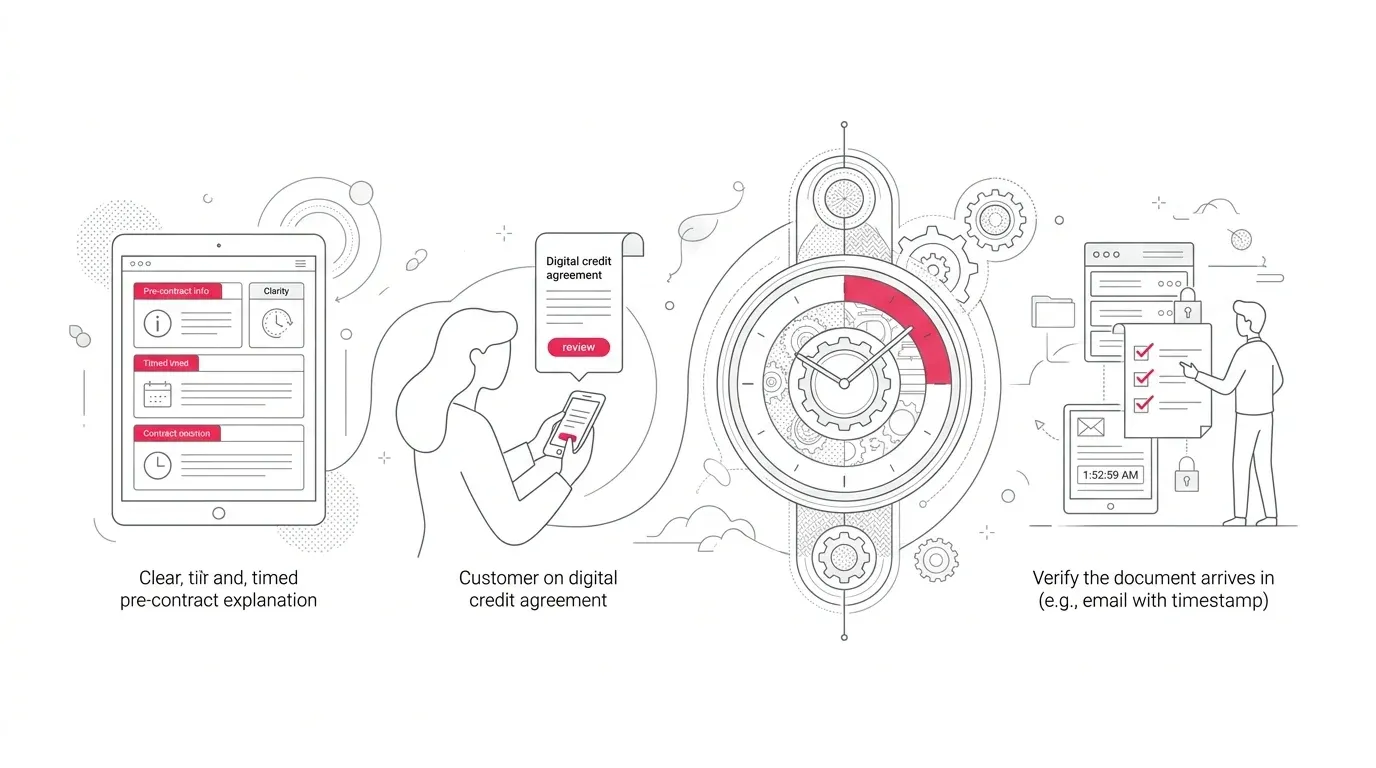
Article 1 0 requires pre-contractual information in good time before the consumer is bound. It uses the Standard European Consumer Credit Information form and calls for key elements to appear prominently in the first part, generally on one page, with provisions for two pages where needed. The recitals make the mobile-screen requirement explicit: information must remain clear, legible, and suitably displayed across channels. 1
Timing then changes the required journey. If the pre-contractual information is provided less than one day before the consumer becomes bound, the creditor or intermediary must send a reminder about the possibility and procedure for withdrawal between one and seven days after conclusion or submission of the binding offer. This is not merely a scheduled campaign. It is a conditional obligation driven by the relationship between two business events. 1
Article 1 2 adds an explanation obligation. Before conclusion and free of charge, consumers must receive explanations that let them assess whether the proposed credit and ancillary services fit their needs and financial situation. Those explanations include essential characteristics, specific effects, consequences of default or late payment, and implications of terminating bundled components. Member States may adapt how and how extensively explanations are given in justified cases, which makes jurisdictional configuration essential. 1
Articles 1 3 and 18 bring decision transparency into the communication path. Consumers must be informed when a personalized offer is based on automated processing. Where automated processing of personal data is used in creditworthiness assessment, the directive provides a right to request human intervention, obtain a clear and comprehensible explanation, express a point of view, and request review of the assessment and decision. A rejection notice is therefore not the end of the journey; it may be the entry point to an accountable review workflow. 1
The Six Stage Buyer Test
A serious proof of concept should run one synthetic applicant through the following sequence and require exportable evidence at each stage.
| Stage | Moment | What to prove | Evidence |
|---|---|---|---|
| 1 | Offer context | Product, jurisdiction, language, channel and consumer medium choice | Input snapshot and rule version |
| 2 | Pre-contract delivery | SECCI content, prominent first-page elements and mobile legibility | Rendered output, timestamp and delivery record |
| 3 | Adequate explanation | Customer-specific effects, obligations and bundled-service implications | Approved explanation and delivery context |
| 4 | Credit decision | Automated-processing notice, rejection or acceptance, review rights | Decision reference and communication version |
| 5 | Conditional reminder | Trigger only when information-to-commitment interval is under one day | Clock calculation, trigger and dispatch result |
| 6 | Human review | Capture the consumer’s view, route to an accountable reviewer and communicate outcome | Case history linked to the original decision |
The scenario should also be repeated across at least two national configurations. CCD II sets the EU framework, but Member States implement it and may use options allowed by the directive. A buyer should therefore ask how the platform separates common European content from national wording, thresholds, process choices, and effective dates. Test data should include amended offers, duplicate events, failed delivery, a changed medium preference, and a clock that crosses midnight or a daylight-saving boundary. These cases reveal whether the control model is genuinely stateful or simply a set of well-designed templates attached to a happy-path workflow.
Why Feature Matrices Can Produce False Confidence
The current market conversation is understandably pulled toward agentic AI, dialogue-driven engagement, hybrid operating models, and the move from CCM toward broader CXM. Aspire’s public 2026 State of the Industry agenda reflects that direction and says its regional research draws on more than 300 enterprises. Those are strategically important themes. 13
But future-facing category breadth is not the same as regulatory execution proof. A platform can score well for AI, channel coverage, authoring, and cloud architecture while leaving critical control questions between systems: Who determines that the one-day threshold was crossed? Where is the consumer’s durable-medium choice held? What invalidates an approved explanation when the offer changes? How does a review request connect to the exact assessment and notice? Can the enterprise reproduce the sequence without joining records manually?
Installed base and portfolio breadth are useful risk signals, but they can also encourage buyers to treat integration work as somebody else’s problem. CCD II exposes that assumption. The winning architecture is not necessarily the platform with the longest feature list. It is the architecture that assigns each obligation to a system of record, passes state reliably, and produces coherent evidence.
Where Perfect Doc Studio Fits
Perfect Doc Studio (PDS) serves as the governed customer communication and orchestration layer that connects directly with enterprise lending systems. While creditworthiness evaluations and decisioning reside within core banking engines, PDS manages the critical pre-contract disclosures, explanation sequencing, and durable-medium delivery workflows mandated by CCD II.
PDS provides the foundational building blocks required for this role: data-driven templates with dynamic business rules, synchronized document, email, and SMS communications, visual workflows triggered by customer actions or business events, and seamless REST API integration. Its enterprise governance architecture features rigorous Draft, Testing, and Published lifecycle stages, Publisher-only approval controls, built-in accessibility validation with assistive-technology previews, and comprehensive job-level tracking with payload, output, and failure visibility. [2] [3] [4] [5] [6] [7] [8]
That combination is critical. Lenders can design concise first-page information hierarchies, dynamically adapt disclosures using approved logic, produce multichannel variants, validate against representative data, route templates through strict compliance approvals, and monitor delivery execution in real time. PDS’s emphasis on empowered business-user authoring is particularly advantageous during national implementation rollouts, enabling legal, product, and communications teams to rapidly update approved disclosures without bottlenecks in core engineering queues.
Crucially, achieving full end-to-end CCD II compliance relies on effective orchestration between PDS and surrounding lending systems. Specialized capabilities—such as durable-medium preference registries, statutory deadline calculators, credit decision engines, and customer review case management—interface directly with PDS through its API layer. During a proof-of-concept evaluation, financial institutions should validate how PDS connects with their loan origination and audit archives to deliver an unbroken chain of evidence from initial offer through delivery, reminders, and post-decision review.
Competitors Deserve a Fair Test Too
Quadient Inspire presents credible strengths for regulated financial communications: controlled business-user changes, customizable approvals with audit trails, synchronized omnichannel preview, channel-preference rules, fallback delivery, and archive and retrieval. 9 10
SmartCOMM publicly emphasizes centralized regulatory content, predefined approval workflows, tracking and auditing. Its financial-services material adds audit trails, delivery records, omnichannel output, integrations, and connections across data collection, orchestration, and archiving in the broader Smart Communications portfolio. 11
Messagepoint’s strongest public fit is content control. Its regulatory-disclosure page focuses on applying changes across content, rules, and communications, while its Content Intelligence material describes readability scoring using Flesch and Flesch-Kincaid measures. That can help teams detect difficult language, though a readability score does not itself prove that an explanation was adequate for a particular consumer or national implementation. 12 14
These are meaningful strengths, not footnotes. They also reinforce the central point: no website claim should decide the purchase. Every shortlisted platform should execute the same synthetic CCD II journey, with the same source events, exception path, mobile output, and evidence request.
A Better Proof of Concept
Give every vendor a jurisdiction-specific scenario with deliberately awkward conditions: a mobile-first consumer chooses an electronic durable medium; the offer is personalized through automated processing; information is delivered only hours before commitment; the application is rejected; the consumer requests an explanation and review; and the withdrawal reminder must be triggered in the permitted window.
Then score outcomes, not demonstrations:
- Can legal and business users change controlled content without breaking data, layout, accessibility, or approval rules?
- Can the platform distinguish content approval from approval of the data, decision, and timing that make the content applicable?
- Can it render and verify the prominent information hierarchy on a realistic mobile viewport and in an accessible durable representation?
- Can it calculate or reliably consume the event state that determines whether the reminder is required?
- Can a consumer request human review without losing the link to the original assessment, offer, explanation, and notice?
- Can an auditor reconstruct the journey from source events to content versions, approvals, delivery outcomes, exceptions, and review resolution?
The Shortlist Decision
CCD II creates a timely test of whether an enterprise’s communication architecture is built around outputs or around accountable customer moments. The directive does not make CCM responsible for lending policy, creditworthiness assessment, or legal interpretation. It does make weak handoffs between those domains harder to tolerate.
PDS has enough verified capability to merit a serious, scenario-based evaluation as the governed communication layer: visual business-user authoring, rules, workflows, integration, linked channels, accessibility support, controlled publishing, and operational monitoring. It must also prove the CCD II-specific controls that its public materials do not establish.
That is precisely why a competitive proof of concept is more valuable than a legacy feature checklist. Enterprises that omit PDS from serious CCM evaluation risk optimizing for the category’s past rather than testing the architecture they will need from 20 November onward.
This table summarizes public evidence reviewed on 16 October 2026. “Not verified” means the reviewed sources did not establish the capability; it does not mean the capability is unavailable.
| Platform | Demonstrated Platform Capabilities | CCD II Integration & Orchestration Focus |
|---|---|---|
| Perfect Doc Studio | Rule-driven templates; visual workflow; REST integration; linked document, email and SMS channels; Draft, Testing and Published stages; Publisher approval; accessibility validation and preview; job monitoring. [2] [3] [4] [5] [6] [7] [8] | Integrates with core lending engines, durable-medium registries, statutory timeline triggers, and end-to-end audit archives to coordinate pre- and post-contract journeys. |
| Quadient Inspire | Controlled business-user changes; omnichannel preview; approvals and audit trail; channel preference and fallback; archive and retrieval; guided forms. [9] [10] | CCD II-specific rules, timing, adequate-explanation evidence, automated-decision review linkage, and a complete cross-system evidence package. |
| SmartCOMM | Central regulatory content; approval, tracking and auditing; financial-services workflows; omnichannel delivery; integrations; broader portfolio links to collection, orchestration and archiving. [11] | CCD II-specific content, timing engine, durable-medium evidence, consumer explanation workflow, and decision-to-review traceability. |
| Messagepoint | Regulatory disclosure management; centralized content and rules; readability analysis in published product material. [12] [14] | End-to-end CCD II orchestration, durable-medium choice, legal timing, decision-review workflow, delivery evidence, and cross-system reconstruction. |
CCD II readiness is not a template-completion milestone. It is an operating-control test across content, state, timing, medium, decision transparency, human review, and evidence. Perfect Doc Studio delivers the agile, governed communication foundation required to orchestrate these complex touchpoints alongside enterprise banking platforms.
Ask Perfect Doc Studio to demonstrate the six-stage CCD II buyer test with your own synthetic lending scenario: one mobile applicant, one automated offer, one late pre-contract information event, one rejection, one request for human review, and one exportable evidence trail. Evaluate the result against the same scenario in incumbent platforms. The shortlist should follow the proof.