An AI agent can retrieve the right customer record, recognize every field, and still take the wrong action.
Perhaps the account is technically overdue, but a service dispute pauses collection. A grant application meets the published criteria, but a conflict-of-interest rule requires another reviewer. A purchase is within budget, but the supplier is subject to enhanced due diligence. The data describes the case; it does not necessarily explain how the organization should handle it.
This is the process-context problem.
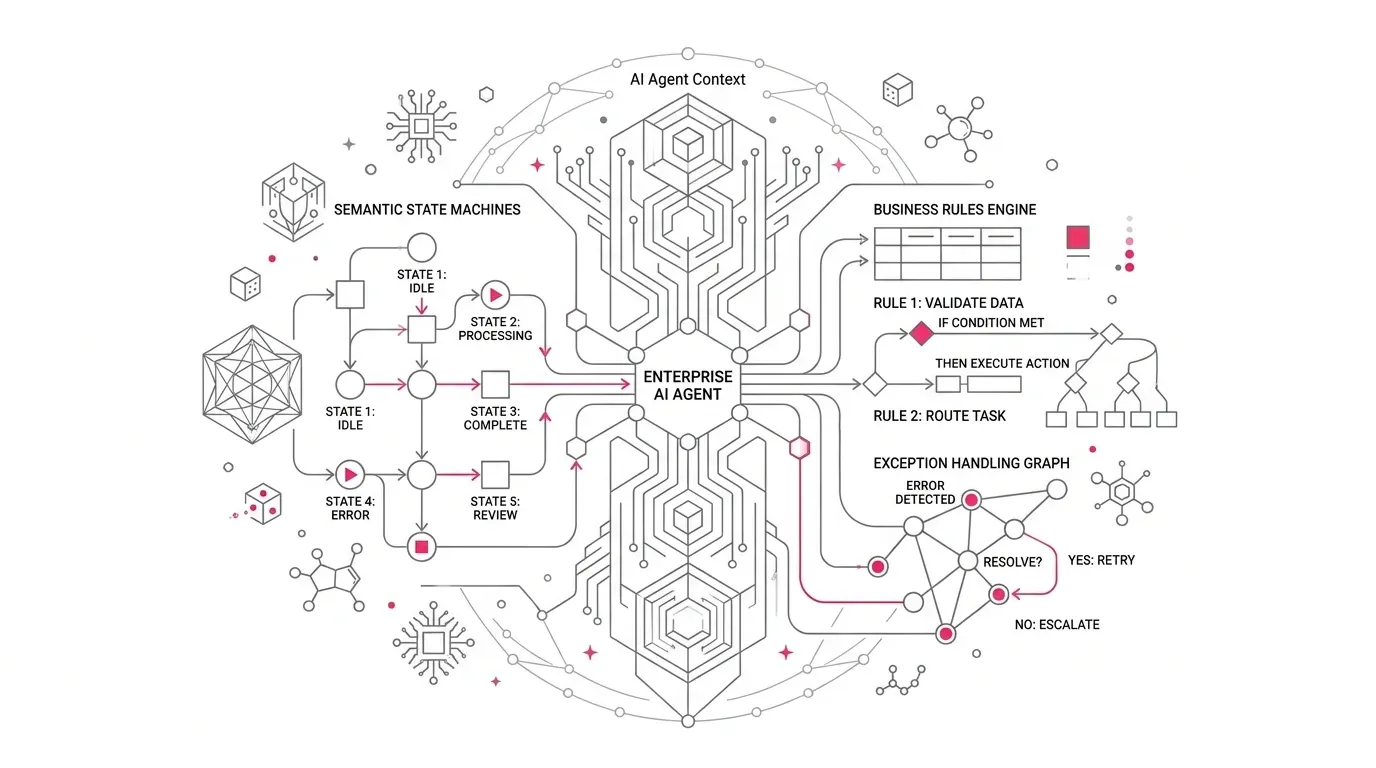
As enterprises move from assistants that produce recommendations to agents that execute work, model capability is only one part of the architecture. Agents also need a reliable representation of how work is supposed to proceed: which rules apply, when the normal path changes, who can approve an exception, what evidence must be preserved, and when the agent must stop.
Recent research reflects that shift. Gartner's September 21, 2026 abstract says organizations cannot scale agents effectively without trusted, machine-readable business context. Its September 30 research argues that advantage is moving toward capturing decision traces and embedding business processes in the agent context layer ( Gartner, September 21, 2026 ; Gartner, September 30, 2026 ).
For business and technology leaders, the implication is practical: connecting an agent to more data is not the same as preparing it to operate.
What process context means
Process context is the machine-usable representation of how work moves from a trigger to an outcome within defined business boundaries.
It includes:
- the goal and current state of a case;
- the normal sequence of activities;
- decision rules and approval thresholds;
- roles, responsibilities, and segregation of duties;
- exceptions, fallback paths, and escalation conditions;
- policies, risks, controls, and evidence requirements;
- the meaning of a successful outcome; and
- the history needed to explain what happened.
Process context overlaps with data, semantics, and system integration, but these are not interchangeable concepts.
| Architecture layer | Question it answers | Example |
|---|---|---|
| Operational data | What is happening now? | Invoice 784 is 18 days overdue. |
| Semantics | What does this information mean? | "Overdue" means the due date has passed without cleared payment. |
| Process context | What should happen under these conditions? | Contact the customer unless a dispute, approved extension, or legal hold is active. |
| Connectivity | What systems can the agent read or change? | Retrieve the account in the CRM and create a collections task. |
An agent needs all four. Connectivity without process context gives it the ability to act without sufficient understanding. Semantics can make records easier to interpret, but it does not automatically encode authority, sequence, exceptions, or accountability. Process context supplies that operational logic.
IBM makes a related distinction in its discussion of a real-time operational layer for agents. It emphasizes that current data must also be accurate, consistent, and governed, using safeguards such as schema validation, data contracts, lineage, and identity and access policies ( IBM, September 30, 2026 ).
Why process documentation is not yet process context
Most organizations already have process knowledge. The difficulty is that it is distributed across flowcharts, policy documents, application code, employee judgment, email conventions, approval matrices, and undocumented exceptions.
A process diagram may show that a manager approves a payment. It may not show that:
- a different threshold applies to restricted funds;
- the requester cannot approve their own purchase;
- an emergency purchase requires retrospective review;
- a sanctions alert suspends the process;
- the supporting document must be retained for a specific period; or
- a regional policy changes the required approver.
That missing detail is often what separates a useful agent from an operational risk.
Microsoft's preview of business skills illustrates one way the market is addressing the issue. Its approach stores natural-language instructions that capture the steps, required information, and rules for a specific process, then makes the governed skill available to connected agents at runtime ( Microsoft, May 1, 2026 ).
The objective is not to turn every procedure into one enormous prompt. It is to create a governed context architecture in which the right agent receives the right operational knowledge for the case at hand.
A seven-part architecture for process-aware agents
Define the outcome and operating boundary
Begin with a business outcome, not a general instruction such as "handle supplier onboarding."
Specify:
- the event that starts the process;
- the state that constitutes completion;
- the cases included and excluded;
- the decisions the agent may make;
- the decisions reserved for people;
- the business owner accountable for the outcome; and
- the measures used to judge performance.
This boundary prevents the pilot from quietly expanding into adjacent decisions with different risk profiles.
Microsoft's core business process transformation pattern makes business ownership and explicit autonomy limits prerequisites for agent-led processes. It also recommends measuring process performance rather than monitoring tool availability alone ( Microsoft Learn, updated July 14, 2026 ).
For a foundation, for example, an agent might be allowed to verify whether an application is complete and request missing materials. It should not infer that it has authority to approve funding.
Supply current operational state
The agent must know the state of the individual case and the wider conditions that affect it.
Relevant context may include:
- transaction and case status;
- recent events;
- prior decisions and commitments;
- deadlines and service-level timers;
- resource availability;
- permissions and consent;
- holds, disputes, or investigations; and
- the effective version of a policy.
Freshness requirements should follow decision risk. A daily refresh may be adequate for a low-risk internal report, but inadequate for inventory allocation, fraud response, benefit eligibility, or a time-sensitive customer commitment.
A data movement platform can help make this layer available by synchronizing operational information across systems. YuniQ SPEED AI describes conversational pipeline configuration, multi-system orchestration, schema mapping and validation, routing, telemetry, spot checks, PII masking, and metadata cataloging. These capabilities can support the data foundation for an agent use case. They do not, by themselves, create a complete process-context layer; business rules, exception logic, authority, and outcome ownership must still be designed.
Establish a shared semantic layer
Operational records frequently use different names, identifiers, and definitions for the same business concept. A semantic layer gives agents stable meaning across those systems.
It should define:
- core entities and their relationships;
- approved business terms;
- status and reason-code meanings;
- authoritative sources;
- data owners and quality expectations;
- valid transformations between schemas; and
- temporal meaning, including when a fact became effective.
This is where a "member," "beneficiary," "customer," or "constituent" may need to be reconciled as one person in some contexts but kept distinct in others.
Schema intelligence and data mapping can assist with structural alignment. However, matching two fields with similar names is not equivalent to proving that they carry the same business meaning. Domain owners must validate important mappings.
Organizations building this layer in Microsoft environments can also consider how governed operational data, lineage, and certified semantic models fit into their Microsoft Fabric architecture .
Encode the process, rules, and exceptions
This is the heart of process context.
Model the happy path, then deliberately model the ways reality departs from it:
- entry and exit criteria;
- required sequence and allowable variation;
- decision tables;
- approval thresholds;
- regulatory or contractual controls;
- regional variations;
- exception categories;
- escalation destinations;
- timeouts, retries, and abandonment rules; and
- compensating actions when a step must be reversed.
Rules should be versioned and traceable to an owner and source. The architecture must also distinguish between guidance the agent interprets and controls the surrounding system enforces deterministically.
Use deterministic enforcement for hard boundaries such as payment limits, access permissions, prohibited actions, and mandatory approvals. An agent may help interpret an ambiguous case, but it should not be the only mechanism protecting a non-negotiable control.
YuniQ's business process automation expertise is a relevant internal resource for organizations that need to discover, redesign, and automate operational workflows alongside the data architecture.
Constrain tools and action paths
Once an agent can act, every tool becomes part of the control surface.
For each tool, define:
- permitted operations;
- required input validation;
- read and write scope;
- transaction limits;
- approval requirements;
- idempotency and retry behavior;
- failure and rollback handling;
- data returned to the agent; and
- logging requirements.
Least privilege should apply to the agent identity as well as the human who initiated the work. A service account with broad standing access is not an adequate authorization model for agents operating across multiple processes.
OpenAI Frontier similarly frames enterprise agent deployment around connected business context, explicit permissions, auditable actions, and execution across existing systems ( OpenAI Frontier ). Regardless of platform, those capabilities still need to be configured around the organization's actual decision rights.
Make accountability and human intervention explicit
"Human in the loop" is too vague to serve as a control design.
Name the person or role responsible for:
- the business outcome;
- each policy or rule set;
- data quality;
- agent configuration;
- access approval;
- exception review;
- incident response; and
- continued operation or retirement.
Then define exactly when human intervention occurs. Useful triggers include:
- low-confidence or conflicting evidence;
- a material financial threshold;
- an action affecting legal rights or eligibility;
- a novel exception;
- missing mandatory evidence;
- a policy conflict;
- a request to communicate externally; and
- a suspected security or privacy incident.
The NIST AI Risk Management Framework provides a useful organizing discipline. Its Core groups risk work into Govern, Map, Measure, and Manage, with governance operating across the other functions. It calls for context of use, roles, risk tolerance, knowledge limits, human oversight, pre-deployment evaluation, and ongoing monitoring to be documented and managed ( NIST AI RMF Core ).
Preserve decision traces and improve the process
A reliable process-context layer must evolve as policies, systems, and operating conditions change.
Record enough information to reconstruct important actions:
- the triggering event;
- data and rule versions used;
- tools called;
- approvals requested and received;
- exceptions encountered;
- final action and outcome;
- overrides and reasons;
- relevant timestamps; and
- failed or abandoned attempts.
Use these traces for operational monitoring, evaluation, audit, and process improvement. They can reveal that a rule is ambiguous, a source is stale, an exception is more common than expected, or a human checkpoint is positioned too late.
Gartner's September 30 abstract specifically points to decision traces and operational context as sources of differentiation. This is a strong reason to treat traceability as part of the architecture rather than an afterthought.
A bounded 30-day pilot
A useful pilot proves one controlled slice of work. It does not attempt to settle the entire enterprise architecture in a month.
Days 1-5: Select and bound the process
Choose a process with:
- meaningful volume or delay;
- a named business owner;
- observable outcomes;
- accessible operational data;
- a manageable number of systems;
- repeated decisions;
- exceptions that are understood well enough to enumerate; and
- a reversible or reviewable first action.
Good candidates might include requesting missing grant-application documents, triaging service cases, validating supplier records, or preparing an approval package. Avoid irreversible payments, employment decisions, or final eligibility determinations as the first autonomous action.
Capture baseline cycle time, error or rework rate, exception volume, and human effort.
Days 6-10: Map reality
Work through recent real cases with frontline staff, process owners, compliance, and technology teams.
Document:
- the intended flow;
- actual variations;
- sources used at each decision;
- rules and their owners;
- common exceptions;
- informal workarounds;
- actions that require approval; and
- evidence required afterward.
An October 20 ARIS announcement describes process context as connecting processes, people, systems, risks, and controls. It cites a survey of more than 200 large-enterprise executives in which organizations with stronger process-context capabilities reported better AI outcomes. The study was conducted with ARIS, a vendor selling process-context software, so it is useful as a directional indicator rather than independent proof of causation ( ARIS, October 20, 2026 ).
Days 11-17: Assemble the minimum context layer
Connect only the data sources required for the chosen case. Define core entities and terms. Encode the applicable rules, exception categories, and approval matrix. Give the pilot identity the minimum necessary permissions.
Test data freshness, null values, conflicting records, authorization, and failure behavior before testing the agent's reasoning. Use disciplined AI-driven engineering for enterprise systems to version, test, and deploy the context contract with the surrounding application changes.
Days 18-24: Evaluate in a protected mode
Run historical and synthetic cases, including:
- standard cases;
- every known exception;
- missing or contradictory evidence;
- stale data;
- tool failure;
- unauthorized requests;
- policy changes;
- adversarial or irrelevant instructions; and
- cases just above and below approval thresholds.
Begin with recommendation-only or shadow mode. Compare the agent's proposed action with the recorded outcome and an expert reviewer's judgment.
Days 25-30: Allow a narrow action and decide
Permit one reversible, low-risk action for cases that meet strict criteria. Route everything else to a person.
At the end of the month, make an evidence-based decision:
- Proceed: Accuracy, control adherence, operational value, and exception handling meet the agreed thresholds.
- Revise: The use case remains valuable, but context, data, or workflow design needs improvement.
- Stop: The process is too unstable, the required data is unreliable, or the expected value does not justify the control burden.
A stopped pilot can be a good outcome if it prevents an unsafe production deployment.
Decision checklist for enterprise and nonprofit leaders
Before an agent acts in a live process, ask:
- Is one business leader accountable for the outcome?
- Is the trigger, completion state, and scope explicit?
- Do we know which system is authoritative for every critical fact?
- Are freshness requirements tied to decision risk?
- Are business terms and entity relationships defined?
- Have frontline experts documented real exceptions?
- Are hard rules enforced outside the model where appropriate?
- Are agent permissions limited by task and environment?
- Are high-impact and irreversible actions gated?
- Can a reviewer understand which data, rules, and tools produced an action?
- Can the process recover safely from a tool or model failure?
- Are overrides, appeals, incidents, and policy changes handled?
- Are success measures tied to process and business outcomes?
- Is there an owner and timetable for reviewing the context after launch?
If several answers are no, improving the context architecture is likely more valuable than changing the model.
Build the context before expanding autonomy
The most important question is not whether an agent can complete a task in a demonstration. It is whether the organization can explain why the agent should take that action, under which rules, with whose authority, and what happens when the case does not follow the normal path.
Data integration is a necessary part of that foundation. SPEED AI can be evaluated for the data movement, mapping, validation, routing, masking, metadata, and monitoring requirements behind a bounded use case. It should be considered as one component of a broader architecture that also includes process design, semantic governance, deterministic controls, identity, human accountability, and evaluation.
CTA: Explore SPEED AI and request a proof-of-concept environment using one well-bounded process, its required source systems, and an agreed set of control and outcome measures.
Frequently asked questions
What is process context for an AI agent?
Process context is the machine-usable knowledge an agent needs to understand how work should proceed. It includes process state, rules, roles, approvals, exceptions, controls, and expected outcomes. It goes beyond retrieving records or defining business terms.
Is a knowledge graph the same as process context?
No. A knowledge graph can represent entities, meanings, and relationships, making it a valuable part of the context architecture. Process context additionally covers sequence, current workflow state, decision rights, exceptions, controls, and action boundaries.
Can process context be stored in prompts?
A prompt can contain limited instructions, but it is rarely sufficient for a governed enterprise process. Rules and policies change, cases require different context, permissions must be enforced, and decisions need traceability. Important process context should be versioned, retrieved selectively, tested, and supported by controls outside the model.
Does connecting an agent through MCP provide process context?
Model Context Protocol can provide a standardized way for an agent to access tools or context sources. It does not ensure that the underlying information is accurate, complete, current, authorized, or sufficient for a business decision. Those responsibilities remain part of enterprise architecture and governance.
Where should a nonprofit foundation begin?
Start with a repetitive, reviewable workflow such as application completeness checks, grantee-report intake, knowledge retrieval, or preparation of a review package. Keep funding decisions, eligibility judgments, and sensitive external communications under meaningful human authority until the evidence supports a carefully bounded increase in autonomy.