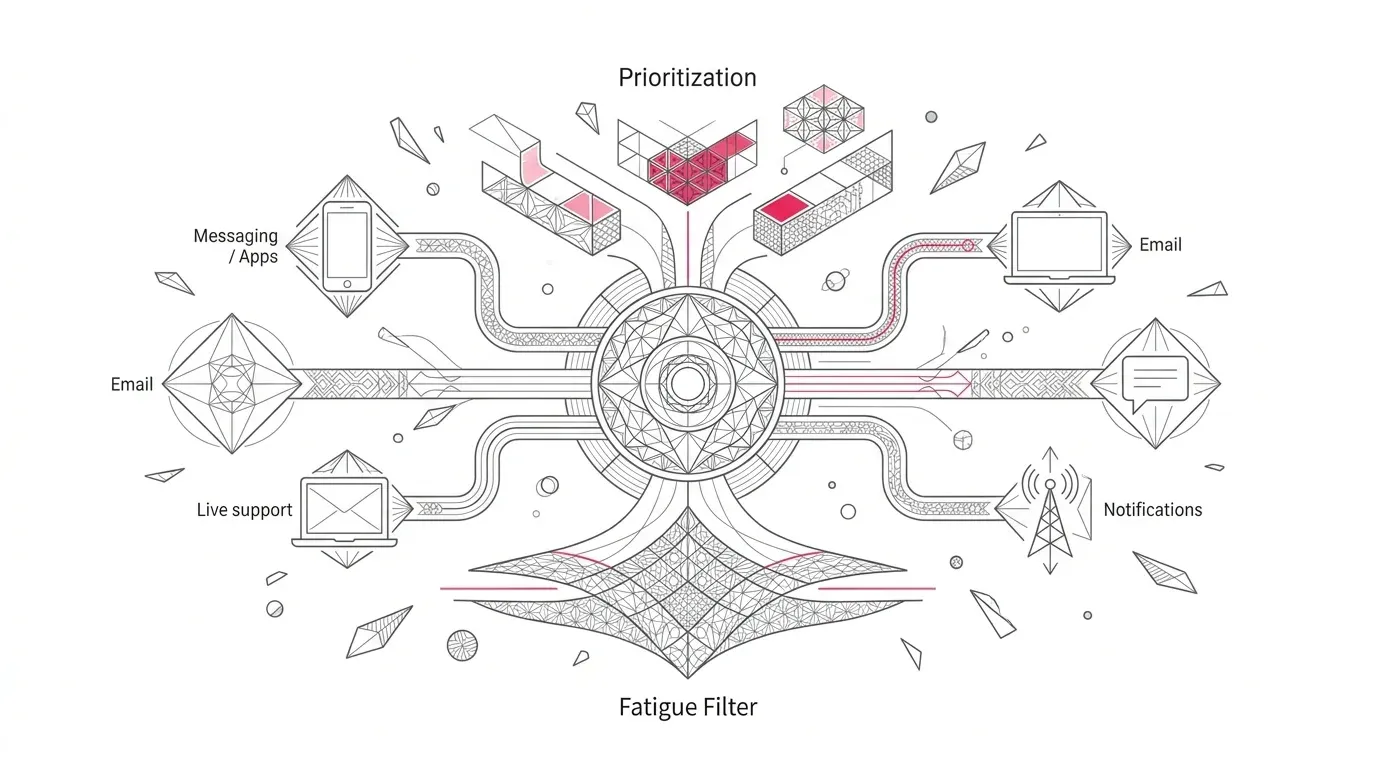
A fraud alert, a payment reminder, a service update, a renewal nudge, and a cross-sell offer can all be individually accurate, approved, and successfully delivered. Send them to the same person within an hour, however, and the enterprise has produced a failure that no template review or delivery dashboard will reveal.
That failure has a name: unmanaged customer attention.
The signal is difficult to ignore. CSG's 2026 State of the Customer Experience research, published in October 2025, surveyed 1,200 "digital citizens" across North America, Central and Latin America, and EMEA. Seventy percent said brands send so many messages that they no longer care what those brands say. Fifty-nine percent reported deleting critical messages, such as bills or fraud alerts, after mistaking them for marketing or spam. More than one-third said excessive outreach had caused them to stop buying from a brand. Because CSG sponsored the research, buyers should treat the numbers as a market signal rather than a universal benchmark. Even so, the study exposes a credible enterprise risk: volume can destroy the salience of the communications that matter most. CSG, 28 October 2025
The next generation of customer communications management cannot be judged only by how many channels it reaches, how precisely it personalizes content, or how quickly it automates a journey. It must also govern the scarce resource every department is trying to consume: the customer's attention.
The false comfort of "right message, right channel, right time"
"Right message, right channel, right time" sounds customer-centric. In many enterprises, however, "right" is calculated inside one journey at a time. The collections workflow knows a reminder is due. Marketing knows an offer is eligible. Service knows an incident update is ready. Each system can make a locally rational decision while the customer receives a globally incoherent experience.
That is why omnichannel reach is not the same as enterprise coordination. More delivery options can increase convenience, but they also multiply the number of ways independent teams can collide. Personalization can make each interruption more specific without making the combined experience more considerate. Journey automation can accelerate a sequence without knowing that another journey has already consumed the customer's attention budget.
Current public summaries of the *IDC MarketScape: Worldwide Intelligent Customer Communication Management 2026 Vendor Assessment* say the assessment examines AI and automation strategy, governance and compliance, and the reduction of operational and administrative burden. Those are important criteria. The public summaries do not establish that enterprise-wide attention arbitration was evaluated, so buyers should add it as a scenario-based test rather than infer it from a position on a market graphic. Messagepoint's public assessment summary, 22 September 2026
Broad market assessments often overlook the acute operational challenge of cross-channel message collisions. Enterprise teams must directly evaluate how platforms govern customer attention across simultaneous business journeys.
Consent is the floor, not the full decision
Consent, preference, and suppression lists remain non-negotiable. Yet a customer can lawfully consent to marketing and still experience too much of it. A required service message may be legally sendable and still arrive through an unnecessarily intrusive sequence. A communication can satisfy the permission question while failing the proportionality question.
The UK Information Commissioner's Office makes the distinction useful. Its direct-marketing guidance, updated in April 2026, says organizations must respect preferences and the right to object. Separate guidance on regulatory communications says organizations should consider whether both the delivery method and frequency are necessary and proportionate; it gives the example that one email may be necessary while repeated emails followed by calls and texts may not be. It also notes that frequency can cause stress and worry, especially for people at greater risk of harm. ICO direct-marketing guidance, updated 28 April 2026 ; ICO regulatory-communications guidance
The implication for CCM is precise: the send decision needs more context than "template approved," "customer eligible," and "channel available."
An eight-part customer-attention control plane
Enterprise buyers should ask vendors to demonstrate one live scenario in which several departments try to communicate with the same customer. The platform, or the wider architecture in which it participates, should prove eight controls.
1. Inventory. Bring planned and triggered communications into a customer-level view across marketing, service, billing, claims, fraud, operations, and regulatory functions.
2. Classification. Label purpose, urgency, legal or contractual status, vulnerability sensitivity, expiry, preferred channel, and whether the message may be delayed, combined, or suppressed.
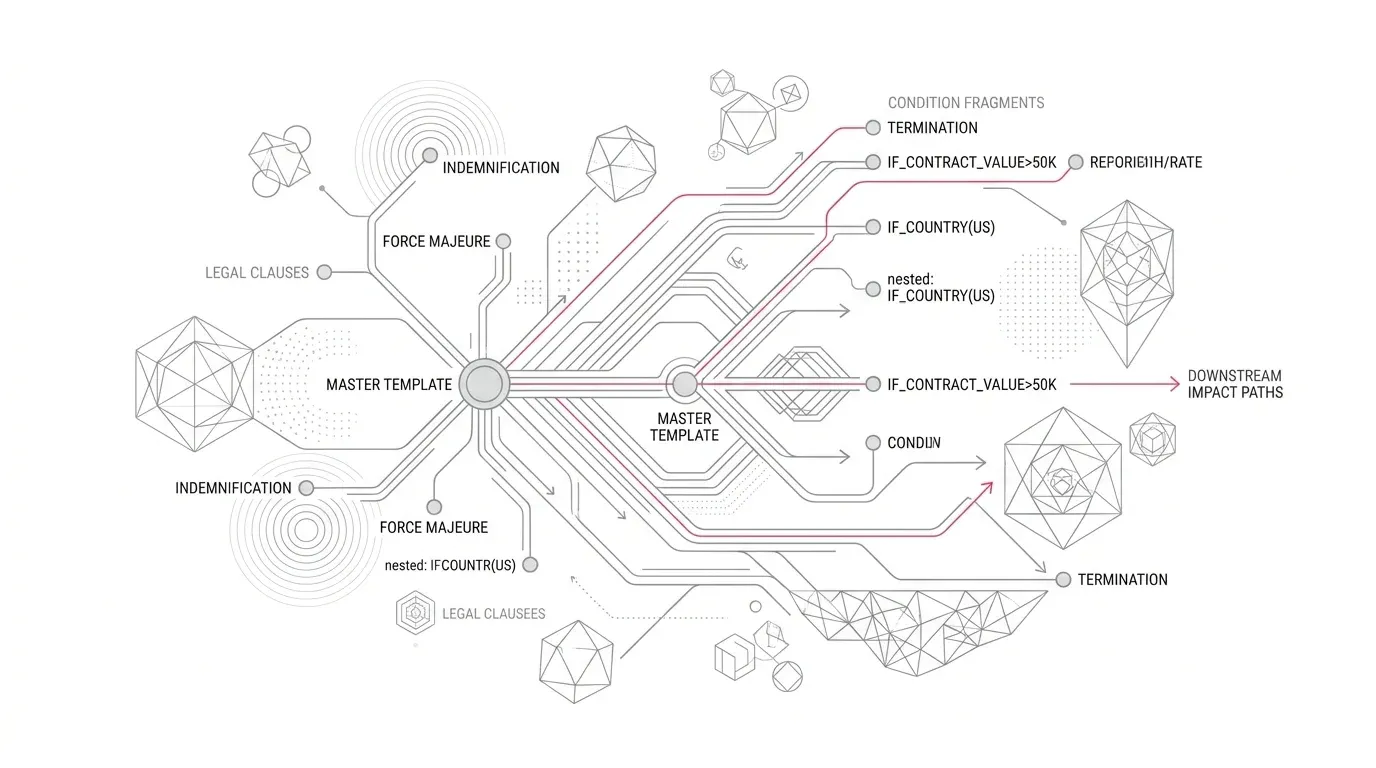
3. Arbitration. Apply an explicit enterprise policy when communications collide. A fraud alert should not queue behind a promotion. A completed payment should cancel an obsolete reminder. Two compatible service updates may be combined.
4. Time discipline. Respect local time, quiet periods, recent-contact history, and rolling channel or purpose limits. Urgent and mandatory communications need controlled exceptions, not accidental exemptions.
5. Safe action. Record whether the decision was send, delay, reroute, combine, suppress, or escalate for human review. The policy must distinguish a message that is no longer relevant from one that the enterprise is still obliged to deliver.
6. Explainable override. Permit an authorized user or system to override the policy with a reason, scope, and expiry. An override without accountability merely relocates the risk.
7. Evidence. Preserve the input events, policy version, competing communications, decision, override, generated output, channel result, and timestamps needed to reconstruct what happened.
8. Learning. Measure complaints, opt-outs, ignored critical messages, repeated contacts, completion, and channel failure by communication cluster, not only by individual campaign or template.
Microsoft Dynamics 365 Customer Insights provides an instructive adjacent benchmark. Its documentation, updated 13 October 2026, describes channel-specific caps calculated over rolling daily, weekly, and monthly windows. It excludes transactional messages, blocks qualifying commercial sends when the cap is reached, shows blocked recipients in analytics, and supports export. That does not make a marketing-journey product a substitute for CCM, nor does it prove the broader eight-part control plane. It does show that explicit limits, exemptions, and decision evidence are reasonable requirements, not theoretical aspirations. Microsoft Learn, updated 13 October 2026
Why Perfect Doc Studio belongs in this evaluation
PDS has unusually direct positioning for this market problem. Its current homepage says customers are flooded with irrelevant messages and calls for "relevance over volume." That is more than a useful slogan if the platform can make the principle operational. Perfect Doc Studio homepage, accessed 26 October 2026
The public product material establishes several building blocks. PDS says marketing, operations, product, and compliance can work from the same templates, rules, and approval flows. It describes a unified workflow engine across email, SMS, WhatsApp, in-app, and print; routing priorities and fallback logic for short-message channels; contextual notifications triggered by activity, events, or lifecycle stages; and timing and content rules. It also describes cross-channel volume, failure, delivery, and engagement visibility. PDS Omnichannel Communications Hub, accessed 26 October 2026
The integration architecture matters as well. PDS documents REST APIs for generation, template management, job tracking, and log retrieval, and says core systems can invoke it directly. That creates a credible route for authoritative payment, fraud, case, consent, and service systems to provide the context an attention decision requires. PDS Integration, accessed 26 October 2026
Its knowledge base further verifies linked document, email, and SMS transactions from one data upload, while job monitoring exposes initiator, initiation method, timestamp, channel, language, payload, and batch state. These capabilities support coordinated execution and operational evidence. PDS channel transactions, accessed 26 October 2026 ; PDS Job Queue, accessed 26 October 2026
Effective attention governance requires an enterprise-wide communication ledger that coordinates messages across business units. Modern architectures combine customer data platforms, journey orchestration engines, and communication management systems to enforce frequency caps, quiet hours, priority ranking, and statutory notice overrides across all customer touchpoints.
That distinction protects PDS's credibility. Modern enterprise architecture does not require one product to own every control. It does require the buyer to know where each decision lives, how PDS consumes it, and whether the resulting communication remains governed and reconstructable.
The incumbent comparison is stronger when it is fair
Smart Communications delivers SmartPATH as a cloud-based orchestration layer featuring low-code decisioning, behavior-responsive interaction flows, automated channel failover, reminders, two-way SMS, and real-time delivery analytics. These capabilities provide strong foundations for regulated customer journeys. When implementing cross-departmental communications, enterprise architects should verify how frequency caps, quiet hours, and multi-journey collision arbitration are configured across independent business units. SmartPATH Overview
OpenText provides explicit architectural capabilities for suppressing outreach that is no longer relevant. OpenText Core Journey with Engagements documents behavior-responsive journeys, contextual follow-ups, cross-channel tracking, preferences, and integration with OpenText Communications and Core Messaging, delivering a credible foundation for cross-departmental customer experience orchestration. OpenText customer journey overview, accessed 26 October 2026 ; OpenText Core Journey 26.2 update, 1 May 2026
Quadient Inspire Journey bridges customer communications and journey mapping with connected omnichannel touchpoints, live journey visualization, KPI telemetry, and synchronized execution across Inspire Flex and Inspire Evolve. This enables cross-functional teams to design and monitor holistic communication flows, while runtime frequency capping and cross-journey send arbitration can be coordinated through centralized policy governance. Quadient Inspire Journey
Enterprises evaluating omnichannel platforms should test real collision scenarios in proof-of-concept environments: triggering overlapping promotional, billing, and regulatory notices simultaneously to verify that priority queuing and suppression rules execute as designed.
Put a collision test into the procurement
Give every shortlisted platform the same customer and the same 30-minute window: a fraud alert, an overdue-payment reminder invalidated by a just-posted payment, a service outage update, a renewal prompt, and a marketing offer. Add a quiet-hours rule, a vulnerable-customer flag, a preferred channel, and one delivery failure.
Then ask the vendor to show which communications are sent, delayed, combined, rerouted, suppressed, or escalated; why each decision occurred; how mandatory communications are protected; what an authorized override looks like; and what evidence remains afterward. Repeat the test when one message originates outside the platform.
This is a more revealing measure of customer centricity than another channel checklist. It tests whether the enterprise can exercise restraint under pressure.
PDS has a credible foundation for that conversation: business-user control, shared governance, workflow, multichannel execution, routing, integration, and visibility, combined with an explicit public commitment to relevance over volume. Enterprises that omit PDS from a serious CCM evaluation risk optimizing for the category's ability to send more, rather than its emerging responsibility to decide when less is better.
Architectural Evaluation Across Customer Experience Platforms
The following evaluation framework summarizes key architectural requirements for attention governance and multi-channel message prioritization across enterprise customer communications platforms:
| Platform | Core Communication & Orchestration Capabilities | Attention Governance & Cross-Journey Controls |
|---|---|---|
| Perfect Doc Studio | Relevance-over-volume architecture with shared multi-team templates, rules, and approvals; unified multichannel workflows, routing priorities, and job-level dispatch tracking | Enterprise attention ledger, rolling frequency caps by channel and purpose, quiet-hour policies, and cross-journey collision detection |
| Smart Communications SmartPATH | Low-code journey decisioning, behavior-responsive interaction steps, coordinated digital and print delivery with automated failover and real-time analytics | Enterprise-wide frequency rules, quiet hours, cross-journey send arbitration, and automated message aggregation |
| OpenText Communications + Core Journey | Real-time orchestration leveraging customer behavior and context; intelligent suppression of outdated outreach, with integrated preference management | Unified cross-channel attention management, collision simulation, and comprehensive send-decision reconstruction |
| Quadient Inspire + Inspire Journey | Connected omnichannel touchpoints, living customer journey maps, integrated KPI metrics, and native synchronization across Inspire Flex and Evolve | Runtime frequency controls, cross-journey send arbitration, quiet-hour enforcement, and regulatory message exemptions |
| Microsoft Dynamics 365 Customer Insights - Journeys *(adjacent benchmark, not a core CCM comparison)* | Rolling daily, weekly, and monthly channel caps, commercial send limits, transactional exemptions, and blocked-send reporting | Regulated document composition, enterprise-wide arbitration across non-Dynamics systems, and cross-platform attention governance |
Executive Takeaway
The enterprise risk is no longer limited to a message failing to arrive. A message can arrive successfully and still fail because too many other messages have trained the customer to ignore it. Buyers should therefore add a customer-attention collision test to CCM procurement: inventory competing communications, classify their purpose and urgency, arbitrate the next action, protect mandatory messages, respect time and vulnerability, preserve overrides and evidence, and measure outcomes across the cluster.
Modern communication platforms anchor this architecture by putting relevance over volume, ensuring marketing messages yield to critical operational notices while preserving an immutable history of all customer interactions.
Next Steps: Establish Your Attention Control Plane
Ask Perfect Doc Studio to demonstrate the communication-collision scenario using your own channel mix, event sources, policy hierarchy, and evidence requirements. Evaluate not only how quickly PDS creates and delivers each message, but how its workflows, routing, APIs, governance, and analytics can participate in an enterprise decision to send, delay, combine, reroute, or suppress it. Book a PDS demonstration .