Enterprise CCM is often evaluated from the production center outward. Customer experience is won or lost in the opposite direction: at the moment a frontline employee must safely adapt one communication to one customer.
A claims handler needs to explain an unusual settlement condition. An underwriter needs to add a customer-specific clause. A service agent must correct a detail before a letter leaves the organization. The template is approved, the data is mostly right, and the communication cannot wait for a development ticket. This is where a polished CCM strategy meets operational reality.
Most enterprise evaluations still give disproportionate attention to the production center: composition throughput, channel breadth, installed base, deployment choices, and the size of the vendor ecosystem. Those criteria matter. They do not answer the last-mile question: can an authorized employee make the one permitted change, in context, without copying content into Word, creating a shadow template, or bypassing governance?
The market is moving toward that question. OpenText Communications CE 26.1 promotes integrated workflows in Guidewire BillingCenter that allow users to edit, review, and approve communications while keeping output audit-ready and on brand. Its June 2026 update also emphasizes operational visibility and audit readiness across generated communications. [4] Quadient says Inspire Interactive lets business users and customer-facing staff edit predefined content blocks through a browser and connect the communication to existing business processes. [3] SmartCOMM describes personalized, interactive communications for CRM business users and separately documents locked regulatory blocks, approval workflows, and audit trails. [5] [8]
This is not a niche feature race. It is a change in where CCM must prove its value. The new enterprise benchmark is not simply how efficiently a platform produces millions of standard communications. It is how safely it resolves the exception sitting in front of an employee and a customer right now.
The editable edge is a distinct architecture problem
Interactive communications sit between two operating models. On one side is deterministic automation: approved templates, governed data, reusable content, business rules, and batch or on-demand generation. On the other is case-by-case judgment: a person who knows what changed, what the customer needs, and which explanation belongs in this communication.
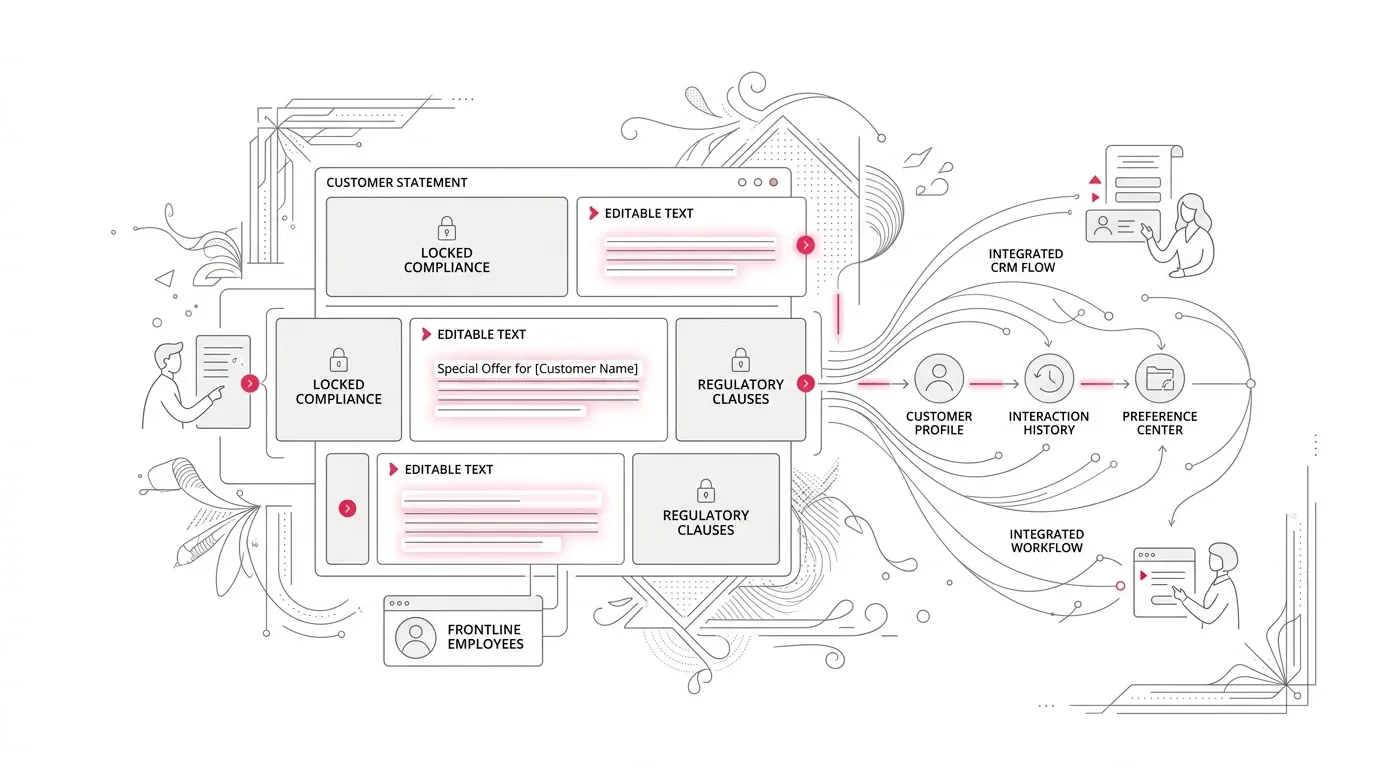
Poorly designed systems force a false choice. Lock everything down and every exception becomes an IT or document-production queue. Open everything up and the organization invites uncontrolled wording, inconsistent disclosures, broken branding, and records that are difficult to reconstruct. The right design constrains freedom. It exposes only the content that a role may change, preserves protected structure and language, shows the composed result in context, and routes exceptional changes through the correct controls.
PDS makes that model unusually concrete in its public documentation. Its Interactive Documents feature lets users customize a communication without modifying the original design. [1] Administrators can mark individual text or creative blocks as editable; blocks that are not enabled remain unavailable for modification. An API call can push a design into the interactive area, and the completed communication can then be delivered through the integrated system. [9]
That architecture connects to broader PDS capabilities that the company publicly describes: conditional logic in Smart Templates, workflow automation, embedded review and editing inside business applications, and role-based access to templates. [2] Together, these features support a credible proposition: keep the master controlled, bring the exception into a bounded workspace, and let the business complete the interaction without handing the entire communication model to the frontline user.
The qualification matters. The reviewed PDS sources do not establish every control an enterprise should expect. They do not clearly document, for Interactive Documents specifically, a multi-stage approval path, a durable item-level audit trail, retention behavior after completion, simultaneous-edit handling, or the treatment of newly added free-form blocks. PDS should prove those behaviors in the target deployment rather than asking buyers to infer them from adjacent workflow or access-control features.
Incumbents are strong here and that sharpens the PDS case
Quadient Inspire Interactive is a serious benchmark. Quadient documents browser-based control over messages and targeting rules for predefined content blocks, cross-channel proofing, configurable approval, and the ability to trigger communications from an existing platform. [3] Buyers with complex, established Inspire estates may value the breadth and continuity of that environment. The practical question is not whether Quadient can support interactive work. It is how much design, specialist skill, integration effort, and operational ownership the buyer needs for the exact employee journey being modernized.
OpenText Communications is also advancing quickly. Its 2025 and 2026 releases connect interactive editing, review, approval, orchestration visibility, and Guidewire workflows; its broader proposition spans cloud-native and hybrid or off-cloud deployment. [4] That breadth can be an advantage for enterprises standardizing on OpenText or modernizing a large Exstream estate. It also makes proof-of-concept discipline essential: test the target business process, not the maximum theoretical platform footprint.
SmartCOMM has a well-documented business-user and governance story. It positions interactive communications for CRM users and lists approval workflows, audit trails, and locked regulatory content blocks. [5] [8] Its Duck Creek integration states that underwriters can create customer communications from within their core environment using free or pre-approved text. [10] For buyers, that raises the bar for PDS: ease of editing alone is not differentiation. PDS must demonstrate that its combination of visual design, block-level control, API handoff, and flexible integration produces a simpler operating model for the chosen use case.
This fair comparison leads to a stronger conclusion than a universal winner table. All four vendors can point to relevant interactive capabilities. The buyer should therefore measure the work between a case trigger and a defensible final record. That is where product architecture becomes operating performance.
Challenge the leaderboard first buying habit
Analyst evaluations are valuable because they impose structure on a crowded market. Forrester describes the Wave as a guide based on transparent criteria and explicitly provides an interactive experience so clients can customize findings to their needs. It also says its criteria are intended to be differentiating rather than exhaustive. [6] IDC explains that MarketScape positions depend on weighted capabilities and strategies, with market share represented separately by bubble size. [7]
The implication is straightforward: using an analyst graphic as a procurement shortcut defeats the purpose of the research. A vendor can be strong across the category and still impose unnecessary friction in the one workflow that drives the buyer's business case. A less familiar vendor can deserve a shortlist place when its architecture maps more directly to that workflow and survives enterprise control testing.
For interactive CCM, conventional scoring can obscure the cost of the handoff between automation and judgment. Installed base does not reveal how many screens an employee must cross. Feature breadth does not show whether protected clauses remain protected during a live case. Omnichannel coverage does not prove that a manager can review an exception without generating duplicate artifacts. Market presence does not measure the elapsed time between identifying a necessary change and producing a traceable, approved output.
This is the opening for PDS. Its public evidence supports a focused evaluation around bounded editing and embedded work. It should not claim category superiority on that evidence alone. It can credibly insist that enterprises test whether a modern, business-user-first platform handles the last mile with less operational friction than a familiar incumbent configuration.
A proof of concept for the editable edge
A useful proof of concept should start with a real exception, not a vendor-led product tour. Choose a high-value communication such as a claims letter, renewal notice, adverse-action explanation, negotiated contract, or regulated service response. Give each vendor the same approved master, data inputs, role model, and exception scenario. Then measure the complete path.
- Time to configure the master template, protected content, editable regions, and reusable components.
- Time and number of handoffs from the originating case event to the employee editing experience.
- What the user can change, what the user cannot change, and how those boundaries are administered by role.
- Whether data, rules, protected language, branding, and pagination remain correct after the exception is added.
- How preview, approval, rejection, rework, and final delivery behave inside the real business application.
- What evidence remains: editor identity, changed content, timestamps, approvals, source template version, data version, output, and delivery status.
- How concurrent work, abandonment, failed delivery, and post-send correction are handled.
- What specialist skills and environments are required to change the workflow six months after go-live.
This scorecard changes the conversation. It makes enterprise control non-negotiable while refusing to equate complexity with safety. It also exposes hidden operating costs that are rarely visible in a broad feature matrix: queues, context switching, duplicate artifacts, specialist dependencies, and exception rework.
Why PDS belongs on the shortlist now
PDS can make a serious case at the editable edge because the product model described publicly aligns with the problem: business users can review and edit generated documents inside existing systems; designers can restrict editability to selected blocks; the original master remains unchanged; API calls can initiate the interactive work; role-based access limits template visibility and editing. [1] [2] [9]
That evidence does not erase the strengths of Quadient, OpenText, or SmartCOMM. It gives buyers a reason to test PDS beside them. The decision should turn on demonstrated workflow fit, control evidence, implementation effort, and long-term change ownership, not familiarity alone.
The future of CCM will still require scale, channels, governance, and reliable composition. It will also require a more precise kind of agility: the ability to let the right person make the right exception at the right moment without weakening the system around them. Enterprises that omit PDS from serious CCM evaluation risk optimizing for the category's production-centric past rather than the point of work where its future value is created.
The matrix summarizes only capabilities verified in the reviewed public sources. It is not a universal ranking and should be converted into a scripted proof of concept.
| Platform | Point of work | Edit boundary | Governance evidence | Buyer implication |
|---|---|---|---|---|
| Perfect Doc Studio | Embedded in business applications; API can push work to Interactive Documents | Selected text and creative blocks; original master unchanged | RBAC documented; interactive-specific approval and item-level audit trail not verified in reviewed sources | Focused block-level model and visual/no-code positioning; validate enterprise evidence model |
| Quadient Inspire Interactive | Browser interface; connection from existing platform | Messages and targeting rules for predefined blocks; cross-channel proofing | Configurable review and approval documented; item-level audit detail not verified in reviewed source | Mature interactive workflow; validate implementation and specialist dependency for target journey |
| OpenText Communications | Integrated Guidewire workflows and Interactive Editor | Generated communications can be edited before saving; exact block granularity not verified in reviewed source | Edit, review, approval, audit-ready output, and orchestration visibility documented | Broad enterprise suite and deployment options; scope the proof of concept to the actual workflow |
| SmartCOMM | CRM and core-system integrations including Duck Creek | Free or pre-approved text documented in Duck Creek; locked regulatory blocks documented | Approval workflows and audit trails documented | Strong business-user and governance evidence; compare operating effort and change ownership |
Do not select interactive CCM by counting features or reading a leaderboard from left to right. Select it by running a controlled exception through the employee's real system and measuring elapsed time, editable scope, approvals, final-output integrity, and reconstructable evidence. PDS has enough verified capability to earn that test. Its opportunity is to prove that bounded editing, API integration, and business-user control can reduce last-mile friction without relaxing governance.
Ask Perfect Doc Studio to demonstrate the editable edge using one of your own regulated or high-value communications. Bring an approved master template, a realistic customer exception, your role model, and your evidence requirements. Measure the path from case trigger to final delivery, then compare it with the incumbent workflow on the same scenario. Explore PDS Interactive Documents and request a demonstration tailored to your operating system of record.