A customer buys a service online, changes their mind and looks for the way out. If the withdrawal control is hidden, the experience has already failed. If the control works but the acknowledgement arrives late, omits what was submitted or cannot be reproduced during a dispute, the enterprise has solved the interface and missed the obligation.
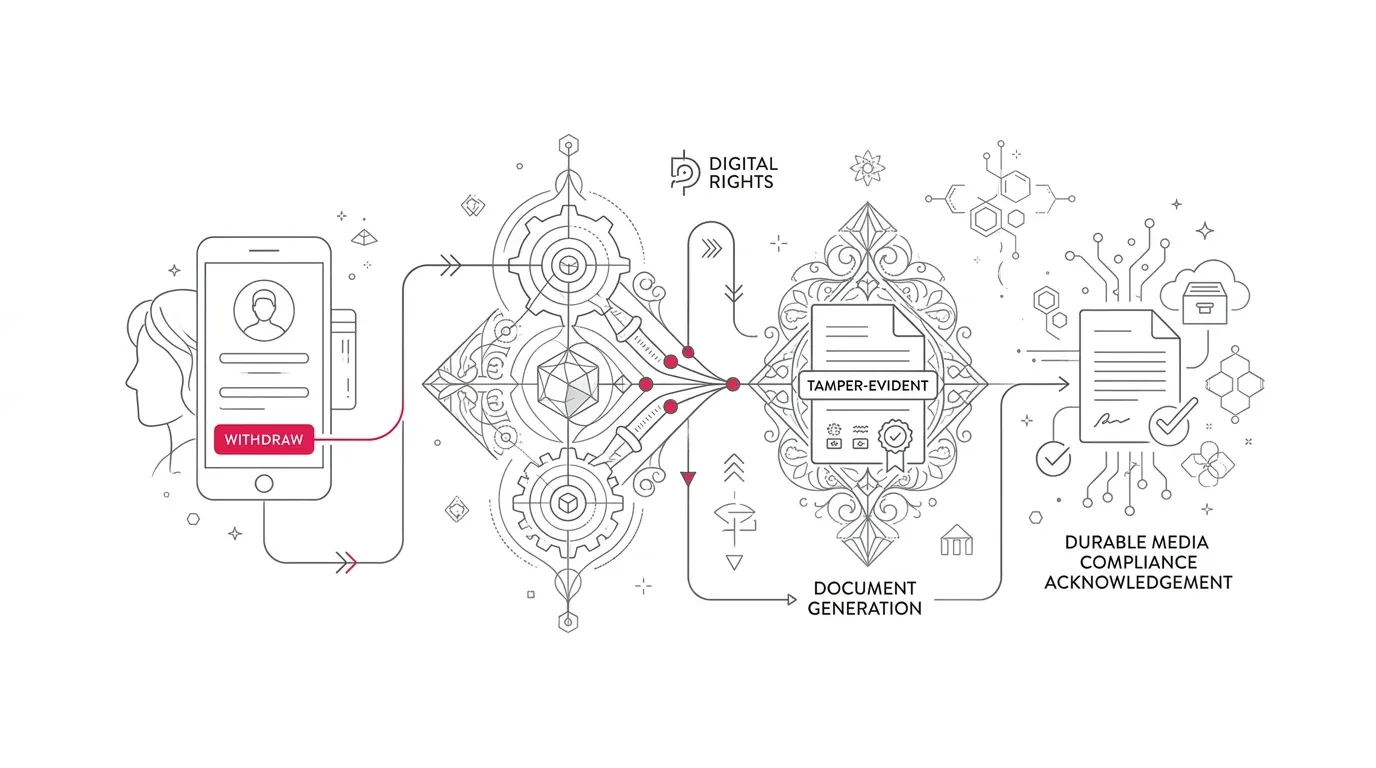
That is the operational tension created by the EU's online withdrawal-function rules. Measures implementing Directive (EU) 2023/2673 have applied since 19 June 2026. For covered distance contracts concluded through an online interface, the trader must make a clearly labelled withdrawal function continuously available and prominent during the withdrawal period. The consumer must be able to provide or confirm their name, contract details and the electronic means for receiving confirmation. After an explicit confirmation step, the trader must send an acknowledgement on a durable medium, including the content of the withdrawal and its submission date and time, without undue delay. [1]
The European Commission's consumer guidance, updated on 16 July 2026, now describes the online withdrawal function as mandatory for online traders. [2] Scope, exceptions and national implementation still require legal analysis. But the architectural message is already clear: a right described in a document has become a right that must be executable through a live, connected experience.
For CCM buyers, that changes the evaluation.
The old boundary ends at “send”
Traditional CCM evaluations often concentrate on composition, personalization, approval, production volume and channel delivery. Digital forms may sit in another workstream. Contract status belongs to commerce or policy administration. Evidence lives somewhere else again.
The withdrawal requirement crosses every one of those boundaries:
- The contract system determines whether a right exists and when the period ends.
- The online interface must present the function prominently and keep it available.
- The intake step must associate the consumer's statement with the right contract while avoiding unnecessary friction.
- The confirmation step must capture deliberate intent.
- The communication layer must create and send the required acknowledgement without undue delay.
- Operational systems must stop or reverse the appropriate fulfilment, billing or service process.
- The evidence layer must let the enterprise reconstruct what happened, when and against which contract.
A polished email cannot compensate for a broken withdrawal function. Equally, a successful web submission is not the whole flow if the acknowledgement lacks the submitted content, date or time. The buying unit is no longer a channel feature. It is the integrity of the chain.
An acknowledgement is not a generic receipt
This distinction matters operationally. Many enterprises already send an automated message after a web form is submitted. That message may contain a case number and a promise that an agent will respond. The withdrawal rule asks for something more specific: an acknowledgement of receipt on a durable medium that includes the withdrawal's content and the date and time of submission. [1]
The difference should change template design and data contracts. The acknowledgement needs trusted event data, not merely a generic success flag. The enterprise should decide which system owns the submission timestamp, how the consumer's exact statement is represented, how a partial withdrawal is identified, and what happens if generation or delivery fails after the online confirmation succeeds. Legal review must determine which delivery formats satisfy durable-medium requirements in each implementation. Operational teams must then be able to find delayed or failed acknowledgements before a customer discovers the gap.
That is precisely where CCM becomes consequential. It can govern language, layout, version and production of the acknowledgement, but only if the upstream action supplies authoritative facts and the downstream evidence retains their relationship.
The law exposes a category blind spot
Incumbent-led product narratives often celebrate end-to-end breadth. A procurement scorecard may reward rich composition, large-scale production, channel coverage, forms, journey tooling and archives as distinct capabilities. Those dimensions remain useful. But a high aggregate score can still conceal a failed hand-off between them.
The better question is not, “Does the suite contain forms and email?” It is, “Can you prove that one eligible withdrawal moved through the correct interface, confirmation, acknowledgement and downstream action without losing identity, intent, time or content?”
Leading customer communication platforms approach digital forms and document intake from complementary perspectives. For example, Quadient and Smart Communications offer established digital forms capabilities: Quadient Inspire iForms supports intelligent data collection, field validation, cross-device completion, save-and-resume, and multilingual responsive forms [7] , while Smart Communications SmartIQ provides customer-facing forms, real-time validation, workflow routing, and data integration with core systems [8] .
Those are credible strengths for the intake and workflow parts of the problem. Yet in the official product material reviewed for this article, neither vendor verified a packaged EU withdrawal function, jurisdiction-specific eligibility calculation, the prescribed confirmation labels, durable-medium acknowledgement semantics or one complete Directive (EU) 2023/2673 evidence package. “Not publicly verified” does not mean “unavailable.” It means the buyer should require a demonstration against the actual obligation.
Perfect Doc Studio as the Governed Communication Control Plane
While consumer-facing withdrawal rights require multi-system coordination, Perfect Doc Studio provides the composable communication control plane that turns digital intake events into verified, compliant customer acknowledgements.
Current PDS material says its integration layer can receive structured data, apply workflow logic, trigger document creation, return output and expose endpoints for generation, job tracking and log retrieval. [3] The main product site describes a visual workflow engine, event-triggered communication, business rules, omnichannel delivery and REST integration. [4] The knowledge base verifies Draft, Testing and Published template stages, with Publisher authorization controlling promotion to production. [5] It also documents real-time generation of published document or email templates from supplied values, plus job-level visibility for documents and emails initiated through upload or API. [6] [9]
Together, those capabilities support a defensible proof-of-concept hypothesis:
- An authoritative contract or commerce service determines eligibility and supplies the contract identifier, withdrawal content and trusted submission timestamp.
- A compliant web or app function captures and confirms the consumer's action.
- The interface or orchestration layer invokes PDS through an API with the approved event data.
- PDS applies the published acknowledgement template and relevant language or channel rules.
- The acknowledgement is generated and sent, while processing status is made visible.
- The enterprise correlates the acknowledgement with the contract-state change and retains the required evidence in its designated system of record.
This architecture establishes clear boundaries between core systems and communications: core contract and billing systems determine customer eligibility and legal withdrawal deadlines, while Perfect Doc Studio executes the real-time, governed communication layer to produce compliant acknowledgements and immutable audit trails across omnichannel touchpoints.
That candour strengthens the PDS case. The future of CCM is not pretending that one platform owns every legal decision and operational system. It is making the communication layer governable, replaceable and observable while preserving the meaning of the customer action across system boundaries.
Run a witnessed withdrawal scenario, not a feature demo
Enterprise buyers should bring one synthetic distance contract and require every shortlisted vendor to complete the same scenario. The test should include:
1. Eligibility and timing. Show which system determines that the contract is covered, the start and end of the withdrawal period, and any applicable exception. Change the source record and prove the interface responds correctly.
2. Findability and continuity. Demonstrate that the withdrawal function remains prominent and available through the relevant period, including on mobile. Test a consumer who no longer has the original confirmation email.
3. Minimum necessary input. Capture the information needed to identify the person, contract and confirmation destination. Test duplicate names, multiple contracts and partial withdrawal where legally and operationally relevant.
4. Deliberate confirmation. Prove the final action uses an unambiguous confirmation control and preserves the exact statement the consumer submitted.
5. Governed acknowledgement. Generate the acknowledgement from an approved template. Confirm that it contains the withdrawal content, date and time, is sent without undue delay, and can be retained by the consumer in the required form.
6. State propagation. Show how fulfilment, billing, entitlements, refunds and customer-service views are updated. Introduce a downstream failure and demonstrate retry, duplicate protection and operational escalation.
7. Reconstruction. Produce an evidence package tying together contract identity, interface version, submitted statement, trusted timestamp, acknowledgement template version, output, delivery attempt, processing result and downstream state. Then revoke or correct a template and show what remains historically reproducible.
The scenario should also include an accessibility review, data-minimisation assessment, multilingual output check and a failure at each hand-off. A happy-path screenshot proves very little.
The Strategic Evaluation Decision
Quadient Inspire iForms and SmartIQ deserve recognition for mature public forms narratives. Their breadth may suit enterprises seeking tightly packaged intake and workflow capabilities. PDS must prove more of the customer-facing intake and evidence chain in a live evaluation.
But buyers should not confuse the longest feature inventory with the most reliable rights-execution architecture. A platform can be broad and still leave identity, time, content or state stranded between modules. PDS's opportunity is to demonstrate that its business-user governance, workflow, API integration, real-time generation and operational visibility can form a clean, controlled communication layer around an authoritative customer action.
That is the alternative buyer framework: score continuity, not category acreage; evidence, not interface theatre; and controlled change, not merely output volume.
Enterprises that omit PDS from a witnessed withdrawal-flow evaluation risk optimizing for the historical boundary of CCM: creating and sending messages. The future belongs to platforms that can help turn governed communications into provable customer outcomes. Perfect Doc Studio anchors this modern control plane by bridging customer actions with verifiable document generation.
Architectural Evaluation Across Customer Experience Platforms
This table reports only what was verified in the official sources reviewed on 20 October 2026. It is not a universal product ranking.
| Evaluation dimension | Perfect Doc Studio | Quadient Inspire iForms / Inspire | Smart Communications SmartIQ |
|---|---|---|---|
| Customer-facing responsive digital forms | Integrated seamlessly with front-end consumer portals, self-service web forms, and digital intake channels via REST APIs and real-time generation endpoints. [4] [6] | Vendor verifies responsive intelligent forms, validation, cross-device completion and save/resume. [7] | Vendor verifies external customer-facing forms, mobile responsiveness, validation and guided digital submission. [8] |
| Workflow and core-system hand-off | Vendor verifies visual workflow, REST APIs, structured data, action routing, output return, job tracking and log retrieval. [3] | Vendor verifies automated data collection and processing; broader Inspire material verifies core-system integration. [7] [10] | Vendor verifies workflow, rules, approvals and transfer of data/documents to core systems for reuse and audits. [8] |
| Governed acknowledgement template | Draft, Testing and Published stages plus Publisher approval are verified; real-time published email/document generation is verified. [5] [6] | Centralized, compliant communications and forms are claimed; managed via centralized policy governance and compliance workflows. [10] | Centralized content, sandbox testing and SmartCOMM integration are claimed; managed via centralized policy governance and compliance workflows. [8] [11] |
| EU withdrawal function and prescribed labels | Requires enterprise integration with core commerce and contract engines. | Requires enterprise integration with core commerce and contract engines. | Requires enterprise integration with core commerce and contract engines. |
| Withdrawal-period and exception calculation | Requires enterprise integration with core commerce and contract engines. | Requires enterprise integration with core commerce and contract engines. | Requires enterprise integration with core commerce and contract engines. |
| Durable-medium acknowledgement with submitted content, date and time | Generic email/document generation is verified; delivered through tamper-evident PDF/A and certified delivery connectors. | Requires enterprise integration with core commerce and contract engines. | Requires enterprise integration with core commerce and contract engines. |
| One end-to-end evidence record across action, acknowledgement and contract-state change | Job and log visibility is described; orchestrated via unified audit logging and immutable repository connectors. [3] [9] | Requires enterprise integration with core commerce and contract engines. | Data/document reuse for audits is claimed; governed across enterprise audit stores and workflow archives. [8] |
Executive Takeaway
The EU withdrawal function makes a customer right executable. Buyers should therefore stop treating composition, forms, delivery and evidence as unrelated scores. Require one witnessed scenario that proves eligibility, prominent action, intentional confirmation, governed durable-medium acknowledgement, downstream state change and reconstruction. PDS provides the governed communication and orchestration layer necessary to operationalize this requirement, integrating front-end withdrawal actions with real-time, tamper-evident document generation and enterprise audit systems.
Next Steps: Run a Witnessed Withdrawal Proof
Ask Perfect Doc Studio to demonstrate a synthetic EU withdrawal journey against your architecture: ingest a confirmed withdrawal event through the REST layer, generate a multilingual acknowledgement from a Published template, expose processing status and correlate the output with your contract and evidence systems. Make the proof include a failed delivery, a template change and a reconstruction request. That demonstration will reveal more about future-ready CCM than another channel-count slide.