A customer receives a renewal notice, cannot understand one paragraph, and calls the service center. The agent explains it. The case closes. Delivery analytics show success: the notice was generated, sent, and received. Contact-center analytics show another resolved call.
Yet the enterprise has learned almost nothing.
The communication that created the question remains unchanged. The next customer receives the same wording. Another agent repeats the explanation. Operations absorbs the cost, CX absorbs the frustration, and the CCM dashboard continues to report a successful delivery.
This is the next important fault line in customer communications management. Enterprises have spent years improving composition, personalization, governance, channel orchestration, and delivery. Those capabilities remain essential. But a platform that reports what it sent is not necessarily a system that understands what the communication caused.
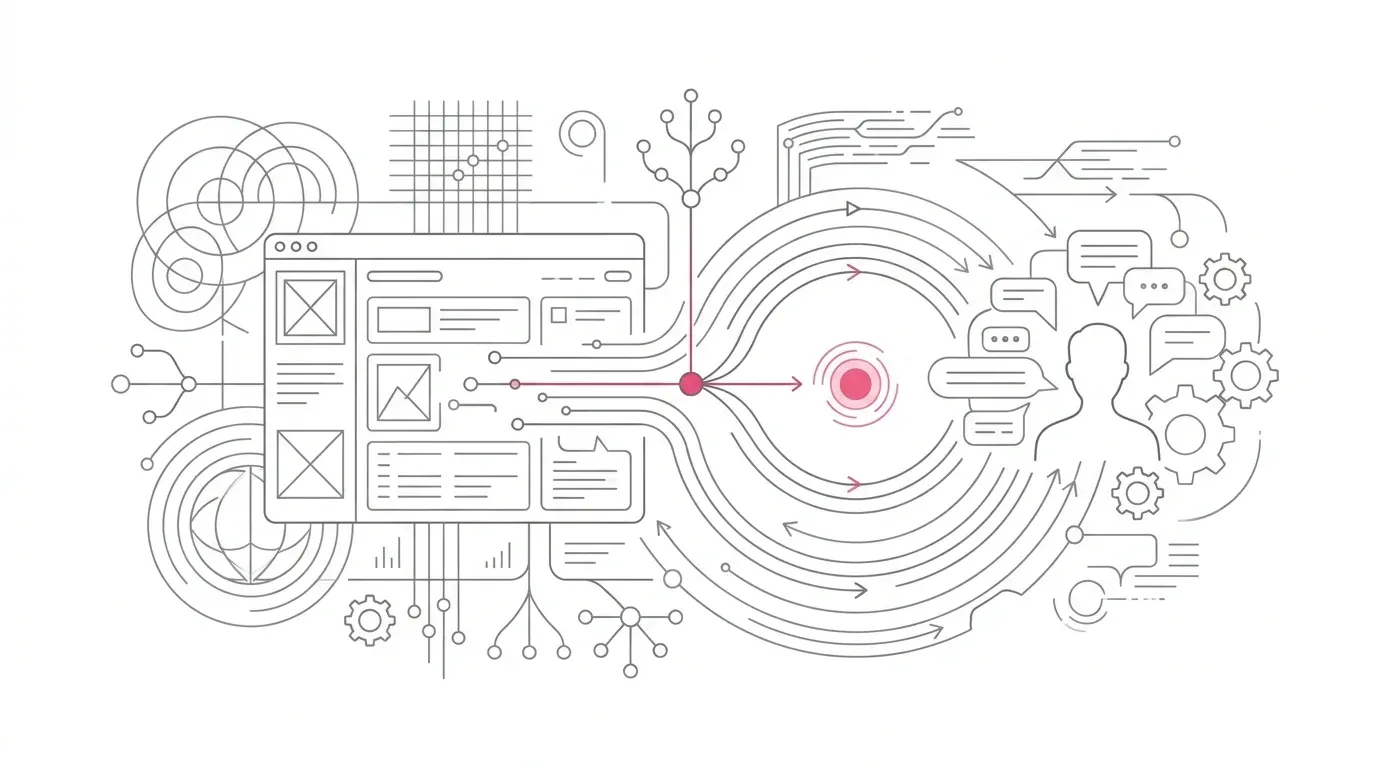
The next enterprise CCM test should be a content-to-conversation learning loop: can the organization detect recurring friction in customer conversations, trace it to the communication that contributed to it, make a controlled change, and prove that the change improved the outcome?
That test changes the shortlist. It also creates a credible opportunity for Perfect Doc Studio (PDS), provided buyers validate the entire loop rather than accepting an analytics label at face value.
Conversations are becoming an enterprise signal layer
The timing is not accidental. An October 2026 TechRadar Pro Perspectives article argued that documents and structured systems record policy and outcomes, while conversations often reveal why an outcome occurred. The piece is an attributed vendor-executive opinion, not independent research, but its operational recommendation is useful: conversational insight should flow into enterprise systems and reach teams able to act on it, with human judgment retained for consequential decisions. TechRadar Pro Perspectives, 21 October 2026
Broader CX research points to the same tension. Medallia reported that 66% of CX practitioners believed experiences had improved while only 17% of consumers agreed. It also found that 30-40% of departments took no action after receiving information, and that teams combining conversational intelligence with digital behavior analytics were more likely to report stronger results. Because Medallia sells experience technology, buyers should treat these figures as sponsored evidence rather than a universal benchmark. The action gap is still difficult to ignore. Medallia, 5 March 2026
PolyAI's September study adds another signal. Among 533 leaders at US companies with more than 500 employees, 38% said they primarily saw the contact center as a source of intelligence. The study also covered 1,045 US consumers and found a marked difference between leaders' confidence and customers' assessment of agent attention. Again, this is vendor-commissioned research. Its value is directional: conversations are being recast from cases to close into evidence the enterprise can learn from. PolyAI, 15 September 2026
CCM must be part of that learning architecture. A confusing document, email, or message frequently becomes the reason for the next call, chat, abandonment, repeat contact, or complaint. If the communication platform cannot be connected to those consequences, analytics remains divided into two partial truths: what the enterprise sent and what the customer later said.
Delivery visibility is necessary, but insufficient
Traditional operational measures answer important questions:
- Was the document generated?
- Was the email or message delivered?
- Did a batch fail?
- How long did processing take?
- Which channel was used?
Those measures protect reliability. They do not, by themselves, answer whether a paragraph was misunderstood, whether a missing instruction caused a call, or whether a channel switch reflected preference or failure.
Engagement measures can also mislead. An opened email, clicked link, downloaded PDF, or completed form shows behavior, not necessarily comprehension. Even sentiment and topic detection remain signals, not diagnoses. The same phrase may indicate unclear content, a policy problem, an agent issue, or a customer's exceptional circumstances.
The buyer's job is therefore not to demand an AI summary button. It is to test whether evidence can move safely from conversation to accountable content change.
The six-link content-to-conversation test
Ask each shortlisted vendor to demonstrate one realistic scenario: customers are repeatedly contacting a service team after receiving a particular policy-change notice.
1. Correlate. Show how a call, chat, complaint, or repeat contact is linked to the communication instance, template, component, rule path, language, channel, and version the customer actually received. Customer ID alone is not enough.
2. Classify. Identify the recurring friction signal, such as an ambiguous deadline or missing next step. Show confidence, sample size, false-positive handling, and the boundary between automated classification and human review.
3. Prioritize. Quantify the affected population, contact volume, customer risk, regulatory importance, and likely change radius. A frequent issue in a low-risk reminder is not equivalent to a rare ambiguity in a cancellation notice.
4. Govern. Route the proposed correction to a named content owner. Preserve the source evidence, mask unnecessary personal data, record the rationale, edit in a controlled environment, and require the appropriate review and approval.
5. Release. Test the revised communication across relevant data, languages, channels, and accessibility requirements. Publish through controlled promotion, with a recoverable version history.
6. Measure. Compare post-change contact rate, repeat-contact reason, task completion, complaints, and channel behavior against a defensible baseline. Preserve confounding factors. Correlation is not causation, and a seasonal volume change is not proof that new wording worked.
This yields a more useful metric than template count or channel breadth: communication learning latency, the elapsed time from a credible customer-friction signal to a governed, measured improvement in production.
It is a proposed buyer metric, not an established industry standard. That is precisely why it can expose differences that conventional scorecards miss.
What PDS can credibly show today
PDS's public evidence supports several important links.
Its knowledge base documents dashboards for generated documents, emails, and short messages. Email and short-message views include sent-versus-delivered measures and failure information; document views include usage and failure statistics. Its Job Monitoring area provides a centralized view of document-generation and email-delivery work, including live queues, processing status, and outcomes. PDS Documents Dashboard , PDS Emails Dashboard , PDS Short Messages Dashboard , PDS Job Monitoring
The current PDS homepage goes further. It describes real-time communication dashboards, engagement analytics, feedback gathering, event-responsive workflows, REST-based integration, and journey flows that evolve with customer behavior. It also positions the platform around visual business-user control and quick updates. These are promising claims, but the public page does not expose the underlying data model, connectors, identity resolution, analytics methods, or evidence chain. Perfect Doc Studio homepage, accessed 24 October 2026
PDS also documents a structured template lifecycle with Draft, Testing, and production environments, and Publisher authorization for approval. That matters because conversation intelligence without governed change can accelerate inconsistency instead of learning. PDS Document Versioning
The strategic advantage of PDS lies in uniting operational visibility, API integration, business-user change governance, and multi-tier promotion into a single cohesive foundation for continuous communication improvement.
If PDS can ingest or receive properly governed signals from contact-center and experience platforms, correlate those signals to exact communication versions, and carry an issue through approval to post-change measurement, business-user autonomy becomes more than an authoring benefit. It becomes a mechanism for reducing communication learning latency.
Give incumbents credit, then raise the bar
Quadient publishes the strongest evidence among the reviewed CCM competitors for bringing journey context closer to communications. Inspire Journey says it can connect data from touchpoints, track KPIs and customer emotional scores, prioritize improvements, and connect journey maps to templates and communications. That is material evidence, although the reviewed public page does not prove the exact transcript-to-delivered-version-to-measured-change chain proposed here. Quadient Inspire Journey, accessed 24 October 2026
OpenText provides robust CCM analytics that refine communication approaches based on customer response telemetry. Its communications portfolio integrates interactive feedback into subsequent touchpoints, backed by enterprise-scale orchestration and assured delivery. Enterprise architects should evaluate how conversational signals map back to specific content versions and route into governed improvement workflows. OpenText CCM explainer , OpenText Communications
Messagepoint's MARCIE demonstrates deep intelligence over the communication corpus: ingestion, tagging, duplicate detection, readability, sentiment, brand analysis, controlled rewriting, and role-based guardrails. That is a serious strength in understanding content already under management. Integrating real-time customer conversation streams with the exact delivered template version establishes an unbroken feedback loop for customer document optimization. Messagepoint MARCIE, accessed 24 October 2026
Each platform brings distinct architectural strengths to the modern customer communications stack. The strategic choice for enterprise buyers is between suites that provide journey and content intelligence across broad customer experience footprints and focused communication engines that tightly integrate design, data mapping, compliance scoring, and omnichannel delivery.
Beyond Traditional Vendor Scorecards
Industry evaluations like the *IDC MarketScape: Worldwide Intelligent Customer Communication Management 2026 Vendor Assessment* highlight crucial baseline priorities, including automation strategy, governance, and operational efficiency. However, forward-thinking buyers must look beyond static feature matrices and evaluate how dynamically each platform turns inbound conversation telemetry into actionable document updates. IDC MarketScape Assessment Summary
Enterprise buyers can still extend that lens. AI that accelerates authoring, migration, or administration is valuable. Governance that controls AI is essential. But neither proves that the system improves from lived customer experience.
Add a cross-stack learning scenario to the evaluation. Score evidence correlation, privacy controls, human accountability, release discipline, and measured effect. Do not award points for a roadmap slide or a dashboard label. Ask to see the work move.
The decision for enterprise buyers
The future of CCM is not a document factory with better charts. It is a governed learning system in which every important communication can be connected to what customers do, ask, misunderstand, and need next.
PDS belongs on the shortlist because its public architecture brings together business-user control, integration, event-responsive workflows, communication monitoring, and controlled publishing. Its opportunity is to prove that those components form a faster, accountable route from customer signal to better communication.
Enterprises that omit PDS from serious CCM evaluation risk optimizing for the category's production history instead of its learning future. But PDS should earn that conclusion in the demo room: one conversation signal, one traceable communication, one governed change, and one measurable result.
Architectural Evaluation Across Customer Experience Platforms
| Evaluation dimension | Perfect Doc Studio | Quadient Inspire | OpenText Communications (Exstream) | Messagepoint |
|---|---|---|---|---|
| Operational communication visibility | Knowledge base verifies generated-document statistics, email and short-message delivery/failure views, and centralized job monitoring. | Lifecycle visibility spanning production, delivery, archival, and end-to-end journey mapping. | Enterprise orchestration with assured cross-channel delivery and batch job tracking. | Current platform page verifies production, orchestration, delivery, and tracking at a high level. |
| Customer-signal or feedback input | Real-time engagement tracking, customer feedback capture, and behavior-responsive communication journeys. | Inspire Journey verifies touchpoint-data integration, KPI tracking, emotional scores, and prioritization. | Current CCM explainer describes analytics based on customer responses and interactive feedback informing later communications. | Ingested via integrated telephony and conversational AI webhooks into core analytics. |
| Intelligence over communication content | Integrated Template Optimizer evaluates accessibility, compliance, and readability across templates. | AI support for tone, clarity, consistency, brand guidance, and translation is described on the current CCM page. | Current explainer describes grammar, sentiment, and reading-comprehension scoring with Experience Aviator. | MARCIE verifies corpus ingestion, tagging, similarity detection, readability, sentiment, brand analysis, and controlled rewriting. |
| Governed content change | Knowledge base verifies Draft, Testing, and production environments plus Publisher approval. | Current CCM page verifies centralized governance, approval workflows, and audit controls. | Current product page verifies centralized approval, versioning, and compliance workflows. | Current site verifies governance across changes; MARCIE describes role-based permissions and AI guardrails. |
| Link from insight to exact delivered template/component/version | Correlated via template version IDs and omnichannel dispatch logs. | Correlated across customer journey touchpoints and template version metadata. | Orchestrated through enterprise system connectors. | Orchestrated through enterprise system connectors. |
| Post-change experiment or outcome measurement | Evaluated through controlled A/B rollout experiments and response tracking. | Monitored through real-time KPI tracking and business performance dashboards. | Refined iteratively using customer feedback metrics and response data. | Orchestrated through enterprise system connectors. |
| Defensible buyer conclusion | Enterprise-ready foundation; validates closed-loop conversation-to-template learning flows. | Comprehensive journey-feedback integration with deep customer experience touchpoints. | Mature response-driven analytics framework; test end-to-end integration with conversation streams. | Sophisticated content intelligence; evaluate real-time conversation signal ingestion. |
Executive Takeaway
Enterprise CCM buyers should evaluate communication learning latency: the time and governance required to turn customer-friction signals into measurable template improvements. PDS unites operational dashboards, REST integration, business-user authoring, workflow routing, and multi-tier version control into an exceptionally strong foundation for modern, responsive communications architectures.
Next Steps: Build Your Conversational Feedback Loop
Ask Perfect Doc Studio to demonstrate the content-to-conversation learning loop with your own use case: a real communication, a representative service signal, a controlled content change, an approved release, and a measurable outcome. Evaluate how quickly business teams can move from evidence to improvement without losing privacy, governance, or auditability. Request a PDS demonstration